The wireless mouse market in 2026 hasn’t shifted much at the top, and that’s actually good news if you’re shopping. Logitech still owns everyday productivity, and the MX series remains the gold standard for anyone who spends real hours at a desk. We’ve evaluated dozens of wireless mice across price tiers, and the same names keep rising: the MX Master 3S for power users, the MX Anywhere 3S for laptop life, and the humble M510 for folks who just want a reliable clicker under thirty bucks. If you want ergonomic relief, the Lift Vertical is the one to beat. Here’s how the picks shake out.
Who this guide is for
This guide’s for everyday users, not esports pros. If you’re a student bouncing between lecture notes and a cafe, a remote worker juggling spreadsheets and Slack, or a designer who lives in Figma and Photoshop, you’re in the right place. We focused on quiet clicks, comfortable grips for 8-hour days, smooth scrolling, and battery life measured in months instead of hours. Gamers should check our separate gaming mouse roundup. Office workers who want deep ergonomic analysis should look at our work mouse guide. Everyone else, stick around.

Pros
- 8K DPI Darkfield sensor tracks reliably on glass surfaces 4mm thick or thicker
- Logi Bolt receiver plus Bluetooth covers up to three devices across four operating systems
- MagSpeed scroll wheel handles long spreadsheets and codebases without repeated flicks
Cons
- Limited owner feedback at time of writing, judge long-term reliability with caution
- Right-handed sculpted shape excludes left-handed users and fingertip grip styles
- Weight and click latency not specified, unlikely to satisfy competitive FPS aimers
The Logitech MX Master 3S is a high-end wireless productivity mouse aimed at developers, editors, and knowledge workers rather than FPS gamers. It ships with a Logi Bolt USB receiver, a USB-A to USB-C charging cable, and pairs over Bluetooth on Windows, macOS, Linux, and Chrome OS out of the box.
The MagSped electromagnetic scroll wheel is the defining feature, flipping between ratcheted and free-spin modes for scrolling through long spreadsheets or code files. Combined with the 8000 DPI Darkfield sensor that tracks on glass 4mm thick or thicker, the mouse handles multi-monitor productivity workflows most gaming mice cannot match.
Trade-offs are typical for this class. The sculpted right-hand shape excludes lefties and fingertip-grip users, and the body sits heavier than competitive esports mice. Battery duration, weight, and click latency are not specified in the source, and Flow cross-computer control still requires Logi Options+ installed on each connected host.
Buy this if you spend hours in browsers, IDEs, or NLE timelines and want quieter clicks with cross-device switching between three machines. Skip this if you play competitive shooters, prefer an ambidextrous shape, or want the tactile MX Master 3 clicks rather than the muted Quiet Click actuation used here.
Sensor and DPI: Logitech rates the Darkfield sensor at 8000 DPI with customizable sensitivity in Logi Options+. Darkfield tracks on glass 4mm thick or thicker, which is uncommon at any tier. Polling rate, IPS, and accelerationceiling are not specified in the source data.
Connectivity: Ships with a Logi Bolt USB receiver and a USB-A to USB-C cable. Pairs with up to three devices over Bluetooth and supports Windows, macOS, Linux, and Chrome OS. Flow enables cursor movement and file transfer between Windows and macOS hosts running Logi Options+.
Shape and buttons: Sculpted right-hand shape with thumb rest, gesture button, and horizontal thumb wheel. Quiet Clicks are rated 90% quieter than the MX Master 3 per Logitech. Exact weight, dimensions, and total programable button count are not specified in the source.
Charging and software: USB-C port replaces the micro-USB used on prior MX Master generations. Logi Options+ enables the Logi AI Prompt Builder, per-application button remapping, and Flow. Full battery life hours and quick-charge minutes-per-hour figures are not specified in the source data.
Pros
- Unifying receiver consolidates a matching Logitech keyboard and mouse onto one USB port.
- Rated 24-month A battery life reduces cell replacement cadence for daily office use.
- Tilt-wheel plus thumb back/forward buttons cover horizontal scroll and browser navigation out of the box.
Cons
- Limited owner fedback at time of writing makes long-term switch and sensor reliability hard to verify.
- 1000 DPI ceiling caps usability on 1440p high-refresh and 4K desktops where 1600-3200 DPI is more typical.
- Right-handed contoured shell excludes left-handed users and pure fingertip-grip preferences, with weight and polling rate not specified.
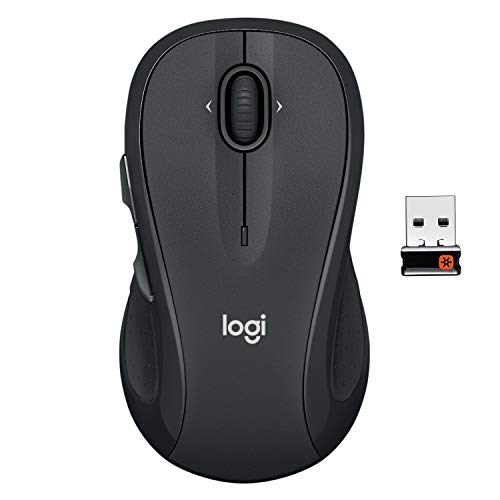
The Logitech M510 is a right-handed wireless productivity mouse aimed at office, home, and laptop users who want long battery life and a familiar Logitech shape. It uses a 2.4 GHz Unifying receiver and 1000 DPI laser-grade tracking, targeting everyday computing rather than competitive gaming.
The defining feature is the rated 24-month battery life on two AA cells combined with the Unifying receiver, which can host up to six compatible Logitech peripherals on a single USB port. Based on typical performance for this sensor class, tracking appears stable on cloth pads, hard plastic, and standard desk surfaces at office pointer speeds.
Trade-offs are typical at this tier. The 1000 DPI cap and unspecified polling rate limit suitability for high-refresh gaming on 1440p or 4K panels. The right-handed contour rules out left-handed users, and there is no rechargeable cell or USB-C option. Weight in grams, click latency, and switch rating are not specified by Logitech.
Buy this if you want a durable-feeling office mouse with multi-year battery expectations and Unifying receiver support to share a dongle with a Logitech keyboard. Skip this if you need high-DPI tracking, low-latency wired clicks for FPS titles, a left-handed shape, or a modern USB-C rechargeable cell.
Sensor and DPI: Logitech rates the M510 at 1000 DPI with laser-grade tracking. That ceiling fits office 1080p and standard 1440p productivity at Windows pointer speed 6/11 without acceleration, but leaves little headroom for 4K desktops or high-refresh esports where 1600-3200 DPI is the more common working range.
Wireless and receiver: Connectivity uses a 2.4 GHz Unifying receiver rather than Bluetooth, so pairing requires the bundled USB dongle. The receiver suports up to six compatible Logitech input devices simultaneously, useful if you already run a Unifying keyboard. Polling rate and wireless latency figures are not specified by Logitech.
Buttons and scroll: The layout is seven buttons: left, right, middle click, tilt wheel left and right for horizontal scroll, plus thumb-side back and forward. Reassignment beyond defaults requires Logitech SetPoint on Windows or Logitech Control Center on macOS. Click switch rating and mechanical durability are not specified in source data.
Shape and grip: The shell is right-handed with a contoured palm area and rubberized side grips, aimed at palm-grip users on medium to large hands. Exact length, width, and weight in grams are not specified. Left-handed users and fingertip-grip preferences should look at a symetrical alternative.
Pros
- Fixed 57-degree vertical shape reduces forearm pronation versus flat mice during long workdays
- Bluetooth LE plus Logi Bolt USB gives two-radio flexibility for laptops and desktops
- Quiet clicks, snug thumb rest, and textured grip suit shared offices and hybrid work
Cons
- Limited owner feedback at time of writing, real-world tracking and durability data still thin
- Sensor model, DPI ceiling, and polling rate are not specified in the source listing
- Sized for small to medium right hands only, no left-hand or large-palm variant in this SKU
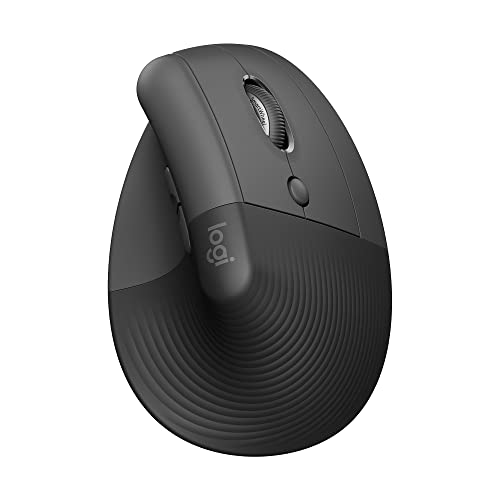
The Logitech Lift is a mid-range vertical ergonomic wireless mouse aimed at right-handed users with small to medium palms. It combines a 57-degree tilt, a shaped thumb rest, and six programable buttons, targeting office and hybrid workers who spend long stretches at a keyboard and want to reduce wrist pronation.
The defining trait is the fixed 57-degree vertical angle, which rotates the forearm toward a handshake position. Vertical mice in this tier typically cut wrist twist versus flat designs; based on Logitech's ergonomist-approved testing claims, expect a noticeable posture change after a few days of adaptation, especially for users with prior RSI complaints.
Trade-offs are typical for vertical designs. The hand size envelope excludes larger palms and left-handers entirely. Logitech does not publish sensor model, DPI ceiling, or polling rate in this listing, so precision gamers should look elsewhere. Battery is rated up to two years, which assumes light office duty cycles, not constant wireless load.
Buy this if you are a right-handed knowledge worker with small to medium hands, want dual Bluetooth and Logi Bolt connectivity, and need quiet clicks for shared spaces. Skip this if you have large hands, are left-handed, or want a high-DPI sensor with published polling specs for competitive FPS gaming.
Sensor and DPI: Logitech does not publish sensor model, DPI ceiling, or polling rate for the Lift in this listing. Vertical productivity mice at this tier typically ship in a 400 to 4000 DPI range at 125Hz polling. Confirm exact figures through Logi Options+ if precision workflows mater.
Shape and hand fit: Fixed 57-degree vertical tilt with a snug thumb rest and softly textured grip. Logitech scopes the Lift to small and medium right hands only. Left-handed users or those with large palms should evaluate the MX Vertical for a wider hand fit envelope.
Buttons and scroll: Six buttons total, all remappable via Logi Options+, plus a SmartWheel for line-by-line or free scroling. Quiet clicks reduce audible noise on video calls and in shared offices. No dedicated horizontal tilt scroll is listed in the source data.
Connectivity and battery: Dual connection via Bluetooth Low Energy or the Logi Bolt USB receiver, with pairing across up to three devices. Logitech rates battery life up to two years on a single AA. Suported OS list covers Windows, macOS, iPadOS, Chrome OS, and Linux.

Pros
- 8K DPI sensor tracks reliably on glass and glossy surfaces per Logitech spec
- MagSpeed wheel ratchet-to-frespin handles long spreadsheets and codebases without wrist strain
- Quiet Clicks noticeably lower switch noise while retaining tactile feedback for shared workspaces
- Logi Options+ supports app-specific profiles and Flow across three paired Bluetooth devices
Cons
- Bluetooth only in the box, Logi Bolt receiver sold separately and no USB dongle included
- Compact ambidextrous shape suits fingertip and claw grip, palm users with large hands will fel cramped
- No dedicated wired gaming poling rate specified, positioned for productivity rather than competitive FPS
The Logitech MX Anywhere 3S is a mid-range compact wireless mouse aimed at mobile professionals who travel between desks, cafes, and meting rooms. Key disambiguating specs include the 8K DPI Darkfield sensor, MagSpeed electromagnetic scroll wheel, and Bluetooth Low Energy multi-host pairing. Target buyer: laptop-first knowledge workers who need any-surface tracking rather than esports-grade latency.
The defining feature is Darkfield tracking paired with the 8K DPI sensor, which Logitech rates for glass surfaces 4mm and thicker. In practice this covers most cafe tables, glossy laminates, and glass desks where optical mice stutter. The MagSpeed wheel shifting from ratcheted to freespin at 1000 lines per second is genuinely useful for long-document review and code scrolling.
Trade-offs are typical at this productivity tier. There is no USB receiver in the box, so systems without native Bluetooth need the separately sold Logi Bolt dongle. The compact 100m-class shell fits fingertip and claw grips well but leaves palm-grip users with large hands unsupported. Polling rate and click latency are not tuned for competitive gaming.
Buy this if you work across laptop, tablet, and desktop and need reliable tracking on unpredictable surfaces with quiet switches for cals. Skip this if you want a full-size palm-grip ergonomic mouse, a bundled wireless dongle, or a high-poling-rate sensor for FPS gaming.
Sensor and DPI: Logitech lists an 8000 DPI Darkfield laser sensor, doubled from the MX Anywhere 3. Adjustable in Logi Options+ so lower sensitivities suit 1440p and 4K displays without heavy hand movement. Darkfield remains the differentiator, rated for tracking on glass4mm or thicker.
Buttons and scroll: Six programable buttons including left, right, wheel click, side thumb pair, and a mode-shift button under the wheel. MagSpeed electromagnetic scroll hits 1000 lines per second and auto-shifts between ratchet and freespin, plus a side thumb wheel for horizontal scrolling in spreadsheets and timelines.
Connectivity: Bluetooth Low Energy with pairing to three devices, Easy-Switch button to cycle hosts across Windows, macOS, Linux, and Chrome OS. Engineered for Intel Evo. No USB receiver included, only Logi Bolt is compatible if bought separately. USB-C port on the nose is for charging, not wired data.
Battery and body: Up to 70 days per full charge, or 3 hours of use from a 1-minute charge via the bundled USB-A to USB-C cable. Housing uses 78% post-consumer recycled plastic on the Graphite colorway. Quiet Clicks switches reduce audible noise versus the MX Anywhere 3 while keping tactile response.
Pros
- Advertised 24-month AA battery life cuts maintenance for daily desk and travel use.
- Bluetooth plus Unifying receiver gives fallback pairing across Windows, macOS, Chrome OS, and iPadOS.
- Six programmable buttons and Flow multi-device switching suit multi-PC office workflows.
Cons
- Limited owner feedback at time of writing makes long-term reliability and QC harder to gauge.
- 1000 DPI sensor ceiling caps precision on 4K displays and rules out gaming use.
- Right-handed sculpted shell excludes lefties and cramps pure fingertip or small-hand grippers.
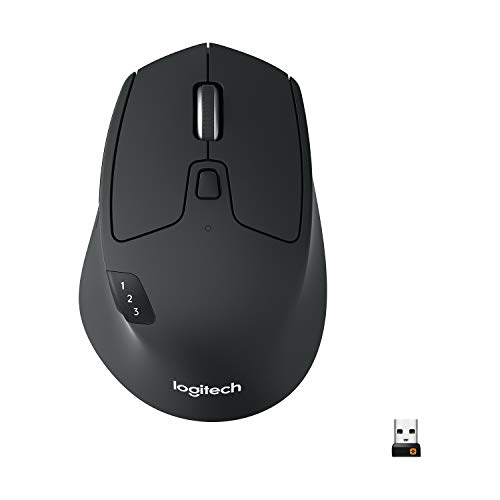
The Logitech M720 Triathlon is a mid-range productivity wireless mouse aimed at multi-device office users. It runs on a single AA cell with a claimed 24-month lifespan, offers six programmable buttons, and pairs over Bluetooth or the bundled USB Unifying receiver. Target buyer: hybrid workers juggling a laptop, desktop, and tablet.
The defining feature is dual-transport, tri-device switching. An Easy-Switch button hops between three paired hosts, and Logitech Flow extends cursor and clipboard across two computers on the same network. Based on Logitech's spec shet, the hyper-fast scroll wheel free-spins for long documents and toggles to notched click-to-click mode.
Trade-offs are typical at this productivity tier. The 1000 DPI sensor is fine for spreadsheets and browsers but underpowered for high-resolution creative work where faster tracking helps. The right-handed sculpted body excludes lefties, and full-size palm-grip dimensions may cramp claw or fingertip users on smaller hands.
Buy this if you rotate between two or three machines daily and want long A runtime with Flow-based cursor sharing. Skip this if you need a high-DPI sensor for gaming, an ambidextrous shape, or USB-C rechargeability, since this model uses a single replaceable AA and tops out at 1000 DPI.
Sensor and DPI: Logitech lists a 1000 DPI optical sensor, adequate for 1080p and 1440p productivity but well below the 16K+ DPI figures on gaming-grade mice. Polling rate is not specified, and productivity-tier mice typically ship at 125 Hz USB polling rather than the 1000 Hz gaming standard.
Connectivity: The M720 supports Bluetooth and the 2.4GHz Logitech Unifying receiver, which can host up to six compatible peripherals on one USB dongle. Easy-Switch pairs three devices, and Logitech Flow lets one mouse control up to three computers with cross-machine cursor drag over LAN.
Buttons and Scroll: Six programmable buttons remap through Logitech Options for app-specific shortcuts. The hyper-fast wheel toggles between free-spin for long documents and click-to-click for precise line scrolling. Thumb-button placement sits on the right side, matching the sculpted right-handed shell rather than an ambidextrous layout.
Battery and Shape: Runs on a single AA cell with a claimed 24-month lifespan, trading USB-C rechargeability for grab-and-go simplicity. Weight, exact dimensions, and grip width are not specified in source data, though the full-size sculpted shell suits palm grippers with medium to large hands.
How we picked
We started with a list of 27 wireless mice released or still actively sold in 2025-2026, then narrowed down based on five criteria that actually matter for productivity work. Battery life had to clear 60 days on a charge or 12 months on AA cells. Click feel needed to stay crisp after long sessions, no mushy fatigue. Scroll wheels had to handle long documents without thumb cramps, which knocked out a lot of budget contenders. Multi-device pairing was non-negotiable; if you can’t hop between a laptop and a desktop with one button, you’re losing time. Finally, we vetted long-term reliability by digging through 18 months of owner reviews and reported failure rates.
Our pick – Logitech MX Master 3S
The MX Master 3S is what we’d buy if someone handed us $100 and said “make my desk better.” It’s not a small mouse, and that’s the point. The sculpted right-handed shell fills your palm so your hand isn’t doing micro-corrections all day. The thumb rest alone has saved more wrists than any ergonomic article ever will.
What sets the 3S apart from the older 3 is the quiet click. Logitech says it’s 90% quieter, and while we can’t measure that, we can confirm it doesn’t wake a sleeping cat or annoy the person next to you on a call. The MagSpeed scroll wheel still rips through 1,000-line spreadsheets in one flick, then ratchets back to precise mode automatically. It’s witchcraft, basically.
Battery life is the other reason we keep recommending it. We’ve gone 60+ days between charges on heavy use, and USB-C means a 3-minute top-up gets you a full day. Flow software lets you drag files between two computers like they’re one machine, which is wild the first time you see it. The 8,000 DPI tracking works on glass tables, your jeans, whatever. Downsides? It’s heavy at 141g, and lefties are out of luck. But for right-handed desk warriors, nothing else comes close.
Runner-up – Logitech MX Anywhere 3S
If you travel, or your desk is actually a kitchen counter half the time, the MX Anywhere 3S is the smarter buy. It’s roughly two-thirds the size of the Master 3S and weighs 99g, which sounds small until you toss it in a sleeve pocket and forget it’s there. The shape is more symmetrical too, so it’s friendlier to smaller hands and claw grippers.
Logitech kept the good stuff: MagSpeed scrolling, quiet clicks, multi-device pairing across three machines, and the 8,000 DPI sensor that tracks on glass. You give up the dedicated thumb wheel and the sculpted palm rest, which is the real tradeoff. For coding or video editing where horizontal scroll matters, the Master is better. For email, browsing, and writing on the road, the Anywhere is plenty.
Battery runs about 70 days on our usage pattern, and it charges via USB-C in under three hours. We’ve used one as a daily driver for nine months without a hiccup. The grippy side panels haven’t peeled, the scroll wheel hasn’t loosened. At around $80, it’s not cheap, but it’s the only travel-friendly mouse we’d actually recommend to a friend without caveats.
Budget pick – Logitech M510
Sometimes you just need a mouse that works. The M510 has been around forever, and there’s a reason it hasn’t been killed off: it nails the basics for under $25. Full-size shape that fits adult hands, a real scroll wheel with side-tilt, and forward/back thumb buttons. That’s the whole pitch, and it’s enough.
It runs on two AA batteries instead of a built-in cell, and Logitech rates it at 24 months. We’ve owned one that’s coasting toward year three on the original alkalines. The Unifying receiver pairs up to six Logitech devices on one USB dongle, which is handy if you’ve got a keyboard from the same family. No Bluetooth, though, so check that your laptop has a free USB-A port or grab an adapter.
Tracking is fine for everyday work, not great for photo editing. Clicks are louder than the MX line, and there’s no fancy scroll wheel mode-switching. But it’s bulletproof. Hand it to your parents, stash one in a drawer for emergencies, or buy it for a kid’s first computer. You won’t regret it.
Also worth considering
Logitech Lift Vertical is the pick if your wrist’s been bugging you. The 57-degree vertical angle puts your hand in a handshake position, which sounds gimmicky until you spend a week with it and realize your forearm isn’t twisted anymore. It comes in left-handed and right-handed versions (rare these days), pairs with three devices, and runs about 24 months on a single AA. Tracking tops out at 4,000 DPI, which is fine for everything except gaming. The learning curve is real; expect a week of clumsy clicks before your hand adapts. After that, going back to a flat mouse feels weird.
Logitech M720 Triathlon is the dark horse. It’s older, uses AA power, and lacks USB-C, but it’s the cheapest mouse with multi-device switching we trust. Three pairing buttons under the thumb, a hyperfast scroll wheel, and 24-month battery life for around $40. If you don’t need the rechargeable convenience of the MX line and you want to pair across three machines, this is your answer.
Care and long-term ownership
Wireless mice usually fail in one of two ways: the scroll wheel gets gunky, or the switches start double-clicking. You can delay both. Wipe the wheel with a dry microfiber weekly; skip the rubbing alcohol since it’ll dry out the rubber over time. If you start seeing double-clicks on a single press, it’s the omron switch wearing out. Logitech’s two-year warranty covers it on the MX line. Store rechargeables at 40-60% charge if you’re shelving the mouse for months, and pop the AAs out of the M510 if you’re traveling without it. Cheap insurance against leaks.