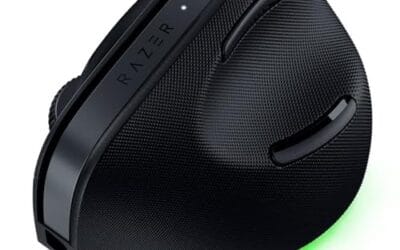

A trackball mouse flips the usual deal. Your hand stays put, and a ball under your thumb, finger, or palm pushes the cursor around. That’s it. No sliding the whole device across a desk, no clearing space for sweeping motions, no chasing the pointer when you run out of mousepad. It’s a small mechanical idea with a loyal following: RSI sufferers who can’t tolerate repetitive wrist motion, audio engineers running tight studio desks, CAD operators who need pixel precision, and folks who just got tired of moving their arm 8 hours a day. Here’s how trackballs actually work in 2026 and when one makes sense.
The short answer
A trackball is a mouse with the ball on top instead of underneath. You spin it with your thumb, index finger, or palm, and the cursor moves. The body itself stays anchored to the desk. Logitech’s M575 family runs the consumer market, Kensington owns the finger-operated niche, and Elecom covers the budget end. If you’ve got wrist pain or a cramped desk, a trackball solves both problems at once without changing how you click.
The longer explanation
Trackballs split into three control styles, and the one you pick changes everything about how the device feels day to day.
Thumb-operated trackballs put a ball roughly 34mm wide on the left side of the shell, right under where your thumb naturally rests. The Logitech M575 owns this category. You grip the body like a regular mouse, but instead of moving the whole thing, your thumb spins the ball. It’s the easiest style to learn because your hand position barely changes from what you’re already used to.
Finger-operated trackballs use a much bigger ball, usually 55mm, centered under your index and middle fingers. Kensington’s Expert Mouse is the classic example. The ball sits in the middle of a symmetric shell that works for left or right hands. Precision is higher because you’ve got two fingers doing the work instead of one digit. Audio and video editors gravitate toward this style for scrubbing timelines.
Palm or center-operated trackballs like the Logitech MX Ergo split the difference. The ball sits where your thumb naturally falls, but the body tilts at 20 degrees to keep your forearm in a neutral position. You’re not bending your wrist sideways to mouse, which is the whole point.

Pros
- Trackball design frees desk space and tracks on any surface, including fabric, glass, or lap.
- Two wireless modes: Bluetooth and encrypted Logi Bolt receiver, easy to swap across PC and Mac.
- Long A battery life rated up to 18 months by Logitech, cell included in the box.
Cons
- Limited owner fedback at time of writing, buy with caution until more independent reviews accumulate.
- No onboard DPI switch, all cursor sped changes require the Logi Options+ software installed.
- Right-handed shell only, and thumb trackballs require an acclimation period from standard optical mice.
The Ergo M575S is an entry-level ergonomic wireless trackball mouse aimed at office and productivity users who want to keep the hand stationary through the workday. Connectivity covers Bluetooth and Logitech's encrypted Logi Bolt USB receiver. Target buyer: desk workers with wrist or forearm fatigue, small setups, or couch and lap use.
The defining feature is the thumb-operated ball, which means cursor movement happens without sliding the mouse across a pad. Logitech cites a 25% reduction in forearm muscle strain based on Ergo Lab testing. Trackballs at this tier typically top out around 2000 DPI, adequate for spreadshets and browser work, not esports.
Trade-offs are real. Source data does not specify DPI, polling rate, weight, or sensor model, so buyers relying on hard specs will find gaps. Only 3 customizable buttons, no onboard DPI toggle, and the AA cell is not rechargeable. Left-handed users are excluded since the shell is right-hand only.
Buy this if you want a wrist-friendly pointing device for long office days, tight desks, or lap use, and you already run Logi Options+. Skip this if you need low-latency gaming performance, left-hand ergonomics, or a rechargeable battery, since this design targets productivity comfort over sped.
Sensor & tracking: Thumb-driven trackball, source does not specify DPI range or optical sensor model. Cursor speed adjusts through the Logi Options+ app rather than an onboard button. Trackballs in this tier typically deliver 400 to 2000 DPI. The ball moves under the thumb while the hand stays planted on the sculpted shell.
Connectivity & latency: Bluetooth LE and an encrypted Logi Bolt USB receiver are both supported, easy to swap between PC and Mac hosts. Polling rate is not specified. Logi Bolt uses secure wireless over 2.4GHz. Fits productivity, CAD, and office workflows, not competitive FPS gaming where wired latency matters.
Ergonomics & shape: Right-handed sculpted shell with a thumb-side trackball, co-developed with Logi Ergo Lab. Logitech cites 25% less forearm muscle strain versus a standard mouse in their internal testing. The manufacturer says it fits most hand sizes, but left-handers are excluded from this shape entirely.
Battery & buttons: A single AA cell is rated up to 18 months and ships in the box. Three customizable buttons plus scroll wheel, with Smart Actions macros configurable in Logi Options+. No onboard DPI switch on the shell itself, so all cursor tuning happens in software.
Why it works this way
The wrist pain story is the reason most people buy a trackball, so it’s worth understanding the mechanics. When you use a regular mouse, three things happen at once: your shoulder pulls your arm sideways, your elbow swings, and your wrist flexes to fine-tune the cursor. Do that for six hours a day and the soft tissue in your forearm doesn’t get a break. Repetitive strain injuries don’t come from any single big motion. They come from thousands of small ones stacked up across a workday.
A trackball cuts the chain. Your forearm rests on the desk and doesn’t move. Your wrist stays in roughly the same position for hours. The only thing working is one or two fingers spinning a ball, and those small muscles handle repetitive motion far better than the bigger muscles in your forearm. That’s not marketing copy. It’s why occupational therapists recommend trackballs to clients who can’t switch jobs but need to keep working.
There’s a second benefit that doesn’t get talked about as much: cursor accuracy at low effort. Because the ball has momentum, a small flick can throw the cursor halfway across a 4K screen. You don’t have to drag your arm 8 inches to move the pointer 2,000 pixels. Once your fingers learn the feel, you can be faster than a standard mouse for some tasks, especially navigating large monitors or multi-screen setups.

Pros
- Thumb-ball design keeps the wrist static, good for cramped desks or reclined use.
- Bluetooth plus Logi Bolt encrypted receiver gives fallback pairing across PC and Mac.
- AA battery rated up to 18 months of use, no charging cable required.
Cons
- Limited owner feedback at time of writing, hard to validate reliability or tracking claims.
- Sensor model, DPI range, and polling rate not specified, unsuitable for gaming buyers.
- Right-hand only shape excludes left-handed users, no ambidextrous or mirrored variant offered.
The Logitech Ergo M575S is a wireless thumb-operated trackball mouse aimed at productivity users who want a stationary pointing device. It sits in the mid-range ergonomic input category with dual Bluetooth and Logi Bolt receiver connectivity. Target buyers are office workers, CAD hobbyists, and desk-space-constrained setups who prefer thumb control over wrist sweeping.
The defining feature is the thumb-driven ball that lets the cursor move without shifting the hand, cutting repetitive forearm motion. Logitech cites a 25 percent reduction in forearm muscle strain based on internal Ergo Lab testing. Trackballs at this tier typically deliver adequate precision for browsing, spreadsheets, and light photo work, though not competitive esports use.
Trade-offs are typical for consumer trackballs at this tier. Logitech does not publish the sensor model, DPI range, or polling rate, so twitch-aim buyers should look elsewhere. The shape is right-hand only. The AA cell delivers a claimed 18-month runtime, but owner reports are needed to confirm real endurance across daily use.
Buy this if you want an ergonomic wireless trackball for daily office work, coding, or a compact desk setup, and you value long AA battery life over rechargeable convenience. Skip this if you are left-handed, need documented high-DPI gaming performance, or prefer a rechargeable trackball with tilt adjustment.
Sensor and DPI: Logitech does not disclose the sensor model, native DPI, or polling rate for the Ergo M575S in the source data. Cursor sped is adjustable through the Logi Options+ software, letting users tune sensitivity per display. Buyers who need documented DPI stages or 1000Hz polling should look at gaming-focused pointing devices.
Ergonomic Shape and Buttons: The sculpted right-hand body places the thumb over the ball, keeping the wrist static during use. Logitech cites 25 percent lower forearm muscle strain, validated by their Ergo Lab. Three customizable buttons plus Smart Actions macros through Logi Options+ cover app switching, browser navigation, and copy-paste shortcuts.
Connectivity and Battery: Dual connectivity covers Bluetooth for tablets or laptops and the encrypted Logi Bolt USB receiver for low-latency use on PC and Mac. One AA cell is included and rated up to 18 months of runtime, which reduces the recharge cadence compared with Li-ion peripherals.
Build and Sustainability: The Graphite colorway uses 52 percent post-consumer recycled plastic, and the Off-White uses 21 percent. Quiet clicks lower mechanical noise in shared rooms. The trackball is user-removable through the ball cage for cleaning, addressing the common dust-buildup issue on thumb-operated designs.
When you would want this
Trackballs aren’t for everyone. They’re great for specific situations, and pretty mediocre outside of those.
You’ve got wrist or forearm pain. This is the #1 reason people switch. If your wrist hurts by Wednesday afternoon, a trackball is the single cheapest change you can make. It’s not a cure for advanced RSI, but it removes one of the biggest contributors. Most people report meaningful relief within a month.
Your desk is cramped. A trackball needs a footprint of about 4 by 5 inches and never moves. If you’re working off a kitchen counter, a tiny home office, or a shared workspace, that matters. There’s no mousepad to maintain, no clearing space when you need to reach across the desk.
You do audio or video editing. Sound engineers love trackballs because you can keep one hand on a fader and the other on the ball without breaking flow. The cursor doesn’t drift when you bump the desk, and you don’t need to reset the mouse position constantly.
You run CAD, CAM, or 3D modeling software. The precision at low cursor speeds is genuinely better than a standard mouse once you’ve adapted. Scrolling through dense drawings or making tiny selections is easier when your hand isn’t fighting friction.
You use a recliner, couch, or lap setup. Trackballs don’t need a flat surface. You can use one balanced on your leg.

Pros
- Three-device pairing across two Bluetooth channels and one 2.4GHz USB-A receiver
- Vertical shape holds forearm in neutral position, useful for RSI-prone office users
- 500mAh Li-Ion battery with USB-C charging, no disposable A cells needed
- Silent primary click switches kep audio footprint low in quiet rooms
Cons
- Limited owner feedback at time of writing makes long-term reliability hard to verify
- Forward and back side buttons do not function on Mac OS, and no buttons are programable
- USB-C port is charge-only, and the bundled receiver is USB-A, not USB-C
- Hand-size cap of 7.5 inches rules out medium-large and large palm users
The ProtoArc EM11 NL is an entry-level wireless vertical mouse aimed at small to medium hands under 7.5 inches. It targets office users and hybrid workers who want a low-cost ergonomic option with multi-device pairing across a work laptop, personal PC, and tablet without swapping dongles.
The defining feature is triple-device connectivity through two Bluetooth channels and a 2.4GHz USB-A receiver, paired with a vertical grip that keeps the wrist near neutral. DPI steps of 1000, 1600, and 2400 suit FHD and QHD document work rather than gaming, and silent primary switches make it viable for shared or recorded workspaces.
Trade-offs are typical at this tier. Buttons are not programmable, the forward and back thumb buttons are disabled on Mac OS, and the included receiver is USB-A only, awkward for newer USB-C laptops. Owner reports note a 1 to 2 week adjustment period is realistic for first-time vertical mouse users.
Buy this if you have hands under 7.5 inches, want cheap multi-device Bluetooth, and mainly use Windows or Android. Skip this if you need programable buttons, Mac side-button support, macro software, or a mouse sized for larger palms.
Sensor and DPI: Optical sensor with three DPI steps at 1000, 1600, and 2400. That range covers general web, spreadsheet, and CAD-adjacent office work on FHD and QHD screens, but sits below the 8000 to 26000 DPI range common on gaming-grade sensors, so precise FPS aiming is not the target use case.
Connectivity: Three-device pairing through two Bluetooth channels and a 2.4GHz USB-A nano receiver. Compatible with Windows 8 or later, Mac OS X 10.12 or later, and Android 4.3 or later. The USB-C port is charge-only, and a USB-C receiver is not included, which limits dongle use on USB-C only laptops.
Buttons and layout: Standard left, right, scroll wheel, DPI toggle, plus forward and back thumb buttons. Left and right switches are silent, while the scroll wheel and side buttons remain audible. No buttons are programmable, and the forward and back side buttons do not work on Mac OS.
Power and shape: Built-in 500mAh Li-Ion battery, recharged via the included USB-C cable, with runtime not specified by the manufacturer. The vertical shell is sized specifically for hand lengths under 7.5 inches, which rules out most large-palm grips typical of full-sizeergonomic mice.
Common misconceptions
A few myths follow trackballs around, and they’re worth clearing up before you decide.
“Trackballs are slow.” False. Modern trackballs run sensors at 400 to 2,000 DPI, with some models hitting 4,000. The Logitech MX Ergo and Kensington Expert both clear the speed bar for any productivity task. The reason people think trackballs are slow is they tried one for ten minutes and gave up. The first hour feels clumsy. The first week feels awkward. After that, it’s fine. After a month, you’re often faster than you were before.
“You’ll never adapt.” Also false. Adaptation takes 1 to 2 weeks of normal daily use. Not “8 hours of dedicated practice” weeks. Just regular weeks. Your hand learns the muscle memory the same way it learned to type. The trick is committing fully. Don’t keep your old mouse plugged in as a backup, because you’ll switch back every time something feels hard and you’ll never get past the learning curve.
“There are no good gaming options.” This one’s true. Skip trackballs for FPS games or anything that needs fast 180-degree flicks. The ball just can’t keep up with mouse-style aim, and pros don’t use them for a reason. For slower games like strategy, simulation, or turn-based RPGs, they’re fine. For Counter-Strike, you’re handicapping yourself.
“They’re expensive.” Not really. The Logitech M575 sits around $50, which is cheaper than most ergonomic vertical mice. Premium options run $100 to $130, but you’re not forced into that tier.

Pros
- Vertical 120x62.8x74.8mm shell promotes neutral wrist posture for users with RSI concerns
- Plug-and-play 2.4GHz dongle works on Windows, macOS, and Linux without drivers
- Five buttons including forward and back cover core productivity navigation needs
- Light 3.4oz body reduces shoulder fatigue during extended pointer sessions
Cons
- Limited owner fedback at time of writing makes long-term reliability hard to gauge
- 1600 DPI ceiling is low for 4K or multi-monitor high-density workflows
- No Bluetooth option, so the USB-A receiver occupies a port and blocks USB-C-only laptops
This is an entry-level wireless vertical ergonomic mouse aimed at office workers, students, and anyone easing wrist and forearm strain from a flat mouse. It uses a 2.4GHz USB receiver rather than Bluetooth, runs on 2 AAA batteries, and steps through 800, 1200, and 1600 DPI.
The defining feature is the vertical shell, which Anker sizes at 120x62.8x74.8mm and 3.4 oz. That geometry holds the wrist in a handshake position, which typically reduces pronation load compared to a flat mouse. Tracking at up to 1600 DPI is adequate for 1080p and standard 1440p office setups based on category norms.
Trade-offs are typical at this tier. The optical sensor model, polling rate, and wireless latency are not specified, so it is not aimed at gaming or precision creative work. The USB-A dongle also rules out modern USB-C-only ultrabooks unless you cary an adapter, and bateries are not included in the box.
Buy this if you want an affordable vertical mouse for daily documents, browsing, and email on a Windows or macOS PC with a free USB-A port. Skip this if you need Bluetooth, high DPI for 4K, or a tuned gaming sensor.
Sensor and DPI: Anker lists an optical sensor with three DPI steps at 800, 1200, and 1600, toggled on the mouse. The specific sensor model is not specified. That range suits 1080p and 1440p office use; users on 4K or dense multi-monitor layouts will find1600 DPI limiting for cursor travel.
Connectivity and latency: Wireless uses a 2.4GHz USB-A receiver that stores in the mouse base, not Bluetooth. Polling rate is not specified, so assume the125Hz typical of budget office mice rather than the1000Hz standard on gaming peripherals. Expect plug-and-play operation on Windows, macOS, and Linux.
Shape and weight: Dimensions are 120x62.8x74.8mm with a weight of 3.4 oz, powered by 2 AAA batteries which are not included. The vertical handshake shell targets a full palm grip; claw and fingertip grips are less natural on this geometry, and there is no left-handed variant noted.
Buttons and power: Five buttons cover left, right, scroll wheel click, and next/previous for web navigation. A DPI cycle button is included. The mouse enters a power-saving mode after 8 minutes of inactivity and wakes on a left or right click, extending AAA battery runtime.
Frequently asked
How long does it take to adapt to a trackball?
Most people feel comfortable within 1 to 2 weeks of daily use, and fully fluent by week four. The first few days feel clumsy, especially clicking and dragging. Don’t keep your old mouse on the desk as a fallback. Full commitment cuts the adaptation period roughly in half because your muscle memory builds faster when there’s no escape hatch.
Are trackballs good for gaming?
For competitive FPS or anything needing fast flicks, no. The ball can’t match a gaming mouse for aim speed, and you’ll lose duels you’d otherwise win. For slower genres like strategy, MMO, or turn-based games, trackballs work fine. Many MMO players actually prefer them for long sessions because they cause less hand fatigue than a 100g gaming mouse.
Thumb vs finger trackball – which is better?
Thumb trackballs are easier to learn and feel more like a regular mouse, which is why the M575 dominates sales. Finger trackballs offer more precision and ambidextrous use, but the learning curve is steeper. Pick thumb if you’re new to trackballs or want minimal adjustment. Pick finger if you do precision work like video editing or CAD and don’t mind the transition.
Do trackballs need cleaning?
Yes, but it’s quick. Pop the ball out every 2 to 4 weeks, wipe the three support bearings with a microfiber cloth, and put it back. Skin oil and dust build up on the bearings and the cursor starts feeling sticky. The whole process takes 30 seconds. It’s the only real maintenance a trackball needs, and it’s far less work than cleaning a mousepad.