
Audio crackling on a Windows 11 PC isn’t usually a hardware failure. It’s almost always a driver conflict, a USB port sharing bandwidth with something noisy, or a ground loop bleeding mains hum into your signal chain. The static shows up as pops during YouTube playback, intermittent zaps in Discord calls, or a rhythmic buzz that tracks your mouse cursor. Replacing the speakers won’t fix any of those. Neither will reinstalling Windows.
Real cost to chase this down sits between $0 and $25. A ground loop isolator runs about $7. A powered USB hub costs $15. Everything else is software toggles and driver swaps that you’ve already paid for. The whole job takes 30 to 90 minutes if you work through the steps in order. Skip ahead and you’ll spend three hours chasing the wrong cause. Here’s the sequence that’s worked on the rigs we’ve serviced.
First check the obvious
Before opening Device Manager, swap the 3.5mm cable. Cheap aux cables develop a flaky tip after about 18 months of bending. The crackling will track every time the plug rotates in the jack. Wiggle it. If the static comes and goes with the wiggle, that’s your problem. A new $4 cable solves it.
Next, move the USB DAC or headset to a different port. Front-panel USB headers on cheap cases share a controller and pick up coil whine from the GPU sitting six inches away. Rear ports tied directly to the motherboard are quieter. If you’re on a USB hub, plug straight into the board. Hubs add jitter when bus-powered.
Finally, set output sample rate to 48000 Hz, 24-bit in Sound Control Panel. Mismatched rates between Windows and the app (Spotify defaults to 44.1, Discord runs at 48) cause resampling artifacts that sound exactly like crackling. Lock it once.
Cause #1: Audio driver conflict or DPC latency spike
This is the biggest culprit by far. Realtek drivers that ship with Windows Update fight with the OEM Realtek driver from your motherboard maker, and the result is a DPC latency spike every few seconds. You’ll hear it as a quick “tick” every 2 to 5 seconds, often louder when the CPU is busy.
Diagnose it with LatencyMon, a free tool from Resplendence Software. Run it for two minutes while playing audio. If the “highest measured interrupt to process latency” exceeds 1000 microseconds, you’ve got a problem driver. LatencyMon names the offender directly. The usual suspects: ndis.sys (network), nvlddmkm.sys (Nvidia GPU), or wdf01000.sys (Realtek HD Audio).
The fix’s straightforward. Go to Device Manager, uninstall the Realtek audio driver, and check the box to delete the driver software. Reboot. Windows reinstalls a generic HD Audio driver. Then grab the latest Realtek package directly from your motherboard manufacturer’s support page, not from Realtek’s site. The OEM build includes the right INF for your specific codec. If you’re on Nvidia, also update the GeForce driver to the current branch since older 545.x drivers had a known DPC bug that bled into audio.
Disable exclusive mode while you’re in there. Right-click your output device, Properties, Advanced tab, uncheck both “exclusive mode” boxes. Apps grabbing exclusive control can starve other streams and cause pops on transition.

Pros
- Passive design needs no battery, USB power, or driver install for true plug and play use
- 3.5mm cable included, compatible with phones, tablets, MP3 players, and Bluetooth car kits
- Compact inline form factor tucks between head unit aux and source without cable strain
Cons
- Limited owner feedback at time of writing, long-term reliability and failure rate data is thin
- Passive isolators can add mild insertion loss and slight high-frequency rolloff on bright tracks
- Fixes ground loop hum only, not alternator whine or RF interference from bad wiring
The BESIGN Ground Loop Noise Isolator is a passive 3.5m audio accessory aimed at eliminating hum and buzz from car aux inputs or home stereo systems. It sits in the budget tier of inline audio filters, targeting drivers using Bluetooth receivers or head units that share power rails with the amplifier.
The defining feature is passive transformer isolation between source and amplifier, breaking the ground loop that causes the classic 60Hz buzz when both devices share vehicle chassis or wall ground. No battery or switch is required, and passive isolators in this class typically add negligible latency with plug and play use.
Trade-offs are typical at this tier. Passive isolators can introduce mild insertion loss and a small high-frequency rolloff, which audiophiles may notice on bright tracks. It only addresses ground loop hum, not alternator whine from failing regulators or RF pickup from cheap cables. Limited owner feedback means long-term reliability data is thin.
Buy this if you hear a constant 60Hz buzz through car aux when your phone or Bluetooth receiver is plugged in, and you want a cheap first fix before rewiring. Skip this if the noise appears only under acceleration, as that points to alternator whine needing a power-line filter instead.
Connectors and Cable: Uses 3.5mm TRS jacks on both ends, with a short 3.5mm auxiliary cable bundled in the package. This fits standard smartphone, tablet, MP3 player, and head unit aux inputs without adapters. No 6.35mm, RCA, or USB variants are specified in the source listing.
Isolation Method: Passive ground loop noise isolation, targeting the hum, buzz, and interference caused when the audio source and speaker share the same power rail. No battery, USB power, or external switch is used, so the signal path stays plug and play with zero warm-up time.
Device Compatibility: Works with any device that exposes a 3.5m output, including smartphones, tablets, MP3 players, portable speakers, and Bluetooth car kits routed into a head unit aux input. Home stereo compatibility depends on the receiver having a 3.5mm aux, otherwise an adapter is required.
What Is Not Specified: BESIGN does not publish frequency response, insertion loss in dB, input impedance, or shielding details for this unit. Waranty length and country of manufacture are also absent from the listing. Buyers needing precise audio specifications should treat this as a general purpose consumer accessory.
Cause #2: Ground loop or electrical interference
A ground loop happens when your PC and your powered speakers (or monitor with built-in speakers) are plugged into outlets on different circuits, or share ground through a third path. You get a 60 Hz hum baseline plus crackle that gets worse when you touch the chassis. Move your hand near the case and the buzz changes pitch? Ground loop, almost certainly.
Confirm by unplugging everything from the PC except the speakers. If the buzz drops, plug things back one at a time. Usually it’s the USB cable to a phone charger, an HDMI cable to a TV on a different breaker, or a cheap dock that doesn’t isolate ground. The fix’s a $7 to $10 ground loop isolator in the 3.5mm line between your output and the speakers. It breaks the loop without affecting frequency response above 80 Hz, which is fine for desktop monitors.
For balanced studio gear with XLR or TRS connections, ground lift switches on the audio interface usually solve it. Don’t lift ground at the wall outlet. That’s a shock hazard and code violation.
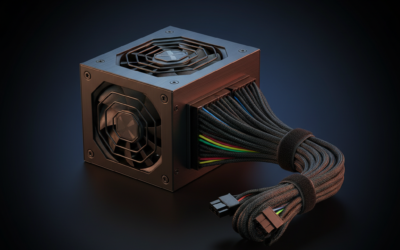
Cheap PSUs leak switching noise into the chassis ground, which then propagates through the motherboard audio codec. If you’ve still got a $30 generic PSU from 2019, that’s a real cause. Swapping to a 80 Plus Gold unit with a properly filtered output usually drops the noise floor by 6 to 10 dB.

Pros
- Passive 3.5mm inline design, no drivers, power, or appairing required
- Compact 2.01 inch body fits between phone and tight dashboard AUX jacks
- Targets alternator whine and ground buzz on shared-power car audio setups
- Broadly compatible with Bluetooth receivers, hands-free car kits, and home stereos
Cons
- Zero owner feedback listed at time of writing, real-world reliability unverified
- No specifications given for impedance, insertion loss, or frequency response
- Passive transformer isolators at thisier typically shave some high-frequency detail and bass
This is a budget passive ground loop noise isolator from elegantstunning, built as a short 3.5mm male-to-female inline dongle measuring 2.01 by 0.59 by 0.59 inches at 0.99 oz. It targets drivers running a Bluetooth receiver or phone into a car AUX input, plus home stereo users hearing 60Hz hum on shared power.
The defining feature is simplicity: plug it between the audio source and the AUX jack, and it isolates the signal grounds so alternator whine or transformer hum stops riding along the audio line. Passive isolators in this size class typically use small 1:1 audio transformers, which handle the vocal band well and tame low-frequency buzz on most head units.
Trade-offs are typical at this tier. The listing gives no impedance, insertion loss, or frequency response figures, so bass extension and top-end sparkle may take a small hit compared to a direct AUX connection. It also cannot fix hum sourced from a bad head unit ground, a failing alternator diode, or a USB charger injecting noise upstream of the 3.5mm jack.
Buy this if you have confirmed ground loop buzz on a 3.5mm AUX path from a Bluetooth receiver or phone and want a cheap first fix. Skip this if your noise is engine-RPM related whine only under load, or if your source uses RCA rather than 3.5mm outputs.
Form factor: Inline 3.5mm dongle with an attached audio cable, 2.01 by 0.59 by 0.59 inches, 0.99 oz. The barrel is small enough to hang from a dash AUX jack without stressing the port, and the pigtail lets you route around tight center consoles.
Connections: 3.5mm plug on one end and 3.5mm socket on the other, sized for any portable device or Bluetooth receiver with a standard TRS or TRRS output. No RCA, no XLR, no USB, so head units with only RCA line-in need a separate adapter or different isolator.
Electrical: Passive design with no power input, bateries, or switches. Electrical specs like insertion loss, isolation in dB, THD, and frequency response are not specified. Passive 3.5mm isolators in this price class typically roll off slightly below 40Hz and above 15kHz, which is audible on critical listening but rarely on car audio.
Intended use: Car AUX inputs with Bluetooth receivers or hands-free kits, and home stereo3.5mm inputs where the source and amp share a power circuit. Not rated for balanced pro audio, mixer inserts, or high-voltage line stages.
Cause #3: USB bandwidth saturation or power delivery dip
USB audio devices crackle when the bus runs out of bandwidth. This is common on USB 3.0 controllers shared between a webcam, an external SSD, and a USB headset. The webcam grabs an isochronous slot, the SSD bursts, and the audio packet drops. You hear it as a quick zap during heavy file copies or when OBS starts capture.
Diagnose by opening Task Manager, Performance, then watching the USB controller utilization while it crackles. If you can’t see USB rows directly, use USBTreeView (free) to map which devices share a controller. Move the audio device to a different physical controller. On most motherboards, the rear I/O has two separate USB controllers and the front panel has a third. The audio interface or headset should sit on its own controller, period.
If you can’t free up a controller, drop the audio device to USB 2.0 mode. Most USB audio interfaces don’t need USB 3 bandwidth at all. A 2-in/2-out interface uses maybe 6 Mbps. Forcing it to USB 2 by using a USB 2 port (the black ones) often clears bandwidth conflicts.
Power delivery‘s the other half. Bus-powered USB DACs drawing 400 mA can starve if the port shares a hub with high-draw devices. A self-powered USB hub with its own 12V brick solves it. Anker and Sabrent make solid ones around $20. Skip the unbranded ones.

Pros
- Covers guitar, bass, keyboard, amp, pedal, and mixer 1/4 inch inputs
- Gig-bag portable form factor for quick fixes during live sets
- Addresses a common and frustrating fault: crackling, intermittent jack sockets
- Source describes application as quick and straightforward, no disassembly implied
Cons
- Limited owner feedback at time of writing, hard to verify long-term effectiveness
- No specification for materials, abrasive grade, or number of uses per unit
- Only fits 1/4 inch sockets, no coverage for XLR, TRS mini, or Speakon connectors
The Krackle Killers Socket Cleaner is a niche cleaning accessory aimed at musicians dealing with noisy 1/4 inch jack sockets on guitars, basses, keyboards, amplifiers, effects pedals, and small sound desks. It targets gigging players and home studio owners who need a portable fix for intermittent signal or crackle at the input stage.
The defining feature is scope: one tool covering every standard 1/4 inch socket in a typical signal chain. Cleaners in this category typically work by mechanically wiping oxidation and dust from the tip and sleve contacts, restoring conductivity without contact spray. Source material does not specify tip material, abrasive rating, or cycle life, so real world longevity is unclear.
Trade-offs at this tier are format driven. It only addresses 1/4 inch jacks, so XLR mic inputs, TRS mini connections on interfaces, and Speakon speaker jacks fall outside its remit. There is also no public spec sheet for construction, and owner feedback is sparse, which limits confidence in how well it holds up across many sockets.
Buy this if you gig regularly and want a low fuss tool to rescue a scratchy guitar jack or amp input during a set. Skip this if your noise problems are on XLR, mini TRS, or Speakon connectors, or if you already own contact cleaner and cotton swabs that do the same job.
Compatible sockets: Designed specifically for 1/4 inch (6.35 mm) mono and stereo jack sockets on electric guitars, basses, keyboards, and other amplified instruments. The same1/4 inch format covers most amp inputs, effects pedal in/out jacks, and channel inputs on typical live sound desks.
Application scope: Source lists guitars, basses, keyboards, virtually any other amplified instrument, amplifiers, effects units, and sound desks. It does not cover XLR microphone inputs, 3.5 mm TRS mini jacks on audio interfaces, or Speakon connectors on PA cabinets.
Portability: Marketed as gig bag friendly, intended for on the gig rectification of socket noise. Exact dimensions and weight are not specified, but the sizing brief implies a form factor small enough to sit alongside cables, tuners, and spare strings without ading meaningful bulk.
Product classification: Listed under Musical Instruments and Cleaning & Care rather than general electronics contact cleaners. No data is provided on materials, replaceable tips, service life in cycles, or whether any solvent or chemical is applied, so cleaning is assumed to be mechanical only.
Preventive maintenance
Once you’ve fixed it, here’s how to keep crackling from coming back. Set Windows Update to defer driver updates by 14 days under Settings, Windows Update, Advanced. That window catches most regression bugs in audio drivers before they hit your machine. Microsoft’s pushed bad Realtek packages twice in the past 18 months.
Clean USB ports every six months. Compressed air at a 45-degree angle clears lint from rear ports, where dust accumulates and increases contact resistance. Poor contact creates intermittent power drops that read as crackling on bus-powered devices. Don’t use a metal pick. Wood toothpicks only.
Keep your audio chain on the same circuit. If you’ve got a UPS or surge strip, run the PC, monitor, and speakers off the same strip. That single ground reference eliminates 90% of ground loop scenarios before they start. Don’t share the strip with a laser printer or space heater. Those switching loads inject noise back into the line.
Finally, document your driver versions. Snapshot the working Realtek and Nvidia version numbers in a text file. Next time Windows Update breaks something, you’ve got a known-good baseline to roll back to via DDU (Display Driver Uninstaller) and a vendor download.
When to call a pro vs DIY
If you’ve worked through driver swaps, port changes, ground loop isolation, and the crackling persists across two completely different output devices (say, USB headset AND 3.5mm speakers), the motherboard audio codec might’ve failed. That’s rare but happens after lightning strikes or PSU failures. At that point a $25 USB DAC bypasses the onboard codec entirely and you’re done. No need for a tech.
Call a pro if the crackling came with other symptoms: random reboots, USB devices dropping, weird POST behavior. Those point to PSU or motherboard issues that need a meter and experience to diagnose. A local shop charges $40 to $80 for diagnosis, which is fair. Don’t pay anyone $150 to swap drivers. That you can do in 20 minutes.
Laptops with crackling under battery only (not plugged in) usually have a failing charge controller or battery cell. That’s a warranty conversation, not a DIY fix.
Tools / parts needed
Software’s free. LatencyMon for DPC analysis. USBTreeView for controller mapping. DDU for clean driver uninstalls. HWiNFO64 if you want to monitor voltage rails on the PSU. Download all four before you start so you’re not scrambling mid-troubleshoot.
Hardware budget runs $7 to $40 depending on which cause you hit. A 3.5mm ground loop isolator is $7. A new 6-foot 3.5mm cable with gold-plated tips runs $5. A powered 4-port USB hub costs $15 to $20. If you need a USB DAC to bypass onboard audio, a Creative G3 or FiiO K3 sits at $35 to $80 and sounds notably cleaner than any motherboard codec.
Skip the audiophile “snake oil” cables. A $400 USB cable can’t fix what a $15 ground loop isolator solves. Real causes are electrical, not metaphysical.
Common questions
Why does my audio crackle only in games?
Game audio runs at higher buffer pressure than YouTube. Drop the in-game audio sample rate to 48 kHz and reduce simultaneous voice channels. Also disable Nvidia’s broadcast app if it’s running, since it sits in the audio path and adds latency.
Will a new soundcard fix crackling?
Sometimes. A discrete sound card or USB DAC bypasses the noisy onboard codec entirely. If the cause is electrical interference on the motherboard, yes it’ll help. If the cause is a driver conflict or USB bandwidth, no, the same issue follows you.
Does Bluetooth audio crackle differently?
Yes. Bluetooth crackling’s usually radio interference (2.4 GHz Wi-Fi nearby) or codec switching between SBC and AAC mid-stream. Force AAC or aptX in the device settings, move the Wi-Fi router to 5 GHz, and the crackling typically stops.
Can a bad PSU cause audio crackling?
It can. Ripple voltage above 50 mV on the 12V rail leaks into the audio codec ground reference. Use HWiNFO64 to check rail voltages. If they swing more than 5% under load, the PSU’s a real candidate.