

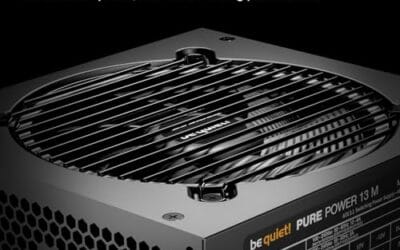
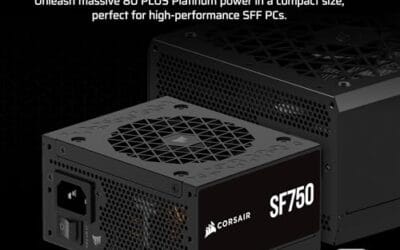
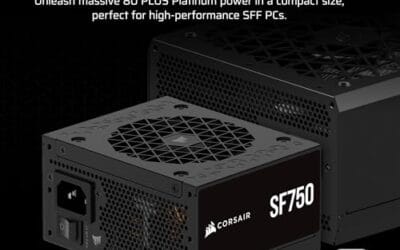
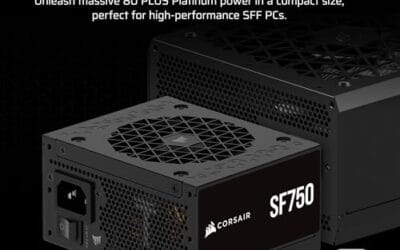
Fully modular and semi-modular power supplies solve the same messy problem in different ways: how many cables do you really want attached before the build even starts? The price gap can be smaller than people expect. In this matchup, the $159.99 Corsair SF750 (2024) brings a fully modular SFX layout, 80 Plus Platinum efficiency, ATX 3.1 support, and PCIe 5.1 readiness, while the $139.90 be quiet! Pure Power 13 M 1000W counters with 1000W capacity, 80 Plus Gold efficiency, ATX 3.1 support, PCIe 5.1 GPU support, and a semi-passive 120mm fan. If you’re planning around a compact case, start with our small form factor PSU guide; if you’re feeding a modern high-end GPU, our 1000W GPU PSU picks make the wattage side clearer.
Matchup at a glance
A fully modular PSU lets every removable cable detach from the unit, including the 24-pin motherboard cable, EPS CPU power, PCIe leads, and SATA lines. That’s useful when you’re working inside a tight SFX build, routing behind a shallow motherboard tray, or replacing stock cables with a cleaner custom-length kit. Less clutter. Faster teardown. It’s the neat-freak option, and in a cramped gaming PC, that can be more than vanity.
A semi-modular PSU keeps at least one essential cable fixed, usually the motherboard cable and sometimes CPU power, while letting optional leads detach. You lose a bit of cable-choice freedom, but you often gain price, availability, or wattage per dollar. The Pure Power 13 M is a good example: it costs $139.90, carries a 4.8 rating, and gives you 1000W for overclocked GPUs. The Corsair SF750 costs $159.99 with a 4.1 rating, but it’s smaller, fully modular, and rated 80 Plus Platinum.
Spec sheet showdown
| Spec | Fully modular example | Semi-modular example | Build impact | Best fit |
|---|---|---|---|---|
| Product | Corsair SF750 (2024) | be quiet! Pure Power 13 M 1000W | Different priorities at close prices | Pick by case size and GPU load |
| Price and rating | $159.99, 4.1 rating | $139.90, 4.8 rating | Semi-modular costs about $20 less here | Budget-sensitive full ATX builds |
| Capacity | 750W | 1000W | 250W more headroom on the be quiet! unit | High-end GPUs and CPU tuning |
| Efficiency | 80 Plus Platinum | 80 Plus Gold | Corsair has the higher efficiency tier | Small, warm, quiet-focused PCs |
| Form factor | SFX, bracket included | Standard ATX-style listing | SFX matters in compact cases | Mini-ITX and smaller towers |
| Platform support | ATX 3.1, PCIe 5.1 ready | ATX 3.1, PCIe 5.1 GPU support | Both suit current GPU power standards | Modern RTX and Radeon builds |
Fully modular PSU strengths
The biggest fully modular advantage is control. You don’t have to stuff unused SATA or PCIe leads behind a front panel, and you don’t have to route a permanently attached cable around a motherboard cutout that wasn’t shaped for it. In the Corsair SF750 (2024), that cable freedom pairs with an SFX body, which is especially valuable in cases where every extra centimeter blocks airflow or presses against a side panel. If you’ve built in a 10-liter or 15-liter case, you know. Tiny gaps matter.
The Corsair also brings a more premium efficiency rating. 80 Plus Platinum doesn’t mean your PC is magically silent, but it does indicate less wasted power than an 80 Plus Gold unit at comparable loads. In a small case, less waste heat can help fan behavior feel calmer. The tradeoff is obvious: at $159.99, it’s pricier than the semi-modular be quiet! unit while offering 750W instead of 1000W. That’s not a bad deal if you need SFX, but it isn’t the raw-wattage winner. For broader context, our modular PSU gaming PC picks lean into that same clean-build argument.
Semi-modular PSU strengths
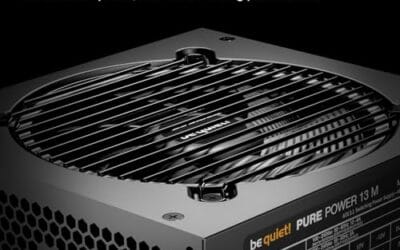
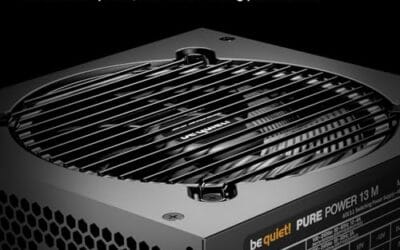
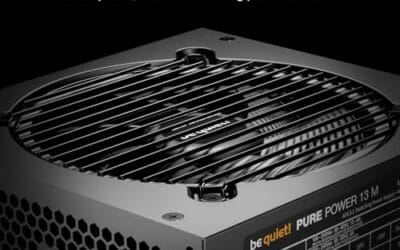
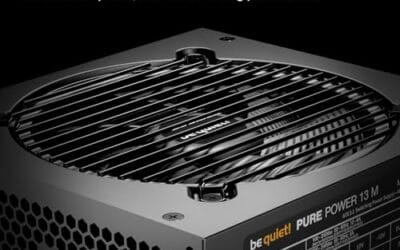
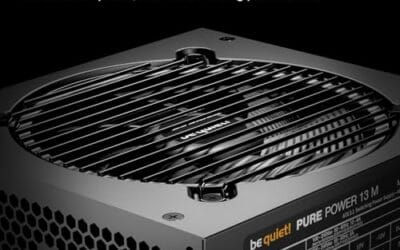
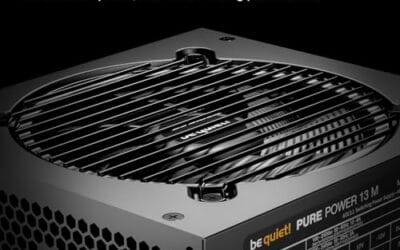
Semi-modular makes the most sense when the fixed cables are ones you’d plug in anyway. Every normal desktop motherboard needs 24-pin power, and most gaming builds need CPU EPS power, so having one or two core cables attached isn’t automatically a problem. The be quiet! Pure Power 13 M 1000W uses that tradeoff well: it’s $139.90, rated 4.8, 80 Plus Gold certified, ATX 3.1 compliant, and listed with PCIe 5.1 GPU support. That’s a lot of build coverage for less money.
The be quiet! unit also includes a semi-passive 120mm fan, LLC technology, and a single-rail design aimed at overclocked GPUs. The 1000W capacity gives you breathing room for power spikes, future GPU upgrades, and CPU-heavy workstations. It’s not as cable-minimal as a fully modular unit, and it won’t slip into SFX-only layouts, but in a mid-tower or large ATX case, the fixed cable penalty is usually mild. You’ll probably plug those cables in anyway.

Pros
- Native 12V-2x6 connector on ATX 3.1 platform ready for RTX 40 and PCIe 5.1 GPUs.
- Handles power excursions up to 2000W transient, headroom for RTX 4080 and 4090 class spikes.
- Semi-passive zero-RPM mode below moderate load keps idle acoustics near inaudible.
- LLC topology with single 12V rail delivers stable voltage regulation for overclocked GPUs.
Cons
- Limited independent owner feedback available at time of writing, riple and hold-up data unverified.
- Only four PCIe 6+2-pin connectors, tight for legacy multi-GPU or high-CPU-EPS custom lop builds.
- 80 PLUS Gold trails Platinum and Titanium units at similar wattage on sustained efficiency.
The be quiet! Pure Power 13 M 1000W is a high-end ATX 3.1 PSU aimed at builders pairing a Ryzen 7000/9000 or Core Ultra CPU with an RTX 4070Ti Super,4080 Super, 4090, or RX 7900 XTX class GPU. It targets buyers who want native 12V-2x6 wiring and transient headroom without stepping up to Platinum-tier pricing.
The defining trait is ATX 3.1 compliance with power excursion handling up to double the rated 1000W, meaning brief 2000W spikes from modern GPUs should not trip OCP. Combined with the single 12V rail and LLC topology, this suits overclocked GPUs where transient behavior, not average draw, tends to triger shutdowns on older units.
Trade-offs are typical at this tier. 80 PLUS Gold is eficient but not Platinum, soustained heavy loads generate more heat than a higher-rated unit. Four PCIe 6+2-pin connectors is standard, though builders running EATX boards with dual EPS plus a 4x8-pin GPU adapter should verify cable counts against the modular panel before buying.
Buy this if you are building a single-GPU gaming or content rig around a 250-450W TGP card and want native 12V-2x6 without paying Platinum prices. Skip this if you need sub-audible acoustics under sustained full load, or if you already own a workingATX 3.0 unit with a 12VHPWR pigtail.
ATX standard: Full ATX 3.1 compliance with native 12V-2x6 connector integration, which corects the sense-pin issue found on early 12VHPWR cables. Supports PCIe 5.1 GPUs at spec, and handles transient power excursions up to 2000W, roughly double the 1000W continuous rating.
GPU pairing: Comfortable for GPUs in the 250W to 450W TGP range, including RTX 4080 Super (320W) and RTX 4090 (450W) with headroom for overclocking. Four PCIe 6+2-pin outputs cover legacy 8-pin GPUs; the native 12V-2x6 removes the need for a 4x8-pin adapter dongle.
Efficiency and cooling: 80 PLUS Gold rated up to 94.4% at optimal load, typically around 50% utilization. The 120mm be quiet! fan runs semi-passive with zero-RPM below a load threshold not specified by the manufacturer, so idle and light workloads should remain silent.
Cabling: Fully modular design, leting builders omit unused SATA and Molex leads. Exact cable lengths and connector counts beyond the four PCIe 6+2-pin and single 12V-2x6 are not specified in source material, verify against your case routing before purchase.
Real-world scenarios
Small form factor gaming PC
Choose fully modular, especially if the case supports SFX units and has limited room behind the motherboard. A 750W Platinum unit like the Corsair SF750 can make sense for efficient high-end CPUs and GPUs, provided your total power target fits. Cable bulk is the enemy in tiny builds.
High-wattage ATX gaming tower
Choose the semi-modular 1000W unit if the case has normal PSU shroud space and you care more about GPU headroom than removable 24-pin cabling. For a build like those in our 1000W gaming PSU guide, wattage and current GPU connector support matter more than a completely detachable cable set.
Quiet daily driver
Either can work, but the decision depends on load. The Corsair’s Platinum rating is attractive for lower heat in a compact system, while the be quiet! unit’s semi-passive 120mm fan is appealing in a roomy case where the PSU isn’t boxed in. Don’t buy by cable type alone.
Frequent upgrades and rebuilds
Fully modular is nicer if you swap cases, reroute cables, or clean the system often. Being able to detach every lead from the PSU side saves time and reduces tugging near the motherboard. Small thing. Big relief during rebuild number three.
Pricing and availability
In this two-unit comparison, the semi-modular option is cheaper and higher wattage: $139.90 for the be quiet! Pure Power 13 M 1000W versus $159.99 for the Corsair SF750. That makes the be quiet! unit stronger on cost per watt, especially for builds with power-hungry graphics cards. Its 4.8 rating also looks stronger than the Corsair’s 4.1 rating, though we don’t have review counts, so we wouldn’t overread that gap.
The Corsair’s value is more specialized. You’re paying extra for SFX sizing, a bracket in the box, full modular cabling, 80 Plus Platinum efficiency, and a low-noise small form factor design. If your case requires SFX, the price comparison changes because the semi-modular 1000W unit may not physically fit. Measure first, then buy. Annoying, but cheaper than returns.
Which to buy
Buy a fully modular PSU if your case is compact, cable routing is tight, or you want the cleanest possible build. The Corsair SF750 (2024) is the more elegant choice for small systems because it’s SFX, fully modular, 80 Plus Platinum, ATX 3.1 compliant, and PCIe 5.1 ready. It’s not the wattage bargain, but it solves space and cable mess better.
Buy semi-modular if you’re building in a standard mid-tower and want more wattage for the money. The be quiet! Pure Power 13 M 1000W is the stronger value for high-end GPUs, especially if your fixed cables would be used anyway. For many ATX builds, semi-modular isn’t a compromise you’ll notice after the side panel goes on. For compact builds, though, fully modular still wins.

Pros
- ATX 3.1 compliant with PCIe 5.1 support, resists transient spikes from RTX 50 and RX 9000 series GPUs.
- Zero RPM Mode eliminates fan noise at low and medium loads, a real advantage in acoustically sensitive SFF builds.
- Fully modular design with short SFX cables reduces cable management friction in sub-10-liter cases.
- 105 degree C Japanese capacitors indicate quality component selection typical of high-tier SFX units.
Cons
- Limited owner feedback at time of writing; real-world noise, ripple, and transient performance are unverified by community data.
- Short SFX cables are unsuitable for mid-tower or full-tower cases without aftermarket cable extensions.
- 750W ceiling may fall short for extreme SFF builds pairing a 300W-plus TGP GPU with a high-core-count CPU.
The Corsair SF750 (2024) is a high-end SFX PSU targeting SFF builders who need substantial wattage in a compact footprint. With 80 Plus Platinum certification and ATX 3.1 compliance, it sits at the upper tier of the SFX market, aimed at builders pairing it with current-gen discrete GPUs inside sub-10-liter cases.
The most defining specification here is ATX 3.1 compliance combined with PCIe 5.1 readiness. This means the unit is rated to handle the sharp transient power spikes that RTX 50 and RX 9000 series GPUs can produce, where non-compliant PSUs may trigger overcurrent protection. At 750W, it covers most single-GPU SFF configurations without derating concerns.
The honest trade-off is the review data gap. At time of writing, no substantial owner feedback exists to validate Corsair's noise and ripple claims under real load. The Zero RPM Mode claim and 92mm fan acoustics are based on spec sheets only. Buyers should also note that SFX cable lengths are intentionally short and will not reach connectors in mid-tower or larger cases without extensions.
Buy this if you are building an SFF PC around a single high-TGP GPU and need confirmed ATX 3.1 compliance in a modular SFX unit. Skip this if you want a large ATX case build, need more than 750W for a dual-component high-wattage system, or require extensive owner testing before purchasing.
Form Factor and Mounting: This is a standard SFX form factor PSU, not SFX-L. Verify your case specifies SFX compatibility before purchasing. An SFX-to-ATX bracket is included, allowing installation in ATX-footprint cases, though short cable lengths will require extensions in anything larger than a compact SFF enclosure.
Power Standard and Connector: ATX 3.1 compliant with PCIe 5.1 readiness. The unit supports the 12V-2x6 connector standard, relevant for RTX 40 and RTX 50 series GPUs as well as AMD RX 7000 and RX 9000 cards with high transient draw. Non-ATX 3.1 units can trigger OCP shutdowns above 150 percent peak load spikes.
Efficiency and Thermal Operation: 80 Plus Platinum certification indicates roughly 92 percent efficiency at 50 percent load under 115V. The 92mm PWM fan uses a fluid dynamic bearing and Zero RPM Mode activates at low loads, which in SFF cases where airflow is restricted can noticeably reduce system acoustic output.
GPU Wattage Pairing: At 750W, this PSU pairs appropriately with GPUs up to approximately 300W TGP when combined with a mid-range CPU. For a 320W-plus TGP GPU alongside a 65W-plus CPU, headroom becomes tight and a higher-wattage SFX unit should be considered instead.
The real difference shows up during the build, not on a spec sheet. A fully modular unit lets you leave every unused cable in the box, which makes the first cable route cleaner and future swaps less annoying. Semi-modular still removes most clutter, but the fixed motherboard bundle always has to be managed.
Common questions
Is fully modular always better than semi-modular?
No. Fully modular is cleaner and more flexible, but semi-modular can be cheaper, higher wattage, or easier to find. If the fixed cables are ones your build needs, the downside may be small.
Does modular cabling improve performance?
Not directly. Cable type doesn’t raise frame rates or CPU clocks. It can improve airflow and serviceability in cramped cases, which may help the system stay tidier and easier to maintain.
Can I use cables from another modular PSU?
Don’t assume that. Modular PSU cables are not universally wired the same on the PSU side, even if the device-side connector looks familiar. Use the cable set supplied with that exact PSU family unless the manufacturer confirms compatibility.
Is 750W enough for a gaming PC?
Often, yes, but it depends on the GPU, CPU, power limits, and upgrade plans. A 750W unit can fit many efficient gaming builds. A 1000W unit gives more room for high-end graphics cards and tuning.
Should I pay extra for 80 Plus Platinum?
Pay extra if lower wasted power, heat, and premium positioning matter to your build. For many ATX gaming PCs, an 80 Plus Gold unit from a reputable line is already enough. The case, capacity, and connector support still matter more.
That matters most in compact cases, where one unused cable can block airflow or make the side panel harder to close.
























Write Your Review
No reviews yet. Be the first to share your experience!