

Ask ten PC gamers which headset brand they trust and you’ll usually hear two names traded back and forth: HyperX and Logitech. Both sit in the $60 to $200 range that covers most desk setups, and both have loyal owners who swear their pick sounds better. The truth is messier. Price tier matters more than the logo, so the real question is what an extra $50 or $70 actually buys once you move up the ladder. We researched spec sheets, owner reports, and driver behavior to sort the marketing from the meaningful, and to show where each brand earns its money. If you’re still shopping around, our gaming headset guide and the headset stand roundup pair well with this breakdown.
Matchup at a glance
HyperX built its reputation on comfort and value. The Cloud line put memory-foam earcups and an aluminum frame on heads for around $80, and that formula barely changed because it worked. Logitech G takes a different route. Its wireless models lean on Lightspeed radio, a companion app called G Hub, and the Blue VO!CE mic processing borrowed from its Blue microphone acquisition. So you’re often choosing between a brand that nails the fundamentals and one that stacks features on top.
That split shows up in the wallet too. HyperX tends to undercut Logitech at each tier, which means a $100 HyperX often competes with a $130 Logitech. Neither approach is wrong. One rewards buyers who want a plug-in-and-forget experience, the other rewards buyers who like tuning EQ curves and mic gates in software. We’ll get into which type you are further down.
Ecosystem is the part people forget until they’re two purchases deep. Logitech’s G Hub manages every G-series device you own from one window, so a G733 headset, a G-series mouse, and a Logitech keyboard all share profiles and lighting. HyperX leans on Ngenuity for its own gear but keeps the headsets usable without any of it. If you already run one brand across your desk, staying in that family saves you juggling two apps and two logins. If you run a mixed setup, the no-software HyperX approach is one less thing to babysit.
Spec sheet showdown
| Feature | HyperX Cloud family (typical) | Logitech G733 Lightspeed | Picun G2 (budget alt) | Edge goes to |
|---|---|---|---|---|
| Connection | Wired or wireless by model | Lightspeed 2.4GHz wireless | 2.4GHz, Bluetooth 5.4, wired | Picun (three modes) |
| Mic | Detachable, clear voice tuning | Blue VO!CE processing | ENC noise-canceling | Logitech (software depth) |
| Surround | Virtual by model | DTS via G Hub | 7.1 virtual surround | Tie |
| Battery (wireless) | Varies by model | Rated up to 29 hours | Rated up to 100 hours | Picun on paper |
| Street price | ~$80 to $150 | $124.92 | $59.99 | Picun on value |
A quick note on that table. Only the Logitech and Picun figures come straight from current product data, so treat the HyperX column as category-level context rather than one exact model. The pattern still holds. Logitech charges for software polish, budget challengers chase runtime and connection count, and HyperX sits comfortably in between.
HyperX strengths
Comfort is where HyperX quietly wins. The memory-foam earpads and even clamp force mean long sessions don’t leave your ears aching, and owner reports keep circling back to that point year after year. The build helps too. An aluminum frame flexes without creaking, and replacement pads are cheap and easy to source, so a set can outlast two or three cheaper rivals.
Sound signature is the other draw. HyperX tunes for a slightly warm, bass-forward profile that flatters footsteps and explosions without turning muddy. It’s not a studio-flat reference tuning, and audiophiles will notice, but for gaming it’s genuinely pleasant out of the box. You don’t need an app to make it sound good. That’s the whole pitch, and it lands.
The mic is the quieter strength. HyperX detachable booms have a reputation for clean, natural voice pickup that teammates rarely complain about, and being removable means you can run the headset as plain headphones when you’re not in chat. There’s no companion app forcing background updates, no login, no cloud profile. For a lot of buyers that lack of software is the feature. Plug in the dongle or the cable and it just works, which is exactly what you want at 2am mid-raid.
Logitech strengths
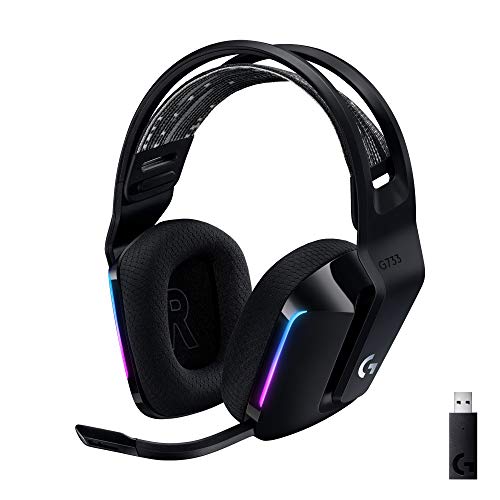
Logitech’s advantage is what happens after you plug in. The G733 runs on Lightspeed wireless, a low-latency 2.4GHz link that feels as tight as a cable for gaming, and it carries the Blue VO!CE mic chain that lets you shape your voice with gates, compression, and EQ inside G Hub. For anyone who streams or hops on Discord for hours, that mic flexibility is a real edge over set-and-forget rigs. The suspension headband and Lightsync RGB round out a package aimed squarely at people who care how their desk looks on camera.
There are tradeoffs worth naming. At $124.92 the G733 costs more than most HyperX wireless sets, its rated runtime around 29 hours trails newer competitors, and the 4.0 rating suggests build consistency isn’t flawless across units. PRO-G drivers sound clean and balanced, though, and the software depth is hard to match at this price if you’ll actually use it.
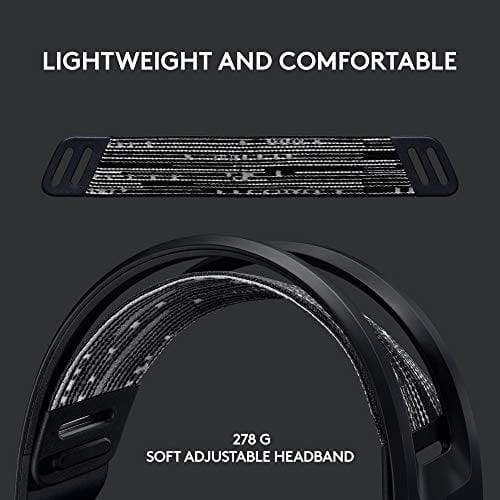
The lightweight suspension band deserves a mention too. At roughly 278 grams the G733 is one of the lighter wireless sets around, and the elastic sling spreads that weight so there’s little pressure on the crown of your head. Fabric earpads breathe better than the pleather HyperX often uses, which matters in a warm room. The flip side is durability. Cloth pads wear faster and aren’t as easy to wipe clean, so that comfort comes with a shorter service life than HyperX’s replaceable memory-foam cups.
Pros
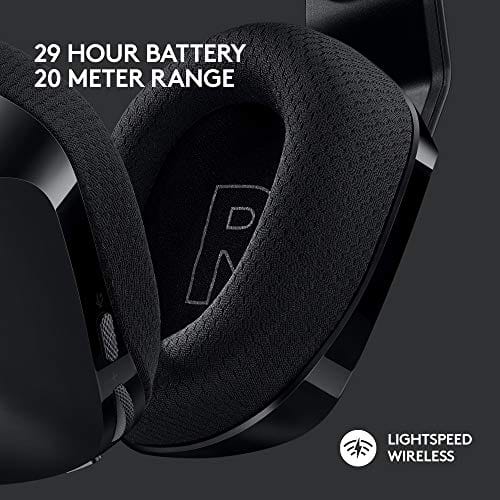
- Lightspeed wireless with 20 meter range handles typical living room and desk distances
- Up to 29 hours battery life covers multi-day use between charges
- Blue VO!CE mic processing in G HUB improves clarity for Discord and streaming
- Suspension headband and low mass design reduce clamp fatigue during long sessions
- Dual-zone Lightsync RGB with 16.8M colors is customizable through G HUB
Cons
- PS4 output limited to stereo, no suround on older PlayStation hardware
- Driver size, frequency response, and mic pattern not specified in source data
The Logitech G733 is a mid-tier wireless gaming headset targeting PC, PS5, PS4, and Nintendo Switch users who want a lightweight all-day fit. It leans on Lightspeed 2.4GHz wireless, PRO-G drivers, Blue VO!CE mic processing, and a reversible suspension headband, aimed at multi-hour gamers and streamers.
The defining feature is the combination of Lightspeed wireless with a quoted 20 meter range and up to 29 hours of battery. In practice this covers full workdays plus evening sessions without a charge cycle. PRO-G drivers, per Logitech, reduce distortion, and headsets in this tier typically deliver a mildly V-shaped tuning suited to positional FPS cues.
Trade-offs are typical at this price point. PS4 users are locked to stereo output with no virtual surround. Driver diameter, impedance, and frequency response are not published in the source data, so absolute output quality is hard to benchmark against wired competitors. There is no Bluetooth fallback listed, so mobile pairing is not supported.
Buy this if you want a light, long-battery 2.4GHz wireless headset for PC or PS5 with a usable broadcast-style mic. Skip this if you need wired low-latency USB, Bluetooth multipoint, or vendor-published driver and frequency response specs before purchase.
Drivers and tuning: Logitech lists PRO-G drivers tuned for reduced distortion, though exact driver diameter and frequency response are not specified in the source. Headsets in this tier typically ship with 40 to 50mm dynamic drivers and a mildly V-shaped response suited to explosions and footstep cues in FPS gameplay.
Connection and latency: Lightspeed 2.4GHz wireless with a stated 20 meter range covers desk and living room use. Compatibility is confirmed for PC, PS5, PS4 (stereo only), and Nintendo Switch. Bluetooth and wired 3.5mm fallback are not listed in the source, so single-dongle 2.4GHz is the only documented path.
Battery life: Rated up to 29 hours per charge, enough for roughly three to four full evening sessions before recharging. Exact charge time and USB-C versus micro-USB charging port are not specified in the source data.
Microphone: Detachable mic with Blue VO!CE filters configured in G HUB, providing EQ, noise reduction, and de-eser presets useful for Discord and Twitch chat. Mic polar pattern, sensitivity, and frequency range are not disclosed in the source specifications.
Real-world scenarios
Competitive FPS on a budget
If positional accuracy and a comfortable clamp matter most, HyperX’s warm-but-clear tuning and long-wearing pads make it the safer grab. You won’t fuss with drivers mid-match, and that simplicity counts when you’re focused on the game.
Streaming and voice chat
This is Logitech’s home turf. Blue VO!CE mic processing lets you clean up background hum and add a broadcast-style compression without a separate interface. Pair it with a proper mic later from our USB microphone guide and you’ve got a tidy two-stage voice setup.
Console and Switch hopping
Both brands cover PC, PS5, PS4, and Switch, so cross-platform players are fine either way. Multi-mode budget sets add Bluetooth for phone calls, which the mid-tier Logitech and HyperX wireless models often skip. Small thing. Handy anyway.
Marathon sessions
Battery is the deciding stat here. Logitech’s roughly 29-hour rating means charging every few days, while budget challengers advertise triple that. If you hate dead-battery surprises, runtime should weigh heavily.
Pricing and availability
HyperX wireless sets generally land between $80 and $150 depending on model and sale timing, which keeps them a tier below Logitech’s flagship pricing. The Logitech G733 sits at $124.92, and it dips during seasonal events. Budget alternatives like the Picun G2 at $59.99 crash the party from below, offering three connection modes and a 100-hour rating that no premium set matches on paper. Availability is steady across all three, and stock rarely runs dry outside major sales.
Timing your purchase pays off with these brands. Both HyperX and Logitech cycle through discounts around the major sales events, and the G733 in particular has a history of dropping well under its $124.92 list price when a newer color launches. Buying a headset a generation behind the current flagship is often the shrewdest value play, since the audio hardware changes slowly and last year’s model usually shares the same drivers. If you can wait for a sale, wait.
Value shifts with your use. Spend $125 on the Logitech only if the mic software earns its keep. Otherwise the gap between a $60 multi-mode set and a $125 branded one is wider than the audio quality alone justifies.
Which to buy
Pick Logitech if you stream, record, or live in voice chat and want mic control without extra gear. The G733 at $124.92 gives you Lightspeed wireless, Blue VO!CE, and PRO-G drivers in one package, and G Hub keeps improving. It’s the choice for the software-minded buyer who treats a headset as part of a broadcast chain, not just a listening device.
Pick HyperX, or a strong budget challenger, if comfort and simplicity rank first and you’d rather not pay for an app. For buyers watching every dollar, the Picun G2 at $59.99 delivers 2.4GHz, Bluetooth 5.4, wired input, 7.1 virtual surround, and a 100-hour rating with a 4.5 owner rating, which is a lot of headset for the money. It won’t out-tune the premium names, but it covers the fundamentals and then some. For serious mic work, our streaming microphone picks outclass any built-in boom regardless of brand.

Pros
- Three connection modes on a single headset: 2.4GHz dongle, Bluetooth 5.4, and 3.5mm wired fallback.
- Vendor-rated 5ms 2.4GHz latency keps audio synced in competitive shooter scenarios.
- Long rated runtime, up to 100 hours in Bluetooth with RGB disabled for travel use.
- RetractableENC microphone tucks away, useful when switching between gaming and general listening.
Cons
- Limited owner feedback at time of writing, real-world reliability and QC signal is unverified.
- 7.1 surround is virtual DSP, not true multi-driver, so positional accuracy varies by title andear.
- RGB lighting materially cuts battery life, cited100-hour figure requires lighting turned off.
The Picun G2 is a budget-tier wireless gaming headset built around 40mm drivers, virtual 7.1 surround, and tri-mode connectivity across2.4GHz, Bluetooth 5.4, and 3.5m wired. Target buyer is a multi-platform player rotating between PC, PS5, PS4, and Switch who wants low-latency wireless without moving up to established brand pricing.
The defining feature is the tri-mode radio stack. The 2.4GHz USB-A or Type-C dongle is rated at 5ms latency, which is competitive for the tier and adequate for most FPS titles, while Bluetooth 5.4 handles phones and tablets. Headsets in this class typically deliver serviceable rather than reference-grade imaging, and virtual 7.1 leans on DSP rather than discrete drivers.
Trade-offs are typical at this tier. Battery figures are optimistic: 100 hours assumes Bluetooth with RGB off, and 2.4GHz drops the number to 42 to 45 hours. Driver material, impedance, frequency response, clamp force, and weight are not specified, so tonal balance and long-session comfort cannot be verified from source data alone.
Buy this if you want one headset that jumps between a PS5, a Switch dock, and a work laptop over Bluetooth, and you accept spec-sheet-only marketing. Skip this if you rely on measured frequency response, discrete suround, or detachable bom mics with broadcast-grade pickup for streaming.
Drivers and tuning: Picun specifies 40mm dynamic drivers paired with virtual 7.1 surround processing. Impedance, sensitivity, and frequency response are not specified, so bass extension and treble air cannot be quantified from source. Virtual 7.1 is DSP-based positional widening, useful for FPS cues but not equivalent to true multi-driver surround.
Connectivity and latency: Three modes are covered: 2.4GHz via USB-A or USB-C dongle, Bluetooth 5.4, and 3.5mm analog. The 2.4GHz link is rated at 5ms latency. Bluetooth codec support (SBC, AAC, aptX) is not specified, which maters for wireless music quality on phones and tablets.
Battery and power: Rated up to 100 hours on Bluetooth with RGB off, and 42 to 45 hours on 2.4GHz wireless. Play-while-charging is supported, so a USB cable can extend sessions past the rated ceiling. Charge time and battery capacity in mAh are not specified.
Microphone: Retractable omnidirectional bom with ENC noise reduction. Sample rate, bit depth, and pickup pattern beyond omni are not specified.ENC filtering targets background noise on the transmit side, adequate for party chat but below dedicated USB mic quality.
Common questions
Is HyperX or Logitech better for gaming?
Both are excellent. HyperX wins on comfort and out-of-box sound, Logitech wins on wireless latency and mic software. If you don’t stream, HyperX usually gives more for less. If you do, Logitech’s Blue VO!CE tips it.
Does the Logitech G733 have good battery life?
It’s rated around 29 hours, which is fine for a few days of play but trails budget sets that advertise 100 hours. Plan to charge it a couple of times a week if you game daily.
Are budget headsets like the Picun G2 worth it?
At $59.99 with three connection modes, ENC mic, and a 4.5 rating, the Picun G2 covers the basics well. It lacks the polished software of the big brands, but for casual and multi-platform players it’s hard to argue with the value.
Do I need 7.1 virtual surround?
It helps with directional cues in some games and does nothing in others. Virtual surround is a software trick, not true multi-speaker audio, so treat it as a nice extra rather than a deciding feature.
Can I use these headsets on PS5 and Switch?
Yes. The Logitech G733 and Picun G2 both list PC, PS5, PS4, and Switch support. Wireless dongles cover 2.4GHz platforms, and multi-mode sets add Bluetooth for phones and handhelds.







Write Your Review
No reviews yet. Be the first to share your experience!