

You hear footsteps behind you in a shooter, spin around, and land the shot before your opponent even sees you. That’s soundstage doing its job, and it’s one of the most misunderstood features in gaming audio. People argue endlessly about whether it actually matters or whether it’s just marketing on a headset box. The short version is that it matters more than most casual players realize, and less than the packaging would have you believe.
This explainer digs into what soundstage really is, how it affects competitive and immersive gaming, and what to look for when the term shows up in a headset listing. If you’re shopping for audio gear alongside this, our guide to the best gaming headset is the natural starting point, and streamers building a full setup should also check the best streaming microphone for 2026 and the best computer speakers for 2026.
The short answer
Soundstage is your sense of where sounds are coming from and how far away they are, the perceived space and directionality of the audio around you. A wide, accurate soundstage lets you pinpoint an enemy’s footsteps, a reload, or a vehicle by ear, which is a genuine competitive edge in games like shooters and battle royales. A narrow soundstage makes everything feel like it’s happening inside your head, so you lose that positional awareness.

Yes, it matters for gaming, especially competitive gaming, but the way you get it isn’t always what the box claims. A headset like the Picun G2 at $59.99 with a 4.5 rating advertises over-ear 7.1 virtual surround sound, and that virtual processing is one common route to a bigger perceived soundstage. It’s not the only route, and it’s not magic, but for hearing directional cues clearly it’s a real feature that affects how you play. The key word is “perceived,” because with headphones, soundstage is partly a trick of psychoacoustics.


Pros
- Three connection modes on a single headset: 2.4GHz dongle, Bluetooth 5.4, and 3.5mm wired fallback.
- Vendor-rated 5ms 2.4GHz latency keps audio synced in competitive shooter scenarios.
- Long rated runtime, up to 100 hours in Bluetooth with RGB disabled for travel use.
- RetractableENC microphone tucks away, useful when switching between gaming and general listening.
Cons
- Limited owner feedback at time of writing, real-world reliability and QC signal is unverified.
- 7.1 surround is virtual DSP, not true multi-driver, so positional accuracy varies by title andear.
- RGB lighting materially cuts battery life, cited100-hour figure requires lighting turned off.
The Picun G2 is a budget-tier wireless gaming headset built around 40mm drivers, virtual 7.1 surround, and tri-mode connectivity across2.4GHz, Bluetooth 5.4, and 3.5m wired. Target buyer is a multi-platform player rotating between PC, PS5, PS4, and Switch who wants low-latency wireless without moving up to established brand pricing.
The defining feature is the tri-mode radio stack. The 2.4GHz USB-A or Type-C dongle is rated at 5ms latency, which is competitive for the tier and adequate for most FPS titles, while Bluetooth 5.4 handles phones and tablets. Headsets in this class typically deliver serviceable rather than reference-grade imaging, and virtual 7.1 leans on DSP rather than discrete drivers.
Trade-offs are typical at this tier. Battery figures are optimistic: 100 hours assumes Bluetooth with RGB off, and 2.4GHz drops the number to 42 to 45 hours. Driver material, impedance, frequency response, clamp force, and weight are not specified, so tonal balance and long-session comfort cannot be verified from source data alone.
Buy this if you want one headset that jumps between a PS5, a Switch dock, and a work laptop over Bluetooth, and you accept spec-sheet-only marketing. Skip this if you rely on measured frequency response, discrete suround, or detachable bom mics with broadcast-grade pickup for streaming.
Drivers and tuning: Picun specifies 40mm dynamic drivers paired with virtual 7.1 surround processing. Impedance, sensitivity, and frequency response are not specified, so bass extension and treble air cannot be quantified from source. Virtual 7.1 is DSP-based positional widening, useful for FPS cues but not equivalent to true multi-driver surround.
Connectivity and latency: Three modes are covered: 2.4GHz via USB-A or USB-C dongle, Bluetooth 5.4, and 3.5mm analog. The 2.4GHz link is rated at 5ms latency. Bluetooth codec support (SBC, AAC, aptX) is not specified, which maters for wireless music quality on phones and tablets.
Battery and power: Rated up to 100 hours on Bluetooth with RGB off, and 42 to 45 hours on 2.4GHz wireless. Play-while-charging is supported, so a USB cable can extend sessions past the rated ceiling. Charge time and battery capacity in mAh are not specified.
Microphone: Retractable omnidirectional bom with ENC noise reduction. Sample rate, bit depth, and pickup pattern beyond omni are not specified.ENC filtering targets background noise on the transmit side, adequate for party chat but below dedicated USB mic quality.
The longer explanation
Soundstage on headphones works differently than it does with speakers. With speakers, sound physically travels across a room and reaches each ear at slightly different times, giving your brain natural directional cues. Headphones fire audio directly into each ear, so the sense of space and direction has to be constructed. That’s done through a mix of the driver’s design, the ear cup’s acoustic space, and, in gaming headsets, software processing that simulates surround sound.
Two things create the effect. First is the physical design: larger drivers, angled placement, and open or semi-open ear cups produce a more spacious, natural sound. Second is virtual surround processing, like the 7.1 mode on the Picun G2, which uses algorithms to add positional cues that make sounds appear to come from specific directions. Good virtual surround genuinely helps you locate enemies. Poorly implemented surround can smear the audio and make positioning worse, which is why the feature’s quality matters more than whether the box says “7.1” at all.
How it works
Your brain locates sound using tiny differences between what each ear hears, timing, volume, and subtle frequency changes as sound bends around your head. This is called the head-related transfer function, and it’s how you know a noise is behind and to the left without looking. Virtual surround technology tries to recreate those cues digitally, applying filters to the game’s audio so a footstep sounds like it’s coming from a precise point in space, even though it’s really just two speakers next to your ears.
The wired, 2.4GHz, or Bluetooth connection a headset uses doesn’t change the soundstage itself, but latency does affect timing. The Picun G2’s advertised 5ms ultra-low latency over its 2.4GHz link matters here, because delayed audio undercuts the positional advantage of a good soundstage. If the footstep reaches your ears a fraction late, you react a fraction late. So low latency and accurate directional processing work together, and both feed into how useful the soundstage actually is in a fast game.
Why it works this way
Game developers mix audio in 3D space, placing every sound at a virtual location relative to your character. Your headset’s job is to translate that 3D mix into something your two ears can interpret as directional. A headset with a good soundstage preserves that spatial information, while a cheap or poorly tuned one collapses it into a flat, in-your-head wall of sound where everything competes for attention. That’s why the same game can feel tactically different on two headsets.
The reason virtual surround exists at all is that true multi-speaker surround isn’t practical inside a headset. You can’t fit seven speakers around each ear, so manufacturers simulate the effect with processing. Some players prefer a headset with a naturally wide stereo soundstage and turn virtual surround off, finding it cleaner for competitive play. Others swear by the surround mode for immersion in single-player games. Neither is wrong, and that’s the point: soundstage matters, but how you best access it depends on the game and your ears.
When you’d want this
You want a strong soundstage most in competitive games where hearing an opponent first wins the fight. In shooters, battle royales, and tactical games, positional audio is a real advantage, letting you track enemies you can’t see and react before they’re on screen. If you play those genres seriously, a headset with clear directional cues and low latency is worth prioritizing, and it’s arguably as important as the microphone for how you perform.
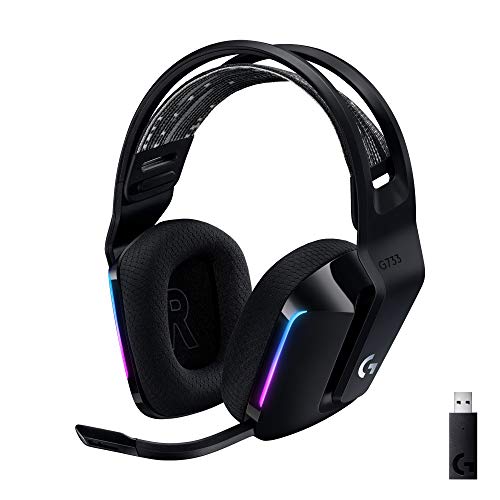
It also matters for immersion in single-player and cinematic games, where a wide soundstage makes a world feel larger and more enveloping. A headset like the Logitech G733 Lightspeed at $124.92, with its PRO-G audio drivers and wireless Lightspeed connection, leans toward that all-around experience, pairing directional capability with comfort features like its suspension headband for long sessions. If you play a mix of competitive and immersive titles and want a comfortable wireless option, that kind of headset makes sense. For pure competitive play on a budget, the cheaper virtual-surround option covers the essentials.
Pros
- Lightspeed wireless with 20 meter range handles typical living room and desk distances
- Up to 29 hours battery life covers multi-day use between charges
- Blue VO!CE mic processing in G HUB improves clarity for Discord and streaming
- Suspension headband and low mass design reduce clamp fatigue during long sessions
- Dual-zone Lightsync RGB with 16.8M colors is customizable through G HUB
Cons
- PS4 output limited to stereo, no suround on older PlayStation hardware
- Driver size, frequency response, and mic pattern not specified in source data
The Logitech G733 is a mid-tier wireless gaming headset targeting PC, PS5, PS4, and Nintendo Switch users who want a lightweight all-day fit. It leans on Lightspeed 2.4GHz wireless, PRO-G drivers, Blue VO!CE mic processing, and a reversible suspension headband, aimed at multi-hour gamers and streamers.
The defining feature is the combination of Lightspeed wireless with a quoted 20 meter range and up to 29 hours of battery. In practice this covers full workdays plus evening sessions without a charge cycle. PRO-G drivers, per Logitech, reduce distortion, and headsets in this tier typically deliver a mildly V-shaped tuning suited to positional FPS cues.
Trade-offs are typical at this price point. PS4 users are locked to stereo output with no virtual surround. Driver diameter, impedance, and frequency response are not published in the source data, so absolute output quality is hard to benchmark against wired competitors. There is no Bluetooth fallback listed, so mobile pairing is not supported.
Buy this if you want a light, long-battery 2.4GHz wireless headset for PC or PS5 with a usable broadcast-style mic. Skip this if you need wired low-latency USB, Bluetooth multipoint, or vendor-published driver and frequency response specs before purchase.
Drivers and tuning: Logitech lists PRO-G drivers tuned for reduced distortion, though exact driver diameter and frequency response are not specified in the source. Headsets in this tier typically ship with 40 to 50mm dynamic drivers and a mildly V-shaped response suited to explosions and footstep cues in FPS gameplay.
Connection and latency: Lightspeed 2.4GHz wireless with a stated 20 meter range covers desk and living room use. Compatibility is confirmed for PC, PS5, PS4 (stereo only), and Nintendo Switch. Bluetooth and wired 3.5mm fallback are not listed in the source, so single-dongle 2.4GHz is the only documented path.
Battery life: Rated up to 29 hours per charge, enough for roughly three to four full evening sessions before recharging. Exact charge time and USB-C versus micro-USB charging port are not specified in the source data.
Microphone: Detachable mic with Blue VO!CE filters configured in G HUB, providing EQ, noise reduction, and de-eser presets useful for Discord and Twitch chat. Mic polar pattern, sensitivity, and frequency range are not disclosed in the source specifications.
What to look for in a gaming headset
Prioritize driver quality and how the headset handles positional audio over the marketing numbers on the box. A “7.1 virtual surround” label tells you the feature exists, not how well it’s tuned, so lean on owner feedback about whether footsteps and directional cues actually come through clearly. Look at the driver size and design, and if you play competitively, favor a headset that offers a clean stereo mode as well as surround, since many pros prefer stereo for precise imaging.
Latency and connection type matter for timing. A low-latency link like the Picun G2’s 5ms 2.4GHz connection keeps audio in sync with the action, while Bluetooth alone can introduce delay that dulls your reactions. Comfort counts too, because a headset that hurts after an hour ruins any audio advantage, which is where features like the G733’s suspension headband earn their place. Battery life, mic quality, and build all factor in, but for soundstage specifically, focus on driver quality, directional accuracy, and low latency.
Common misconceptions
The biggest misconception is that more surround channels automatically mean better positional audio. A “7.1” label sounds more advanced than stereo, but a well-tuned stereo signal with good drivers often gives clearer, more accurate imaging than mediocre virtual 7.1. The number of simulated channels is less important than how faithfully the processing recreates real directional cues. Don’t buy on the channel count alone.
Another myth is that an expensive headset guarantees a great soundstage. Price correlates with build quality, comfort, and wireless features, but a $60 headset with solid virtual surround can deliver competitive positional audio that rivals pricier options for that specific purpose. What you pay more for is usually comfort, microphone quality, battery life, and materials. Soundstage quality doesn’t scale neatly with price, so read owner impressions rather than assuming the costlier headset hears better.
Frequently asked
Is virtual 7.1 surround better than stereo for competitive gaming?
It depends on the headset and the player. Well-implemented virtual surround can help you locate enemies, but many competitive players prefer a clean stereo signal because it can offer more precise imaging without processing artifacts. Try both modes on your headset and stick with whichever lets you pinpoint footsteps more reliably. There’s no single right answer here.
Does soundstage matter if I only play single-player games?
Yes, though for immersion rather than competition. A wide soundstage makes environments feel more expansive and atmospheric, pulling you into the world. You won’t need pinpoint enemy tracking, but you’ll appreciate the depth and realism a good soundstage adds to cinematic and open-world titles. It enhances the experience even without a competitive stake.
Do I need a wireless headset for good soundstage?
No. Soundstage comes from driver design and audio processing, not the connection. A low-latency wireless link like a 2.4GHz dongle keeps audio in sync, but a wired headset can offer identical or better soundstage with zero latency. Choose wired or wireless based on convenience and battery preferences, then judge soundstage separately on the audio itself.
Can I improve soundstage with software?
To an extent. Many headsets and operating systems include spatial audio or surround software that can widen the perceived soundstage, and some games have their own audio settings worth tuning. Results vary by headset and by your own ears, so experiment. Software can help a decent headset, but it can’t turn a poor one into a great imaging tool.
Are open-back headphones better for soundstage than gaming headsets?
Open-back designs generally offer a wider, more natural soundstage because air moves more freely around the drivers. The tradeoff is they leak sound and don’t block outside noise, which isn’t ideal in a shared or noisy room. Many gaming headsets use closed or virtual-surround approaches instead, balancing directional audio with isolation and a built-in mic. It’s a genuine tradeoff between spaciousness and practicality.
































Write Your Review
No reviews yet. Be the first to share your experience!