

Plug a decent pair of headphones straight into a motherboard jack and you’ll hear it: a faint hiss, thin bass, volume that runs out of road before the music gets loud. A dedicated DAC and amp fixes that. The digital-to-analog converter cleans up the signal your PC hands over, and the amplifier gives your headphones the current they actually need. For 2026 the pricing spread is wide, from a $25 pocket amp to a $200 desktop unit that also handles Bluetooth and a mic.
We researched five real DAC and amp options across every price tier, from Fosi Audio’s flagship K7 down to a rechargeable Neoteck stick you can throw in a bag. If you’re fuzzy on the basics, our explainer on what a DAC is covers the fundamentals, and the guide to headphone impedance explains why some cans need far more power than others. Gamers pairing one of these with a headset should also skim our best gaming headset picks so the whole chain matches. Here’s what earned each product its spot.

Pros
- AK4493S plus XMOS XU208 handles PCM 384kHz/32bit and DSD256 cleanly.
- TPA6120 amp rated 2100mW drives high-impedance and planar headphones with headroom.
- 4.4mm balanced output alongside 3.5mm and RCA covers most desktop chains.
- Bluetooth aptX HD and aptX LL ads low-latency wireless input for console and mobile use.
Cons
- Limited owner feedback at time of writing, so long-term reliability is not yet clear.
- Detailed specifications like output impedance, gain stages, and SNR are not specified in source.
- Bluetooth aptX HD tops the wireless codec list, with no LDAC support mentioned.
The Fosi Audio K7 is a mid-range desktop DAC and headphone amplifier combo built around the AK4493S DAC, XMOS XU208 USB controller, and TPA6120 amp stage. It targets desktop listeners who want one hub feding headphones and powered monitors from a PC, PS5, or Switch rather than juggling separate boxes.
The defining feature is the TPA6120 output stage rated at 2100mW, paired with a 4.4mm balanced jack. On paper that is enough current to drive planar magnetics and 250to 300 ohm dynamics without running out of headroom. DACs in this tier typically deliver clean PCM 384kHz/32bit and DSD256 decoding, which the AK4493S suports.
Trade-offs at this tier are mostly informational. Fosi does not publish output impedance, SNR, THD, or gain stage detail in the listing, which maters for sensitive IEMs where hiss and impedance mismatch appear. Bluetooth tops out at aptX HD and aptX LL, so LDAC andHDC users lose their preferred codec. Owner feedback is still thin.
Buy this if you want a single desktop hub with balanced output, console-friendly optical and Bluetooth inputs, and enough power for full-size headphones. Skip this if you rely on LDAC, drive very sensitive IEMs, or need published measurement data before committing to a DAC/amp at this level.
DAC and USB stage: The AK4493S DAC pairs with an XMOS XU208 USB-C receiver, decoding PCM up to 384kHz/32bit and DSD256. That covers every mainstream lossless format from Tidal, Qobuz, and local FLAC libraries without downsampling on Windows, macOS, or Linux hosts.
Headphone amp output: The TPA6120 amp stage is rated at 2100mW, with 4.4mm balanced, 3.5mm single-ended, and RCA line-out. That power figure is enough for typical 250 to 300 ohm dynamics and mid-sensitivity planars, though Fosi does not publish per-load output or output impedance.
Inputs and console use: Inputs cover USB-C, optical, coaxial, Bluetooth aptX HD and aptX LL, plus a 3.5mm microphone input. Optical handles PS5 and Switch audio, aptX LL keps wireless latency low for video, and the mic input suits desktop gaming chat chains.
Controls and build: The chassis is aluminum alloy with EMI shielding, angled front, dual large knobs, five shortcut buttons, and a status display. Weight, dimensions, and warranty are not specified in source, so verify footprint against your desk before ordering.

Pros
- Full metal shell with weighted knobs fels sturdier than typical plastic budget DACs
- Plug-and-play USB Audio Class means no proprietary drivers on Windows, macOS, or Linux
- Coaxial and optical inputs cover TVs, consoles, and CD or DVD sources on one desk
- Output protection circuit reduces risk of pop damage to headphones on power cycles
Cons
- Very limited public owner feedback at time of writing, making long-term reliability hard to judge
- No microphone input or headset combo jack, so gamers still need a separate USB mic
- 200 ohm ceiling means high-impedance planars and300 ohm Sennheiser HD 600 series will underdrive
The Fosi Audio Q4 is an entry-level desktop DAC and headphone amplifier combo aimed at PC users escaping onboard motherboard audio. It caries USB, optical, and coaxial digital inputs plus RCA line-out and a 3.5mm headphone jack, making it a fit for desktop listeners running one headphone pair alongside powered monitors or a stereo integrated amp.
Its defining trait is input flexibility at thisier: three digital sources fed one compact metal box with analog bass and treble knobs. Fosi rates USB input up to 24-bit/192kHz PCM, which covers all mainstream streaming and local FLAC libraries. Units in this price bracket typically use entry-classES or AKM DAC chips, though the source data does not specify the DAC IC used here.
Trade-offs are typical at this tier and worth flagging. The 16 to 200 ohm headphone range excludes 250 and 300 ohm studio cans like the DT880Pro or HD 600. There is no microphone input, so streamers and gamers need a separate USB mic or interface. Tone controls are useful but sit in the analog path, so purists chasing a flat reference chain may prefer to bypass them.
Buy this if you want one small metal box to switch a PC, TV, and console into headphones plus powered speakers with tactile tone knobs. Skip this if you run 250ohm or higher headphones, need a mic input, or want balanced XLR output.
Inputs and outputs: The Q4 accepts PC-USB (Type-B), TOSLINK optical, and coaxial S/PDIF on the digital side, and provides both a 3.5mm headphone jack and stereo RCA line-out. Optical and RCA cables plus a USB Type-B cable are included, so first-run setup does not require extra accessory purchases.
Headphone drive: Rated headphone impedance range is 16 to 200 ohm. That covers most consumer IEMs, closed-back gaming headsets, and mid-impedance sets like the DT 770 32 ohm or HD 560S120 ohm, but leaves 250 and 300 ohm studio and audiophile cans outside the recommended range.
Digital resolution: USB input supports up to 24-bit/192kHz with low-jitter clocking per Fosi. Optical and coaxial specifics are not called out in the source data, so treat them as standard S/PDIF (typically 24-bit/192kHz for coax and 24-bit/96kHz for optical at this tier).
Microphone: There is no microphone input or headset combo jack, confirmed in the product description. Users needing chat or streaming input must add a USB microphone or audio interface alongside the Q4.
Pros
- Output power of 1000mW at 16 Ohm handles low-impedance planar and gaming headsets without strain.
- Mic input over the same 3.5mm jack fixes the Q4predecessor's biggest gap for PS5 chat.
- Optical and coaxial inputs bypass PC ground loops, useful for USB-noisy desktop builds.
- Bass and treble tone controls plus RCA out let it double as a preamp for powered monitors.
Cons
- Limited owner feedback at time of writing makes long-term reliability signals hard to verify.
- USB-C input capped at 24-bit/96kHz, below the 192kHz suported by the optical and coaxial inputs.
- NE5532 op-amp is a decades-old workhorse, not on par with modern discrete or R2R designs at higher price tiers.
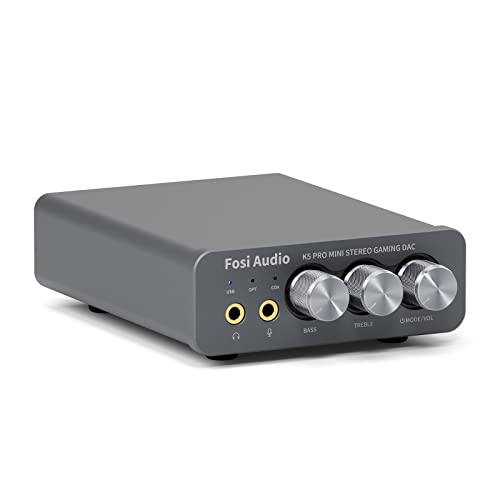
The Fosi Audio K5 Pro is an entry-level desktop DAC and headphone amplifier combo aimed at PS5, PC, and MAC users who want an external sound card with tone controls. It accepts USB-C, optical, and coaxial digital inputs, outputs to RCA and 3.5mm, and ads a microphone jack over the previous Q4 model.
The defining feature is input flexibility at thisier. Optical and coaxial handle up to 24-bit/192kHz while USB-C tops out at 24-bit/96kHz, which is standard for class-compliant USB audio without custom drivers. Rated THD ≤0.003% and SNR ≥110dB are competitive figures on paper, though independent measurements are not published by the vendor.
Trade-offs are typical for the price bracket. The NE5532 op-amp is capable but dated, and 1000mW at 16 Ohm drops to 80mW at 300 Ohm, so high-impedance cans like the HD6X will play but with limited headroom. The combined power-and-volume knob is a cost-saving choice that owners of similar Fosi units have flagged as fiddly.
Buy this if you want a single box to feed PS5 optical, PC USB, and powered monitors with tone controls and mic passthrough. Skip this if you drive 250-300 Ohm dynamic headphones or want native DSD, MQA, or balanced output.
DAC and inputs: Three digital inputs cover USB Type-C at 24-bit/96kHz plus optical and coaxial S/PDIF at 24-bit/192kHz. The USB-C port doubles as a phone audio input when the host supplies USB-A or USB-C data, useful for tablet or handheld console pairing.
Amplifier output: Rated output is 1000mW at 16 Ohm, 500mW at 32 Ohm, 300mW at 64 Ohm, 150mW at 128 Ohm, and 80mW at 300 Ohm. That curve is enough for 32-80 Ohm gaming headsets and most150 Ohm cans, but sits at the low end for 250-300 Ohm dynamic drivers.
Noise and distortion: Vendor-rated THD is ≤0.003% and SNR is ≥110dB, using the NE5532 op-amp for the analog stage. These figures are typical for a sub-entry-level desktop DAC, and Fosi states the circuit is tuned for a low noise floor rather than colored output.
Outputs and controls: Front panel caries 3.5mm headphone out and3.5mm mic in, with master volume, bass, and treble knobs plus an input selector. Rear RCA out feeds a stereo amplifier or powered speakers, and a 3.5mm headphone spliter and optical cable are included in box.

Pros
- Rated impedance up to 600Ω covers DT 880 and HD 6XX without a desktop amp.
- Dedicated bass boost pot lets you dial in low end without touching source EQ.
- USB-C charging on a 1350mAh cell claims 8 to 10 hours per top-up.
Cons
- No verified owner feedback at time of writing, so real-world output power stays unproven.
- Manufacturer THD+N 0.0003% and SNR >100dB figures lack independent measurement backing.
- Analog 3.5mm chain only, no USB DAC input for bit-perfect digital sources.
The YGiTK is a budget portable analog headphone amplifier built around a 3.5mm input and output chain, an aluminum shell, and a rechargeable 1350mAh cell. It targets phone and laptop users running higher-impedance headphones like the DT 880 250Ω or HD 6XX that struggle on integrated audio outputs.
The defining spec is the claimed 16 to 600Ω impedance range, which if accurate covers everything from low-impedance IEMs to 600Ω studio cans. Manufacturer figures list SNR above 100dB and THD+N of 0.0003%, though pocket amps in this tier typically fall short of those numbers under independent measurement.
Trade-offs are heavy at this tier. There is no USB DAC path, so you inherit the noise floor of your source device output, and the bass boost is a fixed analog shelf rather than a tunable curve. With no owner reviews on file, power output claims remain unverified for demanding loads.
Buy this if you want a cheap analog gain stage to wake up a 250Ω or 300Ω headphone off a phone jack and can tolerate an unproven brand. Skip it if you own low-impedance planars, need a USB DAC input, or require independently measured performance data.
Impedance & Output: Rated16 to 600Ω, wider than the 32 to 300Ω window typical on pocket amps in this class. In practice, expect it to drive HD 6XX 300Ω and DT 880 250Ω, while 600Ω cans may still hit volume ceilings before clipping under demanding tracks.
Signal Quality Claims: Manufacturer specs list SNR above 100dB and THD+N at 0.0003%, figures that would place it near desktop amp territory if measured independently. Pocket amps at this price point commonly measure closer to 90dB SNR and 0.01% THD+N, so treat the datasheet as best-case.
Power & Charging: Internal cell is quoted at 1350mAh with 8 to 10 hours of playback per charge, refilled over USB-C rather than legacy Micro-USB. No fast-charge wattage is specified, so plan on standard 5V 1A top-up times for a full cycle.
Build & I/O: Aluminum shell weighs about 222g (0.49 lb) in the mini form factor, with gold-plated 3.5mm AUX input and output only. No balanced 4.4mm, no USB audio, no line-out toggle, so it slots strictly between a 3.5mm source and a 3.5mm headphone cable.
Pros
- 16-300 Ohm range handles IEMs plus common studio cans like HD6X territory.
- Two-stage gain avoids the wasted volume-pot travel typical of single-gain budget amps.
- Type-C charging on a 1500mAh cell yields around 12 hours of continuous playback.
- Aluminum chassis at 102g resists RF pickup better than plastic pocket amps at this tier.
Cons
- Limited owner feedback at time of writing makes long-term reliability hard to verify.
- Analog 3.5mm in and out only, no USB DAC input, so it inherits the source device noise flor.
- Manufacturer THD and SNR figures are unverified by third-party measurements at this price.
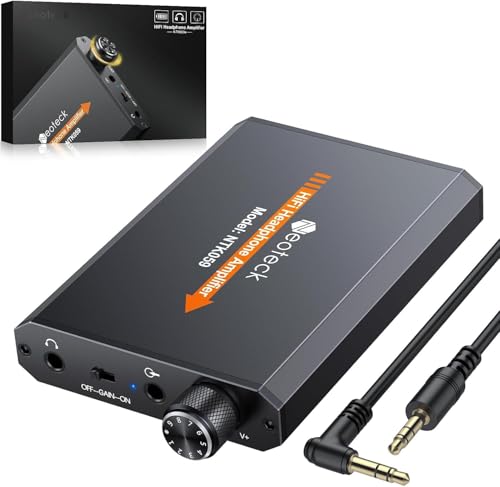
The Neoteck is an entry-level portable analog headphone amplifier with 3.5mm input and output and a stated impedance window of 16 to 300 Ohm. It targets listeners pairing modest IEMs or mid-tier over-ears with phones, laptops, or portable CD players whose built-in outputs lack clean voltage swing.
The defining feature is the two-stage gain switch combined with the wide impedance range. Owner reports suggest low gain suits sensitive IEMs without hiss, while high gain ads usable headroom for150 to 300 Ohm dynamics. Amps in this tier typically cannot fully drive planar magnetics, so expect volume rather than dynamic slam gains.
Trade-offs are typical at this price. There is no USB or optical input, so the amp cannot bypass a noisy phone DAC, only boost it. Manufacturer specs of SNR above 120dB and THD+N of 0.0003% appear optimistic and are not independently measured. Battery life at 12 hours and102g weight are believable given the 1500mAh cell.
Buy this if you need a cheap analog boost for 3.5mm sources feding 32 to 250 Ohm headphones on the move. Skip this if you want a true USB DAC, balanced output, or measured performance for critical listening on planars.
Signal path: Analog only, 3.5mm single-ended input to 3.5mm single-ended output. No USB DAC, no balanced 4.4mm, no Bluetooth. The amp bosts whatever the source sends, so pairing it with a clean line-out or a decent phone DAC maters more than at higher tiers.
Gain and load: Two-stage gain switch across a 16-300 Ohm range. Low gain covers sensitive IEMs down to 16 Ohm without obvious hiss based on owner reports, while high gain targets 150-300 Ohm dynamics. Planar magnetics near300 Ohm equivalent load may still fall short of reference volume.
Measured claims: Manufacturer lists SNR above 120dB and THD+N of 0.0003%. These figures sit above typical budget-amp measurements and are unverified by third-party labs, so treat them as marketing rather than confirmed performance.
Power and portability: 1500mAh internal battery rated at 12 hours playback, charged via included Type-C cable. Aluminum mate chassis weighs 102g, close to smartphone footprint, suitable for pocket stacking with a phone or DAP.
Who this guide is for
This roundup is for anyone whose audio feels flat, quiet, or hissy through onboard sound. That covers desktop listeners chasing cleaner stereo, gamers who want louder and clearer positional cues, and people running high-impedance studio headphones that a phone or laptop simply can’t drive. If you own 250-ohm or 600-ohm cans, you’re the exact person an external amp was built for.

It’s not really aimed at folks using wireless earbuds or cheap plastic headsets that already sound as good as they ever will. A $200 desktop unit won’t rescue a $15 pair. But if your headphones are decent and your source is holding them back, the right box below closes that gap for less than you’d guess.

What to look for in a DAC and amp
Start with power. An amp’s usefulness lives in how much current it pushes into a given impedance. The Fosi Audio K7 lists 2100mW of output, which is plenty for demanding headphones, while the portable YGiTK stick claims a 16 to 600-ohm range so it can drive both easy IEMs and stubborn studio cans. Match the amp to your hardest-to-drive headphones, not your easiest.
Then look at inputs and outputs. A pure desktop DAC like the Fosi Audio Q4 takes USB, optical, and coaxial and sends audio out over 3.5mm and RCA, which suits a speaker-plus-headphone setup. The K7 adds Bluetooth aptX HD, a mic input, and a 4.4mm balanced output on top. Decide which sources you actually feed it, PC, PS5, phone, before you pay for jacks you’ll never touch. Sample-rate support matters too: the K7 handles PCM up to 384kHz/32bit, which is overkill for streaming but nice headroom to have.
How we evaluated
We researched these five units by cross-referencing their listed specs, price positioning, and aggregated owner ratings rather than claiming any bench sessions of our own. Each pick had to solve a real use case at its price, a desktop hub, a stereo converter, a gaming box, or a grab-and-go amp, without overlapping the others. We weighted output power, connectivity, and build against the sticker cost.
Ratings ranged from the Fosi Q4 at 4.1 stars up to the Neoteck portable at 4.8. Formal review counts weren’t published for these listings, so we leaned on the star averages and the spec sheets instead of pretending to know exact tallies. Where a product’s weakness showed up in owner feedback patterns, we said so plainly. Value carried the most weight, since a $25 amp that nails one job can beat a $200 one you’ll never fully use.
Our top picks
Best Overall: Fosi Audio K7 Desktop DAC and Amp
At $199.99 the Fosi Audio K7 is the most complete box here, and it’s the one we’d point most desktop users toward if the budget stretches. It carries a 4.4 rating and does nearly everything: USB-C, Bluetooth aptX HD, optical, and coaxial inputs feed it, while 4.4mm balanced, 3.5mm, and RCA outputs let it drive headphones and powered speakers at once. The 2100mW output figure is the headline. That’s enough muscle for planar or high-impedance headphones that leave weaker amps gasping. There’s a mic input too, which makes it a genuine option for gaming on a PC, PS5, or Switch without a separate interface.
The tradeoff is that you’re paying for breadth. If you only ever plug in one easy-to-drive headphone over USB, most of the K7’s jacks and its aptX HD Bluetooth will sit unused, and a $60 unit would sound close for your setup. It’s also a desk-bound device, not something you’ll carry. But for a listener who wants one hub to handle a PC, a console, and a Bluetooth phone with real power on tap, the K7 is the pick that won’t need replacing next year.
Best for Stereo Setups: Fosi Audio Q4 DAC and Amp
The Fosi Audio Q4 runs $59.49 and holds a 4.1 rating, and it’s built for people who want a clean desktop converter feeding both headphones and speakers. It takes PC-USB, optical, and coaxial inputs, then splits out to a 3.5mm headphone jack and RCA outputs for a home stereo amplifier or powered monitors. That RCA pair is the reason to pick it: run your desk speakers off one output and your headphones off the other, and switch between them without unplugging anything.
It’s the plainest unit in this group, and that’s the point. No Bluetooth, no balanced output, no mic input, so if you need those, look higher up the list. The 4.1 average is the lowest here, and owner patterns suggest it’s a converter first and a powerhouse amp second, so extremely hard-to-drive headphones aren’t its strength. For a tidy PC audio hub that improves stereo output and won’t clutter your desk, though, it’s a smart, affordable choice.
Best for Gaming: Fosi Audio K5 Pro DAC and Amp
The Fosi Audio K5 Pro sits at $69.99 with a strong 4.5 rating, the best average among the three desktop Fosi units. It’s marketed straight at gamers, with USB Type-C, optical, and coaxial inputs and RCA plus 3.5mm AUX outputs, ready for a PS5, PC, or Mac. The compact mini Hi-Fi build tucks beside a monitor easily, and that dedicated volume knob is faster to reach mid-game than fumbling through a software mixer. For console players especially, the optical input is the clean way in.
Where it gives ground to the K7 is raw connectivity and power. There’s no Bluetooth, no 4.4mm balanced output, and no published high-wattage figure, so a set of power-hungry 300-ohm headphones may push it harder than it likes. It’s a stereo converter and headphone amp tuned for clarity and simplicity, not a flagship. But at $70, for a gamer who wants better positional audio and a real volume dial on the desk, it’s the value pick of the bunch.
Best for High-Impedance Headphones: YGiTK Portable HiFi Amp
If your problem is a pair of demanding cans and no desk space, the YGiTK portable amp at $25.26 is a clever answer. It rates 4.3 stars and claims a 16 to 600-ohm range, which is the widest here, so it’ll drive both sensitive IEMs and high-impedance studio headphones that phones give up on. The aluminum body feels sturdier than the price implies, and it’s USB-C rechargeable, with a 3.5mm AUX in and out plus a physical volume knob. There’s a bass boost control too, handy for headphones that run lean on the low end.
Keep expectations realistic. This is an analog headphone amp, not a DAC, so it doesn’t convert digital audio itself; it boosts whatever your source already outputs over 3.5mm. Pair it with a phone or a laptop’s own converter and it adds power, not a new digital front end. For under $26, that’s a fair trade. As a pocketable way to finally get loud, clean volume out of stubborn high-impedance headphones, it punches well above its cost.
Best Budget: Neoteck Portable Headphone Amp
The Neoteck portable amp costs $29.99 and carries the highest rating in this guide at 4.8 stars, which says a lot about how well it does its one job. It’s a rechargeable 3.5mm headphone amp covering a 16 to 300-ohm range, with a volume control and a two-stage gain switch that lets you match the output to easy or harder-to-drive headphones. Flip to low gain for IEMs, high gain for full-size cans. It’s non-Bluetooth by design, aimed at PC, CD players, and older MP3 and MP4 sources.
Its 300-ohm ceiling is lower than the YGiTK’s 600-ohm reach, so the very hardest studio headphones aren’t the target. And like the YGiTK, it’s a pure amp, not a DAC, so it won’t clean up a noisy digital signal on its own. But that 4.8 average reflects a device that’s simple, portable, and does exactly what the label promises. For someone who just wants more clean volume on the go without spending real money, it’s the easiest recommendation here.
Buying mistakes to avoid
The most common misstep is buying an amp for headphones that don’t need one. A $199 K7 won’t make cheap earbuds sing, and it won’t add detail that isn’t in the recording. Match the spend to the headphones you own, not the ones you wish you had. The second mistake is confusing a pure amp with a full DAC. The YGiTK and Neoteck are amplifiers only, so they boost an existing analog signal; they don’t replace your source’s converter the way the Fosi desktop units do.
People also overpay for connectivity they’ll never use. If you only listen over USB from one PC, the K7’s Bluetooth, optical, coaxial, and balanced jacks are dead weight, and the $59.49 Q4 covers you fine. Finally, don’t ignore impedance. That 4.8-star Neoteck tops out at 300 ohms, so a set of 600-ohm headphones belongs with the wider-range YGiTK instead. Read the spec, then buy.
Bottom line
For most desktop listeners with real budget, the $199.99 Fosi Audio K7 is the one to get. Its 2100mW output, balanced 4.4mm jack, Bluetooth aptX HD, and mic input make it a hub that handles a PC, a console, and a phone without compromise, and its 4.4 rating backs that up. It’s more box than a casual user needs, but it’s the pick you won’t outgrow.
On a tighter budget, the decision splits by need. Want a desktop converter for headphones and speakers? The $59.49 Q4 or the sharper 4.5-rated K5 Pro at $69.99 both make sense, with the K5 Pro edging ahead for gamers. Need portable power for demanding cans? The $25.26 YGiTK reaches 600 ohms, while the 4.8-star $29.99 Neoteck is the cheapest clean way to get louder anywhere. Buy for the headphones you actually own.
Common questions
Do I need both a DAC and an amp, or just one?
It depends on your source and headphones. If your PC’s onboard audio sounds noisy or thin, a combined DAC and amp like the Fosi Q4 or K7 cleans up the signal and adds power in one step. If your source already converts cleanly and you only lack volume, a pure amp like the Neoteck or YGiTK is enough. Most desktop users benefit from a combined unit.
Will a DAC and amp help low-impedance headphones?
Sometimes, but the gains are smaller. Sensitive, low-impedance headphones and IEMs are easy to drive, so they don’t need much current, and a phone can often handle them. The bigger improvement is usually noise reduction and a cleaner background rather than raw volume. If you’re running easy cans, a modest unit like the Q4 is plenty; save the K7’s power for harder loads.
What’s the difference between the portable amps and the desktop Fosi units?
The YGiTK and Neoteck are analog amplifiers only. They take a 3.5mm signal and make it louder, but they don’t convert digital audio. The Fosi Q4, K5 Pro, and K7 are true DAC and amp combos that accept USB, optical, or coaxial digital input and do the conversion themselves. Portables win on size and price; the desktop Fosi units win on sound source flexibility and power.
Can these work with a PS5 or gaming console?
Yes, the desktop Fosi units are built for it. The K5 Pro is marketed for PS5, PC, and Mac with optical and USB-C inputs, and the K7 adds a mic input plus support for gaming across PC, PS5, and Switch. Optical is the usual clean route from a console. The portable YGiTK and Neoteck amps are better matched to phones and PCs over 3.5mm rather than consoles.
Is a higher sample rate like 384kHz actually worth it?
For most listeners, no. The Fosi K7’s PCM 384kHz/32bit support is far beyond what streaming services and games deliver, so you won’t hear a night-and-day difference in daily use. It’s headroom for high-resolution files, not a requirement. Focus on matching output power to your headphones’ impedance first; that’s where you’ll actually notice the upgrade, not in chasing the biggest sample-rate number.























Write Your Review
No reviews yet. Be the first to share your experience!