

Does PSU efficiency matter for gaming? Yes, but not in the way a lot of build advice makes it sound. A more efficient power supply will not magically add FPS, reduce input lag, or turn a midrange GPU into a flagship card. What it can do is waste less power as heat, reduce how hard the PSU fan has to work, and make a quiet gaming PC easier to live with over long sessions. If you’re comparing power supplies for a new build, our modular PSU gaming PC guide and 1000W PSU for high-end GPU guide are better places to compare actual capacity and connector needs.
The important bit: efficiency is a support feature, not a performance feature. It matters most after you’ve already chosen enough wattage, the right PCIe power support, a safe form factor, and decent build quality. Small detail. Big knock-on effect.
The short answer
PSU efficiency matters for gaming because it affects wasted heat, fan noise, and electricity use. It does not directly affect frame rate if the unit already supplies stable power and enough wattage for the CPU, GPU, drives, fans, and USB load.

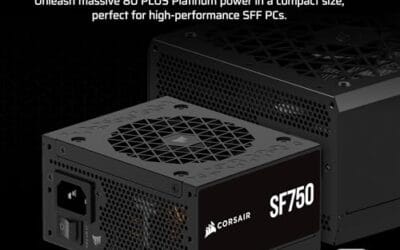
A good example from the prompt data is the Corsair SF750 2024. It costs $159.99, carries a 4.1 rating, and the title lists a fully modular SFX design, low-noise operation, 80 Plus Platinum efficiency, ATX 3.1 compliance, PCIe 5.1 readiness, and an included bracket. That’s a compact, high-efficiency unit for small-form-factor builds, not a universal answer for every gaming tower.


Pros
- ATX 3.1 compliant with PCIe 5.1 support, resists transient spikes from RTX 50 and RX 9000 series GPUs.
- Zero RPM Mode eliminates fan noise at low and medium loads, a real advantage in acoustically sensitive SFF builds.
- Fully modular design with short SFX cables reduces cable management friction in sub-10-liter cases.
- 105 degree C Japanese capacitors indicate quality component selection typical of high-tier SFX units.
Cons
- Limited owner feedback at time of writing; real-world noise, ripple, and transient performance are unverified by community data.
- Short SFX cables are unsuitable for mid-tower or full-tower cases without aftermarket cable extensions.
- 750W ceiling may fall short for extreme SFF builds pairing a 300W-plus TGP GPU with a high-core-count CPU.
The Corsair SF750 (2024) is a high-end SFX PSU targeting SFF builders who need substantial wattage in a compact footprint. With 80 Plus Platinum certification and ATX 3.1 compliance, it sits at the upper tier of the SFX market, aimed at builders pairing it with current-gen discrete GPUs inside sub-10-liter cases.
The most defining specification here is ATX 3.1 compliance combined with PCIe 5.1 readiness. This means the unit is rated to handle the sharp transient power spikes that RTX 50 and RX 9000 series GPUs can produce, where non-compliant PSUs may trigger overcurrent protection. At 750W, it covers most single-GPU SFF configurations without derating concerns.
The honest trade-off is the review data gap. At time of writing, no substantial owner feedback exists to validate Corsair's noise and ripple claims under real load. The Zero RPM Mode claim and 92mm fan acoustics are based on spec sheets only. Buyers should also note that SFX cable lengths are intentionally short and will not reach connectors in mid-tower or larger cases without extensions.
Buy this if you are building an SFF PC around a single high-TGP GPU and need confirmed ATX 3.1 compliance in a modular SFX unit. Skip this if you want a large ATX case build, need more than 750W for a dual-component high-wattage system, or require extensive owner testing before purchasing.
Form Factor and Mounting: This is a standard SFX form factor PSU, not SFX-L. Verify your case specifies SFX compatibility before purchasing. An SFX-to-ATX bracket is included, allowing installation in ATX-footprint cases, though short cable lengths will require extensions in anything larger than a compact SFF enclosure.
Power Standard and Connector: ATX 3.1 compliant with PCIe 5.1 readiness. The unit supports the 12V-2x6 connector standard, relevant for RTX 40 and RTX 50 series GPUs as well as AMD RX 7000 and RX 9000 cards with high transient draw. Non-ATX 3.1 units can trigger OCP shutdowns above 150 percent peak load spikes.
Efficiency and Thermal Operation: 80 Plus Platinum certification indicates roughly 92 percent efficiency at 50 percent load under 115V. The 92mm PWM fan uses a fluid dynamic bearing and Zero RPM Mode activates at low loads, which in SFF cases where airflow is restricted can noticeably reduce system acoustic output.
GPU Wattage Pairing: At 750W, this PSU pairs appropriately with GPUs up to approximately 300W TGP when combined with a mid-range CPU. For a 320W-plus TGP GPU alongside a 65W-plus CPU, headroom becomes tight and a higher-wattage SFX unit should be considered instead.
The longer explanation
A power supply pulls AC power from the wall and converts it into DC power your PC can use. No conversion is perfect. The difference between wall draw and delivered DC output becomes waste heat inside the PSU. A higher efficiency rating means less of that wall power is lost during conversion at a given load level.
For gaming, that usually shows up as comfort rather than speed. If your PC pulls 500 watts under a GPU-heavy game load, a more efficient PSU may dump less heat into its own housing and may need less fan speed to stay comfortable. You’ll notice that more in a quiet room, a compact case, or a build that already runs warm. You probably won’t notice it as a benchmark number.
History / how we got here
Years ago, many PC buyers focused almost entirely on wattage labels. A 750W unit sounded better than a 550W unit, and a 1000W unit sounded safer than both. That thinking wasn’t useless, but it ignored how much power was wasted, how connectors were built, and whether the unit matched the system’s real load.
Efficiency labels became a shorthand for that missing context. 80 Plus Bronze, Gold, Platinum, and similar markings gave shoppers an easier way to compare conversion losses. Modern gaming systems added another layer: ATX 3.1, PCIe 5.1, high transient GPU loads, and semi-passive fan modes. So now efficiency is one part of a broader PSU decision. Not the whole story.
Why it works this way
The PSU’s job is not to make the GPU faster. Its job is to provide usable power within the limits of its design. If the wattage, cables, and protections are adequate, the GPU decides gaming performance based on its silicon, memory, cooling, drivers, and game workload. Efficiency sits beside that, shaping heat and noise.
That is why an efficient 750W unit can be a smarter gaming choice than a cheaper 1000W unit in one build, while a Gold-rated 1000W unit can be smarter in another. The right answer depends on system draw, case size, upgrade plans, and connector support. Don’t buy the badge alone. Match the unit to the load.
When you’d want this
You’d care most about PSU efficiency if you play long sessions, keep your PC in a warm room, want a quieter fan curve, or are building in a small case where every heat source matters. Efficiency also matters if your system idles for many hours, because wasted power adds up slowly over months.
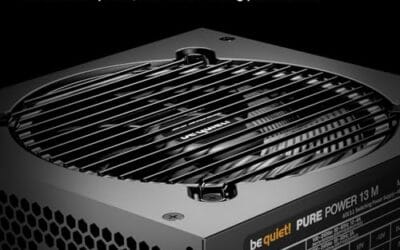
The be quiet! Pure Power 13 M 1000W is the prompt’s higher-capacity example. It costs $139.90, has a 4.8 rating, and its title lists 80 Plus Gold certification, ATX 3.1 support, PCIe 5.1 GPU support, a semi-passive 120mm be quiet! fan, LLC technology, and a single-rail design for overclocked GPUs. That’s relevant for power-hungry gaming PCs, but it may be more PSU than a modest build needs.

Pros
- Native 12V-2x6 connector on ATX 3.1 platform ready for RTX 40 and PCIe 5.1 GPUs.
- Handles power excursions up to 2000W transient, headroom for RTX 4080 and 4090 class spikes.
- Semi-passive zero-RPM mode below moderate load keps idle acoustics near inaudible.
- LLC topology with single 12V rail delivers stable voltage regulation for overclocked GPUs.
Cons
- Limited independent owner feedback available at time of writing, riple and hold-up data unverified.
- Only four PCIe 6+2-pin connectors, tight for legacy multi-GPU or high-CPU-EPS custom lop builds.
- 80 PLUS Gold trails Platinum and Titanium units at similar wattage on sustained efficiency.
The be quiet! Pure Power 13 M 1000W is a high-end ATX 3.1 PSU aimed at builders pairing a Ryzen 7000/9000 or Core Ultra CPU with an RTX 4070Ti Super,4080 Super, 4090, or RX 7900 XTX class GPU. It targets buyers who want native 12V-2x6 wiring and transient headroom without stepping up to Platinum-tier pricing.
The defining trait is ATX 3.1 compliance with power excursion handling up to double the rated 1000W, meaning brief 2000W spikes from modern GPUs should not trip OCP. Combined with the single 12V rail and LLC topology, this suits overclocked GPUs where transient behavior, not average draw, tends to triger shutdowns on older units.
Trade-offs are typical at this tier. 80 PLUS Gold is eficient but not Platinum, soustained heavy loads generate more heat than a higher-rated unit. Four PCIe 6+2-pin connectors is standard, though builders running EATX boards with dual EPS plus a 4x8-pin GPU adapter should verify cable counts against the modular panel before buying.
Buy this if you are building a single-GPU gaming or content rig around a 250-450W TGP card and want native 12V-2x6 without paying Platinum prices. Skip this if you need sub-audible acoustics under sustained full load, or if you already own a workingATX 3.0 unit with a 12VHPWR pigtail.
ATX standard: Full ATX 3.1 compliance with native 12V-2x6 connector integration, which corects the sense-pin issue found on early 12VHPWR cables. Supports PCIe 5.1 GPUs at spec, and handles transient power excursions up to 2000W, roughly double the 1000W continuous rating.
GPU pairing: Comfortable for GPUs in the 250W to 450W TGP range, including RTX 4080 Super (320W) and RTX 4090 (450W) with headroom for overclocking. Four PCIe 6+2-pin outputs cover legacy 8-pin GPUs; the native 12V-2x6 removes the need for a 4x8-pin adapter dongle.
Efficiency and cooling: 80 PLUS Gold rated up to 94.4% at optimal load, typically around 50% utilization. The 120mm be quiet! fan runs semi-passive with zero-RPM below a load threshold not specified by the manufacturer, so idle and light workloads should remain silent.
Cabling: Fully modular design, leting builders omit unused SATA and Molex leads. Exact cable lengths and connector counts beyond the four PCIe 6+2-pin and single 12V-2x6 are not specified in source material, verify against your case routing before purchase.
What to look for in a PSU efficiency choice
Start with capacity and compatibility, then weigh efficiency. A gaming build with a demanding GPU should have enough wattage headroom, the correct native GPU connector support, and cables that fit your case cleanly. An 80 Plus Gold or Platinum label is useful, but it can’t fix a wrong form factor or missing cable support.
Form factor matters too. The Corsair SF750 is SFX, so it’s aimed at compact builds where PSU length and cable management can be tight. The be quiet! Pure Power 13 M is a 1000W ATX-style choice from the prompt facts, aimed more naturally at larger systems and power-hungry GPUs. One is not automatically better. They’re solving different build problems.
Common misconceptions
The biggest misconception is that a higher efficiency rating means higher FPS. It doesn’t. If your current PSU is stable, has enough capacity, and uses the right connectors, moving from Gold to Platinum usually changes heat, noise, and wall draw more than game performance.
Another misconception is that Platinum always beats Gold in value. The Corsair unit’s 80 Plus Platinum rating is attractive in an SFX gaming build, especially with ATX 3.1 and PCIe 5.1 readiness listed in the title. The be quiet! unit’s 80 Plus Gold label pairs with 1000W capacity and PCIe 5.1 GPU support. Different priorities. Different builds.
Efficiency also matters because wasted power turns into heat. A hotter PSU can spin its fan harder, and that extra noise matters in a gaming PC that already has case, CPU, and GPU fans working under load. The difference between decent Bronze and good Gold is not magic, but over a long evening it can mean a cooler-running power supply and a quieter desk. It also leaves less heat trapped near the shroud or lower intake area.
Do not confuse efficiency with capacity, though. An efficient 500W unit is still the wrong buy for a build that needs more headroom, and a huge low-quality unit is not automatically safer. Start with the GPU and CPU power draw, add room for drives and fan pumps, then choose a reputable unit with the connectors your card actually needs. After that, efficiency is the refinement layer.
For most current gaming builds, an 80 Plus Gold unit from a known platform is the safe middle. It keeps power waste modest, avoids the cheapest fan curves, and usually comes with better warranty support. Platinum and Titanium can make sense for always-on workstations, but gamers rarely earn back the premium through the power bill alone.
A useful way to think about the bill is by load, not label. If a gaming PC draws around 500 watts from its components during a heavy session, the wall draw will be higher because conversion is not perfect. Better efficiency narrows that gap. The savings may be small per night, but the lower heat is immediate.
Efficiency can also influence where the PSU fan curve lands. Some units stay semi-passive at lighter loads, then ramp once internal temperature rises. If your build uses a quiet CPU cooler and a tuned GPU fan curve, a loud PSU can become the noise you notice most. You don’t want that surprise after the rest of the build is dialed in.
If two units cost almost the same, choose the more efficient model from the stronger platform. If the efficient unit forces you below the wattage or connector headroom your GPU needs, step up capacity first. Efficiency is a bonus after the safety basics are covered.
Frequently asked
Will a more efficient PSU improve gaming FPS?
No, not by itself. FPS comes from the CPU, GPU, memory, storage behavior, game engine, and cooling limits. A more efficient PSU can reduce waste heat and fan noise, but it won’t create extra GPU horsepower.
Is 80 Plus Gold enough for a gaming PC?
For many gaming PCs, yes. Gold efficiency is a solid target if the unit also has enough wattage, the right connectors, and a reputable design. The be quiet! Pure Power 13 M example pairs Gold certification with 1000W capacity and PCIe 5.1 GPU support.
Is Platinum worth paying more for?
It can be worth it in compact, quiet, or high-use builds. The Corsair SF750 2024 is a useful example because its prompt facts combine SFX size, fully modular cabling, low-noise branding, and 80 Plus Platinum efficiency. If those needs don’t apply, Gold may be enough.
Should I buy more wattage or more efficiency?
Buy enough wattage first. Then compare efficiency inside the wattage and connector range your build needs. A highly efficient unit that lacks the right GPU support isn’t the right pick.
Does efficiency matter for small-form-factor gaming PCs?
Yes, it tends to matter more there. Less waste heat can help a compact case stay calmer, and fully modular cabling can reduce clutter. That’s why an SFX unit like the Corsair SF750 is a more natural match for small cases than for every full tower.



























Write Your Review
No reviews yet. Be the first to share your experience!