
A wireless charger is a flat pad (or stand) that refills your phone‘s battery without a cable plugged into the phone itself. Set the phone on the pad. Hear a chime. Walk away. Behind the plastic surface is a copper coil that creates a small magnetic field, and your phone has a matching coil that catches that field and converts it back into current. That’s the entire trick.
The short answer
Wireless chargers transfer power between two coils using electromagnetic induction. Qi (pronounced “chee”) is the dominant open standard, supported by virtually every modern phone. MagSafe is Apple’s magnetic flavor of Qi, locking the phone in place and pushing higher wattage. Multi-device pads charge phone, watch, and earbuds at once. They’re slower than cable charging but much more convenient for desk and bedside use.
The longer explanation
Two coils, no contact. The charger sends alternating current through its transmitter coil, which creates an oscillating magnetic field. Your phone’s receiver coil sits inside the back glass and picks up that field, generating its own current that the phone’s battery management chip then uses to charge the cell. Efficiency runs about 75-85%, meaning some energy gets lost as heat. That’s why wireless chargers warm up under load.
Qi caps out at 15W for most consumer pads, though some newer standards push 30W or higher under specific conditions. Apple’s MagSafe maxes out at 15W on iPhones (25W on the iPhone 16 with the latest MagSafe puck). Samsung’s fast wireless charging runs at 15W too. The headline wattage’s misleading though. Heat throttling kicks in quickly, so sustained charging usually delivers less than the peak number.
MagSafe adds magnets ringing the coil. The magnets snap the phone into perfect alignment with the charger, which matters because misalignment kills efficiency. Even a few millimeters off-center can drop charging from 10W to 3W. Magnetic alignment guarantees the coils line up, every time.

Pros
- Two pads and two 3ft USB-A to Type-C cables cover desk and travel simultaneously
- Magnet ring aligns on iPhone 12 through 17 coils and AirPods Pro wireless case
- Chip covers overcharge, overcurrent, overvoltage, overheat, and short circuit protection
Cons
- Zero owner feedback at time of writing, real-world reliability and15W claims unverified
- Requires a separate 15W or 20W PD adapter to hit rated speed, no brick included
- Non-MagSafe or thick cases weaken magnetic hold and may misalign the coil
TNDAJI 15W Magnetic Wireless Charging Pad is a budget two-pack MagSafe compatible puck aimed at iPhone 12 through 17 owners and AirPods Pro users who want a spare charger for the office or nightstand without buying two Apple originals. USB-C input, 3ft cable, single coil per puck.
Standout feature is the magnetic alignment array paired with 15W rated output, which per the manufacturer delivers 50% in 30 minutes and a full charge in 2.5 hours on iPhone 15 series. Independent verification is not available, and Apple only certifies its own MagSafe pucks for the full 15W path on iPhone.
Honest trade-off: true 15W to iPhone typically requires MFi MagSafe certification, and third party Qi2 or unbranded pucks often top out closer to 7.5W on newer iPhones. A 15W or 20W PD adapter is mandatory and not included. Thick or non-MagSafe cases will weaken the hold noticeably.
Buy this if you need spare redundant nightstand and desk chargers for iPhone 12 through 17 and can supply your own PD brick. Skip if you require verified 15W speds to a bare iPhone 16 Pro, in which case a certified MagSafe or Qi2 puck is a safer pick.
Output and Input: Rated at up to 15W wireless output per pad with a 3ft USB-A to Type-C cable included. Manufacturer requires a 15W or 20W PD adapter to hit rated speeds. Below 10W input the coil throttles noticeably per the product listing.
Compatibility: Magnet ring supports iPhone 12, 13, 14, 15, 16, and 17 series including Mini, Plus, Pro, and Pro Max variants. AirPods Pro, AirPods 3, and AirPods 4 wireless charging cases align on the same puck. Non-MagSafe cases weaken adsorption per the listing.
Safety and Cooling: Onboard chip monitors overcharge, overcurrent, overvoltage, overheat, and short circuit conditions and cuts output on fault. Honeycomb vents on the rear shell aid passive heat dissipation. Foreign object detection triggers a rapid blue-green LED flash to signal blocked coils.
In the Box: Package ships with two magnetic charging pads and two 3ft USB-A to Type-C cables, no wall adapter. Users must supply a compliant 9V/2A or certified PD brick to reach 15W. Placement guidance calls for hard, flat, non-flammable surfaces only.
Why it works this way
Induction’s an old principle (Michael Faraday figured it out in 1831), but applying it to consumer electronics needed a lot of refinement. Early wireless chargers were inefficient, slow, and finicky about phone position. The Qi spec standardized communication between charger and phone so the two could negotiate power levels safely. Without that handshake, the charger wouldn’t know when to ramp up or back off, and you’d risk overheating the battery.
The reason charging caps where it does comes down to heat. Phone batteries hate heat. Pushing 30W or 40W into a tiny lithium cell through an inefficient coil generates enough warmth to shorten battery life over time. The industry settled around 10-15W as the workable balance between speed and longevity.
When you would want this
Bedside charging’s the classic use case. Plopping the phone on a pad before sleep is easier than fishing for a cable in the dark. Same for desk use. You can drop your phone on a pad between meetings, pick it up, drop it back. No cable wear, no fumbling.
Car chargers benefit too. A magnetic vent mount with built-in wireless charging holds the phone for navigation while topping up the battery. Beats plugging in a Lightning or USB-C cable every drive.
Pros
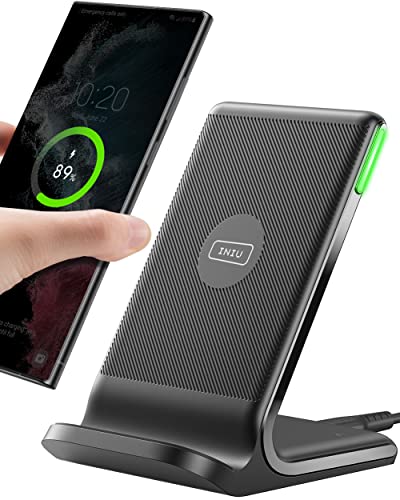
- Dual coil design keps power flowing in portrait or landscape for FaceTime and video
- Adaptive brightness LED avoids the bright indicator glow common on nightstand chargers
- NTC thermal monitoring on the coil helps protect phone battery under sustained charging
Cons
- Limited owner feedback at time of writing makes long term reliability hard to verify
- Peak 15W applies to LG phones only, iPhones cap at 7.5W and Samsung at 10W
- USB C wall adapter is not included, buyer must supply a QC compatible brick
The INIU wireless charging station is a budget Qi stand aimed at users who want a nightstand or desk dock for iPhone, Samsung Galaxy, and Google Pixel handsets. It advertises a 15W peak output through AirFuel branded circuitry and uses a dual coil layout for portrait or landscape placement.
The defining feature is the self adaptive LED indicator, which brightens in daylight and dims at night so the status light does not glare in a dark bedroom. Wireless stands in this tier typically hover around 5W to 10W real world output on iPhone and Samsung, and INIU confirms 7.5W for iPhone and 10W for Galaxy rather than a universal 15W figure.
Trade offs are typical of entry level Qi hardware. No wall adapter is included, so buyers need a USB C QC or PD brick capable of sustaining the rated wattage. Coil alignment on stand form factors can be finicky with thicker cases, and the source data does not specify magnetic alignment or MagSafe support, so treat it as standard Qi.
Buy this if you need a low cost dual orientation Qi stand for a nightstand and already own a USB C fast charge adapter. Skip this if you want full 15W MagSafe speds on iPhone or a puck style pad for cased phones.
Charging output: Peak 15W is reserved for suported LG handsets. Samsung Galaxy devices negotiate 10W, iPhone 12 through 17 Pro Max cap at 7.5W over Qi, and any other Qi compatible phone falls back to the5W baseline profile.
Coil layout: Dual super conductivity coils are stacked vertically to cover both portrait and landscape phone positions, so FaceTime, facial recognition, and video playback stay powered without repositioning the device on the stand.
Thermal protection: An NTC temperature sensor monitors coil temperature in real time and adjusts delivery to reduce heat buildup on the phone back, which is the main degradation vector for wireless charging on lithium ion cells.
In the box: One charging stand, one USB C input cable, and a welcome guide. A wall adapter is not included, and the source data does not specify cable length, stand dimensions, or weight.
Multi-device pads are great if you’re in the Apple ecosystem. One stand can charge an iPhone, AirPods, and Apple Watch simultaneously, killing the cable tangle entirely. Samsung makes similar trios for Galaxy users.
Common misconceptions
First: wireless charging is bad for your battery. Mostly a myth. Modern batteries handle wireless charging fine, and the slower charge rate is arguably gentler than fast wired charging. The only real concern’s heat, and any decent charger throttles before things get spicy.
Second: any wireless charger works at full speed with any phone. Nope. To hit 15W on an iPhone you need a MagSafe-compatible puck. To hit Samsung’s fast wireless you need an EPP-certified pad and a compatible adapter. Mismatched gear drops you to 5W or 7.5W, which feels slow next to a wired connection.
Third: cases block wireless charging. Most cases don’t, as long as they’re under about 3mm thick and don’t have metal plates. Magnetic mounts and pop sockets do interfere though. If charging’s flaky, that’s the first thing to check.
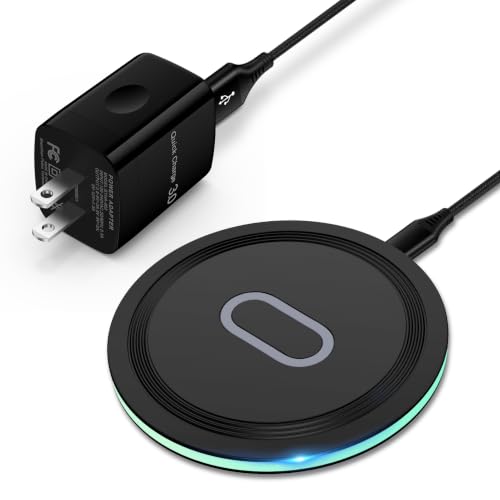
Pros
- Includes the QC 3.0 18W brick, so 15W fast mode works out of the box.
- Bedroom-friendly LED behavior, off after 16 seconds versus always-on indicators on many budget pads.
- Broad Qi compatibility list covering Samsung, Google Pixel, iPhone, AirPods, and Galaxy Buds.
Cons
- Limited owner feedback at time of writing, so long-term coil temperature and reliability are unverified.
- Flat Qi pad only, no MagSafe alignment or magnet ring for iPhone 12 and later.
- 5mm case limit rules out thicker rugged cases, wallet folios, or any metal plate accessory.
The UorMe is an entry-tier Qi wireless charging pad rated at 15W peak for compatible Samsung Galaxy phones, 10W for Galaxy Note 10, 7.5W for iPhone, and 5W for other Qi devices. It targets desk or nightstand users who want a simple, low-cost pad with the wall adapter included in the box.
The standout element is the bundled QC 3.0 18W adapter, since many competing pads at this price omit the brick and cap output near 5W over a generic USB suply. UorMe claims up to 1.8x faster charging versus a standard 5W pad, which tracks with typical Qi 15W profiles on Samsung flagships.
Owner fedback is effectively absent at time of writing, so real-world thermals and coil alignment cannot be verified. It is a flat pad only, so magnetic wallets, PopSockets, cases thicker than 5m, or metal card holders will block charging. There is no fast wireless mode for iPhone MagSafe speeds.
Buy this if you own a recent Samsung Galaxy S21 through S25 and want a plug-and-play 15W pad with the adapter included. Skip this if you rely on MagSafe alignment, need multi-device charging, or want verified owner data on long-term coil temperature and green LED brightness at night.
Power Output: Rated at 15W peak for Samsung Galaxy S22 through S25 series and the S21 line, 10W for Galaxy Note 10, 7.5W for iPhone 11 through 14 series, and 5W baseline for other Qi phones plus AirPods and Galaxy Buds.
Adapter and Input: Ships with a QC 3.0 18W wall plug, which is required to hit the 15W and 10W tiers since standard 5V USB sources cap Qi output near 5W on most pads at this coil class.
Case Compatibility: Rated for plastic or silicone cases up to 5mm thick. Magnetic mounts, ring holders, metal plates, and RFID cards will block the coil and prevent charging. Non-slip silicone on the top surface and base reduces phone slide during vibration.
Safety and Indicator: Protection covers overcharge, overcurrent, overvoltage, overheating, and short circuit per manufacturer. A green LED flashes for 3 seconds on power connection then turns off after 16 seconds in charge mode, avoiding a lit bedside overnight.
Frequently asked
Is wireless charging slower than wired?
Yes, by a meaningful margin. A 15W wireless charger gets you maybe 50% in an hour. A 25W wired charger can hit 75% in the same time. For overnight or all-day desk use the speed gap doesn’t matter, but for quick top-ups, cable’s still faster.
Can I charge my phone through a thick case?
Up to about 3mm thickness usually works. Beyond that, the magnetic field weakens too much and charging drops out or runs slowly. Metal cases or built-in card holders typically block it entirely.
Will a wireless charger work outside the home?
If you’ve got USB-C power, yes. Many pads come with detachable cables, and some run from a portable battery bank. Some coffee shops embed Qi chargers in tables too, though they’re slower than what you’d use at home.
Can I charge two phones on one pad?
Only on pads built for it. They use multiple coils side by side. A single-coil pad can only charge one device at a time even if it’s physically large enough to hold two.