
A powered USB hub is a USB splitter with its own wall power adapter. That extra power matters when you’re hanging multiple power-hungry devices off one port: portable SSDs, webcams, capture cards, audio interfaces, RGB controllers, card readers, external hard drives, and the odd phone that wants to charge while it syncs. A regular hub shares one upstream USB connection, but it can’t create more power than the host port provides.
If you’ve already read our guide to what a USB hub is, think of this as the next step: the same basic idea, with a dedicated power brick doing the heavy lifting. It’s also different from a full docking station, which may add monitor outputs, Ethernet, and laptop charging. A powered USB hub is narrower, cheaper, and often exactly what a desktop PC or laptop setup needs.
Related buying guides: USB-C hubs, Thunderbolt hubs, KVM switches, webcams, and audio interfaces.
The short answer
A powered USB hub gives several USB devices a shared data path to your computer while supplying extra electrical power from an external adapter. The computer still manages the USB connection, but the hub’s adapter helps feed devices that need more current than a bus-powered hub can reliably provide. Simple enough.
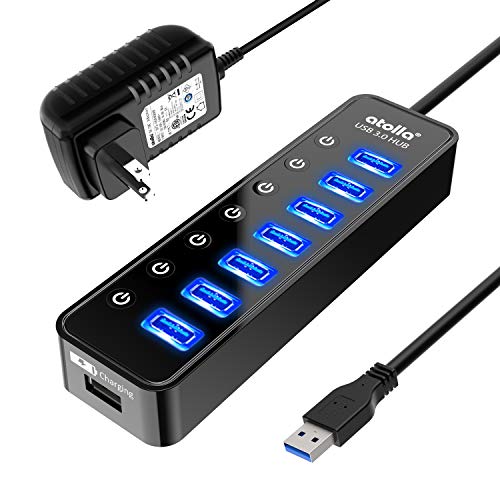
That makes a powered hub useful when devices disconnect, spin down, charge slowly, or refuse to appear unless you unplug something else. For example, the Atolla 7-Port USB 3.0 Powered Hub is listed at $25.99 with a 4.6-star rating across 21,061 reviews, and its title calls out a 5V/4A power adapter, seven data ports, one smart charging port, and individual on/off switches. Those details are exactly why powered hubs are common on busy PC desks.
Pros
- 5Gbps USB 3.0 throughput across all seven data ports for external drives and peripherals.
- Dedicated 2.4A smart charging port keps phone charging separate from data lanes.
- Individual switches allow per-port power control, useful for spin-down of idle HDDs.
- 100cm host cable and 120cm power cord give flexible placement behind monitor arms or desks.
Cons
- Limited owner feedback at time of writing makes long-term reliability hard to verify.
- 20W total budget from the 5V/4A adapter caps simultaneous high-draw drive use.
- USB 3.0 host cable is fixed length and not detachable, limiting future replacement.
The Atolla 7-Port USB 3.0 Hub is a mid-tier powered desktop hub aimed at MacBook, Mac Mini, and laptop users who run out of ports quickly. It pairs seven USB 3.0 data ports with a dedicated smart charging port, individual on/off switches per port, and an external 5V/4A adapter for stable power delivery.
The defining feature is the combination of per-port switches and an external brick. Owners running multiple bus-powered 2.5-inch drives or SD readers benefit from the 20W suply, which reduces the brownout risk common on unpowered hubs. The 5Gbps USB 3.0 spec is adequate for SATA SD enclosures, though NVMe enclosures will bottleneck at roughly 400-450MB/s in practice.
Trade-offs are typical at this tier. There is no USB-C host connection, no per-port amperage spec beyond the charging port, and no indication of overcurrent protection in the source data. The host cable length is fixed at 100cm, which may be short for tower PCs placed on the floor. Aggregate bandwidth is shared across the upstream USB 3.0 link.
Buy this if you need a Mac-friendly desktop hub with physical switches for legacy peripherals, card readers, and occasional phone charging. Skip this if you need USB-C uplink, Power Delivery passthrough, or per-port 10Gbps speeds for modern NVMe enclosures and4K capture devices.
Ports and bandwidth: Seven USB 3.0 Type-A downstream ports rated at 5Gbps each, sharing a single USB 3.0 upstream link to the host. An eighth port is dedicated to smart charging and does not cary data. Hot-swap and plug-and-play are suported without driver installs.
Power delivery: External 5V/4A adapter suplies 20W total across the hub. The smart charging port is rated up to 2.4A for iPhone and iPad. Per-port amperage split for the data ports is not specified, so heavy-draw devices like 3.5-inch drives may need their own power.
Physical dimensions: Hub measures roughly 6.30 x 1.77 x 0.91 inches in a black finish. The USB host cable is 100cm and the DC power cord is 120cm, which suits desktop placement behind a monitor but may fall short for floor-standing towers.
Compatibility: Windows XP through Windows 10, macOS 10.x and above, and Linux distributions are supported. No drivers required. Waranty is stated as 18 months per the listing. Package contents include the hub, 5V/4A adapter, and a quick setup guide.
The longer explanation
USB handles two jobs at once: moving data and delivering power. A mouse barely sips power. A keyboard is usually easy. A flash drive is modest. Start adding external SSDs, hard drives, webcams, lighting controllers, wireless receivers, and headsets, though, and the budget gets tighter fast.
A non-powered hub, often called a bus-powered hub, draws everything from the one USB port it’s plugged into. That single upstream port has to feed the hub electronics and every attached device. If the combined demand goes too high, some devices may not start, may disconnect, or may behave oddly. Not ideal.
A powered hub changes that by plugging into the wall. The data still runs through the upstream USB cable to your PC, but device power can come from the hub’s own adapter. The result isn’t extra bandwidth, and it won’t turn USB 2.0 into USB 3.0. What it gives you is a steadier power source for multiple accessories that would otherwise fight over the limited current from one host port.
This is why powered hubs are popular with desktop PCs tucked under desks, mini PCs with limited ports, laptop workstations, home recording rigs, and sim-racing setups. You get easier cable management, front-of-desk access, and fewer weird disconnects caused by power draw. Not glamorous, but it often fixes the annoying stuff.
History / how we got here
Early USB was built around convenience. Instead of separate serial, parallel, PS/2, and game ports, USB gave PCs one connector family that could handle many peripherals. Keyboards, mice, scanners, printers, and storage could all use the same interface, and hubs made it easy to expand a limited port selection.
At first, many devices were low draw. A keyboard and mouse didn’t ask for much, and flash drives were simple. Then USB storage got faster, external drives became common, webcams improved, and gaming desks filled up with accessories. Laptops also got thinner, sometimes dropping full-size USB-A ports or offering only a few high-speed connectors.
The hub stayed useful, but the power side became more important. A small travel hub is fine for a mouse receiver and thumb drive. A permanent desk hub with several devices attached has a harder job. That’s where powered hubs became the boring but useful answer: keep the USB data connection, add a separate adapter, and stop asking a single laptop port to feed the whole pile.
Why it works this way
Every USB device has to draw power from somewhere. With a bus-powered hub, that source is the host computer’s USB port. With a powered hub, the source can be the hub’s included adapter. That distinction matters because USB ports have limits, and those limits vary by USB generation, device design, cable quality, and port implementation.
Data is a separate limit. A USB 3.0 hub can share a faster upstream connection than an older USB 2.0 hub, but all devices still share that one upstream pipe. If you copy files from two external SSDs at the same time, the hub doesn’t give each drive a private connection to the motherboard. It schedules traffic over the connection it has. You’ll still want direct motherboard ports for the highest-priority storage or capture gear.
Power problems can look like data problems, which is why these hubs are easy to misunderstand. A webcam that drops out during a call might not be a bad webcam. A portable hard drive that clicks, disappears, or reconnects may be short on power. A MIDI controller, audio interface, or capture dongle may behave normally until other devices join the hub. The powered hub gives those devices a better chance to stay stable.
Individual on/off switches, like the ones listed on the Atolla and SABRENT models in this batch, add another convenience layer. You can cut power to a device without yanking its cable. That’s handy for external drives you don’t use all day, LED accessories, controllers, and receivers that you only need during certain sessions.
When you’d want this
You’d want a powered USB hub when the number of attached devices is high, when some of those devices draw meaningful power, or when your PC’s ports are physically inconvenient. A laptop on a stand with one cable running to a hub is cleaner than four dongles dangling from the side. A desktop tower on the floor is easier to live with when the hub sits on the desk.
It’s also a good fit for streamers, podcasters, and anyone with a webcam, microphone, stream deck, capture device, lighting control, and storage attached at once. Gamers can use one for controllers, wireless receivers, racing wheels, button boxes, headsets, and RGB gear, though fast external drives may still deserve a direct port. If you’ve ever unplugged one accessory so another would work, you’re the audience.
For smaller setups, a four-port powered hub can be enough. The SABRENT 4-Port USB 3.0 Hub is listed at $19.99 with a 4.5-star rating across 12,486 reviews, and its title notes individual LED-lit power switches plus an included 5V/2.5A adapter. That’s a sensible size for a compact desk where you don’t need seven or eleven data ports.

Pros
- Per-port LED switches simplify power cycling flaky externals without unplugging the upstream cable
- 5V/2.5A adapter provides headroom for 2.5-inch portable drives and phone charging loads
- Full 5Gbps USB 3.0 spec on all four downstream ports, not a 2.0 fallback
- Hot swappable and driver-free on current Windows, macOS, and Linux builds
Cons
- Limited owner feedback at time of writing, so long-term reliability data is thin
- 12.5W total budget is tight if you attach two spining drives plus charging phones
- Cable length, port spacing, and enclosure material are not specified in source data
The SABRENT HB-UMP3 is an entry-level powered 4-port USB 3.0 hub aimed at desktop users who need to expand a single host port into multiple always-on peripherals. The individual LED-lit switches and bundled 5V/2.5A adapter target users running externals, dongles, or charging cables from one PC or laptop.
The defining feature is per-port switching with LED indicators, which is useful for isolating misbehaving devices, safely cuting bus-powered drives, or killing charge current without unplugging cables. USB 3.0 hubs in this tier typically deliver near-linerate 5Gbps to a single active port, with aggregate throughput shared across the upstream link when multiple devices transfer at once.
Trade-offs at this price are typical. A 2.5A suply gives 12.5W across four ports, which is fine for flash drives, keyboards, and one portable SD, but marginal if you attach two bus-powered 2.5-inch HDDs plus a charging phone. Cable length, chassis material, and controller chipset are not specified, and owner feedback is sparse at time of writing.
Buy this if you want a cheap USB 3.0 expander with real per-port switches for a desktop or dock setup. Skip this if you need USB-C upstream, USB Power Delivery pass-through, or high-wattage charging for tablets and modern laptops.
Ports and speeds: Four downstream USB 3.0 Type-A ports rated up to 5Gbps, with backward compatibility to USB 2.0 at 480Mbps and USB 1.1 at 12Mbps. Upstream connector type is not specified in source data, though USB 3.0 Type-B is typical at this tier.
Power delivery: Bundled 5V/2.5A external adapter supplies a 12.5W total budget across the four ports. That is adequate for keyboards, mice, flash drives, card readers, and a single bus-powered 2.5-inch SSD, but not for high-draw tablets or laptop-class USB Power Delivery.
Switches and indicators: Each port has an independent physical power switch paired with an LED indicator, so you can visually confirm which ports are live and cycle a single device without touching the others or the upstream cable.
Compatibility: Plug and play, hot swappable, driver-free operation on any USB-compliant host. Cable length, dimensions, weight, enclosure material, and controller chipset are not specified in the source listing.
What to look for in a powered USB hub
Start with the port count, but don’t stop there. Count the devices you use every day, then add one or two spare ports so the hub doesn’t feel full immediately. Seven-port models like the Atolla 7-Port are useful for permanent desks, while four-port models like the SABRENT or Atolla 4-Port make more sense for laptops, small workspaces, or travel-friendly setups with an outlet nearby.
Next, check the power adapter rating. The Atolla 7-Port listing specifies a 5V/4A adapter, the Atolla 4-Port listing specifies 5V/3A, and the SABRENT 4-Port listing specifies 5V/2.5A. Higher available current doesn’t mean every device will charge at maximum speed, but it gives the hub more headroom for several attached accessories. If the product page doesn’t clearly show the included adapter, be cautious.
Look at the port type and speed, too. USB 3.0 is a safe baseline for storage devices, webcams, and modern peripherals. If your main need is a mouse, keyboard, printer, or controller, speed matters less. For monitors, laptop charging, Ethernet, or a one-cable workstation, you’re probably shopping for a dock rather than a basic powered hub.
Switches can be more useful than they sound. Per-port buttons let you leave cables plugged in while turning devices off. LED indicators help you see which ports are active at a glance, especially under a monitor or at the back edge of a desk. Cable length also matters; a hub with a tiny upstream cable may be awkward if your tower sits on the floor.
Finally, match the hub to the job. The Wenter 11-Port powered USB hub is listed at $28.49 with a 4.5-star rating across 4,443 reviews, and its title points to ten data ports plus one smart charging port. That’s overkill for a keyboard and mouse, but reasonable for a desk full of low-to-moderate draw peripherals. The Acer 4-port hub in the data is only $9.99 with a 4.7-star rating across 16,370 reviews, but its title emphasizes a Type-C power port rather than an included wall adapter, so read the power details closely before treating it like a full powered hub kit.
Common misconceptions
A powered USB hub doesn’t make every device faster. If the hub and host connection are USB 3.0, you’ll get USB 3.0-class sharing across the hub, but several active devices still divide that upstream bandwidth. For the fastest external storage work, direct ports remain the cleaner choice.
It also doesn’t replace a laptop charger unless the hub is specifically built for USB-C Power Delivery, and most simple USB-A powered hubs aren’t. The wall adapter usually powers the attached devices, not the computer. That’s different from a USB-C dock that can charge a laptop while adding ports.
Another misconception is that every powered hub is safe for every high-draw device. The adapter rating, port design, cable, and device behavior all matter. Some external drives and capture devices are picky. If a device maker recommends a direct motherboard port, follow that guidance.
People also assume more ports are always better. An 11-port hub can be convenient, but it can also become a mess of cables and shared bandwidth if you plug in storage, cameras, and audio gear all at once. Buy enough ports for your setup, not the biggest number on the page.
Frequently asked
Do I need a powered USB hub for a keyboard and mouse?
Usually, no. A keyboard and mouse draw very little power, so a simple bus-powered hub is often fine. A powered hub becomes useful if those devices are part of a larger stack with storage, webcams, audio gear, or controllers. It’s about the total load, not one basic peripheral.
Will a powered USB hub charge my phone faster?
Maybe, but don’t assume it. Some hubs include a smart charging port, and the Atolla 7-Port, Atolla 4-Port, and Wenter 11-Port listings all mention one. Charging speed still depends on the hub design, adapter, cable, and phone. If fast phone charging is the main goal, a dedicated charger is usually cleaner.
Can I plug an external hard drive into a powered USB hub?
Yes, and external drives are one of the better reasons to use one. A powered hub can help a portable hard drive or SSD stay connected when other devices are attached. For critical file transfers, though, use a reliable cable and consider a direct PC port if you’re moving a lot of data.
Is a powered USB hub the same as a docking station?
No. A powered USB hub mainly expands USB ports and supplies power to attached USB devices. A docking station may add monitor outputs, Ethernet, audio, card readers, laptop charging, and more. If you need displays and one-cable laptop charging, you’re shopping beyond a basic powered hub.
Can a powered hub damage my PC?
A properly designed hub from a reputable brand shouldn’t damage your PC in normal use. The hub still connects through USB, and its adapter is meant to feed the downstream ports. Avoid mystery adapters, damaged cables, and off-brand hubs with unclear specs. If something feels hot, smells odd, or causes repeated disconnects, unplug it and replace the hardware.