A docking station is a single accessory that turns your laptop into a desktop in about three seconds. One cable goes from the dock to your laptop, and on the other side you’ve got monitors, keyboard, mouse, Ethernet, maybe a card reader, and power. Walk away with the laptop, walk back, plug in one cable, and everything reconnects. That’s it. That’s the magic.
The short answer
Docking stations are external hubs designed for laptops, typically powered, with multiple video outputs and charging built in. They differ from USB hubs because they push 4K or higher to two or three displays simultaneously, deliver 65W-100W of power back to the laptop, and bundle Ethernet plus SD slots. If you switch between desk and couch (or office and home) several times a week, a dock pays for itself fast.
The longer explanation
Inside a dock is a more capable controller than what you’ll find in a basic hub. Most modern docks use USB-C with DisplayPort Alt Mode, which means the USB-C port carries actual video signals, not just data. Some high-end ones use Thunderbolt 3 or 4 for even more bandwidth, enabling dual 4K at 60Hz or even single 8K. The dock unpacks that signal, splits it across HDMI and DisplayPort outputs, and handles everything else on the side channels.
Power delivery’s a big piece. A USB-C dock with 100W PD can fully power most ultrabooks and even keep gaming laptops topped up during light workloads. The power goes through the same single cable that carries video and data, which is why everything works through one connection. Apple folks call this “one-cable desk” and it’s genuinely useful.
Some docks use a proprietary connector instead. Older ThinkPads had a slot on the bottom. Surface devices use the Surface Connector. These tend to be more reliable for businesses because the connection’s mechanical, not just electrical. The downside? They only work with that one laptop family.

Pros
- Dual HDMI at 4K 60Hz single-display satisfies most productivity and light media workflows.
- 85W PD passthrough covers typical XPS, MacBook Pro 14, and ultrabook charging needs.
- 1 Gbps Ethernet and dual USB-A add wired stability plus peripheral flexibility.
- Compact 0.2 pound footprint travels easily and fits crowded desks or laptop bags.
Cons
- Limited owner feedback at time of writing makes long-term reliability difficult to judge.
- Dual external displays drop to 4K 30Hz, and macOS mirrors instead of extending.
- Not compatible with Linux, and a 100W charger plus USB-C cable are required separately.
The Anker PowerExpand 8-in-1 USB-C PD Media Hub is a mid-range portable docking station targeting laptop users on USB-C, USB4, or Thunderbolt with DP Alt Mode. With dual HDMI, Gigabit Ethernet, 85W passthrough, dual USB-A, and an SD plus microSD reader, it suits XPS, ultrabook, and MacBook owners needing desk-side expansion.
The defining feature is dual HDMI output. On Windows you can run one 4K display at 60Hz or extend two 4K panels at 30Hz, which is workable for documents and browsers but notideal for scrolling-heavy or video editing tasks. Owner-visible behavior on macOS is mirrored-only across both HDMI outputs, a chipset limit typical at this tier.
Trade-offs are real. The hub ships without a charger, so pulling the full 85W to the host requires a 100W wall brick and a compliant USB-C to USB-C cable. Linux is unsupported per Anker, and the 4K 30Hzceiling for true dual-display use will bother anyone driving 60Hz workflows on both panels.
Buy this if you use a Windows orChromeOS laptop with DP Alt Mode, want one cable for power, wired networking, and a single 4K 60Hz monitor. Skip this if you need dual 4K 60Hz output, Linux support, or an integrated power brick in the box.
Display output: Two HDMI ports suporting 4K at 60Hz on a single display or 4K at 30Hz across two displays on Windows. macOS mirrors both HDMI outputs to the same image, per Anker documentation. No DisplayPort output is included.
Power delivery: USB-C PD-IN port passes up to 85W to the host laptop. Anker specifies a 100W USB-C PD wall charger and a USB-C to USB-C cable as required accessories, neither of which is bundled in the box.
Data and networking: Two USB-A data ports, one Gigabit Ethernet port rated 1 Gbps, and a combined SD plus microSD card reader. Host compatibility covers USB-C, USB4, and Thunderbolt laptops running Windows 10, Windows 11, or ChromeOS. Linux is explicitly unsupported.
Physical and waranty: Gray chassis measuring 4.65 by 2.01 by 0.69 inches and weighing 0.2 pounds, sized for travel. Anker lists an 18-month warranty. Package contents include the hub and a welcome guide, with no host-side USB-C cable included based on source data.
Why it works this way
Laptop makers ship fewer ports every year. There’s nowhere to put them in a 14-inch chassis that’s also trying to be 14mm thick. So the industry’s answer was to push everything through USB-C, then let external accessories handle the expansion. A dock’s the natural endpoint of that trend.
The protocol’s clever. USB-C is a connector, not a protocol. The same physical port can carry USB data, DisplayPort video, Thunderbolt, and power, all at once, with the host and accessory negotiating who gets what bandwidth. A dock essentially says “give me all of it” and the laptop hands over every available channel. Then the dock fans it back out to the right ports.
When you would want this
Hybrid workers, mainly. If you bring a laptop home each evening and want to dock into a real workstation, this is the device. Spreading a single laptop screen across two 27-inch monitors makes a real difference for spreadsheet work, coding, or anything where you’ve got a lot of windows open.
Content creators benefit too. You can route a camera through one port, audio interface through another, external SSDs into the back, and still have monitors and Ethernet running. Without a dock, you’d be juggling adapters and probably running out of USB.
Pros
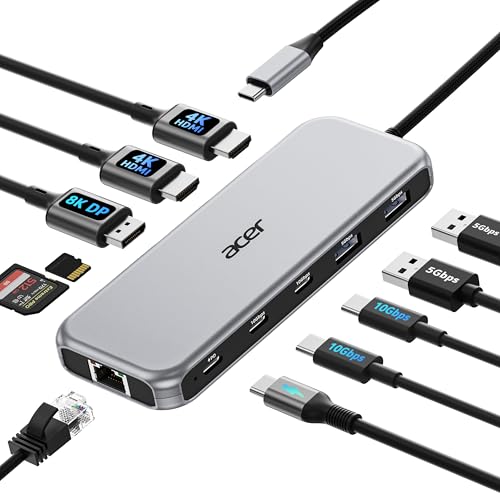
- Triple monitor output via 2 HDMI 4K@60Hz plus 1 DP 8K@30Hz
- 100W PD input with 85W passthrough keeps most USB-C laptops charged
- 10Gbps USB-C data ports handle NVMe enclosures without bottlenecking
- Gigabit RJ45 gives stable wired connection for video calls and file sync
Cons
- Limited owner feedback at time of writing, no established reliability track record
- Requires host laptop with DP Alt Mode USB-C, older ports will not drive displays
- macOS mirrors the same image across all external monitors, no extended triple setup
The Acer 11-in-1 is a budget USB-C docking station aimed at hybrid workers and light creators who want triple display output without paying for Thunderbolt. It bundles 2 HDMI, 1 DP, 2 USB-C, 2 USB-A, gigabit Ethernet, SD and MicroSD, plus 100W PD input into a single hub.
The standout is display flexibility: 8K@30Hz on DP, 4K@60Hz per HDMI, and a triple mode that auto-allocates bandwidth to roughly 4K+4K+1080P at 60Hz. Based on the spec sheet, this covers most dual 4K office setups and mixed resolution productivity workflows without dropping refresh rate on the primary panels.
Trade-offs are typical at this tier. It leans on DP Alt Mode rather than DisplayLink, so laptops without a video-capable USB-C port will not drive external monitors. macOS is limited to mirroring across externals, not extended triple display. PD tops out at 85W to the host, fine for ultrabooks but tight for 16-inch workstation laptops under load.
Buy this if you run a Windows ultrabook with DP Alt Mode and need two or three displays plus wired network at a desk. Skip this if you own an M-series MacBook wanting three independent screens, or a high-TDP mobile workstation that pulls more than 85W sustained.
Display output: 2 HDMI at 4K@60Hz, 1 DisplayPort at 8K@30Hz, and triple display mode that allocates by EDID to a typical 4K@60Hz + 4K@60Hz + 1080P@60Hz layout. Host HDMI version must be 2.0 or higher to hit the rated 4K@60Hz per port.
Data and card readers: 2 USB-C ports at 10Gbps and 2 USB-A ports at 5Gbps, enough headroom for external NVMe enclosures on the USB-C side. SD and MicroSD slots run at 104Mbps, matching UHS-I speed class rather than UHS-II.
Power and network: 100W PD input with 85W delivered to the laptop, so a 100W or higher USB-C charger and cable are required and not included. Wired networking uses a 1000Mbps RJ45 port for gigabit throughput on standard Cat5e or better cabling.
Compatibility: Requires a host USB-C port with DisplayPort Alternate Mode for video output. Works with Windows and macOS laptops, though macOS is restricted to mirrored output across all externals rather than extended triple display.
Even casual users get something out of it. The convenience of “drop the laptop on the desk and walk away” once you’ve experienced it, going back to plugging in three cables feels archaic.
Common misconceptions
Misconception one: any USB-C laptop works with any dock. Not quite. Your laptop’s USB-C port needs to support DisplayPort Alt Mode for video to pass through. Most modern ones do, but cheap budget laptops sometimes skip this. Check the spec sheet before you buy.
Misconception two: a Thunderbolt dock will run dual 4K on any laptop. The dock can output it, but your laptop’s integrated graphics might not. A 4K display at 60Hz eats real GPU resources. Some Intel laptops can drive two 4K screens, others top out at one 4K plus a 1440p. Read your laptop’s spec page carefully.
Misconception three: docks are only for Windows. Mac users benefit just as much, especially with the M-series MacBooks that ship with only two or three USB-C ports. A dock fixes that immediately. macOS handles external displays through DisplayLink drivers for some docks, which is worth knowing if you want more than two external screens on a MacBook.

Pros
- Three HDMI 2.0 outputs enable dual 4K at 60Hz on DP Alt Mode hosts
- 100W PD input with 85W laptop output covers most USB-C ultrabook chargers
- Mixed 10Gbps, 5Gbps, and 480Mbps USB ports let you tier peripherals by bandwidth
Cons
- Limited owner feedback at time of writing makes long-term reliability hard to verify
- Triple 4K at 60Hz not supported, third display drops to 1080p by EDID allocation
- USB ports are data-only with no downstream charging, and PD brick is not included
This is a budget 13-in-1 USB-C docking station aimed at laptop users who need three HDMI outputs, gigabit Ethernet, and 100W PD passthrough from a single upstream cable. It targets hybrid workers on Acer, XPS, Spectre, Surface, and MacBook hosts with DP Alt Mode over USB-C.
The defining feature is triple HDMI 2.0 output. On Windows hosts you get dual 4K at 60Hz, or a triple layout that EDID typically negotiates as 4K plus 4K plus 1080p based on total DisplayLink-style bandwidth. Docks in this tier usually rely on MST plus scaling, so refresh headroom above 60Hz is not expected.
Trade-offs are typical at this price. macOS mirrors rather than extends across multiple external panels, a DP Alt Mode limitation not unique to this unit. USB ports are data-only, so tablets and phones will not charge downstream. A 100W-plus GaN charger and cable are required but not in the box, and Thunderbolt-only laptops without DP Alt Mode are not supported.
Buy this if you run a Windows ultrabook with USB-C DP Alt Mode and want dual 4K plus a third auxiliary panel on a tight budget. Skip this if you need triple 4K at 60Hz, downstream device charging, or a Mac multi-monitor extended desktop, since none of those are supported here.
Display output: Three HDMI ports at 4K at 60Hz maximum, with single or dual 4K at 60Hz confirmed and triple output allocated by EDID and bandwidth, commonly 4K plus 4K plus 1080p at 60Hz. Requires host HDMI 2.0 or higher via DP Alt Mode over USB-C.
Data ports: Two USB-C at 10Gbps, one USB-A at 10Gbps, two USB-A at 5Gbps, and one USB-A at 480Mbps. All ports are data-only with no charging output, so plan peripheral placement by bandwidth tier for NVMe enclosures versus keyboards and mice.
Power and network: USB-C PD input rated 100W with 85W passthrough to the laptop, requiring a 100W-plus GaN brick and E-marked cable not included. RJ45 Ethernet is rated 1Gbps for wired networking with lower latency than 2.4GHz or 5GHz WiFi.
Card readers and compatibility: SD and MicroSD slots run at 104Mbps, aligned with UHS-I speeds. Works with Windows and macOS hosts supporting DP Alt Mode. Thunderbolt-only laptops without DP Alt Mode and USB-C ports limited to data (no video) are not supported.
Frequently asked
Will a dock charge my laptop?
Most USB-C docks include power delivery, typically between 60W and 100W. That’s enough for ultrabooks and mid-range laptops under normal use. Gaming laptops might draw more under load, so check the wattage.
What’s the difference between a dock and a hub?
Hubs add ports. Docks add ports, power, and full display capability through one cable. Docks tend to be bigger, heavier, and pricier, but they do far more.
Can I use one dock with two different laptops?
Yes. Just unplug and replug the USB-C cable. As long as both laptops support DP Alt Mode, the dock works with each. Some pro docks even have a button to swap between two connected hosts.
Do docks work with phones or tablets?
Some do. Samsung phones with DeX mode and iPads running iPadOS can output video through a USB-C dock, though feature support varies. It’s not a primary use case, but it’s a nice bonus.