

If you’ve ever opened a PC case and found a mess of unused cables zip-tied into a bulging knot, you already understand the problem a modular power supply solves. The question “what is a modular PSU” comes up constantly from first-time builders, and the short version is that it lets you plug in only the cables your system actually uses. Everything else stays in the box. For anyone shopping around, our guides to the best modular PSU for a gaming PC in 2026 and the best 1000W PSU picks go deeper on specific models.
This explainer covers what modular actually means, how it differs from the older fixed-cable design, and when the extra cost is worth paying. No fluff, just the practical reasoning a builder needs.
The short answer
A modular PSU is a power supply whose cables detach from the unit itself. Instead of a fixed bundle of wires soldered in at the factory, you get a set of sockets on the PSU and a bag of cables. You connect only the ones your build needs, the 24-pin motherboard cable, the CPU power, the GPU connectors, and leave the rest out. That’s it. The payoff is a cleaner interior, better airflow, and far less cable clutter to hide.
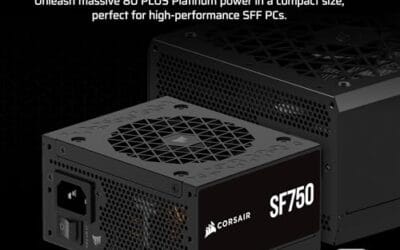
There are three types worth knowing. Non-modular units have every cable permanently attached. Semi-modular units hardwire the essentials, like the motherboard and CPU cables, and let you add the rest. Fully modular units, such as the Corsair SF750, detach everything including the 24-pin. A fully modular design like that $159.99 Platinum-rated SFX unit is the cleanest option for a tight small-form-factor build where every stray cable fights you for space.

Pros
- ATX 3.1 compliant with PCIe 5.1 support, resists transient spikes from RTX 50 and RX 9000 series GPUs.
- Zero RPM Mode eliminates fan noise at low and medium loads, a real advantage in acoustically sensitive SFF builds.
- Fully modular design with short SFX cables reduces cable management friction in sub-10-liter cases.
- 105 degree C Japanese capacitors indicate quality component selection typical of high-tier SFX units.
Cons
- Limited owner feedback at time of writing; real-world noise, ripple, and transient performance are unverified by community data.
- Short SFX cables are unsuitable for mid-tower or full-tower cases without aftermarket cable extensions.
- 750W ceiling may fall short for extreme SFF builds pairing a 300W-plus TGP GPU with a high-core-count CPU.
The Corsair SF750 (2024) is a high-end SFX PSU targeting SFF builders who need substantial wattage in a compact footprint. With 80 Plus Platinum certification and ATX 3.1 compliance, it sits at the upper tier of the SFX market, aimed at builders pairing it with current-gen discrete GPUs inside sub-10-liter cases.
The most defining specification here is ATX 3.1 compliance combined with PCIe 5.1 readiness. This means the unit is rated to handle the sharp transient power spikes that RTX 50 and RX 9000 series GPUs can produce, where non-compliant PSUs may trigger overcurrent protection. At 750W, it covers most single-GPU SFF configurations without derating concerns.
The honest trade-off is the review data gap. At time of writing, no substantial owner feedback exists to validate Corsair's noise and ripple claims under real load. The Zero RPM Mode claim and 92mm fan acoustics are based on spec sheets only. Buyers should also note that SFX cable lengths are intentionally short and will not reach connectors in mid-tower or larger cases without extensions.
Buy this if you are building an SFF PC around a single high-TGP GPU and need confirmed ATX 3.1 compliance in a modular SFX unit. Skip this if you want a large ATX case build, need more than 750W for a dual-component high-wattage system, or require extensive owner testing before purchasing.
Form Factor and Mounting: This is a standard SFX form factor PSU, not SFX-L. Verify your case specifies SFX compatibility before purchasing. An SFX-to-ATX bracket is included, allowing installation in ATX-footprint cases, though short cable lengths will require extensions in anything larger than a compact SFF enclosure.
Power Standard and Connector: ATX 3.1 compliant with PCIe 5.1 readiness. The unit supports the 12V-2x6 connector standard, relevant for RTX 40 and RTX 50 series GPUs as well as AMD RX 7000 and RX 9000 cards with high transient draw. Non-ATX 3.1 units can trigger OCP shutdowns above 150 percent peak load spikes.
Efficiency and Thermal Operation: 80 Plus Platinum certification indicates roughly 92 percent efficiency at 50 percent load under 115V. The 92mm PWM fan uses a fluid dynamic bearing and Zero RPM Mode activates at low loads, which in SFF cases where airflow is restricted can noticeably reduce system acoustic output.
GPU Wattage Pairing: At 750W, this PSU pairs appropriately with GPUs up to approximately 300W TGP when combined with a mid-range CPU. For a 320W-plus TGP GPU alongside a 65W-plus CPU, headroom becomes tight and a higher-wattage SFX unit should be considered instead.
The longer explanation
Under the hood, a PSU converts the AC power from your wall into the low-voltage DC rails your components run on. The modular part has nothing to do with that conversion. It’s purely about how the output cables attach. On a modular unit, the internal circuitry ends at a row of connectors on the back panel, and each detachable cable simply extends a specific rail out to a component.
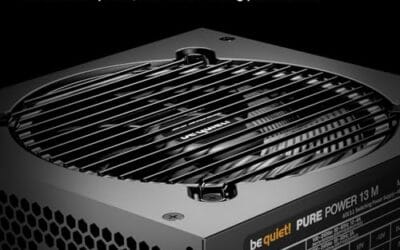
Because the connectors add a small extra junction in the path, some purists once worried about resistance and reliability. In practice that concern is long dead for quality units. Reputable modular supplies use gold-plated or high-current contacts rated well beyond what your components draw. The be quiet! Pure Power 13 M, for instance, is a 1000W single-rail design with 80 Plus Gold certification and LLC technology, and it’s fully rated to feed overclocked GPUs through those detachable connectors without breaking a sweat.
How we got here
Early PCs didn’t need much thought about cables because they didn’t have many. As graphics cards grew hungrier and cases got windows, two things happened at once: power supplies sprouted more connectors, and people started caring how their build looked. A non-modular unit from that era dumped every possible cable into the case whether you used it or not, and builders shoved the extras into any empty corner.
Modular designs arrived as the fix. Semi-modular came first as a cost-conscious middle ground, keeping the always-needed cables fixed while making the situational ones optional. Fully modular followed for people who wanted a spotless interior and custom cable options. Today the feature spans the whole market, from compact SFX units to 1000W-plus behemoths for high-end GPUs.
Why it works this way
The logic is simple. Every cable you don’t install is one less thing blocking airflow and one less thing to route behind the motherboard tray. In a full tower that’s a convenience. In a small case it can be the difference between a build that closes and one that doesn’t. Detachable cables also let you swap in shorter or custom-length replacements, which is why the modular approach pairs so naturally with clean, cable-managed builds.
There’s a serviceability angle too. If a single cable frays or you upgrade to a GPU that needs a different connector, you replace just that cable instead of the whole unit. That flexibility is why modular has become the default expectation on mid-range and premium supplies, even though it costs a little more to manufacture.
Building itself gets easier, which is an underrated benefit. With a non-modular unit you have to feed the whole cable bundle into the case before you can even mount the PSU, then wrestle the excess out of the way. With a modular design you install the supply first, run only the cables you need, and tuck them one at a time. First-time builders in particular find the process far less intimidating. Fewer wires in the way means fewer chances to miss a connector or pinch a cable against the side panel.
When you’d want this
You’ll want a fully modular PSU any time space or aesthetics matter. Small-form-factor builds are the obvious case, since an SFX unit like the Corsair SF750 crams 750W of 80 Plus Platinum power into a tiny footprint, and being able to omit unused cables is close to mandatory in a cramped ITX case. Window-panel showcase builds are the other big reason, because a clean interior photographs and displays far better.
High-wattage builds benefit too, even in roomy cases. A 1000W unit ships with a lot of cables to support multiple GPU power connectors and extra drives, and you rarely need all of them. The be quiet! Pure Power 13 M at $139.90 is a good example: a fully modular 1000W Gold unit aimed at overclocked GPUs, where leaving out the cables you don’t use keeps the airflow paths clear for the components that run hot.

Pros
- Native 12V-2x6 connector on ATX 3.1 platform ready for RTX 40 and PCIe 5.1 GPUs.
- Handles power excursions up to 2000W transient, headroom for RTX 4080 and 4090 class spikes.
- Semi-passive zero-RPM mode below moderate load keps idle acoustics near inaudible.
- LLC topology with single 12V rail delivers stable voltage regulation for overclocked GPUs.
Cons
- Limited independent owner feedback available at time of writing, riple and hold-up data unverified.
- Only four PCIe 6+2-pin connectors, tight for legacy multi-GPU or high-CPU-EPS custom lop builds.
- 80 PLUS Gold trails Platinum and Titanium units at similar wattage on sustained efficiency.
The be quiet! Pure Power 13 M 1000W is a high-end ATX 3.1 PSU aimed at builders pairing a Ryzen 7000/9000 or Core Ultra CPU with an RTX 4070Ti Super,4080 Super, 4090, or RX 7900 XTX class GPU. It targets buyers who want native 12V-2x6 wiring and transient headroom without stepping up to Platinum-tier pricing.
The defining trait is ATX 3.1 compliance with power excursion handling up to double the rated 1000W, meaning brief 2000W spikes from modern GPUs should not trip OCP. Combined with the single 12V rail and LLC topology, this suits overclocked GPUs where transient behavior, not average draw, tends to triger shutdowns on older units.
Trade-offs are typical at this tier. 80 PLUS Gold is eficient but not Platinum, soustained heavy loads generate more heat than a higher-rated unit. Four PCIe 6+2-pin connectors is standard, though builders running EATX boards with dual EPS plus a 4x8-pin GPU adapter should verify cable counts against the modular panel before buying.
Buy this if you are building a single-GPU gaming or content rig around a 250-450W TGP card and want native 12V-2x6 without paying Platinum prices. Skip this if you need sub-audible acoustics under sustained full load, or if you already own a workingATX 3.0 unit with a 12VHPWR pigtail.
ATX standard: Full ATX 3.1 compliance with native 12V-2x6 connector integration, which corects the sense-pin issue found on early 12VHPWR cables. Supports PCIe 5.1 GPUs at spec, and handles transient power excursions up to 2000W, roughly double the 1000W continuous rating.
GPU pairing: Comfortable for GPUs in the 250W to 450W TGP range, including RTX 4080 Super (320W) and RTX 4090 (450W) with headroom for overclocking. Four PCIe 6+2-pin outputs cover legacy 8-pin GPUs; the native 12V-2x6 removes the need for a 4x8-pin adapter dongle.
Efficiency and cooling: 80 PLUS Gold rated up to 94.4% at optimal load, typically around 50% utilization. The 120mm be quiet! fan runs semi-passive with zero-RPM below a load threshold not specified by the manufacturer, so idle and light workloads should remain silent.
Cabling: Fully modular design, leting builders omit unused SATA and Molex leads. Exact cable lengths and connector counts beyond the four PCIe 6+2-pin and single 12V-2x6 are not specified in source material, verify against your case routing before purchase.
What to look for in a modular PSU
Start with wattage that matches your GPU and CPU with headroom to spare, then check the 80 Plus rating for efficiency. Platinum, like the SF750, runs more efficiently than Gold, though Gold units such as the Pure Power 13 M hit a strong value point. Confirm the modern standards too. Both units here are ATX 3.1 compliant and PCIe 5.1 ready, which matters for current high-end graphics cards and their power spikes.
Form factor is the other big one. SFX units fit small cases but cost more per watt, while standard ATX units are cheaper and easier to find. A quiet or semi-passive fan, single-rail design, and a solid warranty round out the checklist. Ratings help as a sanity check: the SF750 sits at 4.1 stars and the Pure Power 13 M at 4.8, so both have earned owner trust.
Common misconceptions
The biggest myth is that modular connectors hurt performance or reliability. They don’t, not on quality units with properly rated contacts. Another is that fully modular is always better than semi-modular. It’s cleaner, sure, but the essential cables get installed either way, so semi-modular gives you most of the benefit for less money.
One dangerous misconception deserves a warning: cables are not universal between brands or even models. The pinout on the PSU side can differ, so plugging one brand’s modular cable into another brand’s unit can fry components. Always use the cables that came in the box, or an exact manufacturer-approved replacement. Never assume they interchange.
People also assume modular units run hotter or louder because of the extra connectors. They don’t. Fan noise and heat come from the internal design and load, not the sockets. A semi-passive unit like the Pure Power 13 M, with its 120mm fan that stays off at low loads, proves the point. Quiet operation is a function of the cooling design and efficiency rating, and it has nothing to do with whether the cables detach.
Frequently asked
Is a modular PSU better than a non-modular one?
For cable management and airflow, yes. You install only the cables you need, so the interior stays clean and less crowded. A non-modular unit can deliver identical power, but you’re left hiding a bundle of unused wires. The modular premium mostly buys tidiness and easier building, not more performance.
Does modular mean it delivers more power?
No. Modularity only describes how the cables attach, not how much power the unit makes. Wattage and the 80 Plus rating determine capacity and efficiency. A 1000W unit like the Pure Power 13 M delivers its full output whether or not the cables detach. The two things are unrelated.
Can I mix modular cables from different power supplies?
You shouldn’t, and it can be genuinely dangerous. The connector pinouts vary between brands and models, so a mismatched cable can send voltage to the wrong pins and damage your hardware. Use only the cables that shipped with your specific unit, or a replacement the manufacturer confirms is compatible.
Is fully modular worth it over semi-modular?
It depends on your case and goals. Fully modular units like the SF750 detach even the 24-pin cable, which helps most in tiny builds or showcase rigs. In a normal mid-tower, semi-modular already hides the situational cables and costs less, so the fully modular upgrade is more about a spotless look than function.
What wattage of modular PSU do I need?
Add up your components’ draw and leave roughly 20 to 30 percent headroom for efficiency and future upgrades. Many current mid-range gaming builds land comfortably on a quality 750W unit, while high-end GPUs and overclocking push you toward 1000W options like the Pure Power 13 M. Match the wattage to your actual hardware, not to a round number.


























Write Your Review
No reviews yet. Be the first to share your experience!