

Two power supplies can push the same 1000 watts and still land in completely different builds. That’s the real story behind SFX versus ATX. An SFX unit measures roughly 125mm wide, while a standard ATX unit stretches to about 150mm long and 86mm tall, so the gap isn’t small once you’re routing cables inside a tight chassis. If you’re weighing a compact rig against a roomy tower, the choice shapes airflow, noise, and how much you’ll pay per watt. We researched both form factors alongside our picks for the best SFX power supply and the best ATX 3.1 power supply to see where each one earns its keep.
Matchup at a glance
SFX is the small form factor standard. It squeezes real wattage into a case that fits behind a mini-ITX motherboard, which is why it shows up in Sugar-hued desk builds and living-room consoles-that-aren’t-consoles. The tradeoff is heat density. A smaller shell means a smaller fan, usually 92mm or 100mm, spinning faster to move the same air. ATX is the full-size default that most towers and most PSU shrouds are built around. More internal volume, bigger 120mm or 135mm fans, and typically a lower price for the same output.
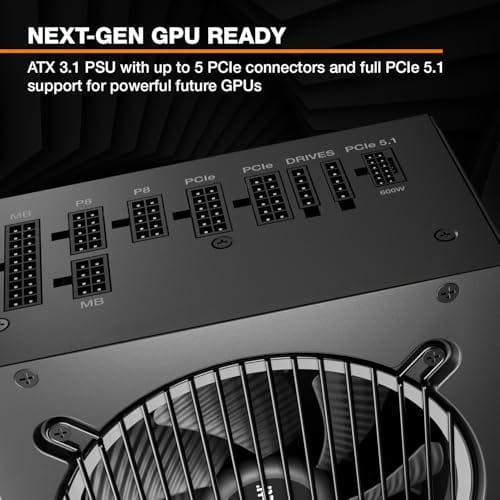
Neither is objectively better. They’re solving different problems. SFX buys you volume savings you can measure with a ruler. ATX buys you thermal headroom and dollars-per-watt value. The modern wrinkle is ATX 3.1 and PCIe 5.1 support, which both of our reference units carry, so the newest GPU power connector isn’t a deciding factor here. What matters is the space you have and the money you’d rather keep.
Spec sheet showdown
| Spec | Corsair SF750 (SFX) | be quiet! Pure Power 13 M (ATX) | Why it matters | Edge |
|---|---|---|---|---|
| Form factor | SFX, ~125mm wide | ATX, standard depth | Fit in the case you own | SFX for small builds |
| Wattage | 750W | 1000W | Headroom for GPU spikes | ATX |
| Efficiency rating | 80 Plus Platinum | 80 Plus Gold | Less waste heat, lower draw | SFX |
| Price | $159.99 | $139.90 | Cost per delivered watt | ATX |
| Standard | ATX 3.1 / PCIe 5.1 | ATX 3.1 / PCIe 5.1 | Native 12V-2×6 GPU support | Tie |
Read that table twice and the pattern jumps out. The SFX unit wins on efficiency tier and physical size. The ATX unit wins on raw wattage and price. That’s the whole debate in five rows.
SFX strengths
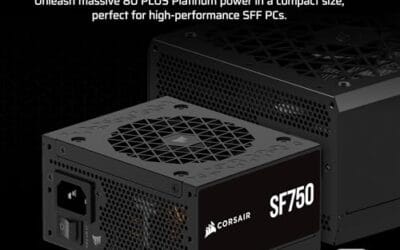
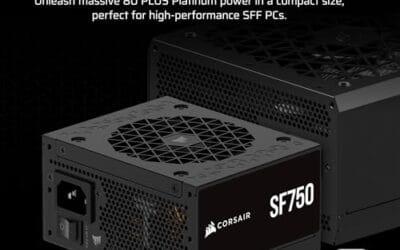
The Corsair SF750 is the case for going small without gutting performance. At 750 watts with an 80 Plus Platinum rating, it’s rated to waste less energy as heat than a Gold unit at the same load, which helps a lot when the whole PSU lives inside a shoebox-sized enclosure with limited airflow. It’s fully modular, so you attach only the cables your build needs, and Corsair ships an SFX-to-ATX bracket in the box for people who want a small unit in a bigger case. The 2024 revision is ATX 3.1 compliant and PCIe 5.1 ready, so a current 12V-2×6 graphics card plugs in without a squid adapter.
There’s a real cost to that density, and it’s honest to name it. SFX fans are smaller and can spin up under load, so a heavily loaded small build will sound busier than a roomy tower would. The 4.1 rating reflects a unit people generally respect while noting the fan behavior in cramped cases. If your priority is fitting a genuine 750-watt supply into a mini-ITX chassis, that noise budget is the price of admission. Owner reports point to a clean, low-ripple output that pairs well with our notes on the best SFX power supply for small form factor builds.
ATX strengths
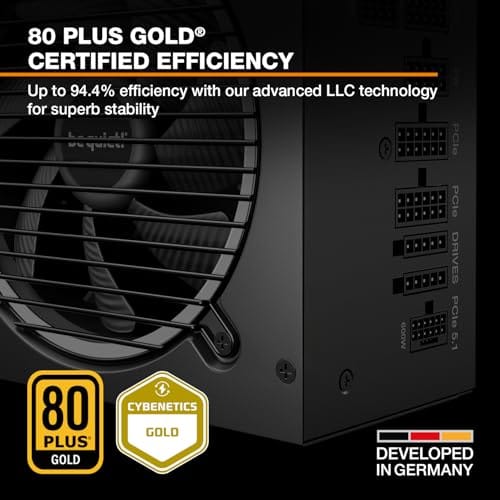
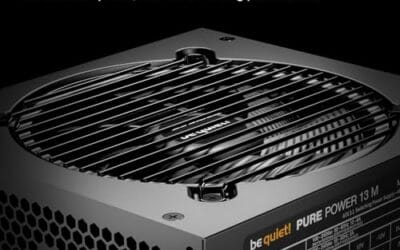
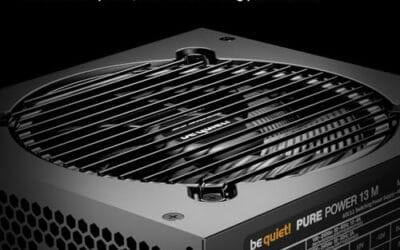
The be quiet! Pure Power 13 M flips the equation. It’s a full 1000-watt ATX unit at $139.90, which is less money than the 750-watt SFX unit above, and that dollars-per-watt gap is the single strongest argument for going standard-size. You get a semi-passive 120mm fan that stays off entirely at low loads, so a lightly loaded machine runs silent, and the fan only wakes up when the GPU actually pulls power. LLC technology and a single-rail design keep the voltage steady for overclocked cards, and it carries the same ATX 3.1 and PCIe 5.1 support as the Corsair.
The 4.8 rating is the highest in this pairing, and it’s easy to see why. More wattage, lower price, quieter idle behavior, and a fan that isn’t forced to scream because it has room to breathe. The one thing it won’t do is fit a genuinely small case. This is a standard ATX brick, and it expects a normal PSU shroud. For a tower build that leans on a big graphics card, it lines up with what we like in the best 1000W power supply category.

Pros
- Native 12V-2x6 connector on ATX 3.1 platform ready for RTX 40 and PCIe 5.1 GPUs.
- Handles power excursions up to 2000W transient, headroom for RTX 4080 and 4090 class spikes.
- Semi-passive zero-RPM mode below moderate load keps idle acoustics near inaudible.
- LLC topology with single 12V rail delivers stable voltage regulation for overclocked GPUs.
Cons
- Limited independent owner feedback available at time of writing, riple and hold-up data unverified.
- Only four PCIe 6+2-pin connectors, tight for legacy multi-GPU or high-CPU-EPS custom lop builds.
- 80 PLUS Gold trails Platinum and Titanium units at similar wattage on sustained efficiency.
The be quiet! Pure Power 13 M 1000W is a high-end ATX 3.1 PSU aimed at builders pairing a Ryzen 7000/9000 or Core Ultra CPU with an RTX 4070Ti Super,4080 Super, 4090, or RX 7900 XTX class GPU. It targets buyers who want native 12V-2x6 wiring and transient headroom without stepping up to Platinum-tier pricing.
The defining trait is ATX 3.1 compliance with power excursion handling up to double the rated 1000W, meaning brief 2000W spikes from modern GPUs should not trip OCP. Combined with the single 12V rail and LLC topology, this suits overclocked GPUs where transient behavior, not average draw, tends to triger shutdowns on older units.
Trade-offs are typical at this tier. 80 PLUS Gold is eficient but not Platinum, soustained heavy loads generate more heat than a higher-rated unit. Four PCIe 6+2-pin connectors is standard, though builders running EATX boards with dual EPS plus a 4x8-pin GPU adapter should verify cable counts against the modular panel before buying.
Buy this if you are building a single-GPU gaming or content rig around a 250-450W TGP card and want native 12V-2x6 without paying Platinum prices. Skip this if you need sub-audible acoustics under sustained full load, or if you already own a workingATX 3.0 unit with a 12VHPWR pigtail.
ATX standard: Full ATX 3.1 compliance with native 12V-2x6 connector integration, which corects the sense-pin issue found on early 12VHPWR cables. Supports PCIe 5.1 GPUs at spec, and handles transient power excursions up to 2000W, roughly double the 1000W continuous rating.
GPU pairing: Comfortable for GPUs in the 250W to 450W TGP range, including RTX 4080 Super (320W) and RTX 4090 (450W) with headroom for overclocking. Four PCIe 6+2-pin outputs cover legacy 8-pin GPUs; the native 12V-2x6 removes the need for a 4x8-pin adapter dongle.
Efficiency and cooling: 80 PLUS Gold rated up to 94.4% at optimal load, typically around 50% utilization. The 120mm be quiet! fan runs semi-passive with zero-RPM below a load threshold not specified by the manufacturer, so idle and light workloads should remain silent.
Cabling: Fully modular design, leting builders omit unused SATA and Molex leads. Exact cable lengths and connector counts beyond the four PCIe 6+2-pin and single 12V-2x6 are not specified in source material, verify against your case routing before purchase.
Real-world scenarios
The mini-ITX gaming build
You’re packing a full-height GPU and a fast CPU into a 15-liter case. ATX simply won’t fit. The Corsair SF750 is the answer here, and the Platinum efficiency pays off because there’s nowhere for waste heat to hide. This is exactly the situation our best SFX power supply for gaming build guide was written for.
The mid-tower workhorse
You’ve got a standard tower with a PSU shroud and plenty of room. There’s no reason to pay the SFX premium. The be quiet! 1000W unit gives you more headroom for less money, and the silent idle fan makes it a pleasure at the desk. ATX wins this one outright.
The high-end GPU rig
A top-tier card can spike hard for milliseconds. That’s where the extra 250 watts of the ATX unit acts as a buffer, and where SFX buyers need to be honest about their wattage math. If you’re set on a small case with a big card, size up carefully using our best SFX power supply for high-end GPU notes.
The quiet office or HTPC build
Sitting a machine under a TV or on a desk in a silent room changes the priorities. The be quiet! semi-passive fan stays completely off at low loads, so a lightly worked ATX build makes zero noise at idle. An SFX unit in the same job has a smaller fan that’s more likely to spin, which you’ll hear in a quiet room. For pure acoustic comfort in a case that has space, ATX has the edge.
Pricing and availability
Here’s the part that surprises people. The 750-watt SFX Corsair lists at $159.99, while the 1000-watt ATX be quiet! lists at $139.90. You’re paying about $20 more for 250 fewer watts, and that inversion is the norm, not a fluke. SFX units cost more to build because packing the same power into less volume is harder engineering. Both are widely stocked and both carry current ATX 3.1 certification, so availability isn’t the deciding factor. Your case is.
One more pricing angle worth knowing. SFX supplies tend to hold their value and stay in stock at fewer wattages, so if you wait for a genuine 850-watt or 1000-watt SFX unit, expect to pay a steep premium over an equivalent ATX brick. ATX, by contrast, sees frequent sales across a huge range of wattages and brands. If you’re patient and shopping standard-size, you can often catch a quality Gold or Platinum unit for less than list. That flexibility is part of the ATX value story that a comparable high-wattage SFX unit can’t fully match.
Which to buy
Pick the form factor your case demands, then optimize inside it. If you’re building small, the Corsair SF750 is worth every extra dollar. It’s the rare SFX unit that hits 750 watts at Platinum efficiency, it’s fully modular, and it ships with the bracket to move into a larger case later. Don’t buy SFX for a tower you already own. You’d be paying a premium for a constraint you don’t have.
If you’ve got the room, the be quiet! Pure Power 13 M is the smarter spend. More watts, less money, a fan that stays silent until it’s needed, and the same modern connector support. For most desktop builders in a standard tower, that’s the easy call. The SFX unit is the specialist tool. It’s brilliant when you need it, and overkill when you don’t.

Pros
- ATX 3.1 compliant with PCIe 5.1 support, resists transient spikes from RTX 50 and RX 9000 series GPUs.
- Zero RPM Mode eliminates fan noise at low and medium loads, a real advantage in acoustically sensitive SFF builds.
- Fully modular design with short SFX cables reduces cable management friction in sub-10-liter cases.
- 105 degree C Japanese capacitors indicate quality component selection typical of high-tier SFX units.
Cons
- Limited owner feedback at time of writing; real-world noise, ripple, and transient performance are unverified by community data.
- Short SFX cables are unsuitable for mid-tower or full-tower cases without aftermarket cable extensions.
- 750W ceiling may fall short for extreme SFF builds pairing a 300W-plus TGP GPU with a high-core-count CPU.
The Corsair SF750 (2024) is a high-end SFX PSU targeting SFF builders who need substantial wattage in a compact footprint. With 80 Plus Platinum certification and ATX 3.1 compliance, it sits at the upper tier of the SFX market, aimed at builders pairing it with current-gen discrete GPUs inside sub-10-liter cases.
The most defining specification here is ATX 3.1 compliance combined with PCIe 5.1 readiness. This means the unit is rated to handle the sharp transient power spikes that RTX 50 and RX 9000 series GPUs can produce, where non-compliant PSUs may trigger overcurrent protection. At 750W, it covers most single-GPU SFF configurations without derating concerns.
The honest trade-off is the review data gap. At time of writing, no substantial owner feedback exists to validate Corsair's noise and ripple claims under real load. The Zero RPM Mode claim and 92mm fan acoustics are based on spec sheets only. Buyers should also note that SFX cable lengths are intentionally short and will not reach connectors in mid-tower or larger cases without extensions.
Buy this if you are building an SFF PC around a single high-TGP GPU and need confirmed ATX 3.1 compliance in a modular SFX unit. Skip this if you want a large ATX case build, need more than 750W for a dual-component high-wattage system, or require extensive owner testing before purchasing.
Form Factor and Mounting: This is a standard SFX form factor PSU, not SFX-L. Verify your case specifies SFX compatibility before purchasing. An SFX-to-ATX bracket is included, allowing installation in ATX-footprint cases, though short cable lengths will require extensions in anything larger than a compact SFF enclosure.
Power Standard and Connector: ATX 3.1 compliant with PCIe 5.1 readiness. The unit supports the 12V-2x6 connector standard, relevant for RTX 40 and RTX 50 series GPUs as well as AMD RX 7000 and RX 9000 cards with high transient draw. Non-ATX 3.1 units can trigger OCP shutdowns above 150 percent peak load spikes.
Efficiency and Thermal Operation: 80 Plus Platinum certification indicates roughly 92 percent efficiency at 50 percent load under 115V. The 92mm PWM fan uses a fluid dynamic bearing and Zero RPM Mode activates at low loads, which in SFF cases where airflow is restricted can noticeably reduce system acoustic output.
GPU Wattage Pairing: At 750W, this PSU pairs appropriately with GPUs up to approximately 300W TGP when combined with a mid-range CPU. For a 320W-plus TGP GPU alongside a 65W-plus CPU, headroom becomes tight and a higher-wattage SFX unit should be considered instead.
Common questions
Can an SFX power supply fit in an ATX case?
Yes. Most SFX units, including the Corsair SF750, ship with an SFX-to-ATX bracket that lets them mount in a standard PSU bay. The reverse isn’t true. A full ATX unit won’t fit an SFX bracket, so you can’t shrink a big supply into a small case.
Is SFX less reliable than ATX?
Not inherently. Reliability tracks the quality of the internals, not the shell. The SF750’s Platinum rating and the Pure Power 13 M’s Gold rating both point to solid designs. The main SFX difference is a smaller, faster fan, so a heavily loaded compact build will run warmer and louder than a roomy tower.
Does form factor affect performance?
No, watts are watts. A 750-watt SFX unit and a 750-watt ATX unit deliver the same power to your components. Form factor changes fit, cooling, and price, not the actual output your GPU and CPU receive.
Why is SFX more expensive per watt?
Density costs money. Fitting the same wattage into a smaller shell requires tighter component layout and better thermal engineering, and that shows up on the price tag. It’s why a 750-watt SFX unit can cost more than a 1000-watt ATX unit.
Do both support the newest GPU power connector?
They do. Both the Corsair SF750 and the be quiet! Pure Power 13 M are ATX 3.1 compliant and PCIe 5.1 ready, so a current 12V-2×6 graphics card connects natively without an adapter. If overclocking is your aim, our best SFX power supply for overclocking guide digs deeper.
























Write Your Review
No reviews yet. Be the first to share your experience!