

If you’ve been pricing out a new graphics card this year, you’ve probably run into the same two names over and over: AMD’s Radeon RX 9070 XT and NVIDIA’s GeForce RTX 5070 Ti. They sit close enough on the shelf that shoppers keep asking which one actually pulls ahead, and the honest answer is that they’re built for slightly different buyers. Both carry 16GB of memory, both target high-refresh 1440p and entry-level 4K, and both landed in early 2025 as the cards most people can realistically afford without stepping into flagship territory.
The real gap shows up in raw rasterization value versus ray-tracing polish and upscaling software. The RX 9070 XT tends to give you more frames per dollar in traditional games, while the RTX 5070 Ti leans on DLSS 4 and stronger ray-tracing hardware to win the fancier workloads. We researched spec sheets, launch pricing, and owner reports to sort out what each card does for a real PC. If you’d rather skip the loose GPU and buy a full system, our roundups of the best RTX 5070 Ti prebuilt PC options and the best GPU for 4K gaming cover the built-machine route, and current best GPU deals are worth a glance before you commit.
The short answer
The difference between the RX 9070 XT and the RTX 5070 Ti is a trade between price-to-raster and feature depth. AMD’s RX 9070 XT launched around $599 and delivers class-leading raw frame rates in standard rendering, so pure gamers get more headroom per dollar. NVIDIA’s RTX 5070 Ti launched near $749 and answers with meaningfully better ray-tracing performance plus DLSS 4 multi-frame generation, which matters if you play the latest path-traced titles or lean on creator apps that favor CUDA. Both use a 256-bit bus and 16GB of VRAM, so neither one runs short on memory at 1440p or 4K.
Put plainly: buy the 9070 XT if you want the most raster frames for the least money, and buy the 5070 Ti if ray tracing, DLSS 4, and content-creation software carry weight for you. If your budget sits below either, an entry card like the ASRock Intel Arc B580 covers 1080p and light 1440p at a fraction of the cost, and it’s a reasonable landing spot while GPU prices settle.

Pros
- 12GB VRAM on 192-bit bus gives headroom over8GB rivals at 1440p.
- Single 8-pin connector and 650W PSU target means broad build compatibility.
- DisplayPort 2.1 with UHBR13.5 suports high-refresh QHD and 4K panels natively.
- 2-slot 249mm length fits compact ATX and many mATX chassis without clearance issues.
Cons
- Limited owner feedback at time of writing makes long-term reliability signals thin.
- PCIe 4.0 x8 interface can bottleneck slightly on older PCIe 3.0 platforms.
- Intel Arc driver maturity in older DX9/DX11 titles still trails NVIDIA and AMD.
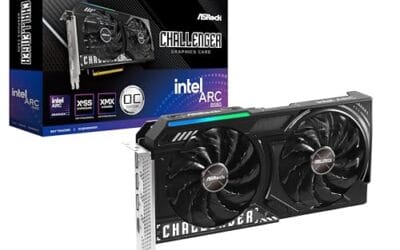
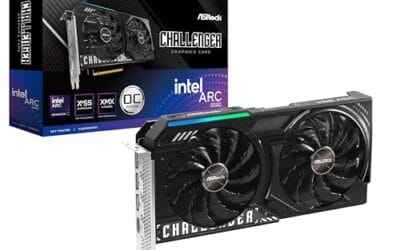
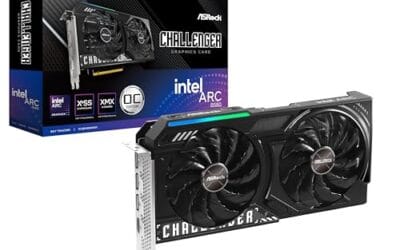
The ASRock Arc B580 Challenger 12GB OC is a mid-range 1440p GPU built on Intel's Xe2-HPG architecture with 20 Xe cores, 160 XMX engines, and a 2740MHz boost clock. It targets QHD gamers and content creators who want more VRAM than 8GB competitors offer at this bracket, without moving up to a 200W-plus card.
The defining feature is the 12GB GDDR6 pool on a 192-bit bus running at 19 Gbps, which gives real texture and framebuffer headroom at1440p. Combined with XeSS 2 AI upscaling and DirectX 12 Ultimate support, Arc B580 cards in this tier typically handle modern raster titles at high settings QHD, based on Intel's reference silicon behavior.
Trade-offs are typical for Intel Arc at this stage. The PCIe 4.0 x8 interface can shave frames on PCIe 3.0 boards, and driver polish on legacy DX9/DX11 games still lags competing vendors. The card requires a single 8-pin, 650W recommended PSU, and 249mm length, so verify chassis clearance and rail headroom before pairing with older bronze-tier supplies.
Buy this if you want a 1440p card with 12GB VRAM, DP 2.1 outputs, and XeSS 2 support on a modern PCIe 4.0 platform. Skip this if your library leans heavily on older DirectX 9 or 11 titles, or your motherboard is PCIe 3.0.
Resolution target: With 12GB GDDR6 on a 192-bit bus at 19 Gbps, this card is positioned for 1440p high settings in modern raster titles, with XeSS 2 upscaling extending playable framerates in heavier ray-traced workloads. 1080p esports at high refresh is well within scope.
Power and PSU pairing: ASRock lists a 650W recommended PSU and a single 8-pin connector. GPUs in this class typically draw around 190W board power, so pair with a quality 650W to 750W unit to leave transient headroom on ATX 3.0 or olderATX 2.x rails.
Build clearance: The2-slot cooler measures 249mm long, 132mm wide, and 41mm high. That fits most mid-towers and many mATX cases, but confirm front-radiator or HDD-cage clearance in compact builds beforeordering, especially SFF chassis rated under 250mm GPU length.
Display outputs: Three DisplayPort 2.1 ports (one primary up to UHBR13.5) plus one HDMI 2.1a drive up to four displays with resolutions up to 8K. UHBR13.5 suports high-refresh 4K and 1440p panels natively without DSC compromises.
The longer explanation
Under the hood, these cards come from two different design philosophies. The RX 9070 XT is built on AMD’s RDNA 4 architecture with 16GB of GDDR6 memory, and it was tuned to push conventional rasterized games hard. That’s the workload most titles still run in, so the card feels quick almost everywhere. AMD also rebuilt its upscaler for this generation, and FSR 4 closed a big chunk of the image-quality gap that older FSR versions carried.
The RTX 5070 Ti runs NVIDIA’s Blackwell architecture with 16GB of faster GDDR7 memory. The bump to GDDR7 gives it more raw bandwidth, and the Blackwell RT cores handle ray tracing with less of a frame-rate hit than AMD’s design. Then there’s DLSS 4, which adds multi-frame generation on top of the usual super-resolution. In supported games, that feature can multiply smoothness in a way AMD hasn’t fully matched yet. So the 5070 Ti isn’t just a hardware story, it’s a software one too.
There’s a memory-technology angle worth spelling out, since it’s easy to gloss over. GDDR6 on the AMD card is mature, cheap, and plenty fast for 1440p, which is part of how AMD hit that lower price. GDDR7 on the NVIDIA side is newer and pushes more bandwidth per pin, and that extra throughput helps most at 4K and with ray tracing turned on. Both cards ride a 256-bit bus, so the raw capacity matches even where the speeds don’t. For the vast majority of games, you won’t notice the difference. It’s the edge cases, the path-traced showpieces and heavy 4K loads, where the faster memory quietly earns its keep.
How we got here
A few years ago, the mid-high tier was a mess of overpriced cards and thin stock. AMD spent the RDNA 2 and RDNA 3 eras chasing NVIDIA on ray tracing and losing that specific fight, even while its raster performance stayed competitive. NVIDIA, meanwhile, kept widening its software moat with each DLSS release. Buyers noticed, and Radeon market share slipped.
RDNA 4 was AMD’s course correction. Instead of pushing a giant halo card, AMD aimed straight at the volume segment where most people actually shop, and it priced the RX 9070 XT aggressively at launch. NVIDIA countered with the RTX 5070 Ti as its own value-minded Blackwell part, positioned above the standard 5070 but below the 5080. The result is the closest head-to-head this price bracket has seen in a while. That’s good for you. Competition here means real choices instead of one obvious default.
Why it works this way
Ray tracing is expensive to compute, and NVIDIA has spent more silicon and more generations refining the dedicated cores that handle it. That head start is why the RTX 5070 Ti pulls ahead once you switch on heavy RT effects or path tracing. It isn’t magic, it’s accumulated engineering. AMD’s RDNA 4 narrowed the gap versus its own past cards, but NVIDIA still holds the RT crown in this tier.
Rasterization is a different story. AMD’s design packs strong traditional throughput, so in games without ray tracing the 9070 XT often trades blows with cards that cost more. Add in the lower launch price, and the frames-per-dollar math tilts toward AMD for classic gaming. The software layer explains the rest. DLSS has a longer track record and wider game support than FSR, so NVIDIA’s upscaling advantage compounds the hardware one. If you build around a top-tier CPU like the setups in our best GPU for 9800X3D guide, either card will keep pace, but the tie-breaker usually lands on which features you’ll actually use.
When you’d want each one
Reach for the RX 9070 XT when your library is mostly competitive shooters, big open-world raster titles, and esports games where raw frame rate rules. At its roughly $599 launch price, it’s the better pure-gaming value, and its 16GB of VRAM handles maxed 1440p textures without complaint. Streamers weighing capture and gameplay together should also look at our best GPU for gaming and streaming notes, since encoder quality factors into that choice as much as frame rate does.
Reach for the RTX 5070 Ti when ray tracing, path-traced showcase games, or creator apps sit in your daily use. The DLSS 4 multi-frame generation and stronger RT cores justify the higher sticker if those boxes get checked. It’s also the safer pick for 4K with RT enabled. Shoppers who want a bit more overhead should compare it against the tier above using our best RTX 5080 prebuilt PC rundown. And if the 5070 Ti stretches your budget, the standard RTX 5070 sits one rung down and keeps the NVIDIA feature set intact.

Pros
- GDDR7 memory on a 12GB frame suits 1440p high-refresh and early 4K workloads without hitting VRAM ceiling quickly.
- 0dB fan-stop below 50C keeps the card silent during desktop use, browsing, and light gaming sessions.
- Dual-ball bearing fans rated for roughly twice the lifespan of sleeve-bearing alternatives, reducing long-term maintenance concerns.
- NVIDIA DLSS 4 support enables frame generation and upscaling, recovering performance in ray-tracing-heavy titles.
Cons
- 3.125-slot footprint requires verifying case GPU clearance before ordering, particularly in mid-tower and mATX builds.
- TGP not explicitly listed in source data; pair with a PSU rated at least 150W above GPU draw for transient headroom, typical recommendation at this tier is 850W or above.
The ASUS TUF Gaming RTX 5070 OC is a high-end discrete GPU built on NVIDIA's Blackwell architecture. With 12GB GDDR7 memory and PCIe 5.0 interface, it targets enthusiast builders running 1440p high-refresh or early 4K setups who want a card that can sustain load without thermal throttling.
The standout feature is the thermal stack. ASUS combines a phase-change GPU thermal pad, MaxContact heat spreader with 5% increased surface area, and three Axial-tech fans spinning on dual-ball bearings. Based on the design specs, the phase-change pad should outperform traditional paste under extended gaming or GPU-compute sessions where die temperatures stabilize near TDP ceiling.
The 3.125-slot width is a real consideration, not a marketing point. Builders in tighter mATX or ITX cases need to confirm GPU slot clearance before purchasing. TGP figures are not listed in source data, but GPUs at this tier typically land between 200W and 250W, so a quality 850W PSU is the minimum sensible pairing. The conformal PCB coating and military-grade capacitors address durability concerns but do not offset the need for adequate airflow in the host case.
Buy this if you are building a dedicated 1440p or 4K gaming rig on PCIe 5.0 and want a card with above-average long-term component reliability. Skip this if your case has less than 3.125 slots of GPU clearance or your PSU is below 750W, as headroom for transient power spikes becomes a real stability risk.
VRAM and Resolution Fit: The 12GB GDDR7 frame is well-positioned for 1440p at maximum settings and 4K at medium-to-high presets in current titles. GDDR7 bandwidth reduces memory bottlenecks compared to GDDR6X at equivalent capacity, which matters in texture-heavy and ray-traced workloads.
Upscaling and Frame Generation: DLSS 4 support includes multi-frame generation, which is significant for GPU-limited scenarios at 4K with ray tracing enabled. Buyers targeting high-refresh 1440p esports titles will find DLSS 4 largely unnecessary at this GPU tier, but ray-tracing users benefit directly.
Slot and Clearance Requirements: The 3.125-slot design requires a minimum of four physical PCIe slot spaces free in the case. Card length is not specified in source data; confirm chassis GPU length clearance against ASUS product page measurements before purchasing.
Power and Connector: Connector type is not specified in source data. GPUs at this tier typically use a 16-pin 12VHPWR or 12V-2x6 connector. Verify PSU connector availability and target a PSU with at least 150W above measured GPU TGP for safe transient headroom.
What to look for in this class of GPU
Start with VRAM, because it ages a card faster than almost anything else. Both of these ship with 16GB, which is the number you want for 1440p and 4K over the next few years. Below that, cards with 8GB or 12GB can start choking on modern texture packs, so treat 16GB as your floor at this tier.
Next, check the board partner’s cooler and power design. The ASUS TUF Gaming take on the RTX 5070 line, for example, uses a beefy 3.125-slot cooler and military-grade components, which helps thermals and noise under load. Also confirm your power supply and case clearance, since these coolers run big. Finally, weigh the feature set honestly. If you never touch ray tracing, you’re paying for silicon you won’t use, and the raster-focused AMD card makes more sense. If you chase every visual bell, NVIDIA’s stack earns its premium.
Common misconceptions
The biggest myth is that more expensive automatically means faster everywhere. It doesn’t. The RTX 5070 Ti costs more, yet the RX 9070 XT can match or beat it in plenty of rasterized games. Price reflects features and software as much as raw speed.
Another misconception is that AMD’s upscaling still looks rough. FSR 4 changed that, and the current gap is far smaller than the reputation suggests. And no, 16GB isn’t overkill here. Modern games at high resolutions genuinely use it, and that headroom is a big part of why both cards should stay relevant for years. One more: frame generation numbers and native frame rates aren’t the same thing, so read reviews carefully before you compare marketing charts.
Frequently asked
Is the RX 9070 XT faster than the RTX 5070 Ti?
In pure rasterized games, the RX 9070 XT is often as fast or faster, and it costs less to boot. Once you turn on heavy ray tracing, the RTX 5070 Ti pulls ahead thanks to stronger RT cores and DLSS 4. So the honest answer is: it depends on the game and the settings you run.
Do both cards have enough VRAM for 4K?
Yes. Both carry 16GB, which is plenty for 4K textures in current titles. That capacity is one of the strongest reasons either card makes a smart medium-term buy at this price point.
Which is better for streaming and content creation?
The RTX 5070 Ti usually gets the nod. NVIDIA’s NVENC encoder and broad CUDA support in creator apps give it an edge for streaming and video work. AMD’s encoder has improved, but NVIDIA still leads in that specific area.
Are these cards good for 1440p high-refresh gaming?
Both are excellent 1440p cards and will push high frame rates in most games. The 9070 XT gives you more frames per dollar in raster, while the 5070 Ti adds ray-tracing muscle and DLSS 4 if you want the extra visual features.
Should I wait or buy now?
If your current card is holding you back, either of these solves that today, and 16GB of VRAM buys you longevity. If you can wait, keep an eye on pricing, since street prices at this tier bounce around based on stock. Match the card to how you actually play, and you won’t regret it.



























Write Your Review
No reviews yet. Be the first to share your experience!