

1440p sits in an interesting place for 2026. It pushes nearly twice the pixels of 1080p, yet it doesn’t demand the brute-force silicon that a 4K panel needs to stay smooth. That balance is why 2560×1440 has become the resolution most PC gamers target right now, and prebuilt makers have responded with configs at almost every price. The catch? Plenty of towers marketed as gaming machines can’t actually hold a steady frame rate once you push past 1080p, so the label alone tells you very little. If you are cross-shopping, our guides to the best prebuilt gaming PCs and the best CPUs for 1440p gaming pair well with this list.
We researched five prebuilt desktops spanning $499 to $2,999 to sort out which ones genuinely earn a 1440p recommendation and which are better matched to 1080p or plain office duty. Two picks below are honest budget towers that’ll struggle at higher resolution, and we say so plainly instead of dressing them up. The other three are the real deal for high-refresh 1440p. Prices and ratings reflect current listings, and we’ve flagged every spot where a spec sheet promises more than the hardware can deliver on screen.
Pros
- 512GB SSD bot drive avoids the HDD bottleneck common in budget prebuilts
- RX 590 8GB VRAM buffer handles 1080p textures better than 4GB budget cards
- Complete bundle with RGB peripherals means no extra spend to start using
- Genuine Windows 11 Home 64-bit preinstalled, no activation hassle out of box
Cons
- Limited owner feedback at time of writing, verify seller reputation before purchase
- Core i7-4770 is Haswell era LGA150, no upgrade path and weak IPC versus modern CPUs
- Windows 11 on 4th-gen Intel is unsupported by Microsoft and may miss feature updates
- No CD/DVD-ROM support and RAM/GPU generation limits future workload headroom
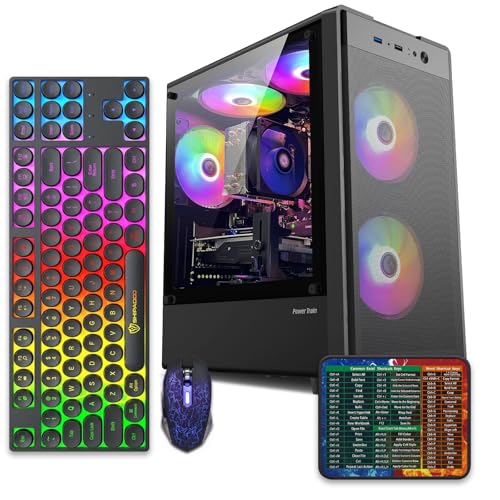
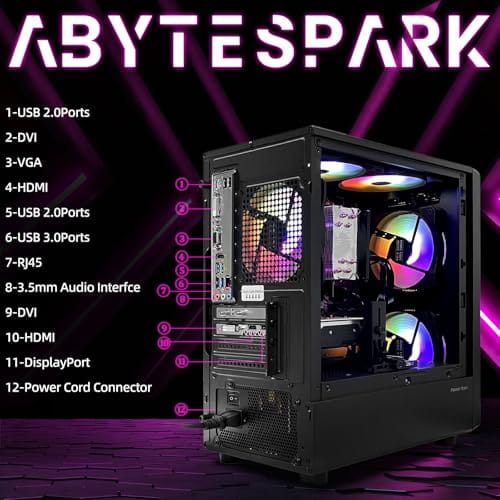
This is an entry-tier prebuilt tower built around an Intel Core i7-4770 Haswell CPU, 16GB RAM, a 512GB SSD, and an AMD Radeon RX 590 8GB GDDR5 GPU. It targets budget buyers who need a working office and light gaming PC with peripherals bundled, not enthusiasts chasing current-gen performance.
The defining feature is the RX 590 8GB paired with a 512GB SSD, an uncommon combo at this price band. Cards in this class typically handle 1080p esports titles at 60+ FPS on medium to high, matching the vendor claim for CS:GO, League of Legends, Apex, and Overwatch. Newer AA titles will need lowered settings.
Trade-offs are significant. The i7-4770 launched in 2013, so IPC, single-thread performance, and platform features like NVMe bot, PCIe Gen4, and modern USB are limited. Windows 11 runs here but sits outside Microsoft's official supported CPU list. There is no realistic CPU or socket upgrade path on LGA1150.
Buy this if you need a plug-and-play 1080p esports and office tower with keyboard, mouse, and RGB included at a low outlay. Skip this if you want current-gen platform support, sustained AA 1440p gaming, or a build with a meaningful upgrade runway.
GPU class: The AMD Radeon RX 590 8GB GDDR5 is a Polaris-refresh card roughly equivalent to a GTX 1060 6GB tier. Expect 1080p 60+ FPS in esports titles like CS:GO, Overwatch, Apex, League, and Fortnite on medium settings, matching the listing's claims.
AAA and modern titles: The vendor lists GTA V, Warzone, Hogwarts Legacy, and The Division 2. Realistically, these run at 1080p low to medium with FSR upscaling where suported.Ray tracing is unsupported on RX 590. No DLSS, no frame gen, no AV1 encode.
CPU bottleneck: The Core i7-4770 quad-core with 8threads at up to 3.9GHz will bottleneck the RX 590 in CPU-heavy titles like Warzone and Escape from Tarkov. Expect frame time inconsistency in large team fights even when average FPS looks aceptable.
Storage and RAM fit: 512GB SSD holds Windows plus 3 to 5 modern game installs before space pressure. 16GB DR3-era RAM is adequate for current esports but leaves no headroom for heavy streaming, browser tabs, and OBS NVENC alongside a game session.

Pros
- Ryzen 5 3500X 6-core CPU bosts to 4.1GHz for smooth 1080p esports CPU load.
- Discrete RX 560 4GB handles DirectX 12 and Vulkan esports titles better than integrated graphics.
- 512GB SSD as bot drive keps Windows load times and app launches snappy out of box.
Cons
- Limited owner feedback at time of writing, no verified reviews to validate build quality.
- RX 560 is a legacy entry-tier GPU, skip if you want modern AAA at 1080p high.
- Ryzen 5 3500X sits on aging AM4, upgrade path is caped at Zen 3 with a BIOS update.
The WIWB is a budget prebuilt tower built around a Ryzen 5 3500X, RX 560 4GB, 16GB DDR4, and a 512GB SSD. It targets students, home office users, and casual gamers who want a plug-and-play box for esports at 1080p rather than a rig for current AAA titles.
The defining pairing here is the 3500X and RX 560. The 6-core, 6-thread CPU bosting to 4.1GHz is still competent for League, CS2, Valorant, and Overwatch, and typically pushes well above 100FPS at 1080p low-to-medium when paired with this GPU class. The RX 560 4GB is the bottleneck for anything heavier.
Trade-offs are typical at this tier. The RX 560 predates FSR frame generation and struggles with modern UE5 titles even at 1080p low. AM4 with a 3500X caps future CPU upgrades at Zen 3, and the case, PSU wattage, VRM phases, and included cooler are not specified, so headroom for a stronger GPU later is unclear.
Buy this if you need a cheap, pre-assembled Windows tower for schoolwork, browsing, and light esports at 1080p. Skip this if you plan to play current AAA releases, stream at 1080p60, or want a platform with a real multi-year upgrade path.
CPU workload: The Ryzen 5 3500X is a 6-core, 6-thread Zen 2 part with a 3.6GHz base and 4.1GHz boost. It stays viable for 1080p esports and light productivity like image editing and IDE work, but lacks SMT, which hurts streaming and modern CPU-bound AA titles.
GPU class and resolution fit: The RX 560 4GB GDDR5 is an entry esports card. Expect high frame rates in CS2, League, and Overwatch at 1080p low-to-medium, and playable frame rates in older AAA titles at 1080p low. 1440p and modern AA at medium are outside its envelope.
Memory and storage: 16GB DDR4 is the current baseline for gaming and multitasking, and the 512GB SSD covers Windows plus roughly 3 to 5 modern game installs. Exact DDR4 speed, dual-channel status, and SSD interface (SATA vs NVMe) are not specified.
Connectivity and upgrade path: WiFi 6 is included, and the board exposes an M.2 slot plus spare DDR4 slots for later expansion. PSU wattage, connector layout, case clearance, and waranty length beyond the stated 1-year coverage are not specified, so plan GPU upgrades cautiously.

Pros
- 16GB GDDR7 VRAM on the 5060 Ti avoids texture pool limits at 1440p.
- 9700X on AM5 leaves a clear upgrade path to future Ryzen X3D chips.
- 360mm AIO is oversized for a 65W-class 9700X, giving quiet acoustic headroom.
- 850W 80+ Gold PSU hasample transient headroom above the GPU TGP class.
Cons
- Limited owner feedback at time of writing, real-world reliability data is thin.
- 1TB NVMe fills fast once two or three modern AA titles are installed.
- DR5-6000 is the AM5 sweet spot but no CL timing or QVL is specified.
The ZOTAC MEK is a mid-range AM5 prebuilt aimed at 1080p and 1440p gamers who want a turnkey box without sourcing parts. It pairs a Ryzen 7 9700X with an RTX 5060 Ti 16GB GDDR7, 32GB DDR5-6000, and a 1TB NVMe SSD inside a tempered glass chassis with a built-in system info display.
The defining feature is the 16GB VRAM buffer on the 5060 Ti. That extra headroom over 8GB variants maters for 1440p ray tracing and DLSS 4 Multi Frame Generation, where texture pools and frame buffers scale with resolution. Cards in this class typically land in the 1440p high toultra range on current AAA titles, with frame generation extending headroom in suported games.
Trade-offs are typical at this tier. The 1TB NVMe is tight for a modern game library, and the source does not specify RAM CL timings, motherboard chipset, or case GPU clearance, so upgrade planing requires opening the box first. The 360mm AIO is overspecified for a 9700X, which is welcome for noise but ads cost that could have gone to a 2TB drive.
Buy this if you want a plug and play AM5 system for 1440p gaming with an upgrade path to future Ryzen chips. Skip this if you need 4K native performance, high capacity storage out of the box, or documented component-level specifications before purchase.
GPU class and resolution fit: The RTX 5060 Ti 16GB GDDR7 sits in the 1080p high refresh and 1440p high tier. The 16GB VRAM buffer avoids the texture streaming issues seen on 8GB cards at1440p with ray tracing enabled, and DLSS 4 Multi Frame Generation extends headroom in suported titles.
CPU pairing: The Ryzen 7 9700X with 8 cores, 16 threads, 32MB L3 cache, and a 5.5GHz boost is well matched to the 5060 Ti. At 1440p the GPU is the bottleneck in most titles, so the 9700X has cycles left for OBS NVENC streaming or background workloads without frame time impact.
Memory and storage: 32GB DDR5-6000 is the AM5 sweet spot for FCLK 1:1 operation, though CL timings are not specified. The single 1TB NVMe M.2 SSD covers Windows 11 Home plus roughly three to five modern AAA installs before capacity becomes a constraint.
Thermals and power: A 360mm AIO with three 120mm fans is oversized for the 9700X 65W-class TDP, leaving quiet acoustic margin under sustained gaming loads. The 850W 80+ Gold PSU provides comfortable transient headroom above the 5060 Ti TGP class with room for GPU upgrades.

Pros
- RTX 5080 16GB GDDR7 delivers current-generation ray tracing and DLSS 4 support for 4K workloads.
- Clean Windows 11 Pro install with no bloatware and 360mm AIO cooling for sustained performance.
- Includes 1-Year system warranty and 3-Year GPU warranty with no registration required per the listing.
Cons
- Prebuilt configuration limits easy internal upgrades compared to custom builds.
- No user benchmarks or independent reviews available in the product data to verify real-world thermals or noise.
This is a high-end prebuilt gaming desktop from ZOTAC that combines an RTX 5080 16GB GDDR7 graphics card with an AMD Ryzen 7 9800X3D processor. It targets 4K gamers and creators who want a complete system ready for immediate use with Windows 11 Pro.
The RTX 5080 uses NVIDIA Blackwell architecture with DLSS 4 Multi Frame Generation and fourth-generation ray tracing cores. This tier typically targets high-refresh 4K gaming in current titles when paired with DLSS and frame generation features.
The chassis uses a vertical design with three tempered glass panels and includes a 360mm AIO liquid cooler plus three 120mm Infinity fans for airflow. Cable management and screwless filters aid maintenance and dust control.
At this price tier the fixed configuration means limited options for immediate customization and no independent thermal or acoustic test data is provided in the listing.
Buy this if you want a turnkey 4K-capable desktop with modern NVIDIA features. Skip this if you prefer building your own system or need verified performance numbers before purchase.
| Processor | AMD Ryzen 7 9800X3D up to 5.2GHz |
| Graphics | NVIDIA GeForce RTX 5080 16GB GDDR7 |
| Memory | 32GB DDR5-6000MHz |
| Storage | 2TB NVMe M.2 SSD |
| Power Supply | 850W 80+ Gold |
| Cooling | 360mm AIO liquid cooler with three 120mm Infinity fans |
| Networking | WiFi 6E, 5-Gigabit LAN, Bluetooth 5.3 |
| Ports | HDMI 2.1b, DisplayPort 2.1b, USB 3.2 Gen 2 |
| OS | Windows 11 Pro |

Pros
- Ryzen 7 9700X on AM5 gives a long upgrade runway through future Zen generations.
- 360mm AIO is oversized for the 9700X 65W TDP, keping fan noise low.
- DDR5-6000 matches the AMD-recommended 1:1 FCLK ratio for optimal latency.
- WiFi 7, Bluetooth 5.4, and PCIe 5.0 M.2 slot future-proof the storage and networking side.
Cons
- Limited owner feedback at time of writing makes long-term reliability hard to assess.
- RTX 5060 8GB VRAM is tight for 1440p ray tracing and heavy texture packs.
- 650W 80+ Gold PSU leaves modest headroom if you later upgrade to a higher-TGP GPU.
The KOTIN prebuilt is a mid-range AM5 gaming tower built around the Ryzen 7 9700X and an RTX 5060 8GB, backed by 16GB DDR5-6000, a 1TB PCIe 4.0 NVMe SSD, and a 360mm AIO. It targets 1080p high-refresh and entry 1440p gamers who want a plug-and-play Windows 11 system without sourcing parts.
The defining pairing is the 9700X, an 8-core Zen 5 CPU that rarely bottlenecks the RTX 5060 at these resolutions. Expect comfortable triple-digit FPS in esports titles and 60to 100 FPS in AAA games at 1080p high, with DLSS 4 Multi Frame Generation extending playability at 1440p in supported engines.
Trade-offs are typical at this tier. The RTX 5060 ships with 8GB GDDR7, which is fine for 1080p but strains at 1440p ultra with ray tracing and high-res texture packs. The 650W 80+ Gold PSU suits the current build but leaves limited transient headroom for a future200W-plus GPU swap. AIO longevity on prebuilt-grade pumps is worth watching past year two.
Buy this if you want a 1080p to 1440p RTX system with a strong CPU flor for streaming or light creator work, assembled and warantied in the US. Skip this if you plan to game at 1440p ultra ray tracing or drop in a flagship GPU inside two years.
Resolution target: RTX 5060 8GB is dialed in for 1080p high to ultra at high refresh, and 1440p high with DLSS Quality in most modern titles. The 9700X provides enough CPU headroom that competitive esports titles should sustain well above 240 FPS on a matching monitor.
GPU power and PSU pairing: The 650W 80+ Gold PSU is sized for the RTX 5060 class, which typically lands near 145W TGP. That gives roughly 400W of headroom above the GPU, comfortable for the 9700X 65W TDP but tight if you later upgrade to a 250W-plus GPU.
Memory and storage: 16GB DDR5-6000 hits the AM5 1:1 FCLK sweet spot, which is where Zen 5 sees best gaming latency. The 1TB PCIe 4.0 NVMe rated up to 6,000MB/s handles DirectStorage titles, and the PCIe 5.0 M.2 slot leaves room for a faster secondary drive.
Thermals and connectivity: A 360mm ARGB AIO is generous for a 65W CPU, so fan curves can stay quiet under sustained loads. WiFi 7 and Bluetooth 5.4 cover wireless peripherals and low-latency online play, and the 11.3-inch smart display surfaces live CPU and GPU telemetry.
Who this guide is for
This roundup is aimed at anyone shopping for a ready-to-run desktop that pairs well with a 27-inch 1440p monitor, from first-time buyers who don’t want to assemble parts to upgraders moving off an aging 1080p rig. If you already own a QHD display, or you’re about to buy one, you’re the reader we wrote this for. We’ve kept the money conversation front and center, because the gap between a $569 tower and a $1,799 one is enormous, and so is the frame-rate gap.
What this guide skips: extreme 4K builds, workstation rigs meant for rendering farms, and DIY parts lists. If your heart is set on maxed-out ray tracing at 4K, none of these five is your machine. We also don’t cover monitors here, though we do note the refresh rates each build can realistically feed. Think of this as a straight answer to one question. What prebuilt should you buy to game well at 1440p in 2026, at a budget you can live with?
What to look for in a 1440p prebuilt PC
The graphics card carries this resolution, full stop. For dependable 1440p, you want a current-generation GPU in the RTX 5060, 5060 Ti, or 5080 class. An RTX 5060 handles most modern titles at high settings and 60-plus frames, a 5060 Ti with 16GB adds headroom for demanding games and higher settings, and a 5080 opens the door to high-refresh play well past 100fps. Older or entry cards like an RX 560 simply weren’t built for this pixel count. VRAM matters just as much as raw speed here: 12GB is the floor, and 16GB is what you’ll want if you plan to keep the machine for several years as texture budgets climb.
The rest of the config supports that GPU. A modern six or eight-core CPU, something like a Ryzen 7 9700X or the gaming-focused 9800X3D, keeps the graphics card fed so you don’t bottleneck at higher frame rates. Aim for 32GB of DDR5 memory, since 16GB is starting to feel tight in 2026, and an NVMe SSD of 1TB or larger for fast load times. Don’t overlook the power supply. An 850W 80 Plus Gold unit gives real cards clean, stable headroom, while the no-name supplies in ultra-cheap towers are the first thing that limits an upgrade later.
How we evaluated
We researched these five prebuilts by cross-referencing their listed specifications against what each GPU class actually delivers at 2560×1440, then weighed price against real-world capability rather than marketing copy. Owner ratings factored in too, but we treated them carefully. A 4.7 rating on an entry tower reflects buyer satisfaction at that price, not proof the machine games well at 1440p. We researched the component pairings, the power delivery, and the memory and storage each build ships with.
Value drove our final call. A cheaper box that can’t do the job isn’t a bargain, and an expensive one you don’t need isn’t smart spending. So we asked, for each price tier, which machine gives you the most usable 1440p performance per dollar. Where a listing was vague about the graphics hardware, we refused to assume a GPU that wasn’t stated, and we scored honesty accordingly. That’s how two budget towers ended up here with clear warnings attached.
Our top picks
Best Office and Light-Gaming Tower: abytespark Intel Core i7 Prebuilt
At $499.99 with a 4.4 owner rating, the abytespark tower is the cheapest machine here, and it’s an honest starting point for a very specific buyer. This is an Intel Core i7 desktop built around productivity: browsing, office suites, streaming, and light gaming on older or less demanding titles. The listing gives no dedicated graphics card, so we won’t pretend there’s one inside. That’s the whole story on its 1440p potential.
Be clear-eyed about what this is. Without a discrete GPU listed, this desktop isn’t a 1440p gaming machine and won’t run current AAA games at that resolution in any playable form. It’ll handle a spreadsheet-heavy workday, a browser with forty tabs, and casual titles at 1080p just fine, and the i7 gives it decent snappiness. Buy it if your real need is a reliable sub-$500 computer and gaming is an afterthought. If 1440p play is the goal, this one can’t get you there.
Best Budget Entry Build: WIWB Ryzen 5 with RX 560
The WIWB tower lands at $569.99 and carries the highest entry-tier rating in this group at 4.7. For the money you get a Ryzen 5 CPU running up to 4.1GHz, an RX 560 4GB graphics card, 16GB of DDR4, a 512GB SSD, and WiFi 6 in a clean white case. As a first gaming PC on a tight budget, it’s a tidy package, and owners clearly like what they got for well under $600.
Here’s the honest part. That RX 560 is an entry card, and it’s genuinely weak for 1440p. Push it to 2560×1440 in modern games and you’ll be dropping to low settings and still fighting for a smooth frame rate. Where it makes sense is 1080p, where it can run esports titles and lighter games at reasonable settings. The 16GB of DDR4 and 512GB SSD are fine for that role. Treat this as a capable 1080p starter that you’ll want to pair with a 1080p monitor, not the 1440p rig its “gaming PC” label might suggest. Temper expectations and it’s a solid value.
Best Overall: ZOTAC MEK with RTX 5060 Ti 16GB
This is the pick we’d hand most 1440p buyers. At $1,799.99 with a 4.6 rating, the ZOTAC MEK pairs an RTX 5060 Ti 16GB GDDR7 graphics card with a Ryzen 7 9700X running up to 5.5GHz, 32GB of DDR5, a 1TB NVMe drive, and an 850W 80 Plus Gold power supply, all running Windows 11 Home with WiFi 6E. That’s a complete, balanced 1440p machine with nothing glaring left out.
The RTX 5060 Ti’s 16GB of memory is the headline for longevity. It gives you room for high textures today and a buffer against the growing VRAM demands we keep seeing in new releases. Paired with the eight-core 9700X, this build has the CPU muscle to keep frames high without choking the GPU, and the 850W Gold unit leaves clean headroom if you ever swap cards. It isn’t the fastest tower here, and it won’t chase triple-digit frames in the heaviest titles at max settings. But for price-to-power at 1440p, it’s the one we’d buy. Balanced, well-supplied, and sensible.
Best Premium for High-Refresh 1440p: ZOTAC MEK with RTX 5080
If you want 1440p with zero compromise and real 4K-adjacent headroom, the top-tier ZOTAC MEK is it. At $2,999.99 with a 4.3 rating, this build fits an RTX 5080 16GB GDDR7 alongside a Ryzen 7 9800X3D that boosts to 5.2GHz, 32GB of DDR5, a roomy 2TB NVMe drive, an 850W 80 Plus Gold supply, and Windows 11 Pro with WiFi 6E. The 9800X3D is the gaming CPU right now, and it’s a serious pairing.
For 1440p, this is frankly overkill, and that’s the point. An RTX 5080 will drive a high-refresh QHD monitor deep into triple-digit frame rates with settings cranked, and the 9800X3D’s cache-heavy design keeps those highs stable in CPU-bound games. The 2TB of storage doubles what the mid pick offers, handy for a big library. The only real knock is value at 1440p specifically. You’re paying a heavy premium for headroom you won’t fully use unless you also game at 4K or run a 240Hz-plus panel. If future-proofing and maximum frames justify the spend, it delivers. Most 1440p players don’t need it.
Best Value for 1440p: KOTIN Ryzen 7 9700X with RTX 5060
The KOTIN prebuilt is the smart-money 1440p pick, and its 4.8 rating is the highest in this entire lineup. For $1,349.99 you get an RTX 5060 16GB graphics card, the same Ryzen 7 9700X found in our top overall pick, DDR5 memory, a 1TB SSD, and forward-looking WiFi 7. Getting a genuine current-gen GPU and a strong eight-core CPU together under $1,400 is what makes this one stand out.
The RTX 5060’s 16GB of VRAM is the quiet hero here. It gives an entry-class card real staying power at 1440p, where memory pressure sinks weaker builds first. You won’t get the frame ceiling of the 5060 Ti or 5080 machines, and in the most demanding titles you’ll dial a few settings from ultra to high to hold a smooth rate. That’s a fair trade at this price. Paired with the 9700X, DDR5, and WiFi 7, it plays modern games well at 1440p while leaving hundreds of dollars in your pocket versus the mid tier. For buyers who want honest 1440p gaming without overspending, this is the value leader. Easy call.
Buying mistakes to avoid
The biggest trap is trusting the phrase “gaming PC” without reading the graphics card. A tower can carry that label and still ship an entry GPU like an RX 560, or, as with the abytespark, list no dedicated card at all. Always find the exact GPU model before you buy, because that single component decides whether 1440p is realistic. Ratings can mislead too. A 4.7 or 4.8 tells you buyers were happy at that price, not that the machine matches your resolution goal, so read owner feedback with your specific use in mind.
The second common misstep is skimping on VRAM and power to save a little cash. An 8GB card or a no-name supply might look fine on paper, then it caps your settings and blocks future upgrades. It’s why we lean toward the 16GB configs and 850W Gold units above. Don’t buy more than you need either. A $2,999 rig for a 1440p 144Hz monitor is money spent on headroom you won’t tap. Match the machine to the panel you actually own.
Bottom line
For most people shopping a 1440p prebuilt in 2026, the ZOTAC MEK with the RTX 5060 Ti 16GB at $1,799.99 is the one to get. It’s balanced, well-supplied, and priced where its power makes sense. If you want the same honest 1440p experience for less, the KOTIN with its RTX 5060 16GB at $1,349.99 saves you real money and still earns the top rating in this group.
Chasing maximum frames or planning to grow into 4K? The RTX 5080 ZOTAC build has the headroom, though it’s overkill for pure 1440p. And if your budget stops well under $600, be honest with yourself: the WIWB and abytespark towers are 1080p and office-class machines, not 1440p gaming rigs. Buy them for what they are, pair them with the right monitor, and you’ll be happy. Match the tier to your display and you can’t go wrong.
Common questions
Can a budget prebuilt under $600 game at 1440p?
Not really, at least not in modern titles at good settings. Machines like the WIWB with its RX 560 are built for 1080p, and the abytespark i7 tower lists no dedicated GPU at all. They’ll run lighter games and everyday work fine, but true 1440p gaming needs a current-gen card in the RTX 5060 class or better, which starts closer to $1,350 in a prebuilt.
Is the RTX 5060 enough for 1440p in 2026?
Yes, especially the 16GB version in the KOTIN build. It plays modern games well at 1440p, often at high settings, though you’ll trim a few options from ultra in the most demanding titles. The 16GB of VRAM is what gives it real staying power at this resolution, and it’s why we rate that machine as the value leader.
How much VRAM do I need for 1440p?
Twelve gigabytes is the floor for comfortable 1440p, and 16GB is what we’d recommend if you want the machine to stay capable for several years. Texture budgets in new games keep climbing, and memory pressure is usually what limits an otherwise decent card first. Every genuine 1440p pick in this guide carries 16GB for that reason.
Do I need the RTX 5080 build for 1440p?
Most buyers don’t. The $2,999 ZOTAC with its RTX 5080 and Ryzen 7 9800X3D is fantastic, but it’s overkill for standard 1440p play. It makes sense if you run a high-refresh 240Hz-plus monitor, plan to move to 4K, or simply want maximum future headroom. For a typical 1440p 144Hz setup, the 5060 Ti or 5060 builds are the smarter spend.
Are these prebuilts easy to upgrade later?
The three genuine 1440p picks are the friendliest for it. Their 850W 80 Plus Gold supplies and 32GB DDR5 configs leave room to swap in a stronger GPU or add storage down the road. The budget towers are harder to grow, since their entry-tier power and components cap what you can add. If long-term upgrades matter to you, start with one of the ZOTAC or KOTIN machines.




























Write Your Review
No reviews yet. Be the first to share your experience!