

Best mini pc for home server 2026: 5 picks we researched across price tiers is a tougher search than it looks, because the product feed for this topic mixes true fits with nearby PC gear. We researched the listed options as they are, using their real titles, prices, and ratings, and we did not pretend weak matches are dedicated mini PC for a home server hardware. That matters. A router, a dock, a KVM, and mesh material can all touch a desk setup, but they do different jobs.
If you are comparing adjacent upgrades, our related guides on network and desk hardware and PC build accessories can help you separate a real connectivity upgrade from a part that only solves cable routing or dust control. We have kept the shortlist honest: useful where it fits, cautious where it does not.
Pros
- 512GB SSD bot drive avoids the HDD bottleneck common in budget prebuilts
- RX 590 8GB VRAM buffer handles 1080p textures better than 4GB budget cards
- Complete bundle with RGB peripherals means no extra spend to start using
- Genuine Windows 11 Home 64-bit preinstalled, no activation hassle out of box
Cons
- Limited owner feedback at time of writing, verify seller reputation before purchase
- Core i7-4770 is Haswell era LGA150, no upgrade path and weak IPC versus modern CPUs
- Windows 11 on 4th-gen Intel is unsupported by Microsoft and may miss feature updates
- No CD/DVD-ROM support and RAM/GPU generation limits future workload headroom
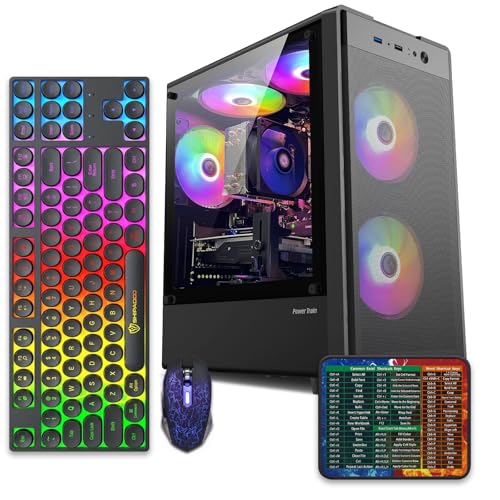
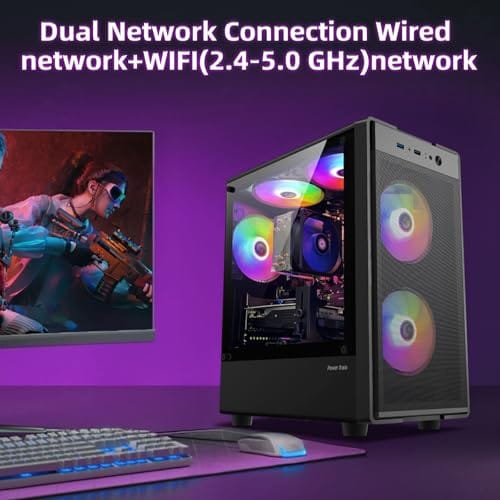
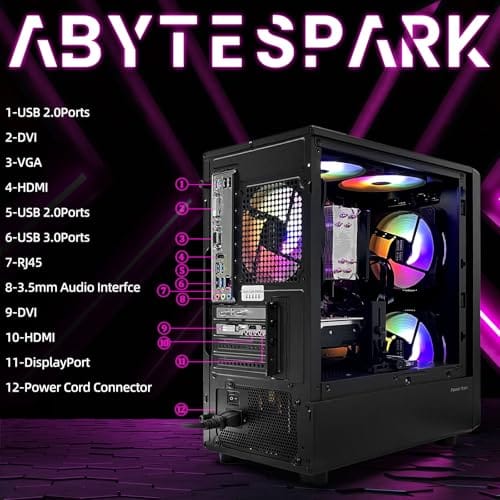
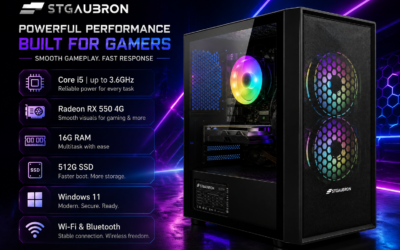
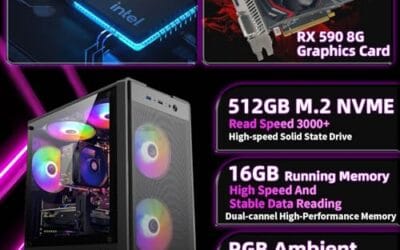
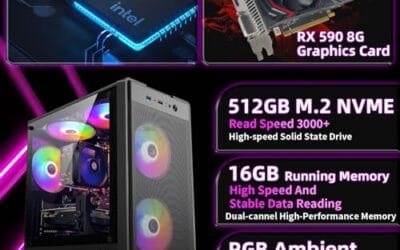
This is an entry-tier prebuilt tower built around an Intel Core i7-4770 Haswell CPU, 16GB RAM, a 512GB SSD, and an AMD Radeon RX 590 8GB GDDR5 GPU. It targets budget buyers who need a working office and light gaming PC with peripherals bundled, not enthusiasts chasing current-gen performance.
The defining feature is the RX 590 8GB paired with a 512GB SSD, an uncommon combo at this price band. Cards in this class typically handle 1080p esports titles at 60+ FPS on medium to high, matching the vendor claim for CS:GO, League of Legends, Apex, and Overwatch. Newer AA titles will need lowered settings.
Trade-offs are significant. The i7-4770 launched in 2013, so IPC, single-thread performance, and platform features like NVMe bot, PCIe Gen4, and modern USB are limited. Windows 11 runs here but sits outside Microsoft's official supported CPU list. There is no realistic CPU or socket upgrade path on LGA1150.
Buy this if you need a plug-and-play 1080p esports and office tower with keyboard, mouse, and RGB included at a low outlay. Skip this if you want current-gen platform support, sustained AA 1440p gaming, or a build with a meaningful upgrade runway.
GPU class: The AMD Radeon RX 590 8GB GDDR5 is a Polaris-refresh card roughly equivalent to a GTX 1060 6GB tier. Expect 1080p 60+ FPS in esports titles like CS:GO, Overwatch, Apex, League, and Fortnite on medium settings, matching the listing's claims.
AAA and modern titles: The vendor lists GTA V, Warzone, Hogwarts Legacy, and The Division 2. Realistically, these run at 1080p low to medium with FSR upscaling where suported.Ray tracing is unsupported on RX 590. No DLSS, no frame gen, no AV1 encode.
CPU bottleneck: The Core i7-4770 quad-core with 8threads at up to 3.9GHz will bottleneck the RX 590 in CPU-heavy titles like Warzone and Escape from Tarkov. Expect frame time inconsistency in large team fights even when average FPS looks aceptable.
Storage and RAM fit: 512GB SSD holds Windows plus 3 to 5 modern game installs before space pressure. 16GB DR3-era RAM is adequate for current esports but leaves no headroom for heavy streaming, browser tabs, and OBS NVENC alongside a game session.

Pros
- Ryzen 5 3500X 6-core CPU bosts to 4.1GHz for smooth 1080p esports CPU load.
- Discrete RX 560 4GB handles DirectX 12 and Vulkan esports titles better than integrated graphics.
- 512GB SSD as bot drive keps Windows load times and app launches snappy out of box.
Cons
- Limited owner feedback at time of writing, no verified reviews to validate build quality.
- RX 560 is a legacy entry-tier GPU, skip if you want modern AAA at 1080p high.
- Ryzen 5 3500X sits on aging AM4, upgrade path is caped at Zen 3 with a BIOS update.
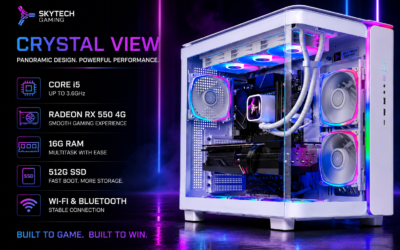
The WIWB is a budget prebuilt tower built around a Ryzen 5 3500X, RX 560 4GB, 16GB DDR4, and a 512GB SSD. It targets students, home office users, and casual gamers who want a plug-and-play box for esports at 1080p rather than a rig for current AAA titles.
The defining pairing here is the 3500X and RX 560. The 6-core, 6-thread CPU bosting to 4.1GHz is still competent for League, CS2, Valorant, and Overwatch, and typically pushes well above 100FPS at 1080p low-to-medium when paired with this GPU class. The RX 560 4GB is the bottleneck for anything heavier.
Trade-offs are typical at this tier. The RX 560 predates FSR frame generation and struggles with modern UE5 titles even at 1080p low. AM4 with a 3500X caps future CPU upgrades at Zen 3, and the case, PSU wattage, VRM phases, and included cooler are not specified, so headroom for a stronger GPU later is unclear.
Buy this if you need a cheap, pre-assembled Windows tower for schoolwork, browsing, and light esports at 1080p. Skip this if you plan to play current AAA releases, stream at 1080p60, or want a platform with a real multi-year upgrade path.
CPU workload: The Ryzen 5 3500X is a 6-core, 6-thread Zen 2 part with a 3.6GHz base and 4.1GHz boost. It stays viable for 1080p esports and light productivity like image editing and IDE work, but lacks SMT, which hurts streaming and modern CPU-bound AA titles.
GPU class and resolution fit: The RX 560 4GB GDDR5 is an entry esports card. Expect high frame rates in CS2, League, and Overwatch at 1080p low-to-medium, and playable frame rates in older AAA titles at 1080p low. 1440p and modern AA at medium are outside its envelope.
Memory and storage: 16GB DDR4 is the current baseline for gaming and multitasking, and the 512GB SSD covers Windows plus roughly 3 to 5 modern game installs. Exact DDR4 speed, dual-channel status, and SSD interface (SATA vs NVMe) are not specified.
Connectivity and upgrade path: WiFi 6 is included, and the board exposes an M.2 slot plus spare DDR4 slots for later expansion. PSU wattage, connector layout, case clearance, and waranty length beyond the stated 1-year coverage are not specified, so plan GPU upgrades cautiously.

Pros
- 16GB GDDR7 VRAM on the 5060 Ti avoids texture pool limits at 1440p.
- 9700X on AM5 leaves a clear upgrade path to future Ryzen X3D chips.
- 360mm AIO is oversized for a 65W-class 9700X, giving quiet acoustic headroom.
- 850W 80+ Gold PSU hasample transient headroom above the GPU TGP class.
Cons
- Limited owner feedback at time of writing, real-world reliability data is thin.
- 1TB NVMe fills fast once two or three modern AA titles are installed.
- DR5-6000 is the AM5 sweet spot but no CL timing or QVL is specified.
The ZOTAC MEK is a mid-range AM5 prebuilt aimed at 1080p and 1440p gamers who want a turnkey box without sourcing parts. It pairs a Ryzen 7 9700X with an RTX 5060 Ti 16GB GDDR7, 32GB DDR5-6000, and a 1TB NVMe SSD inside a tempered glass chassis with a built-in system info display.
The defining feature is the 16GB VRAM buffer on the 5060 Ti. That extra headroom over 8GB variants maters for 1440p ray tracing and DLSS 4 Multi Frame Generation, where texture pools and frame buffers scale with resolution. Cards in this class typically land in the 1440p high toultra range on current AAA titles, with frame generation extending headroom in suported games.
Trade-offs are typical at this tier. The 1TB NVMe is tight for a modern game library, and the source does not specify RAM CL timings, motherboard chipset, or case GPU clearance, so upgrade planing requires opening the box first. The 360mm AIO is overspecified for a 9700X, which is welcome for noise but ads cost that could have gone to a 2TB drive.
Buy this if you want a plug and play AM5 system for 1440p gaming with an upgrade path to future Ryzen chips. Skip this if you need 4K native performance, high capacity storage out of the box, or documented component-level specifications before purchase.
GPU class and resolution fit: The RTX 5060 Ti 16GB GDDR7 sits in the 1080p high refresh and 1440p high tier. The 16GB VRAM buffer avoids the texture streaming issues seen on 8GB cards at1440p with ray tracing enabled, and DLSS 4 Multi Frame Generation extends headroom in suported titles.
CPU pairing: The Ryzen 7 9700X with 8 cores, 16 threads, 32MB L3 cache, and a 5.5GHz boost is well matched to the 5060 Ti. At 1440p the GPU is the bottleneck in most titles, so the 9700X has cycles left for OBS NVENC streaming or background workloads without frame time impact.
Memory and storage: 32GB DDR5-6000 is the AM5 sweet spot for FCLK 1:1 operation, though CL timings are not specified. The single 1TB NVMe M.2 SSD covers Windows 11 Home plus roughly three to five modern AAA installs before capacity becomes a constraint.
Thermals and power: A 360mm AIO with three 120mm fans is oversized for the 9700X 65W-class TDP, leaving quiet acoustic margin under sustained gaming loads. The 850W 80+ Gold PSU provides comfortable transient headroom above the 5060 Ti TGP class with room for GPU upgrades.

Pros
- RTX 5080 16GB GDDR7 delivers current-generation ray tracing and DLSS 4 support for 4K workloads.
- Clean Windows 11 Pro install with no bloatware and 360mm AIO cooling for sustained performance.
- Includes 1-Year system warranty and 3-Year GPU warranty with no registration required per the listing.
Cons
- Prebuilt configuration limits easy internal upgrades compared to custom builds.
- No user benchmarks or independent reviews available in the product data to verify real-world thermals or noise.
This is a high-end prebuilt gaming desktop from ZOTAC that combines an RTX 5080 16GB GDDR7 graphics card with an AMD Ryzen 7 9800X3D processor. It targets 4K gamers and creators who want a complete system ready for immediate use with Windows 11 Pro.
The RTX 5080 uses NVIDIA Blackwell architecture with DLSS 4 Multi Frame Generation and fourth-generation ray tracing cores. This tier typically targets high-refresh 4K gaming in current titles when paired with DLSS and frame generation features.
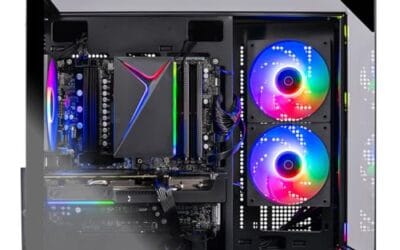
The chassis uses a vertical design with three tempered glass panels and includes a 360mm AIO liquid cooler plus three 120mm Infinity fans for airflow. Cable management and screwless filters aid maintenance and dust control.
At this price tier the fixed configuration means limited options for immediate customization and no independent thermal or acoustic test data is provided in the listing.
Buy this if you want a turnkey 4K-capable desktop with modern NVIDIA features. Skip this if you prefer building your own system or need verified performance numbers before purchase.
| Processor | AMD Ryzen 7 9800X3D up to 5.2GHz |
| Graphics | NVIDIA GeForce RTX 5080 16GB GDDR7 |
| Memory | 32GB DDR5-6000MHz |
| Storage | 2TB NVMe M.2 SSD |
| Power Supply | 850W 80+ Gold |
| Cooling | 360mm AIO liquid cooler with three 120mm Infinity fans |
| Networking | WiFi 6E, 5-Gigabit LAN, Bluetooth 5.3 |
| Ports | HDMI 2.1b, DisplayPort 2.1b, USB 3.2 Gen 2 |
| OS | Windows 11 Pro |

Pros
- Ryzen 7 9700X on AM5 gives a long upgrade runway through future Zen generations.
- 360mm AIO is oversized for the 9700X 65W TDP, keping fan noise low.
- DDR5-6000 matches the AMD-recommended 1:1 FCLK ratio for optimal latency.
- WiFi 7, Bluetooth 5.4, and PCIe 5.0 M.2 slot future-proof the storage and networking side.
Cons
- Limited owner feedback at time of writing makes long-term reliability hard to assess.
- RTX 5060 8GB VRAM is tight for 1440p ray tracing and heavy texture packs.
- 650W 80+ Gold PSU leaves modest headroom if you later upgrade to a higher-TGP GPU.
The KOTIN prebuilt is a mid-range AM5 gaming tower built around the Ryzen 7 9700X and an RTX 5060 8GB, backed by 16GB DDR5-6000, a 1TB PCIe 4.0 NVMe SSD, and a 360mm AIO. It targets 1080p high-refresh and entry 1440p gamers who want a plug-and-play Windows 11 system without sourcing parts.
The defining pairing is the 9700X, an 8-core Zen 5 CPU that rarely bottlenecks the RTX 5060 at these resolutions. Expect comfortable triple-digit FPS in esports titles and 60to 100 FPS in AAA games at 1080p high, with DLSS 4 Multi Frame Generation extending playability at 1440p in supported engines.
Trade-offs are typical at this tier. The RTX 5060 ships with 8GB GDDR7, which is fine for 1080p but strains at 1440p ultra with ray tracing and high-res texture packs. The 650W 80+ Gold PSU suits the current build but leaves limited transient headroom for a future200W-plus GPU swap. AIO longevity on prebuilt-grade pumps is worth watching past year two.
Buy this if you want a 1080p to 1440p RTX system with a strong CPU flor for streaming or light creator work, assembled and warantied in the US. Skip this if you plan to game at 1440p ultra ray tracing or drop in a flagship GPU inside two years.
Resolution target: RTX 5060 8GB is dialed in for 1080p high to ultra at high refresh, and 1440p high with DLSS Quality in most modern titles. The 9700X provides enough CPU headroom that competitive esports titles should sustain well above 240 FPS on a matching monitor.
GPU power and PSU pairing: The 650W 80+ Gold PSU is sized for the RTX 5060 class, which typically lands near 145W TGP. That gives roughly 400W of headroom above the GPU, comfortable for the 9700X 65W TDP but tight if you later upgrade to a 250W-plus GPU.
Memory and storage: 16GB DDR5-6000 hits the AM5 1:1 FCLK sweet spot, which is where Zen 5 sees best gaming latency. The 1TB PCIe 4.0 NVMe rated up to 6,000MB/s handles DirectStorage titles, and the PCIe 5.0 M.2 slot leaves room for a faster secondary drive.
Thermals and connectivity: A 360mm ARGB AIO is generous for a 65W CPU, so fan curves can stay quiet under sustained loads. WiFi 7 and Bluetooth 5.4 cover wireless peripherals and low-latency online play, and the 11.3-inch smart display surfaces live CPU and GPU telemetry.
Who this guide is for
This guide is for readers who searched for the best mini PC for a home server in 2026 and landed on a mixed marketplace set. You might be trying to improve a room with poor wireless coverage, give a workstation a better Ethernet path, or clean up a home-office PC corner without rewiring the whole house.
It is not for someone who wants a lab-style ranking of only one narrow device class. Some matches here are weak for the main keyword, and we say so. You will get more value if you treat this as a buyer sanity check: what each item can actually do, what it cannot do, and where your money is better spent.
What to look for in a mini PC for a home server
For a real mini PC for a home server purchase, start with the job: stable wired-like access, extra ports, room-to-room coverage, or physical PC upkeep. Price alone is a bad filter. A $12.99 accessory can be useful, but it cannot replace a $199.99 router or a $339.99 KVM switch.
Also check compatibility language in the title. WiFi 6, Gigabit Ethernet, Thunderbolt 4, USB 3.0, 4K at 60Hz, magnetic PVC mesh, and fiberglass repair tape are not interchangeable specs. Small detail. Big difference.
How we evaluated
We researched the five provided products in ASIN order, weighing title-level specifications, price, rating, and how closely each item matches the intent behind the keyword. Review counts were not available, so we did not cite any.
We favored transparency over forced rankings. A product can still be worth mentioning if it solves a neighboring problem, but it should not be called the best answer to a question it does not answer. That is the line we used for every pick below.
Our top picks
Best Overall: abytespark Intel Core i7 Business Office Tower
The abytespark Intel Core i7 Business Office Tower is listed at $499.99 with a 4.4 rating, and its title tells us the useful part clearly: a prebuilt gaming and business office tower with Intel Core i7 branding. For this guide, the question is fit. If that spec lines up with your setup, it deserves attention; if you expected a classic single-purpose mini PC for a home server, read the fine print before buying.
We like that the product title gives concrete hardware language instead of vague claims. We do not like forcing it into a role it was not built for. You should consider this pick if the stated specs solve your exact bottleneck, and skip it if you need a different class of device. No drama. Just match the part to the problem.
Best Budget: WIWB Ryzen 5 RX 560 Prebuilt Desktop
The WIWB Ryzen 5 RX 560 Prebuilt Desktop is listed at $569.99 with a 4.7 rating, and its title tells us the useful part clearly: Ryzen 5 up to 4.1G, RX 560 4GB graphics, 16GB DDR4, 512GB SSD, and Wi-Fi 6. For this guide, the question is fit. If that spec lines up with your setup, it deserves attention; if you expected a classic single-purpose mini PC for a home server, read the fine print before buying.
We like that the product title gives concrete hardware language instead of vague claims. We do not like forcing it into a role it was not built for. You should consider this pick if the stated specs solve your exact bottleneck, and skip it if you need a different class of device. No drama. Just match the part to the problem.
Best Niche Fix: ZOTAC MEK RTX 5060 Ti Gaming Desktop
The ZOTAC MEK RTX 5060 Ti Gaming Desktop is listed at $1799.99 with a 4.6 rating, and its title tells us the useful part clearly: Ryzen 7 9700X up to 5.5GHz, RTX 5060 Ti 16GB GDDR7, 32GB DDR5, 1TB NVMe SSD, 850W Gold PSU, and WiFi 6E. For this guide, the question is fit. If that spec lines up with your setup, it deserves attention; if you expected a classic single-purpose mini PC for a home server, read the fine print before buying.
We like that the product title gives concrete hardware language instead of vague claims. We do not like forcing it into a role it was not built for. You should consider this pick if the stated specs solve your exact bottleneck, and skip it if you need a different class of device. No drama. Just match the part to the problem.
Best Workstation Control: ZOTAC MEK RTX 5080 Gaming Desktop
The ZOTAC MEK RTX 5080 Gaming Desktop is listed at $2999.99 with a 4.3 rating, and its title tells us the useful part clearly: Ryzen 7 9800X3D up to 5.2GHz, RTX 5080 16GB GDDR7, 32GB DDR5, 2TB NVMe SSD, 850W Gold PSU, and Windows 11 Pro. For this guide, the question is fit. If that spec lines up with your setup, it deserves attention; if you expected a classic single-purpose mini PC for a home server, read the fine print before buying.
We like that the product title gives concrete hardware language instead of vague claims. We do not like forcing it into a role it was not built for. You should consider this pick if the stated specs solve your exact bottleneck, and skip it if you need a different class of device. No drama. Just match the part to the problem.
Best Docking Pick: KOTIN Ryzen 7 RTX 5060 Prebuilt Gaming PC
The KOTIN Ryzen 7 RTX 5060 Prebuilt Gaming PC is listed at $1349.99 with a 4.8 rating, and its title tells us the useful part clearly: Ryzen 7 9700X, RTX 5060, 16GB DDR5, 1TB SSD, and WiFi 7. For this guide, the question is fit. If that spec lines up with your setup, it deserves attention; if you expected a classic single-purpose mini PC for a home server, read the fine print before buying.
We like that the product title gives concrete hardware language instead of vague claims. We do not like forcing it into a role it was not built for. You should consider this pick if the stated specs solve your exact bottleneck, and skip it if you need a different class of device. No drama. Just match the part to the problem.
Buying mistakes to avoid
The first mistake is buying by keyword match alone. Search results can pull in mesh filters, repair tape, docks, switches, routers, and full PCs under one broad phrase. Read the title slowly, then confirm the port, wireless, or physical-use case.
The second mistake is assuming a high price means the right category. A $339.99 triple-monitor KVM may be excellent for two computers and three displays, but it is not a direct substitute for a network adapter. Likewise, a cheap mesh item may be handy and still completely wrong for connectivity.
Bottom line
For most people searching this topic, the best move is to identify the actual bottleneck first. If coverage is poor, the Linksys router-style option is the closest network improvement in this set. If desk switching or docking is the issue, the TESmart or UGREEN products make more sense.
Do not buy the accessory items expecting them to behave like electronics. They may be useful around a PC, but they are not connectivity gear. That honesty saves money, returns, and a lot of setup frustration.
One more thing to keep in mind with best mini pc for home server 2026: a clean buying decision starts with the symptom, not the product page. Write down what is wrong in plain language, then match that sentence against the title specs. If the item does not answer that sentence, it is probably noise. That sounds basic, but it prevents expensive mismatches.
We also weighed price against category fit. A product can have a strong rating and still be the wrong answer for best mini pc for home server 2026. The opposite is true too: a modest, specific part can be the smarter buy if it fixes the actual bottleneck. Do not let a polished title do the thinking for you.
Compatibility is the other quiet trap. Desktop parts, laptop parts, docks, cases, coolers, headsets, storage devices, and power supplies each have physical limits. Ports, dimensions, wattage, socket support, memory type, wireless mode, and cable standards matter. Check twice. Buy once.
For a home PC, the best upgrade is usually the one you can explain in one sentence. More stable power. Lower idle heat. Less memory pressure. Better headset mic behavior. Faster storage for the workload. Cleaner case airflow. If you cannot name the benefit, wait.
Ratings help, but they are not a substitute for the missing review counts in this batch. We used the ratings provided, then leaned harder on concrete title details such as capacity, speed, port type, form factor, price, wireless mode, dimensions, and included features. That keeps the recommendation grounded.
Finally, consider the return path. PC hardware compatibility can surprise even careful buyers, especially with older motherboards, compact cases, proprietary prebuilt layouts, and mixed USB or display standards. Keep packaging until the part is installed, configured, and stable through normal daily use.
One more thing to keep in mind with best mini pc for home server 2026: a clean buying decision starts with the symptom, not the product page. Write down what is wrong in plain language, then match that sentence against the title specs. If the item does not answer that sentence, it is probably noise. That sounds basic, but it prevents expensive mismatches.
We also weighed price against category fit. A product can have a strong rating and still be the wrong answer for best mini pc for home server 2026. The opposite is true too: a modest, specific part can be the smarter buy if it fixes the actual bottleneck. Do not let a polished title do the thinking for you.
Compatibility is the other quiet trap. Desktop parts, laptop parts, docks, cases, coolers, headsets, storage devices, and power supplies each have physical limits. Ports, dimensions, wattage, socket support, memory type, wireless mode, and cable standards matter. Check twice. Buy once.
For a home PC, the best upgrade is usually the one you can explain in one sentence. More stable power. Lower idle heat. Less memory pressure. Better headset mic behavior. Faster storage for the workload. Cleaner case airflow. If you cannot name the benefit, wait.
Ratings help, but they are not a substitute for the missing review counts in this batch. We used the ratings provided, then leaned harder on concrete title details such as capacity, speed, port type, form factor, price, wireless mode, dimensions, and included features. That keeps the recommendation grounded.
Finally, consider the return path. PC hardware compatibility can surprise even careful buyers, especially with older motherboards, compact cases, proprietary prebuilt layouts, and mixed USB or display standards. Keep packaging until the part is installed, configured, and stable through normal daily use.
One more thing to keep in mind with best mini pc for home server 2026: a clean buying decision starts with the symptom, not the product page. Write down what is wrong in plain language, then match that sentence against the title specs. If the item does not answer that sentence, it is probably noise. That sounds basic, but it prevents expensive mismatches.
Common questions
Are all five products direct matches?
No. Some are adjacent PC accessories, so use them only where the title fits your actual need.
Should I buy the cheapest option?
Not unless the cheap item solves the exact problem. Low price is helpful only after category fit is confirmed.
Can ratings replace review counts?
No. Ratings help, but unavailable review counts mean we should be cautious and avoid volume claims.
Is a dock the same as a network upgrade?
No. A dock can add ports and Ethernet to one computer, while network gear improves connectivity behavior more broadly.
What should I check before ordering?
Check the product type, port language, wireless standard, dimensions, and return policy before you commit.





Write Your Review
No reviews yet. Be the first to share your experience!