

Prebuilt bloatware matters for gaming, but not in the scary way people sometimes describe it. A few startup apps won’t turn an RTX 5060 tower into a slow machine, and a clean mini PC can still feel limited if its CPU, GPU, RAM, or cooling don’t match the game. The real issue is simpler: extra background services can steal memory, add pop-ups, delay boot, and make troubleshooting harder when you’re trying to figure out why a new system feels less responsive than its spec sheet suggests.
That’s why bloatware should be one buying factor, not the only one. If you’re comparing a full gaming tower like the Skytech Gaming Crystal against smaller Windows boxes, start with the same basics you’d use in a prebuilt AMD gaming PC search: GPU tier, RAM capacity, SSD size, power supply, thermals, warranty, and price. For tighter budgets, our budget prebuilt PC coverage is a useful reminder that software cleanup is easy, but weak hardware isn’t. Small detail. Big difference.
The short answer
Yes, prebuilt bloatware can matter for gaming, mainly because it can run at startup, use RAM, trigger overlays, or interfere with updates. It usually doesn’t reduce frame rates by a huge amount on a well-specced desktop, but it can make Windows feel messy and can complicate the first week with a new PC. If you’re buying a gaming tower, you should care more about the graphics card, memory, storage, and cooling, then plan a 20-minute software cleanup after setup.

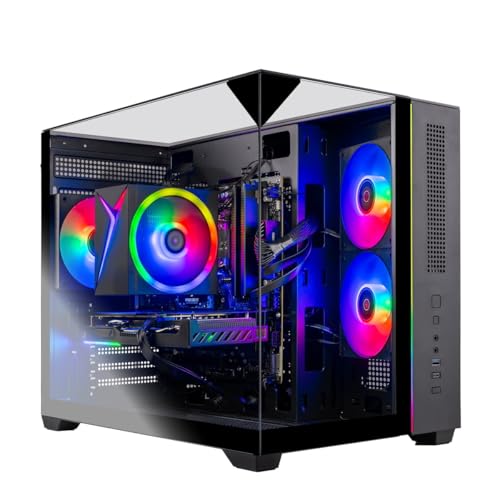
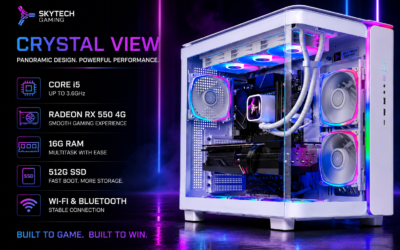
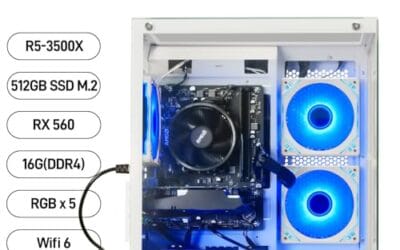
The Skytech Gaming Crystal is a good example of why hardware context matters more than vague fear about preinstalled apps. At $1,199.99 with a 4.4 rating, its listed hardware includes an AMD Ryzen 7 5700 at 3.7GHz, NVIDIA RTX 5060 graphics, 32GB of DDR4-3200 memory, a 1TB NVMe SSD, a 650W Gold PSU, Wi-Fi, and Windows 11. We can’t claim which third-party utilities ship on this exact unit, so the smarter question is whether the system gives you enough headroom to absorb normal Windows background activity. With 32GB RAM and a dedicated GPU, there’s more room than you’d have on a basic office PC.

Pros
- 8-core, 16-thread Ryzen 7 5700 avoids CPU bottleneck for RTX 5060 at 1080p ultra
- 32GB DDR4-3200 exceeds the 16GB gaming baseline for streaming and heavy multitasking
- Triple tempered glass Crystal case with ARGB airflow fans suports thermals under sustained load
Cons
- Zero owner reviews at time of writing, so long-term reliability data is unavailable
- AM4 socket is end-of-life, capping future CPU upgrades at the Ryzen 5000 series
- 650W PSU and 8GB VRAM leave limited headroom for upgrading to higher-TGP GPUs later
The Skytech Crystal is a mid-range prebuilt gaming PC pairing an 8-core AMD Ryzen 7 5700 on AM4 with an NVIDIA RTX 5060 8GB GDR7, 32GB DDR4-3200, and a 1TB NVMe SSD. It targets 1080p high-refresh esports players and AAA gamers who want a plug-and-play tower with a warranty.
The RTX 5060 8GB GDDR7 is the defining component and sits in the 1080p ultra bracket, with GPUs at this tier typically hitting 60+ FPS in modern AAA titles and well above 144 FPS in Valorant, CS2, and Overwatch 2. DLSS 4 and frame generation extend usable headroom into 1440p.
Trade-offs are real at this tier. AM4 is a dead-end socket, so future CPU upgrades stop at the 5000 series. DDR4-3200 lags the DDR5-6000 sweet spot on AM5 builds, and the 8GB VRAM buffer will pressure ray tracing at 1440p in heavier titles. The 650W PSU also limits future GPU upgrades.
Buy this if you want a 1080p ultra or 1440p DLSS-assisted gaming PC with zero build time and a one year parts warranty. Skip this if you plan to upgrade to an RTX 5070 Ti class GPU or move to DDR5, since the AM4 board and 650W PSU will bottleneck that path.
1080p Ultra: The RTX 5060 8GB GDDR7 is a 1080p-first card. Expect 60+ FPS ultra in Baldur's Gate 3, Black Myth Wukong, and ELDEN RING at native resolution, and 240+ FPS in Valorant, CS2, and Overwatch 2 paired with a high-refresh 1080p monitor.
1440p and DLSS 4: 8GB VRAM is the ceiling. 1440p is playable with DLSS Quality and frame generation in most AA titles, but path-traced or heavy ray tracing loads at 1440p can saturate the VRAM buffer in games like Alan Wake 2 and Cyberpunk 2077 Overdrive.
CPU pairing: The Ryzen 7 5700 is an 8-core, 16-thread AM4 chip at 3.7GHz base and 4.6GHz boost. It feeds the RTX 5060 without meaningful bottleneck at 1080p ultra or 1440p, and handles OBS NVENC streaming since encode load lives on the GPU.
Memory and storage: 32GB DDR4-3200 with heat spreaders is above the 16GB gaming baseline and covers moded Minecraft, Escape from Tarkov, and Chrome-heavy multitasking. The 1TB NVMe M.2 SSD stores roughly six to eight modern AAA installs before Call of Duty class titles force selective uninstalls.
The longer explanation
Bloatware is a loose word. On prebuilts, it can mean trial antivirus, vendor launchers, RGB control panels, updater services, browser bookmarks, game-store shortcuts, warranty registration pop-ups, backup tools, or cloud storage offers. Some of those are harmless shortcuts. Some are genuinely useful, like a driver utility or fan-control app. Others run constantly and add little value once the PC is configured. The tricky part is that you shouldn’t assume a specific machine includes a specific app unless the seller says so.
For gaming, the biggest concern is background behavior. A launcher that sits idle isn’t the same as a real-time scanner, updater, telemetry service, or overlay that wakes up mid-session. If you’re playing a CPU-sensitive esports title at 1080p, extra background tasks can affect consistency more than average frame rate. If you’re playing a GPU-heavy single-player game at 1440p, the RTX 5060 or another dedicated GPU will usually be the bigger limiter. Different bottleneck. Different fix.
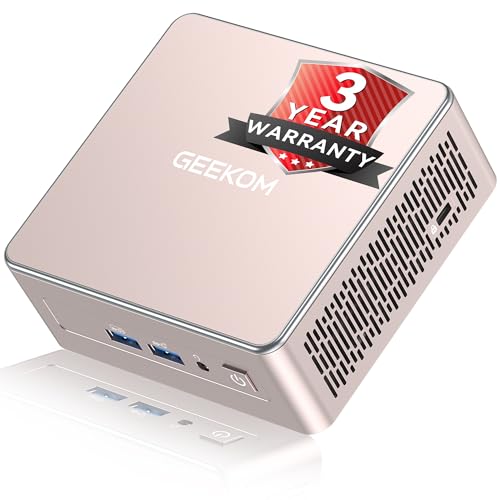
Mini PCs change the conversation. The GEEKOM A5 2026 Edition is listed at $399 with a 4.2 rating, an AMD Ryzen 5 7430U, 16GB of RAM upgradeable to 64GB, a 512GB M.2 NVMe SSD, Windows 11 Pro, 8K support, six USB ports, and 3-year coverage. That’s a capable small desktop for home office and multitasking, but it isn’t described as a gaming tower with a discrete GPU. On a machine like that, background apps can feel more noticeable because you’re often sharing system memory and thermal headroom with everything else. You’ll feel clutter sooner.
History / how we got here
Preinstalled software became common because PC makers wanted to reduce support calls, steer buyers toward account registration, bundle limited-time services, and include hardware utilities without asking new owners to hunt for downloads. In the Windows 7 and Windows 8 era, that often meant heavy trialware and multiple vendor-branded utilities. Modern Windows 11 systems are usually cleaner, but they’re not empty. Microsoft adds its own apps, vendors add their own setup flows, and component makers may require control software for lighting or fan curves.
Gaming PCs added another layer because RGB lighting, motherboard utilities, GPU control panels, audio suites, Wi-Fi drivers, and storefront apps all compete for space in the startup list. Some buyers call all of it bloat. That’s not quite fair. If your fans, lighting, or keyboard macros need a utility, removing it blindly can break features you wanted. But if three apps are only there to sell subscriptions or nag you after boot, you don’t need to keep them. Easy call.
Why it works this way
A prebuilt seller has to ship a PC that works for a wide range of people on day one. That means Windows activation, Wi-Fi, GPU drivers, chipset drivers, audio, Bluetooth, vendor support links, and sometimes a central dashboard. The cleanest possible install is great for enthusiasts, but it can be intimidating for someone who just wants to plug in a monitor and start downloading games. Vendors err toward more help, more prompts, and more bundled services.
The downside is that Windows startup becomes a shared space. Every app wants an icon in the tray. Every updater wants permission to run. Every overlay wants to sit on top of your game. Individually, the impact may be tiny. Together, they can stretch boot time, consume 500MB to 2GB of memory, and make system behavior harder to read. If a game stutters, is it the GPU driver, shader compilation, a Windows update, a cloud sync job, or a security scan? That’s the hidden cost: not always lower performance, but more noise while diagnosing it.
When you’d want this
You’d want some preinstalled software when it controls real hardware features or saves you setup time. A gaming tower with Wi-Fi, a dedicated GPU, RGB lighting, and multiple case fans may need driver packages and control panels. The Skytech listing mentions Wi-Fi and Windows 11 alongside its Ryzen 7 5700, RTX 5060, 32GB DDR4-3200, 1TB NVMe SSD, and 650W Gold PSU. Those specs are the reasons to consider it for gaming, not any assumed software bundle. If a utility helps update drivers or manage lighting, keep it until you’re sure it isn’t needed.
You’d also accept some setup software on a mini PC if it helps warranty registration, firmware updates, or driver recovery. The GEEKOM A5 2026 Edition’s $399 price, Ryzen 5 7430U, 16GB RAM, 512GB NVMe SSD, Windows 11 Pro license, six USB ports, and 3-year coverage make it more of a compact productivity box than a classic gaming rig. For light gaming, emulation, streaming, or cloud gaming, a tidy Windows install helps because you’re working with a smaller power envelope. Don’t panic about bundled utilities, but don’t leave random startup items running forever either.
Pros
- Ryzen 5 7430U 6-core Zen 3 refresh chip covers everyday productivity and light creative loads
- User-serviceable DDR4 and NVMe unlike soldered LPDR mini PCs, easier long-term upgrades
- Four display outputs including 8K capable USB Type-C fits multi-monitor office setups
Cons
- Limited owner feedback at time of writing, real-world reliability data is thin
- DR4 and Vega 7 platform is a Zen 3 refresh, not competitive with newer Zen 4 mini PCs
- No 2.5GbE or Thunderbolt listed, networking and dock options trail current mid-range mini PCs
The GEEKOM A5 2026 Edition is a compact mid-range mini PC built around the AMD Ryzen 5 7430U, a 6-core Zen 3 refresh APU paired with Radeon Vega 7 graphics. With 16GB DDR4, a 512GB NVMe SSD, and Windows 11 Pro preinstalled, it targets home office users and small business deployments needing a tidy behind-monitor box.
The defining feature is upgradability in a 4.6 by 4.4 inch chassis. Dual DR4 SO-DIMM slots scale to 64GB, and storage stacks across an M.2 NVMe slot, an M.2 2242 slot, and a 2.5 inch bay for up to 10TB per GEKOM. Vega 7 iGPUs in this class typically drive 4K desktop work and light 1080p esports, not modern AA titles.
Trade-offs are typical at this tier. The 7430U is a rebadged Zen 3 part on DDR4, so IPC and iGPU throughput trail current Ryzen 7040and8040 mini PCs on DDR5. Source data does not specify LAN speed, Thunderbolt, or sustained TDP, so heavy sustained multithread loads may throttle in the smallABS and metal shell.
Buy this if you want a serviceable Windows 11 Pro mini PC for spreadsheets, browser tabs, Teams cals, and multi-monitor office work with room to add RAM and storage later. Skip this if you need Zen 4 IPC, DDR5 bandwidth, discrete GPU performance, or 2.5GbE networking for NAS and creative workflows.
CPU and iGPU: The Ryzen 5 7430U is a 6-core, 12-thread Zen 3 refresh APU with Radeon Vega 7 graphics. This class of chip is a clear step up from the 500U, 4300U, and 3500U GEEKOM calls out, and it comfortably handles Office, browser-heavy workflows, 4K video playback, and 1080p video calls.
Memory and storage: Two DDR4 SO-DIMM slots scale to 64GB, giving headroom for large Excel models, Chrome tab sprawl, and Adobe Lightroom catalogs. The PCIe NVMe bot drive is upgradable to 4TB, with an additional M.2 242 slot and 2.5 inch SATA bay pushing total capacity to a stated 10TB.
Display output: Four simultaneous displays are supported via 2 HDMI and 2 USB 3.2Gen 2 Type-C outputs, with 8K signaling over Type-C. For office multitasking this covers dual 4K monitors plus a laptop-style secondary panel without a dock.
Connectivity: WiFi 6 and Bluetooth 5.2 handle wireless peripherals and cloud sync, and the unit ships with 6 USB ports per the listing. Wired LAN speed, Thunderbolt support, and exact port breakdown are not specified in the source.
What to look for in a prebuilt bloatware decision
Start with specs, then judge cleanup difficulty. A $1,199.99 tower with an RTX 5060, 32GB RAM, and a 1TB NVMe SSD has enough hardware that software clutter is usually fixable after purchase. A $399 mini PC with 16GB RAM and integrated graphics depends more on CPU efficiency, memory use, and thermal behavior, so you’ll want startup apps leaner from day one. Neither product should be praised or criticized for specific bundled apps unless those apps are documented. Keep it fair.
Before buying, scan the seller page for Windows edition, warranty terms, driver support, and whether the system uses common off-the-shelf parts. After buying, open Settings, Apps, Startup, and Task Manager before installing your whole game library. Disable obvious nonessential startup entries first, leave driver utilities alone until you know what they do, and create a restore point before removing anything tied to RGB, Wi-Fi, audio, motherboard controls, or system updates. If your goal is 1440p gaming, the GPU and cooling still matter more than a few extra shortcuts, which is why comparisons like prebuilt gaming PCs for 1440p should stay hardware-first.
Common misconceptions
The first misconception is that all prebuilt software is malicious or useless. It isn’t. Some utilities are part of the support path, especially for firmware, wireless drivers, RGB, fan curves, and warranty service. The second misconception is that removing everything always improves gaming. Sometimes it does. Sometimes it just removes a useful updater and leaves you with more manual work later.
The third misconception is that a clean Windows install fixes every prebuilt problem. It can make the machine feel fresher, but it won’t turn an integrated-graphics mini PC into a dedicated-GPU tower, and it won’t compensate for weak cooling or a tiny SSD. The fourth is that bloatware is only a desktop issue. Laptops and mini PCs can feel it more because they usually have tighter thermal limits and less upgrade room. So, yes, cleanup matters. But specs first.
Frequently asked
Does bloatware lower gaming FPS?
It can, but the effect depends on what is running. Startup shortcuts won’t matter much, while active scanners, overlays, cloud sync tools, or updaters can cause stutter or brief frame-time spikes. On a tower with 32GB RAM and a dedicated GPU, the effect is usually smaller than on a compact PC with shared resources. You’ll notice background clutter most in CPU-sensitive games and during the first minutes after boot.
Should I do a clean Windows install on a new prebuilt?
Not automatically. A clean install can remove clutter, but it can also remove drivers, support tools, and recovery software you’ll want later. Start by disabling startup apps and uninstalling obvious trial programs. If the PC still feels messy after updates and driver checks, then a clean install becomes more reasonable.
Is a mini PC more affected by bloatware than a gaming tower?
Often, yes. A mini PC like the GEEKOM A5 2026 Edition has a Ryzen 5 7430U, 16GB RAM, and a compact thermal design, so extra background activity can feel more obvious during multitasking or light gaming. A larger gaming tower has more cooling room and, if equipped with a dedicated GPU, more gaming headroom. Still, both benefit from a tidy startup list.
Can I remove vendor control software?
Sometimes, but don’t rush it. If the software controls RGB, fan behavior, hotkeys, Wi-Fi drivers, audio settings, or updates, removing it may break features or make maintenance harder. Disable it from startup first if you’re unsure. If nothing changes after a week, uninstalling is safer.
What matters more than bloatware for a gaming prebuilt?
The GPU, CPU, RAM amount, SSD capacity, cooling, power supply, case airflow, and warranty matter more. For example, the Skytech Gaming Crystal’s RTX 5060, Ryzen 7 5700, 32GB DDR4-3200, 1TB NVMe SSD, and 650W Gold PSU tell you much more about gaming potential than a vague worry about software clutter. Clean up Windows after setup, but don’t let software anxiety distract from the hardware list.



Write Your Review
No reviews yet. Be the first to share your experience!