

The best power supply for a gaming PC in 2026 has to do more than match a wattage number. New GPUs lean on ATX 3.1, PCIe 5.1, and native 12V-2×6 or related cabling, while smaller cases make noise and cable routing harder than they used to be. A good PSU should give your graphics card stable power, leave headroom for upgrades, and avoid turning the whole build into a cable mess.
We researched five current units across compact SFX, mainstream 850W, and 1000W upgrade tiers using the available listing data: prices, ratings, efficiency claims, connector support, form factor, and stated features. If you’re planning the rest of the build too, pair this with our guides to gaming GPUs and gaming CPUs so the PSU isn’t chosen in isolation. Power is boring until it isn’t.

Pros
- ATX 3.1 compliant with PCIe 5.1 support, resists transient spikes from RTX 50 and RX 9000 series GPUs.
- Zero RPM Mode eliminates fan noise at low and medium loads, a real advantage in acoustically sensitive SFF builds.
- Fully modular design with short SFX cables reduces cable management friction in sub-10-liter cases.
- 105 degree C Japanese capacitors indicate quality component selection typical of high-tier SFX units.
Cons
- Limited owner feedback at time of writing; real-world noise, ripple, and transient performance are unverified by community data.
- Short SFX cables are unsuitable for mid-tower or full-tower cases without aftermarket cable extensions.
- 750W ceiling may fall short for extreme SFF builds pairing a 300W-plus TGP GPU with a high-core-count CPU.
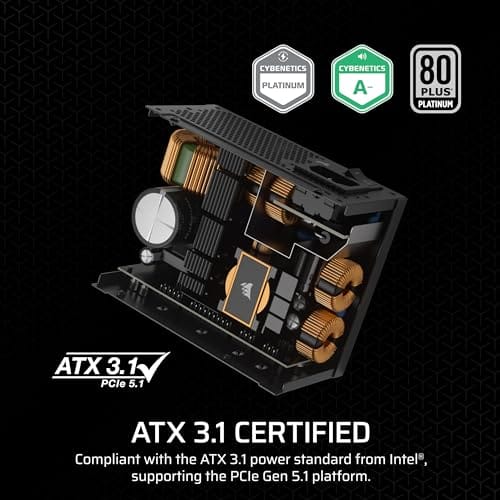
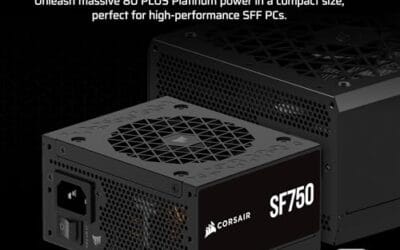
The Corsair SF750 (2024) is a high-end SFX PSU targeting SFF builders who need substantial wattage in a compact footprint. With 80 Plus Platinum certification and ATX 3.1 compliance, it sits at the upper tier of the SFX market, aimed at builders pairing it with current-gen discrete GPUs inside sub-10-liter cases.
The most defining specification here is ATX 3.1 compliance combined with PCIe 5.1 readiness. This means the unit is rated to handle the sharp transient power spikes that RTX 50 and RX 9000 series GPUs can produce, where non-compliant PSUs may trigger overcurrent protection. At 750W, it covers most single-GPU SFF configurations without derating concerns.
The honest trade-off is the review data gap. At time of writing, no substantial owner feedback exists to validate Corsair's noise and ripple claims under real load. The Zero RPM Mode claim and 92mm fan acoustics are based on spec sheets only. Buyers should also note that SFX cable lengths are intentionally short and will not reach connectors in mid-tower or larger cases without extensions.
Buy this if you are building an SFF PC around a single high-TGP GPU and need confirmed ATX 3.1 compliance in a modular SFX unit. Skip this if you want a large ATX case build, need more than 750W for a dual-component high-wattage system, or require extensive owner testing before purchasing.
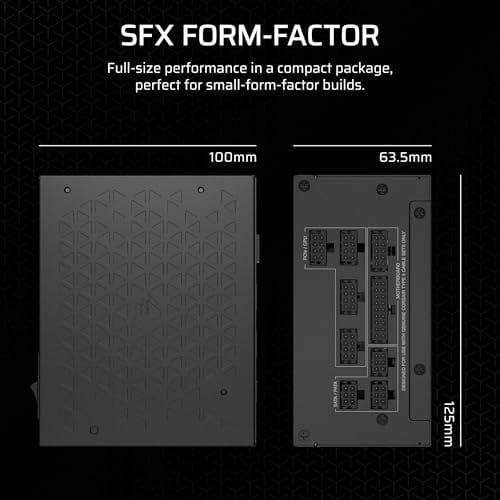
Form Factor and Mounting: This is a standard SFX form factor PSU, not SFX-L. Verify your case specifies SFX compatibility before purchasing. An SFX-to-ATX bracket is included, allowing installation in ATX-footprint cases, though short cable lengths will require extensions in anything larger than a compact SFF enclosure.
Power Standard and Connector: ATX 3.1 compliant with PCIe 5.1 readiness. The unit supports the 12V-2x6 connector standard, relevant for RTX 40 and RTX 50 series GPUs as well as AMD RX 7000 and RX 9000 cards with high transient draw. Non-ATX 3.1 units can trigger OCP shutdowns above 150 percent peak load spikes.
Efficiency and Thermal Operation: 80 Plus Platinum certification indicates roughly 92 percent efficiency at 50 percent load under 115V. The 92mm PWM fan uses a fluid dynamic bearing and Zero RPM Mode activates at low loads, which in SFF cases where airflow is restricted can noticeably reduce system acoustic output.
GPU Wattage Pairing: At 750W, this PSU pairs appropriately with GPUs up to approximately 300W TGP when combined with a mid-range CPU. For a 320W-plus TGP GPU alongside a 65W-plus CPU, headroom becomes tight and a higher-wattage SFX unit should be considered instead.

Pros
- Native 12V-2x6 connector on ATX 3.1 platform ready for RTX 40 and PCIe 5.1 GPUs.
- Handles power excursions up to 2000W transient, headroom for RTX 4080 and 4090 class spikes.
- Semi-passive zero-RPM mode below moderate load keps idle acoustics near inaudible.
- LLC topology with single 12V rail delivers stable voltage regulation for overclocked GPUs.
Cons
- Limited independent owner feedback available at time of writing, riple and hold-up data unverified.
- Only four PCIe 6+2-pin connectors, tight for legacy multi-GPU or high-CPU-EPS custom lop builds.
- 80 PLUS Gold trails Platinum and Titanium units at similar wattage on sustained efficiency.
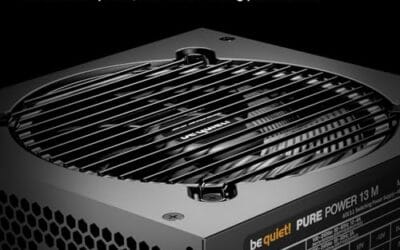
The be quiet! Pure Power 13 M 1000W is a high-end ATX 3.1 PSU aimed at builders pairing a Ryzen 7000/9000 or Core Ultra CPU with an RTX 4070Ti Super,4080 Super, 4090, or RX 7900 XTX class GPU. It targets buyers who want native 12V-2x6 wiring and transient headroom without stepping up to Platinum-tier pricing.
The defining trait is ATX 3.1 compliance with power excursion handling up to double the rated 1000W, meaning brief 2000W spikes from modern GPUs should not trip OCP. Combined with the single 12V rail and LLC topology, this suits overclocked GPUs where transient behavior, not average draw, tends to triger shutdowns on older units.
Trade-offs are typical at this tier. 80 PLUS Gold is eficient but not Platinum, soustained heavy loads generate more heat than a higher-rated unit. Four PCIe 6+2-pin connectors is standard, though builders running EATX boards with dual EPS plus a 4x8-pin GPU adapter should verify cable counts against the modular panel before buying.
Buy this if you are building a single-GPU gaming or content rig around a 250-450W TGP card and want native 12V-2x6 without paying Platinum prices. Skip this if you need sub-audible acoustics under sustained full load, or if you already own a workingATX 3.0 unit with a 12VHPWR pigtail.
ATX standard: Full ATX 3.1 compliance with native 12V-2x6 connector integration, which corects the sense-pin issue found on early 12VHPWR cables. Supports PCIe 5.1 GPUs at spec, and handles transient power excursions up to 2000W, roughly double the 1000W continuous rating.
GPU pairing: Comfortable for GPUs in the 250W to 450W TGP range, including RTX 4080 Super (320W) and RTX 4090 (450W) with headroom for overclocking. Four PCIe 6+2-pin outputs cover legacy 8-pin GPUs; the native 12V-2x6 removes the need for a 4x8-pin adapter dongle.
Efficiency and cooling: 80 PLUS Gold rated up to 94.4% at optimal load, typically around 50% utilization. The 120mm be quiet! fan runs semi-passive with zero-RPM below a load threshold not specified by the manufacturer, so idle and light workloads should remain silent.
Cabling: Fully modular design, leting builders omit unused SATA and Molex leads. Exact cable lengths and connector counts beyond the four PCIe 6+2-pin and single 12V-2x6 are not specified in source material, verify against your case routing before purchase.

Pros
- ATX 3.1 native readiness handles 12V-2x6 transient spikes on modern RTX 40and 50 series GPUs.
- 80 Plus Platinum plus Cybenetics Lambda A+ signals strong efficiency and low acoustic output.
- GaN MOSFETs and large ROG heatsinks target lower internal temperatures than reference platforms.
- Dual ball bearing fan and 0dB mode balance longevity with silent light-load operation.
- Long warranty at this eficiency tier reduces long-term ownership risk for high-end builders.
Cons
- Limited owner feedback at time of writing, so long-term coil whine and ripple data is thin.
- 1000W is overkill for mid-range GPUs like an RTX 4060or RX 7600 class card.
- Detailed specs including cable count, rail layout, and dimensions are not specified in source data.
The ROG Strix 1000W Platinum is a high-end ATX 3.1 fully modular PSU aimed at builders pairing a recent flagship or near-flagship GPU with a mainstream to high-end CPU. With 80 Plus Platinum and Cybenetics Lambda A+ ratings, it targets buyers who care about efficiency, acoustics, and transient headroom rather than the cheapest wat-per-dollar option.
The defining feature is the GaN MOSFET topology paired with ASUS' GPU-first voltage sensing. ASUS claims up to 30% better efficiency and up to 45% improved voltage delivery to the graphics card, which should translate into steadier rail behavior during GPU power spikes. Actual ripple and load-regulation numbers are not specified in source data.
Trade-offs are typical at this tier. 1000W is generous for a single RTX 4070 or 4080 class card but leaves less margin for dual high-TGP GPUs, which are rare anyway. Cable length, connector count, and dimensions are not specified, so case fitment in compact ATX or SFF chassis should be verified against the official datasheet before purchase.
Buy this if you are building a high-end ATX system around an RTX 40 or 50 series GPU and want ATX 3.1 transient tolerance with quiet 0dB behavior at idle. Skip this if your GPU sits below 250W TGP, since a 750W Gold unit will cover that load with less spend.
Standard and eficiency: ATX 3.1 compliant with 80 Plus Platinum certification and Cybenetics Lambda A+ acoustic rating. This pairing indicates high efficiency across typical 20to 100 percent load bands and low measured fan noise, which matters for builds targeting sub-30 dBA idle acoustics.
GPU pairing: 1000W total capacity leaves comfortable transient headroom for a single 320 to 450W TGP GPU such as an RTX 4080Super or RTX 4090class card. ATX 3.1 and 12V-2x6 readiness address the power excursion spec that olderATX 2.x units can trip on.
Cooling and acoustics: Uses a dual ball bearing fan with 0dB technology for passive operation under light gaming or desktop loads. ROG heatsinks over primary switching components target lower component temperatures than reference designs. Exact fan size, curve, and dB ratings are not specified in source data.
Cabling and chassis fit: Fully modular cabling reduces clutter in mid-tower and full-tower ATX builds. Exact PSU length, native 12V-2x6 cable inclusion, PCIe 8-pin count, SATA count, and Molex count are not specified in source data, so confirm against the officialASUS spec sheet before committing to compact cases.

Pros
- Native 12V-2x6 connector avoids janky adapter setups on RTX 40 and 50 series GPUs.
- ATX 3.1 spec resists PCIe 5.1 transient spikes thatip cheaper PSUs into shutdown.
- Fully modular design simplifies cable management and reduces unused cable clutter in the case.
- Cybenetics Gold eficiency translates to lower idle draw and quieter fan behavior under mixed loads.
- Low-noise tuning and flexible embossed cables suit quiet-focused ATX builds.
Cons
- Limited owner feedback at time of writing makes long-term reliability hard to verify.
- 1000W is overkill for mid-range builds pairing with an RTX 4070 or below.
- Corsair does not publish specifics like OEM platform, fan bearing, or waranty term in the source listing.
The Corsair RM1000x is a high-end 1000W ATX 3.1 PSU aimed at builders running current-gen NVIDIA and AMD GPUs that pull heavy transient loads. Fully modular cabling and a native 12V-2x6 connector target buyers assembling RTX 4080, 4090, or upcoming 5080 class rigs where adapter dongles are a known pain point.
The defining feature is ATX 3.1 with PCIe 5.1 readiness paired with the direct 12V-2x6 cable. This maters because modern GPUs can briefly spike well above rated TGP, and olderATX 2.x units often shut down under those excursions. Cybenetics Gold efficiency up to 91% suggests low fan ramp at typical gaming loads based on category norms.
Trade-offs are typical at this wattage. 1000W is more than a single-GPU RTX 4070 or 4070 Super build needs, so you pay for headroom you may not use. The source listing does not specify OEM platform, hold-up time, ripple figures, waranty length, or fan bearing type, so independent bench data is worth checking before purchase.
Buy this if you are pairing a 300W plus GPU with aRyzen 9 or Core i9 and want native 12V-2x6 with transient spike compliance. Skip this if your GPU draws under 220W, where a 750W or 850W unit covers you with room to spare.
ATX standard and PCIe support: The unit isATX 3.1 compliant with PCIe 5.1 readiness, which is the spec written to handle GPU power excursions up to roughly 3x rated TGP for short durations. That makes it a match for RTX 40 and 50 series cards without derating the PSU.
GPU connector: A native 12V-2x6 cable runs directly from the PSU to the GPU, no4x8-pin to 16-pin adapter. This is the updated H++ pin design that mitigates the seating and thermal issues seen on early 12VHPWR implementations.
Wattage pairing: 1000W is the sensible flor for RTX 4090 and future5090 class GPUs paired with a 170W plus CPU like the Core i9-14900K or Ryzen 9 9950X3D. For a 4080Super or 5080 tier build, it leaves comfortable headroom for overclocking and transients.
Efficiency and cabling: Cybenetics Gold rated up to 91% efficiency, with fully modular embossed cables and low-profile combs. Modular design lets you omit unused SATA and Molex runs, which helps airflow in mid-tower ATX cases with restricted PSU shrouds.

Pros
- 80 PLUS Gold efficiency rating is clearly stated (at 115Vac input).
- Fully modular design helps reduce cable clutter and improves build serviceability.
- Smart Zero Fan feature prioritizes low noise at idle and light loads.
- Compact 140mm depth is helpful for cases with limited PSU shroud space.
- 10-year warranty is listed, which is strong for this wattage class.
Cons
- PCIe and CPU power connector counts and types are not specified in the listing, so GPU compatibility needs verification.
- Fan size is inconsistent across the listing (12cm/120mm and 140mm both mentioned).
- ATX standard compliance (ATX 3.0/3.1, 12VHPWR or 12V-2x6) is not specified, which matters for newer GPUs.
- Protection features are mentioned but not itemized (OCP/OVP/OTP/OPP/UVP/SCP not specified).
The Thermaltake Toughpower GF1 850W is a mid-range, fully modular ATX power supply aimed at mainstream enthusiast builds that want solid efficiency and a quieter idle profile. It is a sensible fit for single-GPU gaming PCs and creator workstations where stable power delivery and tidy cabling matter more than chasing niche features.
The defining behavior here is its Smart Zero Fan mode, where the fan stays off until the PSU reaches a certain load percentage, which is a common approach to reduce idle and desktop noise. With 850W available and a single +12V rail using a DC-to-DC design, this class of unit is typically used for higher-draw CPUs and GPUs without feeling constrained by power headroom, assuming the included cable set matches your hardware needs.
Physically, the unit is listed at 150mm (W) x 86mm (H) x 140mm (D), and that shorter 140mm depth can simplify routing in cases where the PSU area is tight or the shroud is crowded with cables. Cooling is described as fluid dynamic bearing, but the fan size is inconsistent in the listing (12cm/120mm is stated in the specs, while 140mm is mentioned in the features).
The main trade-offs are around missing details that experienced builders often check first. The listing does not specify the exact connector mix (CPU EPS, PCIe 8-pin, SATA, peripheral), and it also does not state whether it targets newer ATX 3.x requirements or includes 12VHPWR/12V-2x6 cabling, which can matter depending on your GPU.
Buy this if you want a compact, fully modular 850W Gold PSU with a fan-stop mode and a long listed warranty. Skip this if you need confirmed ATX 3.x support or a specific connector layout and cable type, since those details are not provided in the listing.
| Model / P/N | MODEL: TPD-850AH2FLG; P/N: PS-TPD-0850FNFAGU-P |
| Wattage | 850W (max output capacity listed as 850W) |
| Efficiency | 80 PLUS Gold (listed as meeting Gold at 115Vac input) |
| Modularity | Fully modular |
| Rail design | Single +12V rail (high amperage) with DC-to-DC design |
| PFC | Active PFC |
| Fan and noise mode | Smart Zero Fan; Cooling system listed as 12cm FDB fan; features also mention 140mm fluid bearing fan (listing discrepancy) |
| Dimensions | 150mm (W) x 86mm (H) x 140mm (D) |
| Input voltage | 100-240V |
| Input frequency | 50Hz/60Hz |
| Power Good signal | 100-150 msec |
| Hold-up time | 17 msec |
| Operating temperature | +5°C to +40°C |
| Operating humidity | 20% to 85% |
| Storage temperature | -40°C to +55°C (listed as 40°C to plus 55°C) |
| Storage humidity | 10% to 95% |
| Low-power states | Intel C6/C7 state and ErP Ready |
| Protections | Built-in industrial grade protections (types not specified) |
| Connectors | Not specified in the listing |
| ATX version / PCIe 5 power | Not specified in the listing |
| Warranty | 10-year warranty (listed) |
| Safety approvals | FCC/cTUVus |
PC and case fit: The PSU is listed at 140mm depth, which is helpful in many mid-tower layouts and tighter PSU shrouds where extra cable slack can become a problem.
CPU and GPU pairing: An 850W unit is commonly chosen for higher-end single-GPU systems, but exact suitability depends on your CPU and GPU power targets and transient behavior. Use the PSU headroom to avoid running near maximum output under sustained workloads.
Power connectors: The listing does not specify the number or type of PCIe and EPS cables, and it does not mention 12VHPWR or 12V-2x6. Before buying, confirm the included cable set matches your GPU (and any required adapters) and your motherboard CPU power inputs.
Acoustics and airflow planning: Smart Zero Fan keeps the fan off at lighter loads, which can make a desktop or low-load workstation noticeably quieter. Ensure your case has reasonable ventilation, since fan-stop designs rely more on passive heat dissipation at idle.
Power behavior and uptime: The spec sheet lists a 17 msec hold-up time and a 100-150 msec power-good signal, which are relevant for stability during brief input dips. If you use a UPS, match it to your system draw and consider a sine-wave unit for best compatibility.
Who this guide is for
This guide is for builders choosing a PSU for a gaming desktop with a modern GPU, especially if the card uses newer power connectors or the case has limited space. It covers a $88.99 850W Gold option, several 1000W ATX 3.1 units, and a compact 750W SFX model. That range makes sense because not every gaming PC needs 1000W, but many higher-end builds benefit from extra headroom.
It skips bargain-bin mystery units, old ATX models without current GPU support, and inflated wattage claims with weak platform details. We won’t claim ripple results, cable gauge, fan curves, or electrical performance numbers that aren’t in the listing. Instead, we’re using the product titles as the hard boundary: 80 Plus Gold or Platinum, ATX 3.1, PCIe 5.1 readiness, modular cabling, low-noise language, Cybenetics mentions, warranty where listed, and the stated wattage.
What to look for in a power supply for a gaming PC
Start with wattage, but don’t stop there. An 850W unit can be plenty for many strong single-GPU builds, while 1000W gives more upgrade room for overclocked GPUs, higher-end CPUs, and future graphics cards. The Thermaltake GF1 lists 850W, 80 Plus Gold, full modular cabling, ultra quiet operation, and Zero RPM. The be quiet! Pure Power 13 M, ASUS ROG Strix, and Corsair RM1000x all list 1000W, which makes them better suited to heavier configurations.
Next, check standards and cables. ATX 3.1 and PCIe 5.1 support matter for newer GPU power behavior, and a native 12V-2×6 connector can simplify cabling. Efficiency also matters, with 80 Plus Gold and Platinum options in this batch. Fully modular cabling is a real quality-of-life feature because you’ll only install the cables you need. You’ll thank yourself during the build. Twice.
How we evaluated
We researched five products across the assigned PSU batch, then compared them by wattage, form factor, efficiency certification, modular design, modern GPU support, price, and rating. The Corsair SF750 is $159.99 with a 4.1 rating. The be quiet! Pure Power 13 M 1000W is $139.90 with a 4.8 rating. The ASUS ROG Strix 1000W Platinum is $217.99 with a 4.8 rating. The Corsair RM1000x is $166.24 with a 4.4 rating. The Thermaltake GF1 850W is $88.99 with a 4.0 rating.
Review counts were not available, so we didn’t use volume of owner feedback as a ranking factor. We weighted fit first: SFX for compact builds, 850W value for mainstream gaming, and 1000W ATX 3.1 for higher-end systems. Then we considered efficiency tier, connector language, acoustic claims, and price. A $217.99 Platinum unit with a 10-year warranty can make sense for a premium build, but a $88.99 Gold 850W supply may be the better call for a sensible midrange tower.
Our top picks
Best Overall: be quiet! Pure Power 13 M 1000W
The be quiet! Pure Power 13 M 1000W is the strongest overall match for many 2026 gaming builds because it balances modern standards, wattage, price, and rating. At $139.90 with a 4.8 rating, it lists 80 Plus Gold certification, ATX 3.1 support, PCIe 5.1 GPU support, a semi-passive 120mm be quiet! fan, LLC technology, a single rail, and positioning for overclocked GPUs. That’s a lot of relevant PSU language for the money.
Its main tradeoff is efficiency tier. Gold is solid, but it isn’t Platinum, and the listing doesn’t mention a 10-year warranty like the ASUS title does. Still, the combination of 1000W, ATX 3.1, PCIe 5.1 support, and a lower price than the ASUS and Corsair RM1000x makes it the easiest broad recommendation. If you’re building around a power-hungry GPU and don’t need SFX sizing, this should be near the top of your list.
Best Budget: Thermaltake GF1 Fully Modular ATX 850W
The Thermaltake GF1 is the value pick at $88.99 with a 4.0 rating. It lists 850W output, 80 Plus Gold efficiency, full modular cabling, ultra quiet operation, and Zero RPM. For a mainstream gaming PC with one graphics card, 850W can be a very reasonable target, especially if you’re not chasing the most power-hungry GPU and CPU combination available. The full modular design is especially welcome at this price.
The catch is that the listing doesn’t state ATX 3.1 or PCIe 5.1 support, so buyers with the newest high-end GPUs should confirm cabling and compatibility before choosing it. It’s best for builders who want a cleaner, affordable 850W Gold unit rather than maximum future-proofing. If your GPU requirements are modest and your case is standard ATX, this Thermaltake gives you the essentials without pushing past $100.
Best Premium: ASUS ROG Strix 1000W Platinum
The ASUS ROG Strix 1000W Platinum is the premium choice in this group. At $217.99 with a 4.8 rating, it lists full modular cabling, 80 Plus Platinum certification, ATX 3.1, Cybenetics Lambda A+, GaN MOSFET, GPU-First Intelligent Voltage Stabilizer, and a 10-year warranty. For an expensive gaming build, those listing details line up with what many buyers want: efficiency, modern GPU support, quietness credentials, and long-term coverage.
The weakness is obvious: price. It’s $78.09 more than the be quiet! 1000W unit in this batch and $51.75 more than the Corsair RM1000x. You should buy it if the Platinum rating, warranty mention, and ASUS ROG feature set matter to you. If you’re trying to stretch budget toward a better GPU, the cheaper 1000W options may be smarter.
Best Compact Build: Corsair SF750 2024
The Corsair SF750 2024 is the pick for small-form-factor gaming PCs. It costs $159.99 with a 4.1 rating and lists a fully modular SFX design, low-noise operation, 80 Plus Platinum efficiency, ATX 3.1 compliance, PCIe 5.1 readiness, small form factor sizing, and an included bracket. That last detail matters because compact builds often involve odd mounting and cable routing decisions.
The tradeoff is wattage. 750W can be enough for many efficient gaming builds, but it leaves less headroom than the 850W and 1000W units here. You shouldn’t buy the SF750 just because it’s Platinum if your GPU and CPU combination wants more overhead. Buy it because your case needs SFX, your parts fit the power envelope, and you value a compact, fully modular PSU from Corsair.
Best 1000W Value: Corsair RM1000x ATX 3.1
The Corsair RM1000x ATX 3.1 is a strong 1000W value at $166.24 with a 4.4 rating. The listing states PCIe 5.1 readiness, full modular cabling, low-noise operation, Cybenetics Gold efficiency, and a native 12V-2×6 connector. That native connector is a useful detail for newer graphics cards because it can reduce adapter clutter and keep the cable run cleaner in a gaming tower.
Its downside is that it costs more than the be quiet! Pure Power 13 M while carrying a lower listed rating in this batch. It also uses Gold efficiency rather than Platinum. Even so, Corsair’s RMx line positioning, 1000W capacity, ATX 3.1 language, and native 12V-2×6 connector make it an easy shortlist item for builders who want a modern PSU with straightforward GPU cabling.
Buying mistakes to avoid
Also check the case before you click buy. SFX units like the Corsair SF750 solve space problems in compact cases, but a normal ATX tower usually gives you more PSU choices and longer cable reach. On the other hand, a full-size 1000W unit may not fit every small chassis cleanly. Measure the PSU bay, note the GPU cable path, and leave room behind the motherboard tray for modular leads.
Don’t choose a PSU by wattage alone. A cheap high-watt unit with poor cabling or outdated GPU support can be more annoying than a slightly lower-watt unit with the right standards. For current gaming builds, ATX 3.1 and PCIe 5.1 language deserve attention, especially if you’re using a newer GPU. Fully modular cabling also matters more than first-time builders expect because unused cables block airflow and make the case harder to close.
Don’t overspend blindly either. A 1000W Platinum PSU is nice, but it may not improve your gaming experience if the rest of the PC is midrange. Put money where it changes the build: enough wattage, correct connectors, good efficiency, the right form factor, and reasonable noise behavior. After that, the GPU or SSD budget may deserve the extra cash. That’s the unglamorous answer, but it’s usually right.
Cable planning is part of the value calculation too. A native connector, full modular layout, or included bracket can save time, reduce adapter clutter, and make the finished PC easier to service later.
Bottom line
The be quiet! Pure Power 13 M 1000W is our overall pick for the best power supply for a gaming PC in 2026 because it combines 1000W capacity, ATX 3.1, PCIe 5.1 GPU support, 80 Plus Gold certification, a semi-passive 120mm fan, and a 4.8 rating at $139.90. It fits the widest range of modern gaming builds without forcing a premium price.
Choose the Thermaltake GF1 if you want an affordable 850W Gold unit, the ASUS ROG Strix if you want the premium Platinum option with the longest warranty mention, the Corsair SF750 if you’re building small, and the Corsair RM1000x if you want 1000W with a native 12V-2×6 connector. Match the PSU to the GPU, case, and upgrade plan. Then forget about it for years.
Do not size the PSU only around today’s GPU either. A supply is one of the parts most builders keep through multiple upgrades, so spending for modern ATX support, clean cabling, and enough headroom often saves money later. The right unit should run quietly now and still make sense after a graphics-card swap.
Common questions
Is 850W enough for a gaming PC in 2026?
For many single-GPU gaming PCs, yes. Higher-end GPUs, heavy CPU loads, and upgrade plans may justify moving to 1000W instead.
Do I need ATX 3.1 for a new gaming build?
You don’t always need it, but ATX 3.1 is worth prioritizing if you’re buying a PSU for a modern GPU platform and want cleaner long-term compatibility.
Is 80 Plus Platinum worth it over Gold?
Platinum can improve efficiency and often appears on higher-end models, but Gold is still a strong choice when the unit has the wattage and connectors you need.
Why choose an SFX power supply?
Choose SFX when your case requires it or benefits from the smaller size. The Corsair SF750 is the compact option in this batch.
Which PSU should most builders buy from this list?
Most builders should start with the be quiet! Pure Power 13 M 1000W because it offers modern standards, strong listed wattage, and a competitive price.
Efficiency and acoustics matter after wattage. A Gold or Platinum unit wastes less heat, which lets the fan stay quieter under normal gaming loads. Modular cables help airflow too, since you only install the leads your build actually needs. That combination is what separates a merely adequate PSU from one you keep for years.
Finally, look at warranty length and connector support together. A long warranty is reassuring only if the unit already has the cables your next GPU will need. For a modern gaming PC, ATX 3.1 support, a native high-power GPU cable, and enough SATA or PCIe leads for your storage and accessories should all be checked before price breaks the tie.
That checklist keeps the PSU useful beyond this build later.



Write Your Review
No reviews yet. Be the first to share your experience!