

You hit the power button and nothing happens. No fans spinning, no RGB glow, no beep, no reassuring whir from the tower. Just silence and a blank monitor. When a PC won’t turn on and the power supply is the prime suspect, the good news is that a dead build usually traces back to a handful of ordinary faults, and most of them cost nothing to rule out. We researched the common failure points, cross-checked owner reports across build forums, and pulled together a plain-English path from “totally dead” to “back up and running.”
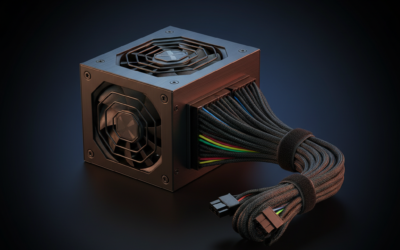
A power supply unit, or PSU, is the box that converts wall AC into the clean DC rails your motherboard, CPU, and GPU actually drink from. It’s easy to blame it first because a truly dead PSU makes everything downstream look broken too. But before you buy a replacement, it pays to confirm the diagnosis. If you do end up shopping, our guides to the best modular PSU for a gaming PC in 2026 and the best 1000W PSU picks for 2026 break down what actually matters. For a high-draw rig, the 1000W options for a high-end GPU are worth a look too. First, though, let’s find out if the unit’s really the problem.
First check the obvious (the 30-second check)
Start with the boring stuff, because that’s where the fix usually hides. Is the wall outlet live? Plug a lamp or phone charger into it. Is the PSU’s own rocker switch, the little I/O toggle on the back of the unit, flipped to I? People bump it while cleaning behind the desk all the time. Confirm the C13 power cable is seated firmly at both ends, wall side and PSU side. A cable that looks plugged in can still be a millimeter shy of contact.
Next, the front-panel connector. That thin cluster of wires running from your case’s power button to the motherboard header (labeled PWR_SW or PWR BTN) works loose more often than you’d think, especially after a move or a case swap. If the header’s off by one pin, the button does nothing. Try jumping the two power pins with a screwdriver for a second. If the system springs to life that way, your button or its wiring is the culprit, not the PSU. Thirty seconds, zero dollars, and you’ve already eliminated half the usual suspects.
One more quick look while you’re back there. Peek inside the case for any standby lights. Most motherboards have a small LED that glows when the board is receiving power, sometimes a dedicated debug light, sometimes just a faint glow near the 24-pin. If that light is on but nothing boots, power is reaching the board and your problem sits downstream of the PSU. If the board is completely dark with the rear switch on and the cable seated, the supply or its connection is the more likely story. That single indicator narrows the search fast.
Cause #1: A tripped PSU protection or a genuinely dead unit
Modern supplies carry over-current, over-voltage, and short-circuit protection. When one of those trips, the unit latches off and refuses to start until it’s fully de-powered. To reset it, flip the rear switch to O, pull the wall cable, then hold the case power button for 15 to 30 seconds to drain residual charge. Wait a full minute, reconnect, and try again. A one-time trip from a brownout or a static event will often clear this way.
If it stays dead, do the paperclip jump. With the PSU unplugged from everything, bridge the green PS_ON wire to any black ground on the 24-pin connector, then flip the switch. If the PSU fan spins, the unit powers on under a basic load, though that’s not a clean bill of health. If it still won’t spin, the supply’s likely gone. A failed PSU that can’t hold its rails is the classic reason a build reads as completely dead. Owner reports point to units in the 5-to-7 year range, or ones that survived a surge, as the frequent offenders. If you’re running a compact build and need a replacement that fits an SFX bracket, the Corsair SF750 is a common pick. It’s an 80 Plus Platinum, fully modular SFX unit rated for 750W, ATX 3.1 compliant and PCIe 5.1 ready, priced around $159.99 with a 4.1 rating, and the bracket’s included for standard ATX cases.
A word on what “dead” really tells you. The paperclip jump only proves the supply can turn on with no real hardware attached. It’s a go/no-go check, not proof the rails are stable under a gaming load. A unit can pass the jump and still collapse the moment your GPU pulls current. So treat a spinning fan as encouraging, not conclusive. If you have a spare known-good supply, the fastest confirmation is simply swapping it in for a few minutes. Boot with the spare, and if the system comes alive, you’ve found your answer without guesswork. That’s the single most reliable way to isolate a flaky PSU from a board fault.

Pros
- ATX 3.1 compliant with PCIe 5.1 support, resists transient spikes from RTX 50 and RX 9000 series GPUs.
- Zero RPM Mode eliminates fan noise at low and medium loads, a real advantage in acoustically sensitive SFF builds.
- Fully modular design with short SFX cables reduces cable management friction in sub-10-liter cases.
- 105 degree C Japanese capacitors indicate quality component selection typical of high-tier SFX units.
Cons
- Limited owner feedback at time of writing; real-world noise, ripple, and transient performance are unverified by community data.
- Short SFX cables are unsuitable for mid-tower or full-tower cases without aftermarket cable extensions.
- 750W ceiling may fall short for extreme SFF builds pairing a 300W-plus TGP GPU with a high-core-count CPU.
The Corsair SF750 (2024) is a high-end SFX PSU targeting SFF builders who need substantial wattage in a compact footprint. With 80 Plus Platinum certification and ATX 3.1 compliance, it sits at the upper tier of the SFX market, aimed at builders pairing it with current-gen discrete GPUs inside sub-10-liter cases.
The most defining specification here is ATX 3.1 compliance combined with PCIe 5.1 readiness. This means the unit is rated to handle the sharp transient power spikes that RTX 50 and RX 9000 series GPUs can produce, where non-compliant PSUs may trigger overcurrent protection. At 750W, it covers most single-GPU SFF configurations without derating concerns.
The honest trade-off is the review data gap. At time of writing, no substantial owner feedback exists to validate Corsair's noise and ripple claims under real load. The Zero RPM Mode claim and 92mm fan acoustics are based on spec sheets only. Buyers should also note that SFX cable lengths are intentionally short and will not reach connectors in mid-tower or larger cases without extensions.
Buy this if you are building an SFF PC around a single high-TGP GPU and need confirmed ATX 3.1 compliance in a modular SFX unit. Skip this if you want a large ATX case build, need more than 750W for a dual-component high-wattage system, or require extensive owner testing before purchasing.
Form Factor and Mounting: This is a standard SFX form factor PSU, not SFX-L. Verify your case specifies SFX compatibility before purchasing. An SFX-to-ATX bracket is included, allowing installation in ATX-footprint cases, though short cable lengths will require extensions in anything larger than a compact SFF enclosure.
Power Standard and Connector: ATX 3.1 compliant with PCIe 5.1 readiness. The unit supports the 12V-2x6 connector standard, relevant for RTX 40 and RTX 50 series GPUs as well as AMD RX 7000 and RX 9000 cards with high transient draw. Non-ATX 3.1 units can trigger OCP shutdowns above 150 percent peak load spikes.
Efficiency and Thermal Operation: 80 Plus Platinum certification indicates roughly 92 percent efficiency at 50 percent load under 115V. The 92mm PWM fan uses a fluid dynamic bearing and Zero RPM Mode activates at low loads, which in SFF cases where airflow is restricted can noticeably reduce system acoustic output.
GPU Wattage Pairing: At 750W, this PSU pairs appropriately with GPUs up to approximately 300W TGP when combined with a mid-range CPU. For a 320W-plus TGP GPU alongside a 65W-plus CPU, headroom becomes tight and a higher-wattage SFX unit should be considered instead.
Cause #2: Loose or wrong power connectors on the board
Here’s the trap that catches a lot of first-time builders. A motherboard needs two separate power feeds to boot: the big 24-pin ATX connector along the edge, and the 8-pin (or 4+4) EPS connector up near the CPU socket. If only the 24-pin is plugged in, many boards give you nothing. No fans, no post, no error. It looks exactly like a dead PSU. Owner reports on this are endless, and the EPS cable is easy to forget because it hides behind the cooler.
Reseat both connectors firmly until they click. On modular supplies, check the other end too, at the PSU side, because a partially inserted modular cable is just as fatal. While you’re in there, don’t mix cable sets between different PSU brands or models. Modular pinouts are not standardized, and a cable from one unit plugged into another can dump the wrong voltage into your board. That’s a fast way to fry components. Match every cable to the exact supply it shipped with, and reseat the GPU’s PCIe power leads as well, since a modern card that can’t get power sometimes stalls the whole boot.
Cause #3: An undersized or failing supply under load
Sometimes the PC does something. Fans twitch for half a second, then everything cuts out and retries in a loop. That short spin-then-die pattern usually means the supply can’t hold voltage the instant a real load hits, which points to an aging unit or one that’s simply too small for the hardware. A modern GPU can spike well past its rated draw for milliseconds, and a tired or undersized PSU folds under that transient. If you added a bigger graphics card and the trouble started right after, you’ve probably outgrown the old supply.
For a standard ATX tower with a hungry GPU, moving up to a 1000W unit gives you headroom for those spikes without the fan screaming. The be quiet! Pure Power 13 M 1000W is a solid candidate here: 80 Plus Gold certified, ATX 3.1 with PCIe 5.1 support, a single-rail design, and a semi-passive 120mm fan that stays quiet at idle. It’s around $139.90 with a 4.8 rating and is built with overclocked GPUs in mind. If you overclock, our rundown of the best 1000W PSUs for overclocking digs into why transient response matters so much.

Pros
- Native 12V-2x6 connector on ATX 3.1 platform ready for RTX 40 and PCIe 5.1 GPUs.
- Handles power excursions up to 2000W transient, headroom for RTX 4080 and 4090 class spikes.
- Semi-passive zero-RPM mode below moderate load keps idle acoustics near inaudible.
- LLC topology with single 12V rail delivers stable voltage regulation for overclocked GPUs.
Cons
- Limited independent owner feedback available at time of writing, riple and hold-up data unverified.
- Only four PCIe 6+2-pin connectors, tight for legacy multi-GPU or high-CPU-EPS custom lop builds.
- 80 PLUS Gold trails Platinum and Titanium units at similar wattage on sustained efficiency.
The be quiet! Pure Power 13 M 1000W is a high-end ATX 3.1 PSU aimed at builders pairing a Ryzen 7000/9000 or Core Ultra CPU with an RTX 4070Ti Super,4080 Super, 4090, or RX 7900 XTX class GPU. It targets buyers who want native 12V-2x6 wiring and transient headroom without stepping up to Platinum-tier pricing.
The defining trait is ATX 3.1 compliance with power excursion handling up to double the rated 1000W, meaning brief 2000W spikes from modern GPUs should not trip OCP. Combined with the single 12V rail and LLC topology, this suits overclocked GPUs where transient behavior, not average draw, tends to triger shutdowns on older units.
Trade-offs are typical at this tier. 80 PLUS Gold is eficient but not Platinum, soustained heavy loads generate more heat than a higher-rated unit. Four PCIe 6+2-pin connectors is standard, though builders running EATX boards with dual EPS plus a 4x8-pin GPU adapter should verify cable counts against the modular panel before buying.
Buy this if you are building a single-GPU gaming or content rig around a 250-450W TGP card and want native 12V-2x6 without paying Platinum prices. Skip this if you need sub-audible acoustics under sustained full load, or if you already own a workingATX 3.0 unit with a 12VHPWR pigtail.
ATX standard: Full ATX 3.1 compliance with native 12V-2x6 connector integration, which corects the sense-pin issue found on early 12VHPWR cables. Supports PCIe 5.1 GPUs at spec, and handles transient power excursions up to 2000W, roughly double the 1000W continuous rating.
GPU pairing: Comfortable for GPUs in the 250W to 450W TGP range, including RTX 4080 Super (320W) and RTX 4090 (450W) with headroom for overclocking. Four PCIe 6+2-pin outputs cover legacy 8-pin GPUs; the native 12V-2x6 removes the need for a 4x8-pin adapter dongle.
Efficiency and cooling: 80 PLUS Gold rated up to 94.4% at optimal load, typically around 50% utilization. The 120mm be quiet! fan runs semi-passive with zero-RPM below a load threshold not specified by the manufacturer, so idle and light workloads should remain silent.
Cabling: Fully modular design, leting builders omit unused SATA and Molex leads. Exact cable lengths and connector counts beyond the four PCIe 6+2-pin and single 12V-2x6 are not specified in source material, verify against your case routing before purchase.
Preventive maintenance
A little upkeep buys years. Dust is the quiet killer, so blow out the PSU intake and the case filters every few months with short bursts of compressed air, PSU switched off. Put the whole system behind a real surge protector or, better, a small UPS, because dirty grid power and brownouts age capacitors fast. Don’t run a supply pinned near 100% of its rating for hours on end. Sizing your PSU so typical load lands around 50 to 70% keeps it cool, quiet, and long-lived. And leave the rear switch on so the standby rail can keep the board’s residual capacitors happy between sessions.
Heat and airflow matter too. Make sure the PSU’s own fan has clearance and isn’t smothered against a dust filter or a wall of cables. If your case mounts the supply fan-down, confirm the bottom vent has a filter and that it isn’t sitting flush on carpet, which chokes intake and cooks the unit over time. Keep an eye on the little things: a faint electrical smell, a fan that suddenly ramps for no reason, or coil whine that gets louder month over month. Those are early warnings that the supply is under strain. Catching them before a hard failure means you replace on your schedule, not in the middle of a dead boot.
When it’s not fixable: what to replace
If the reset didn’t take, the paperclip jump failed, and both board connectors are seated, the supply itself is the part to swap. A PSU is not something to nurse along once it’s flaky, because a dying unit can take other components with it. Buy from a known brand with a real warranty, pick the correct form factor for your case, and give yourself wattage headroom over your peak draw.
For a small-form-factor or Mini-ITX build, an SFX unit like the Corsair SF750 drops into the tight bays those cases use, and the included bracket lets it sit in a full ATX opening if you’re moving up later. For a standard mid-tower, the be quiet! Pure Power 13 M 1000W covers a high-end single-GPU rig with room to spare. If you’re matching a supply to a specific chip, our PSU guide for the 9800X3D walks through the pairing. Either way, confirm the modular cables you use are the ones made for that exact unit.
Tools and parts needed
You don’t need much. A Phillips #2 screwdriver, a can of compressed air, and a paperclip or jumper for the bench check cover the diagnosis. Keep a spare known-good C13 power cable around, since a bad cord mimics a dead PSU perfectly. If you’re replacing the unit, have zip ties or Velcro for cable management and your case’s manual handy for the connector layout. That’s the whole kit. Nothing exotic.
A few more questions
How do I know it’s the PSU and not the motherboard?
Do the paperclip jump first. If the PSU fan spins on its own but the board stays dark with everything connected, the board or its power connectors are suspect. If the PSU won’t spin even jumped, the supply’s the problem. It’s the cheapest check to run before you swap anything, and it isolates the two most likely culprits in about a minute.
Can a dead PSU damage other parts?
A unit that fails outright usually just stops, but one that fails while delivering unstable voltage can stress the motherboard, drives, or GPU. That’s why a supply throwing intermittent shutdowns shouldn’t be nursed along. Replace it with a reputable model that has proper protection circuitry, and don’t reuse mismatched modular cables that could feed the wrong rail into your board.
What wattage should I buy as a replacement?
Add up your CPU and GPU peak draw, then leave 30 to 40% headroom for transient spikes. A mainstream gaming rig is comfortable on 750W to 850W, while a high-end GPU build is happier on 1000W. Our 1000W picks for a gaming build and the small-form-factor 1000W options cover both ends if you want specific models.









Write Your Review
No reviews yet. Be the first to share your experience!