

Spend twenty minutes reading forum threads and you’ll see the same fight over and over: wired purists swearing by lag-free audio, wireless fans who never want a cable snagging their chair again. The honest answer is that the gap has shrunk a lot. A modern 2.4GHz headset like the Picun G2 quotes 5ms latency, which is close enough to wired that most players can’t feel it. So the real question isn’t which technology wins. It’s what each price tier actually buys you. If you’re still narrowing your shortlist, our roundups of the best wireless gaming headset and the best gaming headset overall pair well with this breakdown.
We researched both sides using two representative products: the $59.99 Picun G2, which does 2.4GHz, Bluetooth 5.4, and wired all in one unit, and the $124.92 Logitech G733 Lightspeed, a wireless-first design. Different budgets, different priorities. Here’s how the choice really shakes out.
Matchup at a glance
Wired headsets keep things simple. Plug a 3.5mm or USB cable into your PC or controller and you’re done. No battery to charge, no dongle to lose, no firmware to update. The tradeoff is obvious the moment you stand up: you’re tethered to your desk, and a snagged cable can yank the headset off your ears or pull your controller mid-match.
Wireless splits into two camps. Bluetooth is convenient and works with phones, but it adds noticeable audio delay that competitive players hate. A dedicated 2.4GHz dongle is the answer, and it’s what both the Picun G2 and the Logitech G733 use for their low-latency mode. That’s why a budget 2.4GHz set can feel just as responsive as a pricier one. The money mostly buys you build quality, mic processing, and battery headroom, not raw speed.
Keep one thing in mind as you weigh the two. The comparison isn’t really wired against wireless anymore, because most good wireless headsets still include a wire in the box for the low-battery moments. So you’re rarely giving up wired entirely. What you’re deciding is whether wireless is your default mode or your backup. That reframing makes the price question a lot easier to answer, and it’s why so many enthusiasts stopped treating the two as rivals.
Spec sheet showdown
| Feature | Wired (general) | Wireless (general) | Picun G2 ($59.99) | Logitech G733 ($124.92) |
|---|---|---|---|---|
| Connection | 3.5mm / USB cable | 2.4GHz dongle or Bluetooth | 2.4GHz + BT 5.4 + wired | 2.4GHz Lightspeed |
| Latency | Effectively zero | 5ms (2.4GHz) up to 100ms+ (BT) | 5ms ultra-low | Lightspeed low-latency |
| Battery | None needed | 20 to 100+ hours | Up to 100 hours | Rated for all-day use |
| Mic | Varies | Varies | ENC noise-canceling | Blue VO!CE processing |
| Rating | n/a | n/a | 4.5 stars | 4 stars |
Wired strengths
The case for wired is short and hard to argue with. There’s zero latency, no battery anxiety, and usually a lower price for the same driver quality. You never open a match at 8 percent charge. You never wonder if a firmware update bricked your dongle. For a stationary desktop setup where the tower sits within a cable’s reach, wired removes a whole category of problems.
It’s also the safe pick for pure audio value. Because you’re not paying for a radio, a battery, and a charging circuit, more of your budget goes toward the drivers and pads. That’s why a lot of enthusiasts keep a wired set as their main and treat wireless as a convenience luxury. The one real weakness is freedom of movement. Cables snag, tangle, and wear out at the connector over time.
Wireless strengths
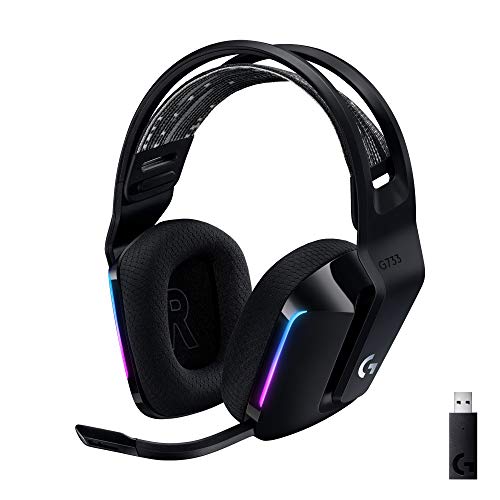
Wireless earns its keep in comfort and flexibility. You can lean back, grab a drink, and walk to the door without ripping the headset off. The Logitech G733 leans hard into this with a suspension headband that spreads weight across your head instead of pinning it to two contact points, plus Lightsync RGB and Blue VO!CE mic processing that cleans up your voice for teammates and streams. At $124.92 and a 4-star rating, it’s built for people who live in their chair for long sessions.
The knock on wireless used to be lag. That argument is mostly dead for 2.4GHz gear. The G733 uses Lightspeed for a low-latency link, and cheaper sets hit similar numbers, so the delay you’ll actually notice only shows up on Bluetooth. What you’re really paying extra for at this tier is the headband design, the PRO-G audio drivers, and the mic software. If those matter to you, the premium is easy to justify.
Weight matters more than people expect on long nights. The G733 is famously light, and that suspension band keeps the clamp gentle so your temples aren’t sore after a raid. Cheaper wireless sets can skimp here, using thinner pads that heat up and pinch. It’s not a spec you’ll see on the box, but it’s the difference between a headset you forget you’re wearing and one you’re constantly adjusting. That comfort tax is a real part of what your money buys at this price.
Pros
- Lightspeed wireless with 20 meter range handles typical living room and desk distances
- Up to 29 hours battery life covers multi-day use between charges
- Blue VO!CE mic processing in G HUB improves clarity for Discord and streaming
- Suspension headband and low mass design reduce clamp fatigue during long sessions
- Dual-zone Lightsync RGB with 16.8M colors is customizable through G HUB
Cons
- PS4 output limited to stereo, no suround on older PlayStation hardware
- Driver size, frequency response, and mic pattern not specified in source data
The Logitech G733 is a mid-tier wireless gaming headset targeting PC, PS5, PS4, and Nintendo Switch users who want a lightweight all-day fit. It leans on Lightspeed 2.4GHz wireless, PRO-G drivers, Blue VO!CE mic processing, and a reversible suspension headband, aimed at multi-hour gamers and streamers.
The defining feature is the combination of Lightspeed wireless with a quoted 20 meter range and up to 29 hours of battery. In practice this covers full workdays plus evening sessions without a charge cycle. PRO-G drivers, per Logitech, reduce distortion, and headsets in this tier typically deliver a mildly V-shaped tuning suited to positional FPS cues.
Trade-offs are typical at this price point. PS4 users are locked to stereo output with no virtual surround. Driver diameter, impedance, and frequency response are not published in the source data, so absolute output quality is hard to benchmark against wired competitors. There is no Bluetooth fallback listed, so mobile pairing is not supported.
Buy this if you want a light, long-battery 2.4GHz wireless headset for PC or PS5 with a usable broadcast-style mic. Skip this if you need wired low-latency USB, Bluetooth multipoint, or vendor-published driver and frequency response specs before purchase.
Drivers and tuning: Logitech lists PRO-G drivers tuned for reduced distortion, though exact driver diameter and frequency response are not specified in the source. Headsets in this tier typically ship with 40 to 50mm dynamic drivers and a mildly V-shaped response suited to explosions and footstep cues in FPS gameplay.
Connection and latency: Lightspeed 2.4GHz wireless with a stated 20 meter range covers desk and living room use. Compatibility is confirmed for PC, PS5, PS4 (stereo only), and Nintendo Switch. Bluetooth and wired 3.5mm fallback are not listed in the source, so single-dongle 2.4GHz is the only documented path.
Battery life: Rated up to 29 hours per charge, enough for roughly three to four full evening sessions before recharging. Exact charge time and USB-C versus micro-USB charging port are not specified in the source data.
Microphone: Detachable mic with Blue VO!CE filters configured in G HUB, providing EQ, noise reduction, and de-eser presets useful for Discord and Twitch chat. Mic polar pattern, sensitivity, and frequency range are not disclosed in the source specifications.
Real-world scenarios
Competitive FPS on a desktop
Here wired or 2.4GHz both work. The 5ms figure on a set like the Picun G2 is well under the threshold most players can detect, so you won’t lose a gunfight to your headset. Skip Bluetooth for this. Its delay is real and you’ll feel it.
Long RPG and streaming marathons
This is where wireless comfort pays off. The G733’s suspension headband and lighter clamp make five-hour sessions easier on your skull, and Blue VO!CE keeps your stream audio clean. Battery life covers a full day, so charging becomes a routine, not an interruption.
Console and couch gaming
If you play PS5, PS4, or Switch from the sofa, wireless is the clear win because you’re nowhere near a jack. Both headsets here list console support. A 2.4GHz dongle in the console’s USB port gives you low latency without a cable stretched across the living room.
Tight budget, one headset for everything
A hybrid like the Picun G2 is the smart hedge. It does 2.4GHz for gaming, Bluetooth 5.4 for your phone, and plain wired when the battery dies. One set, three modes, under sixty bucks. That flexibility is genuinely hard to beat at the price.
Pricing and availability
The two products here bracket the range nicely. The Picun G2 sits at $59.99 with a 4.5-star rating and packs three connection modes plus a claimed 100-hour battery, which is a lot of headset for the money. The Logitech G733 runs $124.92 with a 4-star rating and trades raw feature count for polish: the suspension headband, PRO-G drivers, and Blue VO!CE mic. Both are widely stocked. Prices on gaming audio move around a lot during sales, so it’s worth checking before you commit.
One note on value. Because 2.4GHz latency is basically solved, the extra $65 between these two isn’t buying you speed. It’s buying comfort, mic quality, and brand-name driver tuning. That’s a fair trade for some people and pure overkill for others.
Which to buy
If you sit at a desk, care most about audio value, and don’t mind a cable, a wired or hybrid set is the rational choice. If you want freedom, a comfy headband for marathon sessions, and clean mic processing, wireless is worth the premium, and the G733 is a solid representative of that tier.
For most people reading this, though, the hybrid answer wins. The Picun G2 gives you 2.4GHz gaming, Bluetooth for your phone, and a wired fallback in one $59.99 package, so you’re not locked into a single mode. It’s the pick that refuses to make you choose. Buy the premium wireless set if comfort and mic polish are your top priorities; otherwise the flexible budget option covers nearly every situation.

Pros
- Three connection modes on a single headset: 2.4GHz dongle, Bluetooth 5.4, and 3.5mm wired fallback.
- Vendor-rated 5ms 2.4GHz latency keps audio synced in competitive shooter scenarios.
- Long rated runtime, up to 100 hours in Bluetooth with RGB disabled for travel use.
- RetractableENC microphone tucks away, useful when switching between gaming and general listening.
Cons
- Limited owner feedback at time of writing, real-world reliability and QC signal is unverified.
- 7.1 surround is virtual DSP, not true multi-driver, so positional accuracy varies by title andear.
- RGB lighting materially cuts battery life, cited100-hour figure requires lighting turned off.
The Picun G2 is a budget-tier wireless gaming headset built around 40mm drivers, virtual 7.1 surround, and tri-mode connectivity across2.4GHz, Bluetooth 5.4, and 3.5m wired. Target buyer is a multi-platform player rotating between PC, PS5, PS4, and Switch who wants low-latency wireless without moving up to established brand pricing.
The defining feature is the tri-mode radio stack. The 2.4GHz USB-A or Type-C dongle is rated at 5ms latency, which is competitive for the tier and adequate for most FPS titles, while Bluetooth 5.4 handles phones and tablets. Headsets in this class typically deliver serviceable rather than reference-grade imaging, and virtual 7.1 leans on DSP rather than discrete drivers.
Trade-offs are typical at this tier. Battery figures are optimistic: 100 hours assumes Bluetooth with RGB off, and 2.4GHz drops the number to 42 to 45 hours. Driver material, impedance, frequency response, clamp force, and weight are not specified, so tonal balance and long-session comfort cannot be verified from source data alone.
Buy this if you want one headset that jumps between a PS5, a Switch dock, and a work laptop over Bluetooth, and you accept spec-sheet-only marketing. Skip this if you rely on measured frequency response, discrete suround, or detachable bom mics with broadcast-grade pickup for streaming.
Drivers and tuning: Picun specifies 40mm dynamic drivers paired with virtual 7.1 surround processing. Impedance, sensitivity, and frequency response are not specified, so bass extension and treble air cannot be quantified from source. Virtual 7.1 is DSP-based positional widening, useful for FPS cues but not equivalent to true multi-driver surround.
Connectivity and latency: Three modes are covered: 2.4GHz via USB-A or USB-C dongle, Bluetooth 5.4, and 3.5mm analog. The 2.4GHz link is rated at 5ms latency. Bluetooth codec support (SBC, AAC, aptX) is not specified, which maters for wireless music quality on phones and tablets.
Battery and power: Rated up to 100 hours on Bluetooth with RGB off, and 42 to 45 hours on 2.4GHz wireless. Play-while-charging is supported, so a USB cable can extend sessions past the rated ceiling. Charge time and battery capacity in mAh are not specified.
Microphone: Retractable omnidirectional bom with ENC noise reduction. Sample rate, bit depth, and pickup pattern beyond omni are not specified.ENC filtering targets background noise on the transmit side, adequate for party chat but below dedicated USB mic quality.
Common questions
Is wireless gaming audio really as fast as wired now?
For 2.4GHz connections, effectively yes. A set like the Picun G2 quotes 5ms latency, which sits below what most players can perceive. Bluetooth is the exception, since it adds a delay you can hear, so use the 2.4GHz dongle for competitive play and save Bluetooth for music and calls.
Does a wired headset always sound better?
Not automatically, but dollar for dollar it often does. Since you’re not funding a radio and a battery, more of the price lands on the drivers. At the same budget a wired set can have an audio edge, though a well-tuned wireless set like the G733 with PRO-G drivers closes that gap.
Will a wireless headset work with my PS5 or Switch?
Usually, if it ships a 2.4GHz USB dongle. Both headsets here list PC, PS5, PS4, and Switch support. Plug the dongle into the console’s USB port and you’re set. Always confirm the specific platform on the product page before buying.
How long do gaming headset batteries last?
It varies widely by model. The Picun G2 claims up to 100 hours, which is unusually high, while many premium sets land closer to 20 to 40 hours because they run RGB and heavier processing. If you hate charging, a big battery rating should weigh heavily in your decision.
Is a hybrid headset worth it over a wireless-only one?
If you value flexibility, absolutely. A hybrid like the Picun G2 does 2.4GHz, Bluetooth 5.4, and wired, so a dead battery never sidelines you and one headset covers your PC, console, and phone. Wireless-only sets can feel more premium, but they lock you into a single connection path.































Write Your Review
No reviews yet. Be the first to share your experience!