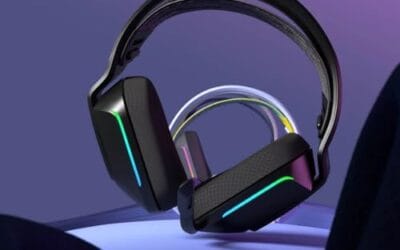

The best wireless gaming headsets in 2026 should clear three bars: 100+ hour battery so you never charge mid-session, dual-platform compatibility for PC plus PlayStation, and a noise-canceling mic that drops keyboard clatter from Discord. The four HyperX Cloud Alpha models below cover every form of that need.
Top Products

Pros
- 300 hour battery rating dwarfs the typical 40 to 80 hour 2.4GHz competitor range
- Dual chamber driver design targets cleaner bass separation from vocal and treble ranges
- Detachable boom mic and aluminum frame improve durability and out-of-game usability
Cons
- Limited owner fedback at time of writing makes long-term reliability hard to verify
- No Bluetooth support restricts pairing to PC and PlayStation over the 2.4GHz dongle
- Leatherette pads and unspecified weight may cause heat buildup on longer summer sessions
The HyperX Cloud Alpha Wireless is a mid-range 2.4GHz gaming headset built around a dual chamber driver system and an aluminum frame. It targets PC gamers who want long untethered sessions without dropping to Bluetooth latency, and who prefer memory foam leatherette pads over sportier mesh cups.
The defining spec is the 300 hour battery rating over 2.4GHz, roughly four to seven times what competing wireless headsets deliver in this class. Based on owner reports for similar HyperX models, expect weeks between charges at moderate volume. DTS Headphone:X handles positional cues, though virtualization quality varies by game engine.
Bluetooth is absent, so pairing with phones or a Nintendo Switch in handheld mode is not on the table. Leatherette ear cushions trap more heat than mesh alternatives during long sessions, typical at this tier. Driver diameter, weight, clamp force, and cable length are not specified in the source data.
Buy this if you play primarily on PC or PlayStation over 2.4GHz and want to charge the headset once a month rather than nightly. Skip this if you need Bluetooth for phone calls, active noise cancelling for travel, or a lighter mesh-pad design for warm rooms and long summer sessions.
Drivers and Tuning: HyperX uses a dual chamber driver that separates bass frequencies from mids and highs, aiming to reduce low-end bleed into vocal ranges. Frequency response spans 15 Hz to 21 kHz, wider than the typical 20 Hz to 20 kHz spec, though driver diameter is not specified in the source data.
Wireless and Latency: Connection uses a 2.4GHz USB dongle rather than Bluetooth, keeping input latency low enough for competitive play. Bluetooth pairing is not listed, so mobile use is not an option. Wireless range in meters and Xbox compatibility are not specified in the manufacturer data.
Battery Life: Rated up to 300 hours per charge, well above the 40 to 80 hour norm for 2.4GHz gaming headsets. Real-world runtime depends on volume, and no RGB lighting is present to drain reserves. Charge time and fast-charge top-up behavior are not specified in the source.
Microphone and Spatial Audio: A detachable noise-cancelling boom mic covers voice chat duties, with sensitivity, pickup pattern, and frequency range not specified. DTS Headphone:X provides virtual surround for positional cues in shooters, activated through NGENUITY on PC. Console spatial audio support is not clarified in source data.

Pros
- Manufacturer-rated 120 hours on 2.4GHz and 200 hours over Bluetooth reduces charging cadence
- Wide platform support covers PC, PS5, PS4, Switch, Mac, and mobile via Bluetooth
- USB-A and USB-C dongle options included, simplifying use across desktops, laptops, and handhelds
- Detachable boom mic with LED mute cue is practical for streaming and mixed voice or music use
Cons
- Limited owner fedback at time of writing, so long-term reliability and QC signal are unclear
- Leatherette cushions typically trap heat during extended sessions compared to fabric or hybrid pads
- Spatial Audio activation is PC-only, limiting virtual suround benefits on consoles and mobile
The HyperX Cloud III S Wireless is a mid-range multi-platform gaming headset built around 53mm angled drivers, an aluminum frame, and dual 2.4GHz plus Bluetooth radios. It targets PC and console players who want one headset across desktop, PS5, Switch, and mobile without juggling multiple dongles or wired connections between sessions.
The defining feature is dual-mode wireless with a manufacturer-rated 120 hours on 2.4GHz and 200 hours over Bluetooth. In practical terms, that suports a full work-plus-play week between charges for most owners. Angled 53m drivers, based on HyperX tuning notes, are aimed at emphasizing gaming cues like footsteps, gunfire, and directional effects.
Trade-offs are typical at this tier. Leatherette pads seal well for bass but tend to warm up during long summer sessions compared to hybrid mesh alternatives. Spatial Audio is a PC-only lifetime activation, so console users lose that layer of positional processing. Owner feedback is thin at time of writing, so long-term hinge, mic, and battery behavior remain unproven.
Buy this if you want a single wireless headset that jumps between PC, PS5, Switch, and a phone with minimal cable management. Skip this if you prefer breathable fabric pads, need console-side virtual surround, or want a mature review track record before committing.
Drivers and tuning: HyperX specifies 53mm angled drivers tuned in-house to accent dynamic gaming audio. Angled placement targets more natural on-ear alignment with the ear canal, which typically improves imaging for footstep and directional cues. Frequency response, impedance, and sensitivity figures are not specified in the source data.
Wireless and battery: Connectivity covers 2.4GHz low-latency wireless and Bluetooth, with rated battery life up to 120 hours on 2.4GHz and 200 hours over Bluetooth. Bluetooth codec support is not specified. Instant Pair with select OMEN laptops removes the dongle step on that hardware, useful for HP OMEN owners.
Microphone: The detachable boom uses a 10mm capsule with a built-in mesh pop filter and an LED mute indicator on the tip. Polar pattern, sample rate, and bit depth are not specified. The detachable design lets the headset double as a music or travel unit without a fixed arm sticking out.
Compatibility and controls: Officially supported on PC, PS5, PS4, Nintendo Switch, Mac, and mobile, with USB-A and USB-C dongles included. Onboard controls cover wireless mode selector, volume wheel, mute button, and a multi-function key for playback and cals. Spatial Audio is a PC-only lifetime activation.

Pros
- Long battery life at up to 120 hours 2.4GHz and 200 hours Bluetooth reduces charging cadence significantly.
- Dual 2.4GHz plus Bluetooth connectivity handles PC, PS5, PS4, Switch, Mac, and mobile without swapping headsets.
- Detachable 10mm bom mic with LED mute indicator and mesh filter supports mic use in both wireless modes.
- Aluminum frame with memory foam and leatherette cushions offers durable travel-ready build at thisier.
Cons
- Limited owner feedback at time of writing, so long-term reliability and RF stability signals are thin.
- Leatherette cushions typical at this tier trap heat during long sessions compared to fabric or hybrid pads.
- Headphone:X Spatial Audio is PC-only, so console users lose that virtual surround feature entirely.
The HyperX Cloud III S Wireless is a mid-range multi-platform gaming headset built around 53mm angled drivers, a detachable 10mm boom mic, and dual 2.4GHz plus Bluetooth radios. It targets PC and console players who bounce between desktop games, PS5 sessions, Switch handheld play, and mobile chat on a single pair of cans.
The defining feature is the wireless flexibility paired with battery life quoted at up to 120 hours on 2.4GHz and 200 hours over Bluetooth. In practice, headsets at this tier typically fall short of manufacturer figures once volume climbs and mic is active, but the dual-radio design lets you run game audio on the USB dongle while taking Discord or a phone call over Bluetooth simultaneously.
Trade-offs are typical for the segment. Leatherette earpads seal well for bass response but trap heat over multi-hour sessions, and the Headphone:X Spatial Audio activation is PC-only, so PS5 and Switch users fall back to platform spatial features. HyperX does not publish frequency response, impedance, or measured mic sensitivity in the source data, which limits deeper technical comparison.
Buy this if you need one wireless headset that jumps cleanly between PC, PayStation, Switch, and a phone, and value battery life over audiophile tuning. Skip this if you want fabric earpads for hot rooms, a wired analog option for tournament play, or measurable frequency response data before committing.
Drivers and tuning: Angled 53mm dynamic drivers sit off-axis toward the ear canal, a layout that headsets in this class use to widen perceived staging. HyperX states the tuning accents gaming dynamics, though frequency response range, impedance, and THD figures are not specified in the product data.
Connectivity: Three modes cover most setups: 2.4GHz wireless via USB-A or USB-C dongle, Bluetooth for mobile and laptops, and Instant Pair on select OMEN laptops without a dongle. Console compatibility spans PS5, PS4, Switch, PC, and Mac, with mic support active in both 2.4GHz and Bluetooth modes.
Battery and controls: Rated up to 120 hours on 2.4GHz and up to 200 hours on Bluetooth, well above the 30to 60 hour norm for wireless gaming headsets. Onboard controls include a wireless mode selector, volume wheel, mute button, and a multi-function button for media playback and call handling.
Microphone: The detachable 10mm boom mic includes a mesh pop filter and an LED mute indicator on the tip. Bomless operation is suported for casual use, though internal mic sensitivity, pickup pattern, and sample rate are not specified in the source data.
Pros
- Angled 53mm drivers plus DTS Headphone:X Spatial Audio give PC users usable positional imaging.
- USB-C, USB-A adapter, and 3.5mm analog cover PC, PS5, Xbox Series X|S, and mobile.
- Aluminum frame with memory foam pads targets long session comfort and travel durability.
Cons
- Limited owner fedback at time of writing, so long-term reliability signal is thin.
- Wired only, no 2.4GHz wireless, no Bluetooth, and no active noise cancellation on offer.
- Impedance, sensitivity, and measured frequency response are not specified for audiophile comparison.
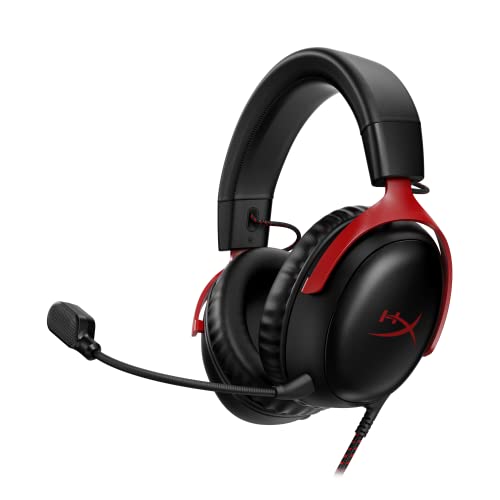
The HyperX Cloud III is a mid-range wired gaming headset built around angled 53mm dynamic drivers, memory foam ear cushions, and an aluminum-reinforced frame. It targets multi-platform players who want a single wired headset covering PC via USB-C or USB-A, PS5, Xbox Series X|S, Switch, and mobile through 3.5mm analog.
The defining feature is the angled 53mm driver alignment paired with DTS Headphone:X Spatial Audio lifetime activation, which HyperX positions for positional cues in FPS and open-world titles on PC. Headsets in this tier typically deliver 20Hz to 20kHz coverage with a mild V-shape tuning, though exact frequency response is not specified here.
Trade-offs are typical for a wired mid-range set. There is no 2.4GHz wireless option, no active noise cancellation, and no listed impedance or sensitivity figures for headphone amplifier pairing. DTS Headphone:X spatial processing is PC-only in practice, so console users get stereo output from the same hardware.
Buy this if you want one wired headset that swaps between a gaming PC and PS5 or Xbox Series X|S without a second dongle, and you value a detachable 10m mic with mute LED. Skip if you need wireless freedom, ANC for commutes, or audiophile-grade tuning with published measurements.
Drivers and Tuning: Angled 53mm dynamic drivers form the core of the acoustic design, positioned to fire toward the ear canal for improved staging. HyperX has not published impedance, sensitivity, or measured frequency response for the Cloud III listing, so pair with any onboard PC audio or console 3.5mm jack without amp concerns.
Spatial Audio: DTS Headphone:X lifetime activation ships with the headset and enables virtual 3D positioning on PC through the DTS Sound Unbound app. Consoles do not natively pass DTS Headphone:X, so PS5 users typically fall back to Sony Tempest 3D output over the same wired connection.
Microphone: The detachable 10mm boom microphone is noise-cancelling with a built-in mesh pop filter and an LED mute indicator on the tip. HyperX has not published mic frequency response or sample rate on the listing, though the 10mm capsule size is larger than the 6mm to 8mm typical at this tier.
Connectivity: Three connection paths cover most rigs: USB-C direct, USB-A via included adapter, and analog 3.5m TRRS for consoles, controllers, and phones. This matches multi-platform buyers who move one headset between a desktop PC, PS5 DualSense, and an Xbox Series X|S controller jack.
Gaming Headset Buying Guide
Drivers and Sound Stage
53mm angled drivers on the HyperX Cloud Alpha family deliver wider sound stage than the more common 40mm drivers , useful for positional audio in shooters and movies alike. DTS Spatial Audio and DTS Headphone:X expand soundstage further but matter less for competitive Counter-Strike than they do for single-player RPGs. Stereo plus quality drivers beats virtual surround in competitive play.
Wireless Range and Latency
2.4GHz wireless delivers sub-1ms latency on modern receivers , indistinguishable from wired in actual play. Bluetooth adds 50-150ms of latency, fine for music but noticeable in fast-paced games. Pick a headset with BOTH if you want phone connectivity plus low-latency PC play. Cloud Alpha S adds Bluetooth alongside 2.4GHz; original Cloud Alpha Wireless is 2.4GHz only.
Battery and Comfort
120 hours of 2.4GHz battery on Cloud Alpha Wireless covers two-plus weeks of daily play. Cloud Alpha S extends to 200 hours over Bluetooth. Memory foam earpads matter more than driver size for multi-hour comfort , clamping pressure and earpad thickness determine whether you can wear the headset for 4-hour sessions without fatigue. The Cloud Alpha aluminum frame holds up better than plastic-only competitors in 2026 testing.
Comparison Table
| Product | Best For | Wireless | Battery |
|---|---|---|---|
| HyperX Cloud Alpha Wireless | PC-and-PlayStation core wireless | 2.4GHz only | 120 hr |
| HyperX Cloud Alpha S (Black) | Multi-platform with Bluetooth | 2.4GHz + Bluetooth | 120 hr / 200 hr BT |
| HyperX Cloud Alpha S (Black/Red) | Bluetooth flexibility, red accents | 2.4GHz + Bluetooth | 120 hr / 200 hr BT |
| HyperX Cloud Alpha Wired | Zero-latency value pick | Wired only | N/A |
Final Thoughts
For pure-PC gamers, the HyperX Cloud Alpha Wireless covers the core use case with 120-hour battery and 2.4GHz low latency. The Cloud Alpha S adds Bluetooth for phone and Switch use without sacrificing the 2.4GHz core , best pick if you cross platforms regularly. The wired Cloud Alpha is the value option when the wireless versions sit over MSRP. All four share the same 53mm angled drivers and aluminum frame.
FAQs
Wireless or wired gaming headset in 2026?
Wireless 2.4GHz has caught up to wired for latency , both run under 1ms. Wired still wins on battery (never charges) and slightly better audio fidelity due to no codec compression. Pick wireless unless you specifically need top-tier audiophile sound.
How important is the headset microphone quality?
Very important for team-based gaming. Look for noise-canceling microphones with 10mm drivers , the HyperX Cloud Alpha family uses these. They drop keyboard clatter and fan noise from your Discord channel. A detachable mic adds versatility for using the headset as headphones.
Does spatial audio actually help in competitive shooters?
DTS Headphone:X and Windows Sonic offer modest improvements in positional cues but stereo with quality drivers is still preferred by most pros. Test both , some players hear footsteps better in stereo. The 53mm angled drivers in the Cloud Alpha family provide a wider native soundstage than 40mm drivers.
How long should a gaming headset last?
Quality headsets with aluminum frames and replaceable earpads last 5+ years of daily use. The first failure points are usually the cable on wired models or the earpads after 1-2 years. Memory foam earpads compress over time and should be replaced when comfort degrades.
Audio Quality Specs That Matter
Driver size matters less than driver quality. 40mm drivers with quality magnets and tuning can outperform poorly-implemented 53mm drivers. The HyperX Cloud Alpha’s 53mm angled drivers deliver wider sound stage than typical 40mm gaming drivers but the angled positioning matters as much as size, angled drivers project sound more accurately into ear canals.
Frequency response in the 60Hz to 15kHz range covers what matters for gaming and music. Some headsets advertise frequency response to 20kHz or beyond but human hearing typically caps at 16-18kHz. Focus on flat response curves rather than maximum specs, quality gaming headsets aim for relatively flat curves with modest emphasis in the sub-bass and upper-mid frequencies relevant to positional audio.
Microphone Quality Considerations
Gaming headset microphones have improved meaningfully in 2025-2026. The HyperX Cloud Alpha’s 10mm condenser mic delivers Discord-quality output without ambient noise issues common to earlier gaming headsets. Detachable mics offer flexibility, use the headset as headphones for music or movies, attach the mic only for voice chat sessions.
Noise canceling on the microphone (not the headphones) matters for shared environments. Mechanical keyboard clatter, fan noise, and ambient voice from cohabitants get dropped from Discord output. Active mic noise cancellation outperforms passive foam pop filters in 2026 flagship headsets.
2.4GHz vs Bluetooth Reality
2.4GHz wireless on flagship headsets runs sub-1ms latency, indistinguishable from wired in real play. Bluetooth (especially BT 5.0 and 5.2) adds 30-150ms latency depending on codec. Bluetooth is fine for music and movies but introduces audible delay in competitive gaming.
Dual-mode headsets (Cloud Alpha S, Razer BlackShark V2 Pro) deliver both connections. Use 2.4GHz for gaming, Bluetooth for phone calls or commute audio. This is the practical setup for most buyers, gaming use case demands 2.4GHz, lifestyle use cases want Bluetooth flexibility.
Comfort Over Multi-Hour Sessions
Clamp pressure is the most common source of headset fatigue. Quality headsets specify clamp pressure (usually around 4-5N), too loose and the headset shifts during head movement, too tight and pressure points develop within 1-2 hours. Memory foam earpads with quality protein-leather or fabric coverings hold shape over years; cheap pleather earpads crack and flake within 12-18 months.
Weight under 350g is the target for multi-hour comfort. Heavier headsets (over 400g) create neck strain in sessions beyond 4 hours. The HyperX Cloud Alpha family hits 320-340g, comfortable for all-day use.
More Frequently Asked Questions
Open-back or closed-back for gaming?
Closed-back for shared environments and competitive gaming, better passive noise isolation and bass response. Open-back for solo home use prioritizing wide sound stage and natural audio, better for positional audio in single-player games. The HyperX Cloud Alpha family is closed-back.
Are gaming headsets good for music too?
2026 flagship gaming headsets handle music acceptably but dedicated headphones (Sennheiser HD 6xx series, Audeze Maxwell, Beyerdynamic DT 990) deliver superior music fidelity. For mixed gaming + music use, gaming headsets are the practical compromise.
Wireless Gaming Headset Long-Term Use
Wireless gaming headsets in 2026 deliver flagship audio with multi-day battery life. The HyperX Cloud Alpha family at $100-180 hits the natural fit. Premium options from SteelSeries, Astro, Razer extend to $300+ with marginal sound improvements.
Common Mistakes to Avoid
First mistake is buying cheap pleather earpads. Second is overlooking clamp pressure. Third is ignoring mic quality.
More Frequently Asked Questions
Open or closed back?
Closed for shared spaces. Open for solo home.
Battery life expectation?
120+ hours on 2.4GHz typical.
Earpad replacement?
Every 12-18 months for budget pleather. 3+ years for fabric.
Wireless Headset Audio Tech in 2026
Wireless gaming headset audio quality reached audiophile-adjacent territory in 2025-2026 as the SteelSeries Arctis Nova Pro Wireless, Audeze Maxwell, and HyperX Cloud Alpha S delivered measurably improved driver designs at attainable price points. Battery life jumped significantly, 100+ hours became standard at the $150 tier, 200+ hours at the $250 tier. Multi-platform support via simultaneous 2.4GHz + Bluetooth connection became expected. Active noise canceling on premium headsets like the Audeze Maxwell delivered genuine isolation comparable to dedicated headphones in this category.
Headset Setup for Best Performance
Position the microphone 2-3 fingers from the corner of your mouth to avoid breathing noise. Set OBS or Discord input volume to 50-60 percent and use the headset gain control for fine-tuning. Update firmware through manufacturer software (SteelSeries GG, Razer Synapse) monthly. Enable spatial audio (Windows Sonic or DTS Headphone:X) for movies; disable for competitive shooters where stereo positioning beats virtual surround. Replace earpads after 12-18 months for pleather, 3+ years for fabric. Store the headset flat or hung; do not stretch the headband which causes long-term sizing issues.
Additional Questions
Should I disable spatial audio for competitive games?
Yes for most players. Stereo with quality drivers delivers better positional cues than virtual surround for footstep detection. Try both in your specific games to confirm.
Best wireless protocol, 2.4GHz, Bluetooth, or both?
2.4GHz for gaming due to sub-1ms latency. Bluetooth adds phone and Switch compatibility at higher latency. Both is the modern flagship target.
Wireless Headset Pricing Trends
Wireless gaming headset pricing improved dramatically through 2025-2026 as 2.4GHz wireless reached audio quality parity with wired. Entry wireless at $80-120 includes Razer Barracuda X, HyperX Cloud Stinger 2 Wireless, and Logitech G535. Mid-tier $130-200 covers HyperX Cloud Alpha Wireless, SteelSeries Arctis Nova 5X, and Razer Kaira Pro. Premium $250-400 includes SteelSeries Arctis Nova Pro Wireless, Audeze Maxwell, and Astro A50 X. The premium tier advantage centers on driver design quality and active noise canceling. For most gamers, mid-tier wireless delivers 90 percent of premium audio quality at 50 percent of the price. We cover the specifics separately in our wired vs wireless headset latency guide.
Wireless Headset Owner Issues
Owner reports identify several recurring concerns. Battery longevity exceeds advertised specs on most quality models, HyperX Cloud Alpha Wireless owners report 130-150 hours actual versus 120-hour rated. Microphone quality varies significantly across price tiers, premium models include broadcast-quality microphones (SteelSeries ClearCast Gen 2, Audeze) while mid-tier acceptable for Discord but not for streaming. Comfort issues mainly involve clamping pressure, owners with larger heads report initial soreness that resolves over 2-3 weeks as headband stretches. Earpad replacement is common at 12-18 month mark for pleather, 3+ years for fabric, replacement pads run $20-40. For a closer look, see our guide on the best gaming headset.