

Surround sound in a headset is a bit of a magic trick. You’ve got two speakers, one per ear, yet somehow a game convinces you footsteps are coming from behind your left shoulder. That illusion is what people mean when they talk about surround in a headset, and it comes in two very different flavors. Understanding which one you’re buying changes what you should expect, and how much you should spend. We’ve researched how both work and where each one actually helps.
If you’re shopping for gear alongside this explainer, our gaming headset guide and wireless headset picks cover specific models. This piece is about the concept underneath them.
The short answer
Surround sound in a headset means the audio is processed so your brain places sounds in 3D space around your head, not just left and right. Most gaming headsets do this with virtual surround, where software fakes multiple speaker positions using just the two physical drivers you’re wearing. A “7.1” label almost always means virtual 7.1, not eight real speakers crammed into each cup. It’s a digital effect, and a good one can genuinely help you hear where a threat is.

A budget example shows how common this is. The Picun G2 Wireless runs $59.99 with a 4.5 rating and advertises over-ear 7.1 virtual surround, 2.4GHz and Bluetooth 5.4 and wired connections, 5ms low latency, and a 100-hour battery. That 7.1 is virtual, generated from two drivers, which is exactly what the vast majority of gaming headsets do at this price.


Pros
- Three connection modes on a single headset: 2.4GHz dongle, Bluetooth 5.4, and 3.5mm wired fallback.
- Vendor-rated 5ms 2.4GHz latency keps audio synced in competitive shooter scenarios.
- Long rated runtime, up to 100 hours in Bluetooth with RGB disabled for travel use.
- RetractableENC microphone tucks away, useful when switching between gaming and general listening.
Cons
- Limited owner feedback at time of writing, real-world reliability and QC signal is unverified.
- 7.1 surround is virtual DSP, not true multi-driver, so positional accuracy varies by title andear.
- RGB lighting materially cuts battery life, cited100-hour figure requires lighting turned off.
The Picun G2 is a budget-tier wireless gaming headset built around 40mm drivers, virtual 7.1 surround, and tri-mode connectivity across2.4GHz, Bluetooth 5.4, and 3.5m wired. Target buyer is a multi-platform player rotating between PC, PS5, PS4, and Switch who wants low-latency wireless without moving up to established brand pricing.
The defining feature is the tri-mode radio stack. The 2.4GHz USB-A or Type-C dongle is rated at 5ms latency, which is competitive for the tier and adequate for most FPS titles, while Bluetooth 5.4 handles phones and tablets. Headsets in this class typically deliver serviceable rather than reference-grade imaging, and virtual 7.1 leans on DSP rather than discrete drivers.
Trade-offs are typical at this tier. Battery figures are optimistic: 100 hours assumes Bluetooth with RGB off, and 2.4GHz drops the number to 42 to 45 hours. Driver material, impedance, frequency response, clamp force, and weight are not specified, so tonal balance and long-session comfort cannot be verified from source data alone.
Buy this if you want one headset that jumps between a PS5, a Switch dock, and a work laptop over Bluetooth, and you accept spec-sheet-only marketing. Skip this if you rely on measured frequency response, discrete suround, or detachable bom mics with broadcast-grade pickup for streaming.
Drivers and tuning: Picun specifies 40mm dynamic drivers paired with virtual 7.1 surround processing. Impedance, sensitivity, and frequency response are not specified, so bass extension and treble air cannot be quantified from source. Virtual 7.1 is DSP-based positional widening, useful for FPS cues but not equivalent to true multi-driver surround.
Connectivity and latency: Three modes are covered: 2.4GHz via USB-A or USB-C dongle, Bluetooth 5.4, and 3.5mm analog. The 2.4GHz link is rated at 5ms latency. Bluetooth codec support (SBC, AAC, aptX) is not specified, which maters for wireless music quality on phones and tablets.
Battery and power: Rated up to 100 hours on Bluetooth with RGB off, and 42 to 45 hours on 2.4GHz wireless. Play-while-charging is supported, so a USB cable can extend sessions past the rated ceiling. Charge time and battery capacity in mAh are not specified.
Microphone: Retractable omnidirectional bom with ENC noise reduction. Sample rate, bit depth, and pickup pattern beyond omni are not specified.ENC filtering targets background noise on the transmit side, adequate for party chat but below dedicated USB mic quality.
The longer explanation
Your ears locate sound using tiny differences: a noise hits your right ear a fraction earlier and slightly louder than your left, and the shape of your outer ear colors frequencies depending on direction. Your brain reads those cues automatically. Virtual surround software mimics them. It applies what’s called a head-related transfer function, a filter that reshapes the timing and tone of a sound so your brain thinks it originated from a specific point in space, even though it’s still just two drivers pushing air.
True surround is the other approach, and it’s rare in headsets. It means physically separate drivers in each earcup, each handling a channel. Those exist, but they’re uncommon because packing multiple quality drivers into a small cup often muddies the sound rather than sharpening it. That’s why software-based virtual surround has become the standard. It’s cheaper, lighter, and frequently sounds better than cramming in extra hardware.
How it works
The processing can happen in a few places. Some headsets run it on a built-in chip. Others rely on a companion app or a platform feature like Windows Sonic or Dolby Atmos for Headphones, which takes a multichannel game signal and folds it down into a spatialized stereo output for your two drivers. Consoles handle it too, which is why a headset advertised for PC, PS5, and Switch can deliver surround across all of them.
The quality of the illusion depends heavily on the software, not just the headset. Two headsets with identical drivers can sound wildly different depending on the spatial engine feeding them. That’s why the same pair of cups might feel flat with one game’s built-in audio and convincing with Dolby Atmos enabled. The drivers reproduce sound. The math decides where that sound seems to sit.
Latency plays a quiet role here too. Spatial processing takes time, and if that delay stacks on top of a laggy wireless link, audio can drift out of sync with the action on screen. That’s why a low-latency 2.4GHz connection matters more for surround than for plain stereo. When the pipeline is tight, your brain trusts the positional cues. When it’s sloppy, the effect falls apart and footsteps arrive a beat late.
Why it works this way
Headphones sit right against your ears, which is both a problem and an opportunity. The problem: without processing, everything sounds like it’s coming from inside your skull, flat and centered. The opportunity: because the drivers are so close and consistent, software can precisely control the cues reaching each ear. That tight control is exactly what virtual surround needs to place sounds convincingly.
Speakers in a room can’t do this as cleanly, because your walls, furniture, and the crosstalk between left and right speakers all interfere. A headset removes those variables. So the engineering logic is simple. Rather than fight physics by stuffing hardware into a cramped earcup, manufacturers lean on digital signal processing that already has ideal conditions to work with.
There’s a personal angle worth knowing about too. Everyone’s ears are shaped a little differently, so a single generic spatial filter fits some people better than others. That’s why a few gamers swear by surround while others say it sounds off to them. Newer engines let you tune the profile or pick from presets to nudge the effect toward what your own ears expect, which can turn a so-so illusion into a convincing one.
When you’d want this
Competitive shooters are the clearest case. Hearing whether footsteps are above you, behind you, or to your right can decide a round, and virtual surround sharpens that directional read compared to plain stereo. Immersive single-player games benefit too, since positional audio deepens the sense of being inside a world. If you play a lot of Warzone, Valorant, or big open-world titles, surround processing earns its place.
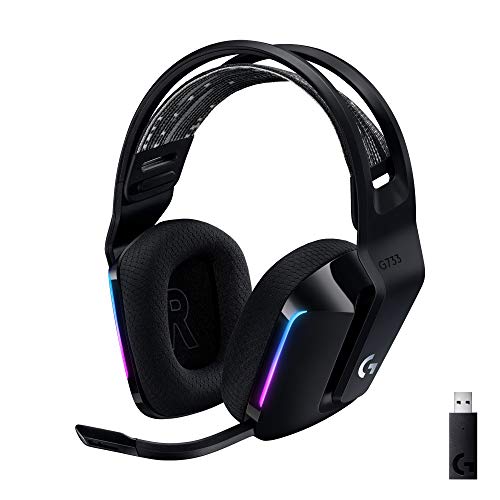
It matters less if you mostly listen to music or watch video, where stereo is the native format and surround can smear the mix. A well-built stereo headset with a clean signal chain often serves those users better. The Logitech G733 Lightspeed at $124.92, rated 4.0, is a wireless option built around PRO-G audio drivers and a Blue VO!CE mic, tuned for gaming with a light suspension headband. It shows how brands package spatial-friendly drivers with comfort features aimed at long sessions.
Pros
- Lightspeed wireless with 20 meter range handles typical living room and desk distances
- Up to 29 hours battery life covers multi-day use between charges
- Blue VO!CE mic processing in G HUB improves clarity for Discord and streaming
- Suspension headband and low mass design reduce clamp fatigue during long sessions
- Dual-zone Lightsync RGB with 16.8M colors is customizable through G HUB
Cons
- PS4 output limited to stereo, no suround on older PlayStation hardware
- Driver size, frequency response, and mic pattern not specified in source data
The Logitech G733 is a mid-tier wireless gaming headset targeting PC, PS5, PS4, and Nintendo Switch users who want a lightweight all-day fit. It leans on Lightspeed 2.4GHz wireless, PRO-G drivers, Blue VO!CE mic processing, and a reversible suspension headband, aimed at multi-hour gamers and streamers.
The defining feature is the combination of Lightspeed wireless with a quoted 20 meter range and up to 29 hours of battery. In practice this covers full workdays plus evening sessions without a charge cycle. PRO-G drivers, per Logitech, reduce distortion, and headsets in this tier typically deliver a mildly V-shaped tuning suited to positional FPS cues.
Trade-offs are typical at this price point. PS4 users are locked to stereo output with no virtual surround. Driver diameter, impedance, and frequency response are not published in the source data, so absolute output quality is hard to benchmark against wired competitors. There is no Bluetooth fallback listed, so mobile pairing is not supported.
Buy this if you want a light, long-battery 2.4GHz wireless headset for PC or PS5 with a usable broadcast-style mic. Skip this if you need wired low-latency USB, Bluetooth multipoint, or vendor-published driver and frequency response specs before purchase.
Drivers and tuning: Logitech lists PRO-G drivers tuned for reduced distortion, though exact driver diameter and frequency response are not specified in the source. Headsets in this tier typically ship with 40 to 50mm dynamic drivers and a mildly V-shaped response suited to explosions and footstep cues in FPS gameplay.
Connection and latency: Lightspeed 2.4GHz wireless with a stated 20 meter range covers desk and living room use. Compatibility is confirmed for PC, PS5, PS4 (stereo only), and Nintendo Switch. Bluetooth and wired 3.5mm fallback are not listed in the source, so single-dongle 2.4GHz is the only documented path.
Battery life: Rated up to 29 hours per charge, enough for roughly three to four full evening sessions before recharging. Exact charge time and USB-C versus micro-USB charging port are not specified in the source data.
Microphone: Detachable mic with Blue VO!CE filters configured in G HUB, providing EQ, noise reduction, and de-eser presets useful for Discord and Twitch chat. Mic polar pattern, sensitivity, and frequency range are not disclosed in the source specifications.
What to look for in a surround headset
Focus on driver quality and the spatial software before you’re wowed by a “7.1” sticker, since nearly all of them are virtual anyway. Good, well-tuned drivers with support for a strong engine like Dolby Atmos or Windows Sonic will out-position a headset with worse drivers and a flashier number. Comfort matters for long sessions, so check clamp force and earcup depth in owner reports. And decide on connection: a low-latency 2.4GHz wireless link, like the Picun G2’s 5ms, keeps audio in sync, while Bluetooth adds convenience but more delay.
A clear microphone rounds it out if you play with a team. Features like ENC noise-canceling on the Picun or Blue VO!CE on the Logitech clean up your voice, which has nothing to do with surround but plenty to do with whether teammates can hear your callouts. For placement options off your desk, a good headset stand keeps everything tidy.
Common misconceptions
The biggest myth is that “7.1” means eight speakers per ear. It almost never does. It’s a virtual effect from two drivers, and that’s fine, because virtual surround done well beats cheap multi-driver hardware. Another myth is that surround always sounds better than stereo. For music it often sounds worse, since the effect can hollow out a mix that was made for two channels. Turn it off for tunes, on for games.
People also assume more expensive automatically means better positional audio. Not so. A $60 headset with a solid spatial engine can out-locate a pricier pair running weak software. The processing carries the illusion, so the pairing of drivers and engine matters more than the sticker price. Judge the whole package, not one line on the box. And don’t assume surround demands a wired connection either. A tight 2.4GHz link like the Picun G2’s 5ms keeps the spatial cues in sync just as well as a cable, so you can keep the positional edge without being tethered to your desk.
Frequently asked
Is virtual surround as good as real surround?
For headsets, virtual is usually the better choice. Real multi-driver cups often muddy the sound, while a strong virtual engine places audio cleanly using two quality drivers. Most gaming headsets you’ll see are virtual, and that’s not a downgrade.
Do I need a special sound card for surround?
No. Modern PCs, PS5, and Switch all handle the processing, and features like Windows Sonic are free and built in. A dedicated card or DAC can improve overall audio quality, but it isn’t required for virtual surround to work.
Does surround sound help in competitive games?
Yes, meaningfully. Being able to tell where footsteps or gunfire come from gives you a real reaction advantage over flat stereo. Many competitive players enable it specifically for that directional edge, then tune settings to taste.
Should I use surround for music too?
Usually not. Music is mixed for stereo, and surround processing can smear or hollow it out. Flip the effect off for listening and back on for games. Most software lets you toggle it per app or on the fly.
What does the 7.1 in a headset actually mean?
It refers to a virtual 7.1-channel effect generated from two physical drivers, not eight real speakers. The number describes the simulated speaker layout the software recreates. Treat it as a feature label, not a hardware count.
































Write Your Review
No reviews yet. Be the first to share your experience!