

Walk into any discussion about gaming or studio headphones and someone will drop the terms “open-back” and “closed-back” like everyone already knows the difference. If you don’t, you’re not alone, and the choice genuinely changes how your headphones sound, how they feel over long sessions, and whether the person next to you hears your game. It’s one of the most consequential decisions in audio, yet it’s usually buried in spec sheets. For where these designs land in real products, our roundups of the best open-back headphones for gaming 2026 and the best gaming headset options put the theory to work.
This explainer covers what open-back and closed-back actually mean, why the two designs sound so different, and which one fits your room, your games, and your ears. We’ll keep the audio jargon minimal and lean on the practical differences you’d notice the moment you put each type on. No golden ears required.
The short answer
The difference is right there in the name: it’s about whether the outer housing of each earcup is sealed or vented. Closed-back headphones seal the back of the driver, trapping sound so it fires only into your ears. Open-back headphones use a perforated or grilled housing that lets air and sound pass through both ways, which changes the whole character of what you hear.
That single design choice cascades into everything. Closed-back gives you isolation, stronger bass, and privacy, which is why most gaming headsets, like the Logitech G733 Lightspeed, use a sealed design. Open-back trades isolation for a wider, more natural soundstage that many find better for competitive positional audio and long listening. Neither is objectively better, they just serve different priorities.

Pros
- Lightspeed wireless with 20 meter range handles typical living room and desk distances
- Up to 29 hours battery life covers multi-day use between charges
- Blue VO!CE mic processing in G HUB improves clarity for Discord and streaming
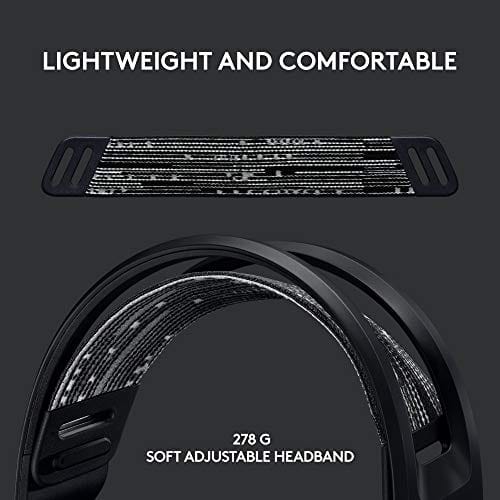
- Suspension headband and low mass design reduce clamp fatigue during long sessions
- Dual-zone Lightsync RGB with 16.8M colors is customizable through G HUB
Cons
- PS4 output limited to stereo, no suround on older PlayStation hardware
- Driver size, frequency response, and mic pattern not specified in source data
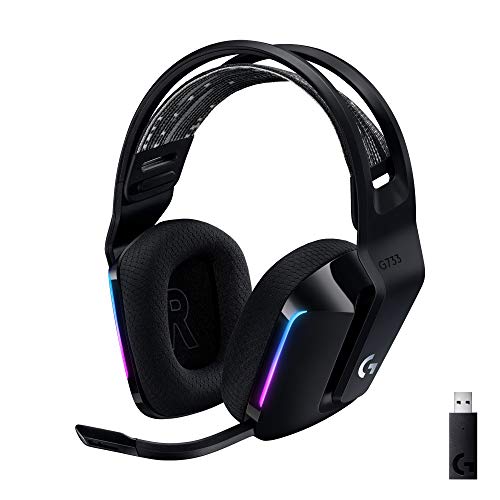
The Logitech G733 is a mid-tier wireless gaming headset targeting PC, PS5, PS4, and Nintendo Switch users who want a lightweight all-day fit. It leans on Lightspeed 2.4GHz wireless, PRO-G drivers, Blue VO!CE mic processing, and a reversible suspension headband, aimed at multi-hour gamers and streamers.
The defining feature is the combination of Lightspeed wireless with a quoted 20 meter range and up to 29 hours of battery. In practice this covers full workdays plus evening sessions without a charge cycle. PRO-G drivers, per Logitech, reduce distortion, and headsets in this tier typically deliver a mildly V-shaped tuning suited to positional FPS cues.
Trade-offs are typical at this price point. PS4 users are locked to stereo output with no virtual surround. Driver diameter, impedance, and frequency response are not published in the source data, so absolute output quality is hard to benchmark against wired competitors. There is no Bluetooth fallback listed, so mobile pairing is not supported.
Buy this if you want a light, long-battery 2.4GHz wireless headset for PC or PS5 with a usable broadcast-style mic. Skip this if you need wired low-latency USB, Bluetooth multipoint, or vendor-published driver and frequency response specs before purchase.
Drivers and tuning: Logitech lists PRO-G drivers tuned for reduced distortion, though exact driver diameter and frequency response are not specified in the source. Headsets in this tier typically ship with 40 to 50mm dynamic drivers and a mildly V-shaped response suited to explosions and footstep cues in FPS gameplay.
Connection and latency: Lightspeed 2.4GHz wireless with a stated 20 meter range covers desk and living room use. Compatibility is confirmed for PC, PS5, PS4 (stereo only), and Nintendo Switch. Bluetooth and wired 3.5mm fallback are not listed in the source, so single-dongle 2.4GHz is the only documented path.
Battery life: Rated up to 29 hours per charge, enough for roughly three to four full evening sessions before recharging. Exact charge time and USB-C versus micro-USB charging port are not specified in the source data.
Microphone: Detachable mic with Blue VO!CE filters configured in G HUB, providing EQ, noise reduction, and de-eser presets useful for Discord and Twitch chat. Mic polar pattern, sensitivity, and frequency range are not disclosed in the source specifications.
At $124.92 with a 4.0-star rating, the Logitech G733 Lightspeed is a wireless closed-back gaming headset with a suspension headband, Lightsync RGB, PRO-G audio drivers, and a Blue VO!CE mic. Its sealed earcups are a textbook closed-back setup: they keep game audio in, block room noise, and deliver punchy low end, which is exactly why the design dominates mainstream gaming headsets.
The longer explanation
A headphone driver is basically a tiny speaker, and speakers move air on both sides of the diaphragm. In a closed-back design, the rear wave is sealed inside the cup, which boosts bass and blocks outside noise but can create a slightly boxed-in, resonant quality. The sound has nowhere to go but your ear canal, so it feels close and direct, sometimes to the point of feeling like it’s happening inside your head.
Open-back designs let that rear wave escape through the vented housing. Without the trapped pressure, the sound opens up, instruments and footsteps feel like they’re placed around you rather than pressed against your ears. The cost is obvious the moment you wear them: they leak sound out and let room noise in, so a quiet, private space is basically required to enjoy them.
There’s a comfort dimension too that people discover only after long sessions. Because closed cups seal against your head, they trap heat and can make your ears sweat during a marathon gaming night. Open-back cups breathe, so they tend to stay cooler and feel lighter over hours. That airflow is a small thing on paper, but for someone wearing headphones eight hours a day, it changes how tolerable the experience is by the end.
How we got here
Closed-back came first for practical reasons. Early headphones needed to work in noisy environments, radio studios, aircraft, telephone switchboards, where isolation was the entire point. Sealing the driver kept outside noise out and kept the wearer’s audio private, which mattered when the person beside you was doing the same job a foot away.
Open-back emerged as audiophiles and studio mixing engineers chased a more accurate, spacious sound for critical listening in quiet rooms. Freed from the need to isolate, designers could tune for the most natural presentation. Gaming borrowed both traditions: mainstream headsets went closed for convenience and bass, while competitive players and enthusiasts discovered open-back’s positional clarity gave them an edge in quiet setups.
Why it works this way
The physics is straightforward once you picture the trapped air. A sealed cup builds up pressure behind the driver, which reinforces low frequencies and stops the diaphragm from moving as freely. That’s why closed-backs often hit harder in the bass but can sound a little congested in the mids. The seal also physically blocks sound waves in both directions, giving you isolation and privacy as a bonus.
Open-backs remove that pressure, letting the diaphragm move naturally and the sound disperse. The result is a more even frequency response and a soundstage that mimics speakers in a room. The unavoidable tradeoff is that the same openness that creates the airy sound also lets everything leak, in and out, which is a feature in a quiet room and a dealbreaker on a train.
When you’d want this
Reach for closed-back when isolation, privacy, or portability matter. Gaming in a shared room, commuting, streaming near an open mic, or wanting strong bass all point to a sealed design, which is why most wireless gaming headsets go that route. If you can’t control the noise around you, closed-back is the practical, forgiving choice that works anywhere.
Choose open-back when you have a quiet space and prioritize soundstage and comfort. Competitive players hunting precise footstep direction, listeners on long sessions who want less ear fatigue, and anyone doing critical listening benefit most. A budget-friendly closed-back like the Picun G2 covers the versatile everyday case, while open-back is the specialist pick for the right environment.

Pros
- Three connection modes on a single headset: 2.4GHz dongle, Bluetooth 5.4, and 3.5mm wired fallback.
- Vendor-rated 5ms 2.4GHz latency keps audio synced in competitive shooter scenarios.
- Long rated runtime, up to 100 hours in Bluetooth with RGB disabled for travel use.
- RetractableENC microphone tucks away, useful when switching between gaming and general listening.
Cons
- Limited owner feedback at time of writing, real-world reliability and QC signal is unverified.
- 7.1 surround is virtual DSP, not true multi-driver, so positional accuracy varies by title andear.
- RGB lighting materially cuts battery life, cited100-hour figure requires lighting turned off.
The Picun G2 is a budget-tier wireless gaming headset built around 40mm drivers, virtual 7.1 surround, and tri-mode connectivity across2.4GHz, Bluetooth 5.4, and 3.5m wired. Target buyer is a multi-platform player rotating between PC, PS5, PS4, and Switch who wants low-latency wireless without moving up to established brand pricing.
The defining feature is the tri-mode radio stack. The 2.4GHz USB-A or Type-C dongle is rated at 5ms latency, which is competitive for the tier and adequate for most FPS titles, while Bluetooth 5.4 handles phones and tablets. Headsets in this class typically deliver serviceable rather than reference-grade imaging, and virtual 7.1 leans on DSP rather than discrete drivers.
Trade-offs are typical at this tier. Battery figures are optimistic: 100 hours assumes Bluetooth with RGB off, and 2.4GHz drops the number to 42 to 45 hours. Driver material, impedance, frequency response, clamp force, and weight are not specified, so tonal balance and long-session comfort cannot be verified from source data alone.
Buy this if you want one headset that jumps between a PS5, a Switch dock, and a work laptop over Bluetooth, and you accept spec-sheet-only marketing. Skip this if you rely on measured frequency response, discrete suround, or detachable bom mics with broadcast-grade pickup for streaming.
Drivers and tuning: Picun specifies 40mm dynamic drivers paired with virtual 7.1 surround processing. Impedance, sensitivity, and frequency response are not specified, so bass extension and treble air cannot be quantified from source. Virtual 7.1 is DSP-based positional widening, useful for FPS cues but not equivalent to true multi-driver surround.
Connectivity and latency: Three modes are covered: 2.4GHz via USB-A or USB-C dongle, Bluetooth 5.4, and 3.5mm analog. The 2.4GHz link is rated at 5ms latency. Bluetooth codec support (SBC, AAC, aptX) is not specified, which maters for wireless music quality on phones and tablets.
Battery and power: Rated up to 100 hours on Bluetooth with RGB off, and 42 to 45 hours on 2.4GHz wireless. Play-while-charging is supported, so a USB cable can extend sessions past the rated ceiling. Charge time and battery capacity in mAh are not specified.
Microphone: Retractable omnidirectional bom with ENC noise reduction. Sample rate, bit depth, and pickup pattern beyond omni are not specified.ENC filtering targets background noise on the transmit side, adequate for party chat but below dedicated USB mic quality.
The Picun G2 runs $59.99 with a 4.5-star rating and packs a lot into a closed-back over-ear headset: 7.1 virtual surround, 2.4GHz wireless plus Bluetooth 5.4 and a wired mode, 5ms low latency, roughly 100 hours of battery, and an ENC noise-canceling mic. Its sealed design makes it a flexible pick for shared spaces where you can’t rely on a quiet room, the exact scenario where closed-back earns its keep over an open design.
What to look for in a headphone design
Match the design to your environment first. If your room is quiet and private, open-back rewards you with soundstage and comfort. If it isn’t, closed-back saves you from annoying everyone and being annoyed in return. Then consider your primary use: competitive gaming leans toward positional clarity, casual gaming and music are happy with either, and streaming near a live mic strongly favors sealed cups to avoid audio bleed.
Don’t overlook comfort and weight for long sessions, since open-backs often run lighter and cooler on the ears. And remember that features like wireless, surround processing, and mic quality matter as much as the housing type. A great closed-back beats a mediocre open-back for most people, so weigh the whole package, not just the label on the box.
Common misconceptions
The most common myth is that open-back always sounds better, when it only sounds better in the right quiet environment and can be useless in a noisy one. Another is that closed-back has no soundstage, when good closed designs image plenty well for gaming. And people assume open-back headphones are fragile or leaky by defect, when the leakage is intentional and central to how they produce their spacious sound. One more: some believe surround processing turns any headset into a positional powerhouse, but virtual 7.1 helps far less than a genuinely open, well-imaging pair in a quiet room.
Frequently asked
Are open-back headphones better for competitive gaming?
Often yes, if your room is quiet. Open-back designs tend to have a wider soundstage, which makes it easier to pinpoint footsteps and directional cues in shooters. The catch is they leak sound and let room noise in, so they only shine in a quiet, private space. In a shared or noisy room, a good closed-back headset actually serves you better because outside noise won’t drown out the game.
Do closed-back headphones have worse sound?
Not at all, they’re just different. Closed-back designs typically deliver stronger bass and full isolation, which many gamers and commuters prefer. They can sound slightly more closed-in than open-backs, but a well-tuned closed pair images well and hits hard. The design is a tradeoff, not a downgrade, and for most real-world situations the isolation and bass are genuine advantages worth having.
Can I use open-back headphones with a mic for streaming?
You can, but be careful about audio bleed. Open-backs leak game and voice audio outward, so a sensitive streaming mic may pick up echoey game sound and create feedback or a muddy broadcast. Closed-back headsets contain that audio, which is why streamers usually favor sealed designs. If you stream near a live mic, a closed-back like the Logitech G733 avoids the bleed problem entirely.
Do open-back headphones leak that much sound?
Yes, more than people expect. Because the housing is vented, anyone sitting near you can hear what you’re listening to, and you’ll hear them too. In a quiet home office it’s a non-issue, but in a shared room, library, or office it can be disruptive. That leakage is the price of the open soundstage, so plan your environment around it before buying open-back.
Which should a first-time buyer pick?
For most first-time buyers, closed-back is the safer, more versatile choice. It works in any environment, offers isolation and bass, and doesn’t demand a silent room. Open-back is a rewarding step for someone with a quiet space who wants a wider soundstage and knows the tradeoffs. Start closed for flexibility, and consider open-back later once you know exactly what your setup and listening habits call for.































Write Your Review
No reviews yet. Be the first to share your experience!