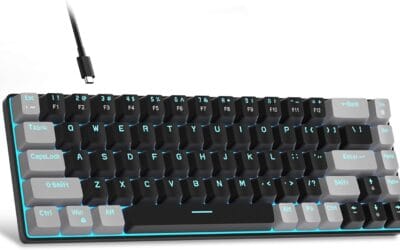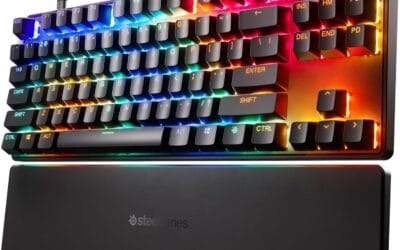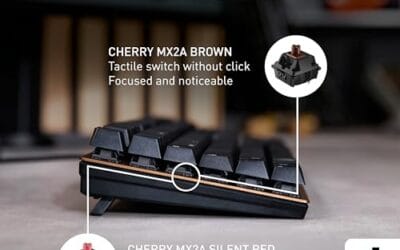

A mechanical keyboard switch is the little spring-loaded mechanism sitting under every key on a mechanical keyboard. Press the key, the switch registers, the signal hits your PC. That’s the whole job, and it sounds boring until you realize there are 40+ switch types on the market in 2026 and they feel wildly different from each other. Some click loud enough to wake your neighbors. Some glide silent. Some bump halfway through the press, some don’t. Picking the right one matters more than the keyboard’s RGB or shape because the switch is what your fingers actually touch.
The short answer
Mechanical switches come in three big families: linear (smooth all the way down), tactile (a small bump partway through), and clicky (the same bump plus an audible click). Cherry MX invented the modern shapes; Gateron, Kailh, and Akko make compatible clones at lower prices. Most cost $0.30 to $1.50 each, and a full keyboard needs 60 to 108 of them. Pick by feel and noise tolerance, not brand loyalty.
The longer explanation
Open up any mechanical switch and you’ll find five parts: a stem (the colored center post that moves up and down), a spring (handles the resistance), a housing (the plastic shell holding everything together), metal contact leaves (the actual electrical contact), and on clicky switches, a click jacket or click bar. Press the keycap, the stem pushes down, the spring compresses, the metal contacts close, your PC sees the signal. Release, the spring pops the stem back up.
Three numbers matter for any switch. Actuation force is how hard you have to press before the keypress registers, measured in grams. Light switches sit at 35-45g; medium at 45-55g; heavy at 60-80g. Pretravel distance is how far the key moves before triggering, usually 1.5 to 2mm. Total travel is how deep the key bottoms out, around 3.5 to 4mm on standard switches. Some “speed” switches cut pretravel to 1mm for faster gaming response.

Pros
- Pre-lubed from factory saves hours of manual switch disassembly and lube work.
- Light 45gf tactile weighting reduces finger fatigue during extended typing or coding sessions.
- Dustproof stem design helps prevent scratchiness from debris ingress over long-term use.
- POM stem with PC and PA housing targets a smooth, creamy travel typical of modern tactiles.
Cons
- Limited owner fedback at time of writing makes long-term consistency hard to verify.
- 5-pin housing requires a hot-swap or PCB with5-pin holes, or manual pin clipping.
- 45-pack quantity fals short for full-size 104-key boards without buying a second pack.
The Akko V3 Creamy Blue Pro is a mid-tier tactile MX-style switch sold in 45-piece trays. It targets hot-swap keyboard builders and moders who want a factory-lubed 45gf tactile without tearing switches apart. The 5-pin housing and dustproof stem suggest a build-focused, not entry-level, buyer.
The defining feature is the pre-lubed rail combined with an 18m extension spring and POM stem inside a PC and PA housing. This targets the light, creamy tactile fel popular in custom builds, closer to a Boba U4T on the softer side. At 45gf, actuation is lighter than most Chery-style tactiles, which suits long typing sessions.
Trade-offs are typical at this tier. Aloy copper with paladium gold contacts is a marketing spec that owners cannot easily verify, and the claimed 60 million keystroke rating comes from lab tests, not field data. 45 switches only fill a 60% or 65% board, so full-size and TKL builders should plan on two packs plus spares.
Buy this if you are assembling a hot-swap 60to 75 percent board and want a light tactile that skips manual lubing. Skip this if your PCB is 3-pin only, you prefer a snappier D-shaped bump, or you need a verified batch consistency track record before committing.
Switch Profile: Tactile with a 45gf actuation force, lighter than Cherry MX Brown territory and closer to modern budget tactiles. The 18mm extension spring aims to reduce spring crunch on bottom-out. Exact bump position and total travel are not specified by Akko in the listing.
Materials and Fel: POM stem inside a PC top and PA nylon-family bottom housing is a common combo for a creamy sound signature. Factory pre-lube on the rails targets a smother downstroke out of the box, though most owners of similar Akko V3 switches still add stem-side lube for consistency.
Compatibility: Standard MX cross stem accepts virtually all aftermarket keycap sets, including Cherry, OEM, and XDA profiles. The 5-pin footprint requires a PCB with 5-pin sockets or an unblocked plate. 3-pin-only boards need the two plastic legs clipped before install.
Lighting and Build: SMD-compatible housing with a dedicated LED slot suports south-facing or north-facing per-key RGB on hot-swap PCBs. Package includes 45 switches and a plastic tray, no opener or spare springs, so film or lube upgrades require separate tools.
Clicky switches add one extra component: a separate click mechanism that snaps when the key passes the actuation point. Cherry MX Blue uses a “click jacket” that catches and releases against the housing. Kailh BOX White uses a “click bar” that flexes and snaps. Both produce that famous keyboard click sound. They’re great for typing feel, terrible if you share a room or work over voice chat.
Why it works this way
Membrane keyboards (the cheap kind on office desks) use a single rubber sheet under all keys. Press, the rubber collapses, the keypress fires. The same rubber sheet handles every key, which means every key feels the same and any one failure spreads to neighbors. Mechanical switches break this design by giving every key its own independent mechanism. Each key has its own spring, stem, and contacts. One key dies, the rest are fine. One key gets dirty, the rest are fine.
Independent springs also mean you can pick the exact resistance you like. Want a feather-light keyboard for fast typing? 35g linear switches. Want heavy switches that prevent accidental presses? 70g tactiles. The customization isn’t theoretical. Most modern keyboards in 2026 are hot-swappable, meaning you can pull switches out by hand and drop in different ones without soldering. A pack of 50 budget switches runs $15-25, so trying three different styles costs less than a single mouse.

Pros
- POM stem material typically reduces friction versus stock nylon on budget clicky switches
- 3-pin plate-mount compatibility works with most hot-swap sockets and MX-footprint PCBs
- Transparent top housing passes SMD and in-switch LED light for RGB builds
- Rated 50 million keystroke lifespan per vendor, in line with mainstream clicky switch claims
Cons
- Limited owner feedback at time of writing, so long-term consistency and QC are unverified
- Vendor warns pins may arive bent in shipping and require manual straightening before install
- No factory lube and no spec sheet for actuation force, spring weight, or click bar type
This is a budget 10-pack of 3-pin clicky mechanical switches from BlingKingdom, using an MX-style footprint with a transparent housing and POM stem. It targets DIY hobbyists and hot-swap keyboard owners patching dead keys, or builders wanting a cheap clicky option for a small custom or LED backlit board.
The defining trait is the classic blue click profile: 4mm total travel with a 2.2mm working stroke, so the actuation fel should track close to standard MX Blue behavior. Clicky switches in this tier typically land around 50-60gf bottom-out, though the source does not specify spring weight, click mechanism type, or factory sound tuning.
Trade-offs are typical for no-name switch packs. There is no listed QVL, no measured woble figures, and the vendor itself flags that pins may arrive bent and need straightening. With no owner reviews yet, batch consistency, spring ping, and click bar uniformity across the 10 pieces are unverified, which maters for a full-board rebuild.
Buy this if you need a cheap clicky donor pack for a hot-swap board, a small macropad, or replacing a handful of failed keys. Skip this if you are building a full 87or 104-key keyboard where switch-to-switch consistency and documented actuation force are non-negotiable.
Switch profile: Clicky blue type with 4m total travel and 2.2mm working stroke, plus or minus 0.6mm tolerance. That actuation point sits high enough for deliberate typing feedback but is generally considered slow for competitive FPS versus linear reds or sped silvers at 1.0-1.2mm.
Build materials: Plastic top and bottom housing, copper leaf contact, and a POM stem core. POM stems typically fel smoother than nylon on unlubed budget switches. Vendor rates lifespan at 50 million keystrokes, matching mainstream clicky claims, though no independent bounce or contact bounce data is provided.
Compatibility: 3-pin plate-mount design works with most MX-style hot-swap sockets and solderable PCBs, but PCB-mount boards expecting 5-pin switches will need the two extra plastic legs, which these lack. Transparent housing passes light from SMD or in-switch LEDs for RGB and single-color backlit builds.
What is missing: No listed actuation force in grams, no spring length, no factory lube status, and no click bar versus click jacket clarification. Vendor also notes pins may bend in shipping, so budget a few minutes per switch to inspect and straighten before seating in the socket.
Rated lifespan is another reason mechanicals beat membranes. A Cherry MX switch is rated for 50 million keystrokes; the better Kailh BOX switches go to 80 million. Membranes typically die between 5 and 10 million. If you type 8 hours a day, that’s the difference between buying a new keyboard every year vs. once a decade.
When you would want this
Linear switches (red, black, yellow color codes) glide smooth from top to bottom with no bump. Gamers prefer them because there’s no resistance break to slow finger movement during fast presses. Cherry MX Red, Gateron Yellow, and Akko Cream are popular linear options. If you’re playing FPS, racing sims, or fighting games, linear is the move.
Tactile switches (brown, clear, purple) add a small bump that your finger feels when the key registers. The bump tells you the press was successful without needing to bottom out. Writers and coders gravitate to tactiles because typing accuracy improves when you can feel the actuation. Cherry MX Brown is the safe pick. Gateron Brown is smoother. Holy Pandas are the cult favorite with stronger tactile feedback.
Clicky switches (blue, green, white) are tactile bumps plus an audible click. Touch typists who learned on typewriters love them. Office coworkers and roommates do not. Cherry MX Blue is the classic. Kailh BOX White has a crisper click that some prefer. Just don’t run these on voice calls.

Pros
- Bulk 50-pack quantity covers full-size or TKL rebuilds with spares left over
- 3-pin MX footprint fits most mainstream hot-swap PCBs without adapter work
- Clicky tactile bump suits office typing and general desktop use
- Switch puller included, no need to source a separate keycap-and-switch tool
Cons
- Limited owner feedback at time of writing, long-term consistency and QC are unverified
- Actuation force, travel distance, and spring weight are not specified by the seller
- Clicky acoustics cary in shared spaces and are porly suited to voice cals or streaming
The Exircy pack is a budget bulk-quantity clicky switch set aimed at DIY mechanical keyboard builders, 3D-printed keeb projects, and users refreshing a worn hot-swap board. The 50-piece count and included switch puller signal a full-board rebuild scope rather than a small repair kit for one or two dead keys.
The defining feature is the 3-pin MX-style stem paired with a transparent housing. That combo drops into the majority of mainstream hot-swap PCBs and lets RGB or single-color LEDs shine through cleanly. Clicky blues in this tier typically sit around 50to 60 gram actuation with an audible tactile bump, though the seller does not confirm exact spring weight.
Trade-offs are typical at this price tier. Actuation force, travel, pre-travel, and factory lube status are all unspecified, so tuning behavior is unpredictable. Clicky acoustics are loud in shared rooms, and3-pin switches require a plate-mounted board or PCB with alignment support. Owner feedback is currently thin, so batch-to-batch consistency cannot be verified from reviews.
Buy this if you want a cheap bulk pack of clicky blues for a 3D-printed build, a hot-swap experiment, or spare-parts stock. Skip this if you need documented force curves, factory-lubed stems, or quiet office-friendly switches for voice-call environments.
Switch type: Clicky tactile blue-style mechanical with a click-jacket mechanism producing an audible snap on actuation. The seller does not publish actuation force, total travel, or pre-travel figures, so expect category-typical values in the 50 to 60 gram range and roughly 4m total travel until confirmed.
Pin layout: Standard 3-pin MX-compatible footprint, meaning only the center plastic post and two metal pins are present. This fits most plate-mounted hot-swap PCBs but requires plate support on5-pin sockets, and clip-off is not need.
Build materials: Housing uses acrylic with a transparent top for LED pass-through, zinc aloy internal contacts, and steel coil springs per the listing. No mention of POM stems, nylon bases, or factory lubing, so stem woble and scratchiness are unpredictable across the 50-piece batch.
Use case fit: Best suited to typing-focused users who want a loud clicky profile at low cost per switch. Gaming performance is acceptable for casual play, but the audible click and unspecified debounce behavior make these a weak fit for competitive rapid-tap scenarios.
Common misconceptions
“Mechanical switches are loud.” Only clicky switches are loud. Linears and tactiles are typically quieter than the cheap membrane keyboard on your work desk. Silent linear switches like Cherry MX Silent Red even include rubber dampeners on the stem that absorb the bottom-out impact. They’re nearly noiseless.
“You need to learn a new typing style.” No. Mechanical switches work like any keyboard, just better. Your existing typing speed and accuracy transfer immediately. Most people see a small accuracy improvement within a week because the feedback is more consistent than membrane keys.
“All switches are basically the same.” Wildly false. A Cherry MX Red and a Kailh BOX White feel like completely different products. One is silent linear, one is loud clicky. Try a switch sample tester (under $20 on Amazon) before committing to a keyboard, because once you’ve built a $200 keyboard with switches you hate, swapping costs another $30-50 in new switches.
“Cherry MX is the best.” Cherry pioneered the design but Gateron, Kailh, and Akko have all caught up or surpassed Cherry’s quality in many switches. Modern Gateron switches are smoother than Cherry equivalents, and Kailh BOX switches are more dustproof. Buy by the specific switch model, not the brand name.

Pros
- 3-pin footprint fits both3-pin and 5-pin hot-swap PCBs without clipping
- Pre-lubed from factory saves the hand-lube step on 50 switches
- Transparent housing complements per-key or underglow RGB backlighting
- Tactile blue profile targets typists who want fedback plus audible click
Cons
- Limited owner feedback at time of writing makes consistency hard to verify
- No published actuation force, travel distance, or bottom-out spec from vendor
- Generic Zyghjort branding with no stem material or spring weight disclosed
This is a budget bulk pack of 50 tactile mechanical keyboard switches with a 3-pin plate-mount footprint, clear housing, and factory lubrication. It targets hobbyists refreshing a hot-swap board or salvaging a soldered keyboard, not enthusiasts chasing a specific tuned sound profile or documented force curve.
The defining feature is the bulk count paired with pre-lube. Fifty switches cover a full-size 104-key layout with a small remainder for spares. Based on vendor claims, factory lube should knock down spring ping and stem scratchiness, though tactile switches in this price bracket typically ship with light, uneven lube compared to hand-tuned builds.
Trade-offs are typical at this tier. The listing omits actuation force in grams, total travel distance, pre-travel, and stem material, which makes cross-shopping against Gateron, Kailh, or Outemu references guesswork. The 3-pin design fits both 3-pin and 5-pin sockets but skips the extra plastic legs that improve stability on plate-less builds.
Buy this if you need a cheap 50-pack to fill a hot-swap board with tactile blues and can tolerate unspecified force and travel figures. Skip this if you want documented switch specs, a known OEM, or tuned acoustics for a keyboard build you plan to kep long term.
Switch profile: Vendor markets these as tactile blue clickers with a crisp rebound. Actuation force, travel distance, and tactile bump position are not specified, so tuning expectations against known references like Kailh Box White or Gateron Blue is not possible from the listing alone.
PCB compatibility: The 3-pin plate-mount footprint drops into any hot-swap PCB rated for MX-style switches, including 5-pin sockets. Count is 50 pieces, which covers a 104-key full-size, an 87-key TKL with spares, or two60 percent boards with room for lost stems.
Housing and lube: Transparent housing passes per-key RGB without dimming, useful on south-facing LED boards. Factory machine lubrication is applied, though at this price bracket coverage tends to be light and inconsistent versus hand-lubed switches from enthusiast vendors.
Durability claim: Vendor rates the switches at 50 million actuations with copper contact washers and a plastic housing described as dust and water resistant. No IP rating is cited, so treat the waterproof claim as spill resistance at the stem, not submersion.
Frequently asked
What’s the quietest mechanical switch?
Silent linear switches like Cherry MX Silent Red, Gateron Silent Yellow, or Akko Silent V3 Cream. They have rubber dampeners on the stem that absorb both the top and bottom of the keystroke. Measured noise output is around 35-45 dB, quieter than most membrane keyboards. If you take calls all day, pick one of these and you’ll never get a complaint about keyboard noise again.
Are mechanical switches worth it for gaming?
For competitive gaming, yes. The faster actuation and shorter debounce times of linear switches give you a small but real reaction-time edge over membrane keyboards. Cherry MX Speed Silver and Gateron Yellow are the popular esports picks. For casual gaming, the benefit is smaller but you still get the durability and consistency that membrane boards can’t match after a year of heavy use.
Can I mix different switches on one keyboard?
Yes, on hot-swap keyboards. Many enthusiasts use tactile switches on the alphanumeric keys for typing feel and linear switches on WASD for gaming. Modifier keys (shift, ctrl, space) often get heavier switches to prevent accidental presses. It’s the kind of customization mechanical keyboards make trivial, and you can change your mind anytime without buying a new keyboard.
How long do mechanical switches last?
Cherry MX switches are rated for 50 million keystrokes per key. Kailh BOX switches go to 80 million. At typical office typing speeds of 60 WPM (300 keystrokes per minute), that’s roughly 4,000+ hours of typing before a single switch fails. In practice, switches usually outlive the keyboard’s other components like the USB cable or PCB. Don’t worry about durability.