

Ask ten streamers what mic to buy and you’ll get roughly three USB answers for every one XLR answer, and there’s a reason for that split. A decent USB mic can land under $70 and record a clean voice track in about five minutes flat. An XLR chain, by contrast, usually starts around $130 once you add an interface, and it climbs from there. So the real question isn’t which sounds better on paper. It’s which price tier actually buys you more for the way you record. If you’re still shopping the broader field, our roundups of the best USB microphones and the best streaming microphones pair nicely with this breakdown.
Matchup at a glance
USB and XLR describe how a mic connects, not how good it sounds. A USB mic has the analog-to-digital converter and preamp baked into the body, so it plugs straight into a laptop and shows up as an input. That’s the whole pitch: fewer boxes, fewer cables, fewer things to misconfigure at 11pm before a stream. The tradeoff is that you’re locked into the electronics the maker chose, and you can only run one mic per USB port without extra software juggling.
XLR flips the setup. The mic is a dumb analog device that needs an audio interface or mixer to convert and amplify the signal. More gear, more spend, more cable to route. What you get back is control. You pick the interface, you pick the mic, you can swap either one later, and you can run two or three inputs at once. For a solo talker on a budget, USB usually wins on value. For anyone planning a second host or a real booth, XLR earns its extra cost. Simple as that.
Spec sheet showdown
| Factor | USB mic | XLR mic + interface | Why it matters | Edge |
|---|---|---|---|---|
| Entry price | $40 to $100 | $130 and up | Interface adds $80 to $150 on top of the mic | USB |
| Setup time | Under 5 minutes | 15 to 30 minutes | Drivers, phantom power, gain staging | USB |
| Upgrade path | Replace the whole unit | Swap mic or interface alone | Protects spend over years | XLR |
| Multi-mic support | One per port, awkward | Two to eight inputs | Co-hosts, instruments, guests | XLR |
| Portability | One cable, grab and go | Mic, cable, interface, power | Travel and dorm-desk reality | USB |
USB strengths
The USB case is mostly about removing friction. There’s no phantom power switch to forget, no separate interface to buy, and no gain-staging ritual across two devices. You plug in, pick the input, and you’re recording. For a first-time podcaster or a Twitch newcomer, that head start is worth a lot, because the mic you actually use beats the mic sitting in a box waiting for a $120 interface you keep meaning to order.
USB also covers the all-in-one crowd, and that’s where a good wireless headset earns a look. The Picun G2 runs $59.99 with a 4.5 rating, and it leans on 2.4GHz, Bluetooth 5.4, and wired modes with a quoted 5ms latency and a 100-hour battery. Its ENC noise-canceling boom mic won’t match a dedicated condenser, but for Discord calls and casual streams it’s genuinely fine, and you get 7.1 virtual surround for game audio in the same purchase. That’s the USB philosophy in one device: one connection, everything handled, nothing to route.
XLR strengths
XLR is the long game. Because the mic and the interface are separate, you can spend $200 now and still be running the same interface five years later behind a nicer capsule. You also get real headroom for growth. Add a second XLR input and suddenly you’re recording a co-host in the same room on independent channels, which USB simply can’t do cleanly. Phantom power, higher-quality preamps, balanced cabling that shrugs off interference over long runs, it all stacks up for anyone who treats audio as the product rather than an afterthought.
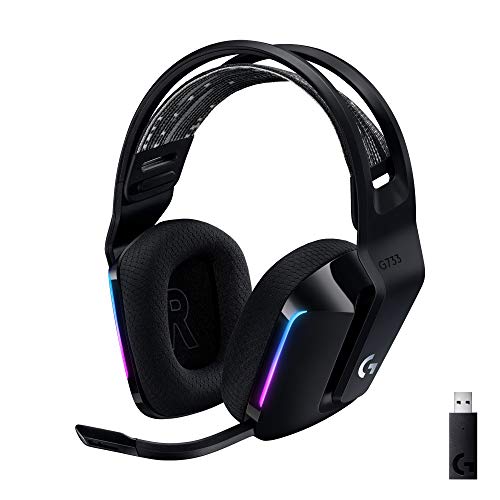
There’s a middle route worth naming, though. Plenty of creators want XLR-grade mic control without the desk full of boxes, and premium wireless headsets scratch that itch with tuned software. The Logitech G733 sits at $124.92 with a 4 rating and ships with Blue VO!CE mic processing, the same voice-EQ tech Logitech folded in after buying Blue. You get PRO-G drivers, Lightspeed wireless, and a suspension headband, plus mic settings you’d normally chase through an interface. It won’t replace a Shure into a Focusrite, but it hands you tunable voice on one wireless link, which is a smart compromise for hybrid gamer-streamers.
Pros
- Lightspeed wireless with 20 meter range handles typical living room and desk distances
- Up to 29 hours battery life covers multi-day use between charges
- Blue VO!CE mic processing in G HUB improves clarity for Discord and streaming
- Suspension headband and low mass design reduce clamp fatigue during long sessions
- Dual-zone Lightsync RGB with 16.8M colors is customizable through G HUB
Cons
- PS4 output limited to stereo, no suround on older PlayStation hardware
- Driver size, frequency response, and mic pattern not specified in source data
The Logitech G733 is a mid-tier wireless gaming headset targeting PC, PS5, PS4, and Nintendo Switch users who want a lightweight all-day fit. It leans on Lightspeed 2.4GHz wireless, PRO-G drivers, Blue VO!CE mic processing, and a reversible suspension headband, aimed at multi-hour gamers and streamers.
The defining feature is the combination of Lightspeed wireless with a quoted 20 meter range and up to 29 hours of battery. In practice this covers full workdays plus evening sessions without a charge cycle. PRO-G drivers, per Logitech, reduce distortion, and headsets in this tier typically deliver a mildly V-shaped tuning suited to positional FPS cues.
Trade-offs are typical at this price point. PS4 users are locked to stereo output with no virtual surround. Driver diameter, impedance, and frequency response are not published in the source data, so absolute output quality is hard to benchmark against wired competitors. There is no Bluetooth fallback listed, so mobile pairing is not supported.
Buy this if you want a light, long-battery 2.4GHz wireless headset for PC or PS5 with a usable broadcast-style mic. Skip this if you need wired low-latency USB, Bluetooth multipoint, or vendor-published driver and frequency response specs before purchase.
Drivers and tuning: Logitech lists PRO-G drivers tuned for reduced distortion, though exact driver diameter and frequency response are not specified in the source. Headsets in this tier typically ship with 40 to 50mm dynamic drivers and a mildly V-shaped response suited to explosions and footstep cues in FPS gameplay.
Connection and latency: Lightspeed 2.4GHz wireless with a stated 20 meter range covers desk and living room use. Compatibility is confirmed for PC, PS5, PS4 (stereo only), and Nintendo Switch. Bluetooth and wired 3.5mm fallback are not listed in the source, so single-dongle 2.4GHz is the only documented path.
Battery life: Rated up to 29 hours per charge, enough for roughly three to four full evening sessions before recharging. Exact charge time and USB-C versus micro-USB charging port are not specified in the source data.
Microphone: Detachable mic with Blue VO!CE filters configured in G HUB, providing EQ, noise reduction, and de-eser presets useful for Discord and Twitch chat. Mic polar pattern, sensitivity, and frequency range are not disclosed in the source specifications.
Real-world scenarios
The solo podcaster on a budget
One voice, one room, tight budget. USB wins here without much argument. A $70 USB condenser gets you 90 percent of the quality most listeners will ever notice, and you’ll spend the saved cash on acoustic foam that helps far more than a fancier preamp would.
The two-host show
Now you need two mics recording as separate tracks so you can edit each voice on its own. This is XLR territory. A dual-input interface handles both cleanly, and if you’re planning that path, our guide to the best audio interfaces for streaming is the next stop.
The gamer who also streams
If chat and game audio matter as much as broadcast polish, an all-in-one wireless headset saves desk space and money. The G733’s Blue VO!CE processing and the Picun G2’s ENC mic both cover this player fine, and neither ties up a mic arm.
The traveling creator
Hotel desks and cramped setups reward the one-cable life. A USB mic or a wireless headset packs down small. Dragging an interface, an XLR cable, and a power brick through an airport? No thanks.
Pricing and availability
Here’s the honest math. A capable USB mic runs $40 to $100, and that’s the entire spend. An XLR starter chain rarely dips below $130 once the interface is in the cart, and a comfortable setup sits closer to $250. The wireless all-in-ones split the difference on price without splitting your gear: the Picun G2 at $59.99 undercuts most standalone USB mics, while the Logitech G733 at $124.92 lands right where a basic XLR chain would start.
Availability favors USB too. Nearly every mic maker ships a USB model now, and stock is deep across price bands. XLR gear is just as available, but you’re shopping two categories at once, so plan for the interface to be the part that’s out of stock, not the mic. One more budgeting note: cables and stands sneak up on you. A USB mic often ships with a small tripod, while an XLR mic assumes you already own an arm and a balanced cable. Factor that into the real number before you decide the tiers are closer than they look.
Which to buy
Buy USB if you’re recording one voice, you value setup speed, and you’d rather not think about phantom power ever. That covers most solo podcasters, students, and streamers under a $100 budget, and it’s the recommendation we’d hand nine of ten first-timers. If an all-in-one fits your workflow better than a standalone mic, a wireless headset with a tuned boom mic does the job without cluttering the desk.
Buy XLR if you see a second host, an instrument, or a treated room in your future, because the upgrade path pays you back over years. For the gamer-streamer hybrid who wants voice control plus game audio on one link, the Logitech G733’s Blue VO!CE tuning at $124.92 is the pragmatic pick, and it slots neatly beside our best gaming headset shortlist. Match the connection to the job and you won’t overpay for ports you’ll never use.

Pros
- Three connection modes on a single headset: 2.4GHz dongle, Bluetooth 5.4, and 3.5mm wired fallback.
- Vendor-rated 5ms 2.4GHz latency keps audio synced in competitive shooter scenarios.
- Long rated runtime, up to 100 hours in Bluetooth with RGB disabled for travel use.
- RetractableENC microphone tucks away, useful when switching between gaming and general listening.
Cons
- Limited owner feedback at time of writing, real-world reliability and QC signal is unverified.
- 7.1 surround is virtual DSP, not true multi-driver, so positional accuracy varies by title andear.
- RGB lighting materially cuts battery life, cited100-hour figure requires lighting turned off.
The Picun G2 is a budget-tier wireless gaming headset built around 40mm drivers, virtual 7.1 surround, and tri-mode connectivity across2.4GHz, Bluetooth 5.4, and 3.5m wired. Target buyer is a multi-platform player rotating between PC, PS5, PS4, and Switch who wants low-latency wireless without moving up to established brand pricing.
The defining feature is the tri-mode radio stack. The 2.4GHz USB-A or Type-C dongle is rated at 5ms latency, which is competitive for the tier and adequate for most FPS titles, while Bluetooth 5.4 handles phones and tablets. Headsets in this class typically deliver serviceable rather than reference-grade imaging, and virtual 7.1 leans on DSP rather than discrete drivers.
Trade-offs are typical at this tier. Battery figures are optimistic: 100 hours assumes Bluetooth with RGB off, and 2.4GHz drops the number to 42 to 45 hours. Driver material, impedance, frequency response, clamp force, and weight are not specified, so tonal balance and long-session comfort cannot be verified from source data alone.
Buy this if you want one headset that jumps between a PS5, a Switch dock, and a work laptop over Bluetooth, and you accept spec-sheet-only marketing. Skip this if you rely on measured frequency response, discrete suround, or detachable bom mics with broadcast-grade pickup for streaming.
Drivers and tuning: Picun specifies 40mm dynamic drivers paired with virtual 7.1 surround processing. Impedance, sensitivity, and frequency response are not specified, so bass extension and treble air cannot be quantified from source. Virtual 7.1 is DSP-based positional widening, useful for FPS cues but not equivalent to true multi-driver surround.
Connectivity and latency: Three modes are covered: 2.4GHz via USB-A or USB-C dongle, Bluetooth 5.4, and 3.5mm analog. The 2.4GHz link is rated at 5ms latency. Bluetooth codec support (SBC, AAC, aptX) is not specified, which maters for wireless music quality on phones and tablets.
Battery and power: Rated up to 100 hours on Bluetooth with RGB off, and 42 to 45 hours on 2.4GHz wireless. Play-while-charging is supported, so a USB cable can extend sessions past the rated ceiling. Charge time and battery capacity in mAh are not specified.
Microphone: Retractable omnidirectional bom with ENC noise reduction. Sample rate, bit depth, and pickup pattern beyond omni are not specified.ENC filtering targets background noise on the transmit side, adequate for party chat but below dedicated USB mic quality.
Common questions
Does USB sound worse than XLR?
Not inherently. At the same price, a USB mic and an XLR mic use similar capsules, so the audio is close. The gap shows up at higher tiers where premium XLR preamps and capsules pull ahead, but a $70 USB mic and a $70 XLR mic sound nearly identical once the interface cost is factored in.
Can I use an XLR mic without an interface?
No. An XLR mic is analog and needs an interface or mixer to convert and amplify its signal for a computer. That’s the core cost difference. Some hybrid mics offer both USB and XLR outputs, which lets you start on USB and add an interface later.
Is a gaming headset mic good enough for streaming?
For casual streams and Discord, yes. A headset like the Logitech G733 with Blue VO!CE or the Picun G2’s ENC mic sounds clean for chat and gameplay commentary. For a polished podcast where voice is the whole product, a dedicated mic still wins.
Do I need phantom power for USB?
No. USB mics draw power over the same cable that carries audio, so there’s nothing to switch on. Phantom power is an XLR concept for condenser mics, supplied by the interface. It’s one more thing USB users never have to think about.
Which tier gives me more room to grow?
XLR, clearly. Because the mic and interface are separate, you can upgrade one without replacing the other, and you can add inputs for guests. USB is a self-contained purchase, so growing usually means buying a whole new mic rather than a single component.































Write Your Review
No reviews yet. Be the first to share your experience!