

Mini PCs went from a niche curiosity to a serious desktop replacement in about five years, and two names keep surfacing in the debate: Intel NUC and Beelink. One is the brand that basically invented the modern 4-inch-square PC. The other undercut it on price and grabbed a huge chunk of the market. If you’re shopping a compact build or a small budget desktop, you’ll bump into both, and the real question isn’t which logo is fancier. It’s which price tier actually buys you more usable performance. We researched both platforms and cross-shopped them against budget desktops like the ones in our budget prebuilt roundup to see where the money lands.
Matchup at a glance
Intel NUC is the reference design. Intel built the platform, sold it directly for years, and handed the lineup to ASUS, so you get tight firmware, reliable BIOS updates, and Intel Core silicon that leans hard into single-threaded speed. That polish costs money. A comparably specced NUC often runs 20 to 40 percent more than the Beelink sitting next to it.
Beelink took the opposite route. It ships AMD Ryzen and Intel N-series chips in compact chassis at aggressive prices, frequently bundling more RAM and storage for the same spend. The tradeoff shows up in the details: firmware that updates less often, support that’s slower to answer, and cooling that can get loud under sustained load. Both brands are fine machines. They just chase different buyers.
Spec sheet showdown
| Spec | Intel NUC (typical) | Beelink (typical) | abytespark i7 Desktop | WIWB Ryzen 5 Desktop |
|---|---|---|---|---|
| Platform | Intel Core | AMD Ryzen / Intel N | Intel Core i7 | Ryzen 5 up to 4.1 GHz |
| Form factor | 4×4 mini | Compact mini | Full tower | Full tower (white) |
| Graphics | Integrated | Integrated | Integrated | RX 560 4GB |
| Memory | SO-DIMM, upgradable | SO-DIMM, upgradable | Desktop DIMM | 16GB DDR4 |
| Storage | M.2 NVMe | M.2 + 2.5-inch bay | SSD | 512GB SSD |
| Street price | $450 to $800+ | $200 to $600 | $499.99 | $569.99 |
Two things jump out. Beelink almost always wins on raw dollars-per-gigabyte, and a discrete card like the RX 560 in the WIWB tower changes the gaming math entirely, since neither mini PC ships dedicated graphics at this price.
Intel NUC strengths
The NUC’s advantage is boring in the best way. It just works, and it keeps working. Intel’s firmware team ships regular BIOS updates, Thunderbolt behaves predictably, and the Core chips inside deliver snappy single-core speed that you feel every time you open an app or load a spreadsheet. For an office, a point-of-sale kiosk, or a home lab where uptime matters more than saving forty bucks, that reliability is worth paying for.
You also get better resale and better documentation. NUCs have a huge community, so mounting brackets, spare parts, and troubleshooting guides are everywhere. The knock is cost. Intel rarely bundles generous RAM or storage, so a bare NUC kit plus a memory kit plus an SSD can climb past $700 before you’ve booted Windows. That’s the premium for a known-good platform.
Cooling is another quiet win. Intel tunes the fan curves conservatively, so a NUC under a normal office load stays composed and rarely spins up to a distracting whine. VESA mounting behind a monitor is a first-class feature, not an afterthought, and the tiny footprint disappears on a desk. For anyone deploying a dozen identical machines, that consistency, unit to unit, is exactly what an IT team wants. Fewer variables. Fewer support tickets.
Beelink strengths
Beelink wins the spec-per-dollar fight, and it isn’t close. The same money that buys a bare NUC often lands you a fully built Beelink with 16GB of RAM and a 500GB SSD already installed. AMD Ryzen chips also bring stronger integrated graphics, so light gaming and media playback run smoother than on an equivalent Intel iGPU. For a media box, a student machine, or a second PC that lives behind a monitor, that value is hard to argue with.
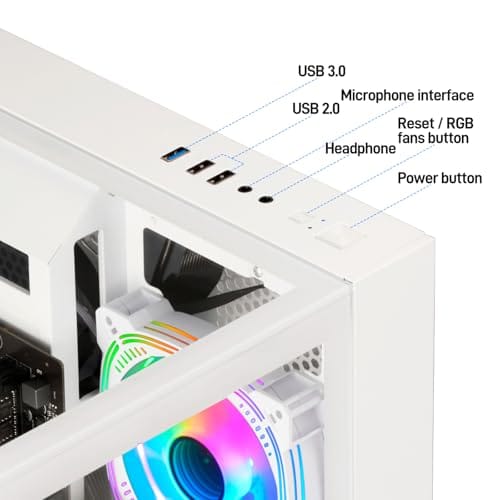
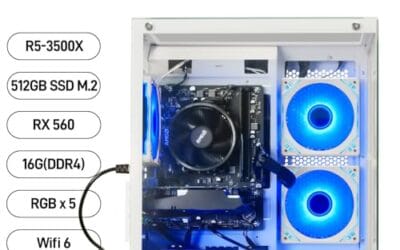
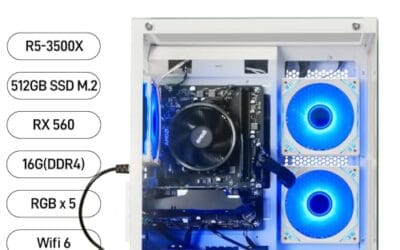
If you want that value pushed into a full tower with a real graphics card, the WIWB Ryzen 5 build shows the ceiling. It pairs a Ryzen 5 boosting up to 4.1 GHz with an RX 560 4GB card, 16GB of DDR4, a 512GB SSD, and Wi-Fi 6, and it holds a 4.7 rating at $569.99. That’s a Beelink-style value pitch scaled up, and it’s a natural cross-shop for anyone weighing a mini PC against a small desktop.
The value story does come with caveats worth knowing. Beelink’s firmware updates land less often than Intel’s, so a BIOS quirk can linger longer before a fix arrives. Owner reports also flag fan noise under sustained load, since the small chassis has less room to dissipate heat than a tower. None of that is a dealbreaker for a media box or a spare machine. It’s simply the reason the price is lower, and it’s the calculation you’re making when you save that forty or fifty bucks.

Pros
- Ryzen 5 3500X 6-core CPU bosts to 4.1GHz for smooth 1080p esports CPU load.
- Discrete RX 560 4GB handles DirectX 12 and Vulkan esports titles better than integrated graphics.
- 512GB SSD as bot drive keps Windows load times and app launches snappy out of box.
Cons
- Limited owner feedback at time of writing, no verified reviews to validate build quality.
- RX 560 is a legacy entry-tier GPU, skip if you want modern AAA at 1080p high.
- Ryzen 5 3500X sits on aging AM4, upgrade path is caped at Zen 3 with a BIOS update.
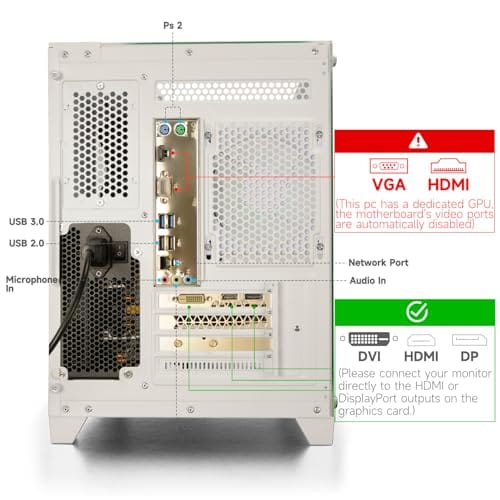
The WIWB is a budget prebuilt tower built around a Ryzen 5 3500X, RX 560 4GB, 16GB DDR4, and a 512GB SSD. It targets students, home office users, and casual gamers who want a plug-and-play box for esports at 1080p rather than a rig for current AAA titles.
The defining pairing here is the 3500X and RX 560. The 6-core, 6-thread CPU bosting to 4.1GHz is still competent for League, CS2, Valorant, and Overwatch, and typically pushes well above 100FPS at 1080p low-to-medium when paired with this GPU class. The RX 560 4GB is the bottleneck for anything heavier.
Trade-offs are typical at this tier. The RX 560 predates FSR frame generation and struggles with modern UE5 titles even at 1080p low. AM4 with a 3500X caps future CPU upgrades at Zen 3, and the case, PSU wattage, VRM phases, and included cooler are not specified, so headroom for a stronger GPU later is unclear.
Buy this if you need a cheap, pre-assembled Windows tower for schoolwork, browsing, and light esports at 1080p. Skip this if you plan to play current AAA releases, stream at 1080p60, or want a platform with a real multi-year upgrade path.
CPU workload: The Ryzen 5 3500X is a 6-core, 6-thread Zen 2 part with a 3.6GHz base and 4.1GHz boost. It stays viable for 1080p esports and light productivity like image editing and IDE work, but lacks SMT, which hurts streaming and modern CPU-bound AA titles.
GPU class and resolution fit: The RX 560 4GB GDDR5 is an entry esports card. Expect high frame rates in CS2, League, and Overwatch at 1080p low-to-medium, and playable frame rates in older AAA titles at 1080p low. 1440p and modern AA at medium are outside its envelope.
Memory and storage: 16GB DDR4 is the current baseline for gaming and multitasking, and the 512GB SSD covers Windows plus roughly 3 to 5 modern game installs. Exact DDR4 speed, dual-channel status, and SSD interface (SATA vs NVMe) are not specified.
Connectivity and upgrade path: WiFi 6 is included, and the board exposes an M.2 slot plus spare DDR4 slots for later expansion. PSU wattage, connector layout, case clearance, and waranty length beyond the stated 1-year coverage are not specified, so plan GPU upgrades cautiously.
Real-world scenarios
Home office and everyday desktop work
For browser tabs, email, video calls, and office suites, both platforms fly. Here the NUC’s firmware polish edges ahead for a business fleet, but a single Beelink saves real money for a home setup. Most people won’t feel the difference.
Media center and living-room PC
Beelink’s Ryzen graphics and dual-storage bays make it a natural HTPC. It’s quiet at idle, sips power, and handles 4K playback without breaking stride. If that’s your goal, our HTPC picks line up closely with what Beelink does best.
Always-on home server or lab
Running Plex, Home Assistant, or a few containers around the clock? The NUC’s stability and Intel Quick Sync tilt the scales, though a Beelink with more RAM stretches your dollar for a light home server role. Pick based on how much you value hands-off uptime.
Casual gaming
Neither mini PC is a gaming rig. Both lean on integrated graphics, so you’re looking at older or lighter esports titles at 1080p on low settings, and even then you’re managing expectations. If frames matter, the tower route with a discrete card, like that WIWB build, leaves both minis behind. An RX 560 won’t win benchmarks, but it clears a bar no iGPU in this bracket reaches. Simple as that.
Pricing and availability
Street pricing is where this gets interesting. Beelink units float between roughly $200 and $600 depending on chip and memory, and they’re almost always in stock on the usual marketplaces. Intel NUC pricing runs from about $450 for older Core models to well past $800 for current builds, and some kits ship without RAM or storage, which quietly raises the real total.
The desktop cross-shops sit right in that overlap. The abytespark Intel Core i7 tower lists at $499.99 with a 4.4 rating, and the WIWB Ryzen 5 build runs $569.99 at 4.7. Both are in stock and both undercut a fully kitted NUC while adding tower expandability the minis can’t match.
Watch the fine print on any mini PC listing, though. A NUC sold as a “kit” usually means no memory and no drive, so the real cost is the sticker plus a RAM kit plus an SSD. A Beelink or one of these towers typically ships ready to run. When you compare all-in prices instead of headline prices, the gap between the platforms narrows, and sometimes it flips entirely.
Which to buy
Buy the Intel NUC if reliability, firmware support, and a proven platform matter more than the sticker. It’s the safe call for a business fleet, a set-and-forget server, or anyone who doesn’t want to troubleshoot cooling quirks. You’ll pay more, but you’re paying for fewer surprises. Buy Beelink if you want the most hardware per dollar and you’re comfortable with occasionally slower support.
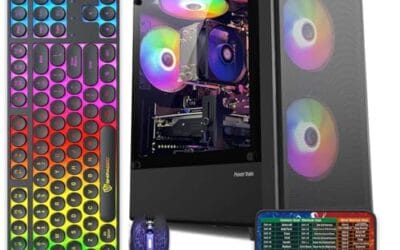
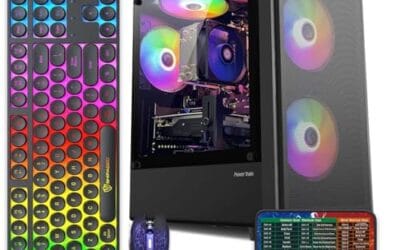
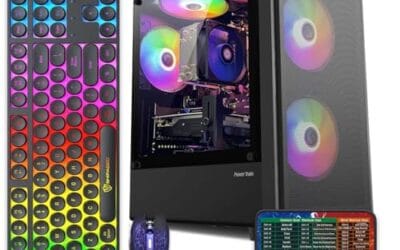
And if a compact desktop with room to grow suits you better than a sealed mini, the abytespark Intel Core i7 tower is a sensible landing spot at $499.99. It brings Intel Core speed in a chassis you can actually open and upgrade later, which is something no NUC or Beelink offers. Cross-shop it against our full budget prebuilt list before you commit.
Pros
- 512GB SSD bot drive avoids the HDD bottleneck common in budget prebuilts
- RX 590 8GB VRAM buffer handles 1080p textures better than 4GB budget cards
- Complete bundle with RGB peripherals means no extra spend to start using
- Genuine Windows 11 Home 64-bit preinstalled, no activation hassle out of box
Cons
- Limited owner feedback at time of writing, verify seller reputation before purchase
- Core i7-4770 is Haswell era LGA150, no upgrade path and weak IPC versus modern CPUs
- Windows 11 on 4th-gen Intel is unsupported by Microsoft and may miss feature updates
- No CD/DVD-ROM support and RAM/GPU generation limits future workload headroom
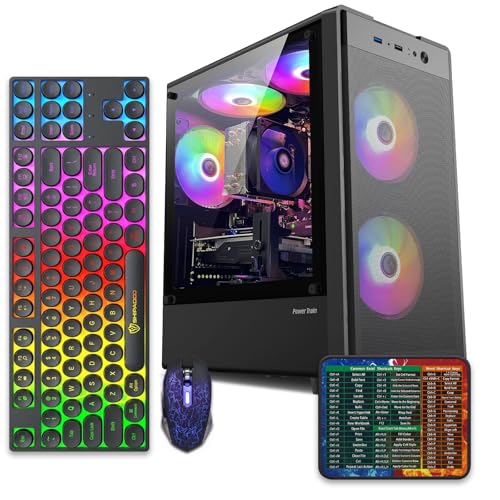
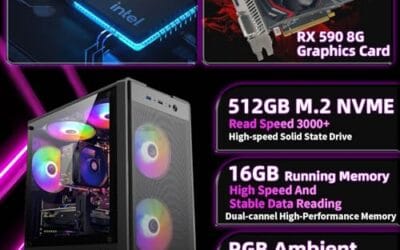
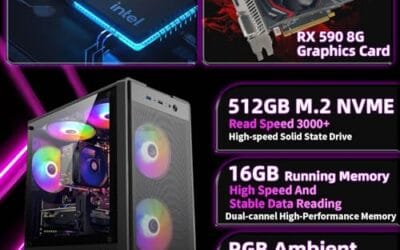
This is an entry-tier prebuilt tower built around an Intel Core i7-4770 Haswell CPU, 16GB RAM, a 512GB SSD, and an AMD Radeon RX 590 8GB GDDR5 GPU. It targets budget buyers who need a working office and light gaming PC with peripherals bundled, not enthusiasts chasing current-gen performance.
The defining feature is the RX 590 8GB paired with a 512GB SSD, an uncommon combo at this price band. Cards in this class typically handle 1080p esports titles at 60+ FPS on medium to high, matching the vendor claim for CS:GO, League of Legends, Apex, and Overwatch. Newer AA titles will need lowered settings.
Trade-offs are significant. The i7-4770 launched in 2013, so IPC, single-thread performance, and platform features like NVMe bot, PCIe Gen4, and modern USB are limited. Windows 11 runs here but sits outside Microsoft's official supported CPU list. There is no realistic CPU or socket upgrade path on LGA1150.
Buy this if you need a plug-and-play 1080p esports and office tower with keyboard, mouse, and RGB included at a low outlay. Skip this if you want current-gen platform support, sustained AA 1440p gaming, or a build with a meaningful upgrade runway.
GPU class: The AMD Radeon RX 590 8GB GDDR5 is a Polaris-refresh card roughly equivalent to a GTX 1060 6GB tier. Expect 1080p 60+ FPS in esports titles like CS:GO, Overwatch, Apex, League, and Fortnite on medium settings, matching the listing's claims.
AAA and modern titles: The vendor lists GTA V, Warzone, Hogwarts Legacy, and The Division 2. Realistically, these run at 1080p low to medium with FSR upscaling where suported.Ray tracing is unsupported on RX 590. No DLSS, no frame gen, no AV1 encode.
CPU bottleneck: The Core i7-4770 quad-core with 8threads at up to 3.9GHz will bottleneck the RX 590 in CPU-heavy titles like Warzone and Escape from Tarkov. Expect frame time inconsistency in large team fights even when average FPS looks aceptable.
Storage and RAM fit: 512GB SSD holds Windows plus 3 to 5 modern game installs before space pressure. 16GB DR3-era RAM is adequate for current esports but leaves no headroom for heavy streaming, browser tabs, and OBS NVENC alongside a game session.
Common questions
Is Beelink as reliable as Intel NUC?
For most home users, yes, but the NUC has a longer support track record and more frequent BIOS updates. Beelink hardware is solid at the price, though owner reports note that support responses can be slow and fan noise rises under heavy load. For always-on or business use, the NUC’s polish still leads.
Can either one game?
Lightly. Both rely on integrated graphics, so esports titles at 1080p on low settings are realistic and modern AAA games are not. If gaming is a priority, a tower with a discrete card like the RX 560 in the WIWB build is the better move.
Which is easier to upgrade?
Both minis let you swap SO-DIMM memory and M.2 storage, and Beelink often adds a 2.5-inch bay. Neither lets you change the CPU or add a graphics card. A tower like the abytespark i7 or WIWB Ryzen 5 wins on expandability every time.
Do I need to add RAM or an SSD myself?
Often with a NUC kit, yes, since many ship bare. Beelink units and the desktop builds here arrive with memory and storage already installed, which is part of why their all-in price looks better on paper.
Is a mini PC or a budget tower the smarter buy?
It depends on space and goals. Mini PCs win on footprint and power draw. Towers like these two win on graphics, expandability, and long-term flexibility for a similar spend. If your desk has room, the tower usually gives you more headroom for the money.


























Write Your Review
No reviews yet. Be the first to share your experience!