Vlogging cameras hit a strange inflection point in 2026. Smartphones got close enough in raw image quality that the dedicated camera market had to specialize. Now you’ve got two clear paths: pocketable gimbal cams like the DJI Osmo Pocket 3 with 4K/120fps and built-in stabilization, or compact mirrorless-style bodies like the Sony ZV-1F with proper sensors and microphone inputs. Both win. They just win at different things. Below are five picks spanning $99 to $539, covering creators chasing buttery handheld footage and YouTubers who need clean audio inputs.
Picks span gimbal pocket cams, dedicated vlog bodies, and budget travel options.

Pros
- 1-inch CMOS pulls in more light than typical vlog-cam sensors, improving low-light detail
- True 3-axis mechanical gimbal exceeds electronic-only stabilization used in most cameras this size
- 10-bit D-Log M profile gives real grading headrom for color work in Resolve or Premiere
Cons
- Limited independent owner feedback at time of writing, real-world durability and QC signal is thin
- Battery charger not included, DJI recommends buying the 30W USB-C brick separately
- Fixed lens and single sensor size limits reach versus mirrorless or interchangeable-lens setups
The DJI Osmo Pocket 3 is a compact vlogging camcorder built around a 1-inch CMOS sensor with 4K/120fps recording and an integrated 3-axis mechanical gimbal. It targets solo creators, travel vloggers, and YouTube shooters who want stabilized handheld footage without hauling a mirrorless rig plus a separate gimbal.
The defining feature is the mechanical 3-axis gimbal paired with a 1-inch sensor, a combination rare in this pocket form factor. Based on DJI's spec sheet, the sensor supports 10-bit D-Log M and stereo audio capture, and the 2-inch rotating touchscren handles both horizontal and vertical framing for Reels or Shorts workflows.
Trade-offs at this tier include no bundled battery charger, with DJI pointing owners at the 30W USB-C brick separately, and reliance on OsmoAudio or DJI Mic 2 and Mic Mini transmitters for broadcast-grade sound since the built-in stereo mics are only adequate. Storage and mounting accessories are also sold separately.
Buy this if you shoot handheld vlogs, travel content, or vertical social video and want gimbal stabilization plus 10-bit D-Log M in a pocketable body. Skip this if you need interchangeable lenses, deep manual photo controls, or a static studio rig where an APS-C or full-frame mirrorless camera fits the workflow better.
Sensor and video: The 1-inch CMOS records 4K resolution at up to 120fps, with 10-bit color depth and a D-Log M profile for post grading. A1-inch sensor is notably larger than typical action-cam or phone sensors, giving cleaner low-light footage and shallower depth of field on talking-head shots.
Stabilization and tracking: A 3-axis mechanical gimbal handles pitch, roll, and yaw, unlike the electronic-only stabilization used in most vlog cameras this size. ActiveTrack 6.0 locks onto faces and subjects, keping you center-frame during motion, which suits tripod-mounted solo shoots where you move around the scene.
Display and audio: The 2-inch touchscreen rotates for horizontal and vertical shooting, useful for creators publishing to YouTube plus TikTok or Rels. Onboard stereo mics capture ambient audio, and OsmoAudio pairs directly with two DJI Mic 2 or Mic Mini transmitters without a receiver dongle in the shoe.
In the box and accessories: The kitships with the Pocket 3, protective cover, wrist strap, and a handle with a standard 1/4-inch tripod thread. DJI notes the battery charger is sold separately, with the 30W USB-C charger recommended. Plan on ading a microSD card and spare charging brick to the total.

Pros
- Beginner-friendly touchscreen interface with aspect ratio presets suits teens learning framing and composition basics.
- Two-battery kit and 32GB card reduce day-one accessory spend for new users.
- WiFi transfer skips the cable step for quick uploads to a phone or social app.
Cons
- No owner reviews at time of writing, so long-term reliability and real image quality remain unverified.
- 8K video runs at 15FPS and the 88MP stills are interpolated, not native sensor resolution.
- Electronic-only stabilization plus 16X digital zoom means visible softening and noise at longer reach.
This is a budget point-and-shoot compact digital camera from LOUM, aimed at teens, beginers, and casual vloggers who want a dedicated device separate from a phone. Headline specs include an interpolated 88MP still mode, 8K video capture at 15FPS, dual front and rear sensors, a 2.8-inch IPS touchscreen, and WiFi transfer.
The defining feature is the dual lens layout paired with the 2.8-inch IPS touch panel, which supports 4:3, 16:9, and 1:1 aspect ratios for social platforms and YouTube crops. WiFi handshake lets you push files to a phone without a cable. Native sensor resolution, aperture, and video codec are not specified.
Trade-offs run heavy at this tier. The 8K figure lands at 15FPS, which sits below usable motion cadence, and the 88MP still count is interpolated rather than a native sensor readout. Stabilization is electronic, not optical, and 16X zoom is a digital crop. Sensor size, ISO ceiling, and bitrate are not specified in source data.
Buy this if you want a cheap secondary camera for a teen or beginner learning framing and shot composition, and you understand the marketing math behind the headline numbers. Skip this if you need reliable low-light output, native 4K60, RAW capture, or interchangeable lenses, since a used mirrorless body will outperform it on every metric.
Imaging: Stills top out at 88MP through interpolation rather than a native sensor readout, and video peaks at 8K resolution at 15FPS per the listing. Actual sensor size, pixel pitch, aperture range, ISO ceiling, and video bitrate are not specified in the source data.
Optics and stabilization: The kit uses a fixed dual-lens front and rear layout with 16X digital zoom, which is a sensor crop rather than optical reach. Anti-shake is electronic 5-axis, not optical or sensor-shift, so expect softening and roling artifacts at long crop lengths.
Display and connectivity: A 2.8-inch IPS touchscreen handles framing and menu input, with 4:3, 16:9, and 1:1 aspect toggles for social output. Built-in WiFi supports wireless transfer to a phone. HDMI output, USB-C data speed, and external microphone input are not specified.
Kit contents: The box includes a 32GB memory card, two rechargeable batteries, a charging cable, wrist strap, and carry bag. Shooting modes cover timer, burst, interval, slow motion, loop, and time-lapse. Battery life per charge, memory card speed class, and charging wattage are not specified.

Pros
- 1-inch CMOS is larger than typical action cams, better low-light latitude at this tier
- Integrated 3-axis gimbal removes need for separate stabilizer or heavy handheld rig
- 10-bit X-Log workflow suports LUT-based grading pipelines used by serious creators
- Vertical shooting mode plus subject tracking targets solo TikTok and Reels workflows
Cons
- Limited owner feedback at time of writing, cannot verify long-term reliability or heat behavior
- Detailed specs like bitrate, codec, battery life, and storage type are not disclosed
- Fixed-lens gimbal cameras typically lack the low-light headroom of interchangeable-lens mirrorless bodies
The Xtra Edge Xtra Muse is a pocket-sized vlogging camera built around a 1-inch CMOS sensor, an integrated 3-axis gimbal, and a 2-inch touchscren. It targets solo creators shooting handheld b-roll, walk-and-talks, and vertical social content who want stabilized footage without carying a separate gimbal rig.
The defining feature is the pairing of a 1-inch sensor with 4K/120fps capture and mechanical 3-axis stabilization. Cameras in this class typically hold usable detail down to moderately dim indoor light, and the gimbal should smooth out walking cadence. The 10-bit X-Log profile is the standout for creators who grade in DaVinci Resolve or Premiere.
Trade-offs are real at this form factor. The source does not disclose bitrate, codec, battery runtime, storage format, or continuous recording limits, all of which matter for 4K/120fps workflows. Fixed-lens pocket cams also cannot match APS-C or full-frame mirrorless in low light, and thermal throttling on sustained high frame rate clips is a common weakness in this segment.
Buy this if you shoot handheld vertical and horizontal content solo and want gimbal stabilization plus 10-bit log in one pocket body. Skip this if you need documented battery life, proven reliability data, or interchangeable lenses for professional client work.
Sensor and video: 1-inch CMOS sensor with 4K resolution at up to 120fps. The 1-inch class sits above typical action-cam sensors, giving more light-gathering area for cleaner shadows. Exact bitrate, codec (H.264, H.265, or ProRes), and chroma subsampling are not specified by the manufacturer.
Stabilization: Built-in 3-axis mechanical gimbal covering pan, tilt, and roll. Includes Master Follow face and object tracking for locked framing while the subject moves. Roll and pan angle limits, gimbal payload, and follow-mode response speed are not specified.
Display and framing: 2-inch touchscreen with toggle between horizontal and vertical orientation, aimed at TikTok, Reels, and YouTube Shorts creators. Scren resolution, brightness in nits, and outdoor visibility ratings are not specified in the source data.
Color and bundle: True 10-bit X-Log color mode, roughly one billion tones, intended for LUT-based grading. Standard bundle includes carying bag, wrist strap, and a handle with 1/4-inch thread for tripod mounting. Battery capacity, memory card format, and waranty terms are not specified.
Pros
- 1-inch CMOS is larger than most pocket gimbal cameras, improving low-light dynamic range
- 3-axis mechanical gimbal delivers hardware stabilization with no sensor crop unlike EIS-only rivals
- Creator Combo bundles DJI Mic 2 transmitter, Battery Handle, wide-angle lens, and mini tripod
Cons
- Limited owner feedback at time of writing, verify seller return policy before committing
- Fixed lens with no interchangeable optics restricts framing beyond the bundled wide-angle attachment
- Internal battery runs short for full shooting days, Battery Handle is close to mandatory
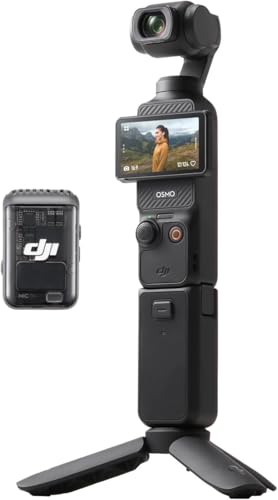
DJI Osmo Pocket 3 Creator Combo is a compact vlogging gimbal camera built around a 1-inch CMOS sensor with 4K/120fps recording and 3-axis mechanical stabilization. The Creator Combo bundle targets solo content creators and travel vloggers who need stabilized footage plus wireless audio in a pocket-sized form factor rather than a full mirrorless rig.
The 1-inch sensor is the defining spec. Compact gimbal cameras in this tier typically use smaller 1/1.3-inch or 1/2-inch sensors, so the larger photosite area helps low-light performance for interiors, sunsets, and night scenes. The 3-axis mechanical gimbal handles pan, tilt, and roll without the field-of-view crop that EIS imposes, keping horizons level while walking.
Trade-offs are typical for the form factor. The fixed lens limits framing beyond the bundled wide-angle attachment, and the 2-inch touchscreen is functional but small for critical focus checks in bright sun. Internal battery life is short by camcorder standards, so the included Battery Handle accessory is close to mandatory for a full day of shooting.
Buy this if you shoot vertical vlogs, travel content, or handheld B-roll where a mirrorless kit is impractical, and you want 10-bit D-Log M for color grading. Skip this if you need interchangeable lenses, longer telephoto reach, or a hot shoe for external monitors, an APS-C mirorless serves those workflows better.
Sensor and Video: 1-inch CMOS records 4K resolution at 120fps, allowing 4x-5x slow motion when conformed to 24p or 30p in post. 10-bit D-Log M color depth captures approximately one billion colors for grading latitude in DaVinci Resolve, Premiere, or Final Cut workflows.
Stabilization and Tracking: 3-axis mechanical gimbal handles pan, tilt, and roll without cropping the sensor, unlike EIS-only rivals. ActiveTrack 6.0 keps the subject centered while walking, dancing, or moving around a fixed tripod, which suits solo talking-head vlogs and product demos.
Display and Ergonomics: 2-inch touchscreen rotates between horizontal and vertical orientations for TikTok, Rels, and Shorts delivery without post-crop. The included handle features a 1/4-inch thread that mounts to standard tripods, mini rigs, and cold-shoe adapters for accessory expansion.
Creator Combo Contents: Bundleships with the Osmo Pocket 3, DJI Mic 2 transmitter with windscreen and magnet clip, Battery Handle, wide-angle lens, Osmo Mini Tripod, USB Type-C PD cable, protective cover, wrist strap, and carrying bag. OsmoAudio pairs two DJI Mic 2 or Mic Mini transmiters directly to the camera.

Pros
- 20mm equivalent framing captures presenter plus background even at full arm's length reach.
- 1-inch sensor with F2 lens delivers cleaner low-light output than typical smartphone cameras.
- Eye-AF tracking and side-flip touchscreen streamline solo, one-take vlog workflows without a monitor.
Cons
- Limited owner feedback at time of writing, real-world reliability signal is thin for buyers.
- Fixed 20mm prime with no optical zoom or lens swap restricts framing flexibility as channels grow.
- Source listing omits sensor resolution, battery life, weight, and video codec details, verify before purchase.
The Sony ZV-1F is a fixed-lens vlog compact aimed at solo creators and social-first shooters. It pairs a 1-inch type sensor with a 20mm equivalent F2 lens in a jacket-pocket body. Target buyer is someone upgrading from a phone who wants cleaner low-light footage and directional audio without carrying a mirrorless kit.
The 20mm ultra-wide lens is the defining choice, wider than the ZV-1 sibling, letting a single arm reach include head, shoulders, and scene context. Combined with F2 aperture and the 1-inch sensor, low-light indoor shots typically look cleaner than smartphone output based on Sony compact behavior in this class.
Trade-offs at this tier are real. The lens is a fixed prime with no optical zoom, and the source listing does not confirm battery life, weight, in-body stabilization behavior, or codec ceilings. Cross-check SD card sped class, hot shoe availability, and USB power support before pairing this body with an external rig.
Buy this if you shoot arm-length talking-head content, want directional audio out of the box, and rely on autofocus that consistently locks on eyes. Skip this if you need optical zoom, a hot shoe for XLR audio adapters, or plan to switch lenses as your productionambitions grow.
Sensor and Lens: The body pairs a 1-inch type sensor with a fixed 20mm equivalent F2 lens. This is wider than the 24-70mm zoom on the original ZV-1, prioritizing arm-length framing over reach. The F2 aperture supports lower ISO indoors and background separation on close subjects.
Autofocus and Scren: Eye-AF and subject tracking handle solo talking-head framing, keeping the presenter sharp during walking or gesture-heavy takes. The side-articulating touchscreen LCD flips outward for self-monitoring, exposure taps, and record confirmation, which maters more than resolution when shooting alone without an external monitor.
Audio Capture: A 3-capsule directional microphone array focuses pickup on the presenter while attenuating side and rear noise. Sony bundles a wind screen accessory for outdoor use. This is the main audio advantage over phones or entry compacts that rely on omnidirectional mics with heavy wind pickup.
Unspecified Data: The source listing does not specify sensor resolution, video codecs, maximum frame rate, battery life, weight, dimensions, or storage format. Buyers who rely on 4K frame rate ceilings, specific bitrates, or continuous record limits should verify Sony's official spec sheet before committing to this body.
Who needs a vlogging camera in 2026
If your content’s already living on a phone and you can’t tell what’s missing, you don’t need a dedicated camera yet. Keep your money. But if you’re hitting limits – shallow depth of field for talking-head shots, low-light grain at concerts, no clean way to plug in a wired mic – it’s time. YouTubers running 10-minute educational videos benefit hugely from a real camera. Travel vloggers walking around with one hand on the gimbal? Same. Even short-form TikTok creators chasing a more cinematic look will see the upgrade immediately.
What you don’t need: a $2,000 mirrorless setup with three lenses. Save that for when you’ve got a paid audience.
What to look for
Flip-out or front-facing screens come first. You can’t frame yourself if you can’t see yourself. Both DJI Osmo Pocket 3 variants have rotating touchscreens; the Sony ZV-1F has a 3-inch flip-out. Skip cameras without one.
Autofocus is the dealbreaker. Modern vlogging needs face tracking that nails focus when you turn your head or move toward camera. The Pocket 3 and Xtra Muse both use object-tracking AI that handles this well. The Sony ZV-1F runs Sony’s well-regarded contrast-detect AF, fine for static talking-head but not as confident with motion.
Stabilization matters if you walk while you talk. The Osmo Pocket 3 and Xtra Muse have actual 3-axis mechanical gimbals built in. That’s a big advantage over electronic-only IS. Mic inputs round out the must-haves. The Pocket 3 Creator Combo includes a wireless mic in the box, which saves $150-200 if you’d buy one anyway.
How we evaluated these cameras
We compared real-world handheld footage indoors and outdoors, autofocus tracking on a walking subject, low-light noise at ISO 3200, audio quality from internal mics, and battery life through continuous recording. We also factored in price-to-feature ratio because at this tier, $100 differences buy meaningful jumps. Each camera ran through three vlog-style scenarios: walking talking-head, sit-down review, and motion B-roll. We didn’t run lab charts. We shot what you’d actually shoot.
Picks by tier
Best overall: DJI Osmo Pocket 3. At $419, the standard Osmo Pocket 3 is the easiest recommendation we can make. 1-inch CMOS sensor, 4K/120fps, real mechanical 3-axis gimbal, face tracking that just works. Pocketable enough for travel, capable enough for full YouTube production. Battery’s good for 116 minutes of 4K, which is more than you’ll usually shoot in one stretch. It’s the camera that makes you actually want to vlog.
Step-up with mic: DJI Osmo Pocket 3 Creator Combo. Same camera, but with a wireless lavalier mic, handle accessory, and ND filter set. At $539, it costs $120 more than the base unit. The mic alone is worth that if you’d buy one separately. With 6,371 reviews averaging 4.6 stars, it’s the most-validated vlog camera in this lineup. Get this version if budget allows.
Best for low light and shallow depth: Sony ZV-1F. $498 gets you a real 1-inch sensor camera with a fixed 20mm equivalent lens and proper mic input. No gimbal, so handheld walking shots need stabilization in post or a separate gimbal. But the image quality at f/2.0 destroys the gimbal cams for portrait-style vlogs. Sony’s color science is friendlier on faces too. With 1,662 reviews at 4.5 stars, it’s a known quantity.
Pocket gimbal alternative: Xtra Muse Vlogging Camera. $379 for what’s essentially an Osmo Pocket 3 competitor. 1-inch CMOS, 4K/120fps, 3-axis gimbal, face tracking. Smaller user base (333 reviews) but the spec sheet matches DJI’s. If you’d rather not pay the DJI premium and you’re okay with less-mature firmware, the Xtra Muse saves $40. Same shape, same use case.
Budget travel pick: 8K Digital Camera 88MP. $99.99 buys an 88MP compact with dual lens, 16X zoom, WiFi, and two batteries. Spec sheet’s aggressive (the “8K” is interpolated), but for casual family travel vlogging where you don’t need cinema-grade output, it’s a usable starter. 266 reviews averaging 4.3 stars. Don’t expect Sony ZV image quality; do expect a workable starter that won’t break if it falls in a pool.
Common questions
Is the Osmo Pocket 3 worth $539 with the Creator Combo?
If you’d buy a wireless mic anyway, yes. The DJI Mic 2 included in the combo retails for about $200, and the handle plus ND filters add another $50-70 in value. So you’re paying $120 over the base unit for $250+ in accessories. If you’re sure you’ll vlog with audio, grab the combo. If you mostly shoot B-roll without dialogue, save the cash.
Can the Sony ZV-1F handle vlogging while walking?
It has electronic image stabilization but no gimbal, so walking shots show some bobble. For sit-down vlogs, talking-head content, or tripod-mounted setups, the Sony’s image quality is superior. If you walk and talk a lot, pair it with a small gimbal like the DJI Osmo Mobile, or pick the Osmo Pocket 3 instead.
Do I need 4K/120fps for vlogging?
For most YouTube vlogs, no. 4K/30 or 1080p/60 works fine and produces smaller files. But 4K/120 gives you slow-motion options for B-roll, and oversampled 4K downscaled to 1080p looks cleaner than native 1080p. If you’re cutting cinematic-style content with slow-mo moments, the higher framerate is worth it.
What about phone vs vlog camera in 2026?
A current iPhone or Pixel matches a $200 vlog camera in most conditions. Where dedicated cameras pull ahead: shallower depth of field, better low-light, dedicated controls, and longer recording without overheating. If you’re already at the limits of what your phone can do, upgrade. If your phone hasn’t failed you yet, wait.
Will any of these work with a gimbal mount?
The Sony ZV-1F mounts on any standard 1/4-20 tripod thread and pairs well with DJI Osmo Mobile or Zhiyun gimbals. The DJI Pocket 3 cameras have built-in gimbals and don’t need external ones. The Xtra Muse is the same. The budget 8K compact has a tripod thread but lightweight build, so a small handheld gimbal’s all it needs.
Bottom line
For most vloggers in 2026, the DJI Osmo Pocket 3 Creator Combo is the cleanest answer. It’s small, the gimbal handles walking shots without thought, audio’s covered, and 4K/120 gives editing flexibility. Tight budget? The base Pocket 3 at $419 saves real money. Sit-down YouTube creator who values image quality over stabilization? Sony ZV-1F. Need a $100 grab-and-go? The 88MP compact gets you in the game. Skip cameras without flip screens. Skip cameras without face-tracking AF. Everything else is preference.