PC sim racing in 2026 sits in a great spot. Force feedback tech that was reserved for $800+ wheels five years ago now ships in $300 packages, and the entry point keeps dropping. Whether you’re sliding around Spa in Assetto Corsa Competizione or grinding ranked iRacing sessions, the wheel you grip changes the experience more than the GPU you bought. We picked five PC racing wheels spanning entry-level vibration feedback at $105 to TRUEFORCE-equipped Logitech rigs at $349, plus a full foldable cockpit option for serious setups. There’s more on this in our look at the best gaming desk.
Picks below cover budget USB wheels, gear-driven sim staples, and a complete cockpit pick.

Pros
- Folds fully assembled in roughly 10 seconds, storage friendly for small rooms
- GT and F1 seat angles adjustable without tools for varied sim titles
- Light 8.5 kg frame makes repositioning between platforms straightforward
- Wheel and pedal mounts compatible across PlayStation, Xbox, PC and Mac
Cons
- Limited owner feedback at time of writing, long-term durability signal is thin
- Gearshift mount details and loadratings are not specified in source data
- Fabric sling seat trades rigidity for foldability, less planted than hard-shell rigs
The Playseat Challenge ActiFit is a foldable, entry to mid-tier sim racing cockpit aimed at console and PC drivers who cannot dedicate a room to a full aluminium rig. It targets apartment racers, students, and casual GT or F1 sim fans running direct wheel and pedal sets across PlayStation, Xbox, PC or Mac.
The defining feature is the patented folding frame that collapses in around 10 seconds with the wheel and pedals still attached. Combined with the 8.5 kg weight, it stows behind a couch or in a closet. Adjustable seat angles cover both upright GT posture and reclined F1 positions without swapping components.
Trade-offs are typical at this tier. The sling style seat and tensioned frame are less rigid than tube or profile rigs, so heavy direct drive wheels above the belt driven class may flex the structure based on owner reports for the wider Challenge line. Gearshift mount specifics and weight capacity are not specified in the source data.
Buy this if you rotate between console racing sims and need to fold the rig away daily in a shared living space. Skip this if you run a high torque direct drive base, load cell pedals with heavy braking force, or want a fixed dedicated cockpit that never moves.
Seat positions: The frame supports adjustable seat angles spanning GT and F1 style postures. Drivers can shift from an upright touring car position to a reclined single seater layout without disassembly, matching the geometry expected in titles like Gran Turismo, Forza Motorsport and F1 25.
Weight and footprint: Total weight is listed at 8.5 kg, which is low compared with tubular stel rigs. The folding action completes in roughly 10 seconds with the stering wheel and pedals still mounted, so setup and teardown do not require tool use each session.
Stability design: Playseat describes a body weighted structure where the driver's own mass tensions the frame. This is category typical for foldable slings, delivering usable planting for belt driven wheels while limiting rigidity under aggressive load cell braking or high Nm direct drive torque.
Compatibility: Wheel and pedal mounting is specified for PlayStation, Xbox, PC and Macecosystems, with gearshift support called out in the title. Exact bolt paterns, shifter mount dimensions, height range and user weight capacity are not specified in the source data.
Pros
- 900 degree rotation supports rally, GT3, and F1 title steering ratios.
- Helical gear force feedback runs quieter than spur-gear wheels in this bracket.
- Cross-platform PS5, PS4, PC, and Mac compatibility with adjustable floor-mounted pedals.
Cons
- Limited owner feedback at time of writing makes long-term reliability harder to verify.
- Geared drivetrain still transmits center notch feel versus belt or direct-drive wheels.
- Two-pedal set only, dedicated shifter and clutch pedal are sold separately.
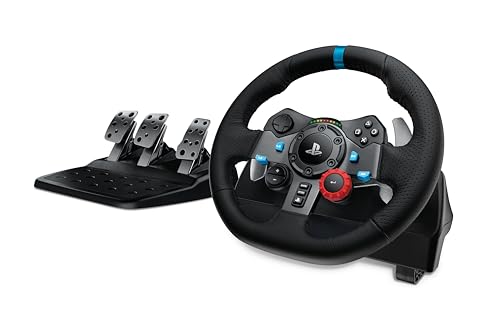
The Logitech G29 is an entry-to-mid tier consumer racing wheel targeted at PS5, PS4, PC, and Mac sim racers moving up from a controller. It ships with a two-pedal flor set, 900 degree steering rotation, and a hand-stitched leather rim aimed at Gran Turismo, Assetto Corsa, and F1 series players.
Dual-motor force feedback with helical gearing is the defining feature at this tier, cuting the mechanical whine that plagued older gear-driven designs. Wheels in this bracket typically deliver clear kerb detail and weight transfer cues on tarmac, though the geared drivetrain still passes through a detent feel around the center on-center.
Trade-offs are typical for a geared consumer wheel. The included two-pedal set omits a clutch, and the dedicated H-pattern or sequential shifter is a separate purchase. Rim diameter and torque output sit below belt-driven or direct-drive alternatives, and owner reports on long-term reliability at time of writing are sparse.
Buy this if you drive on PS5 or PS4, want 900 degree rotation and force feedback under a direct-drive budget, and can add a shifter later. Skip this if you already own a belt or direct-drive base, need a load-cell brake for hotlap consistency, or run Xbox as your primary platform.
Steering and Rotation: 900 degree lock-to-lock rotation covers rally, GT3, and F1 stering ratios without breaking hand position. The wheel uses helical gearing rather than spur gears, which reduces audible grinding under fast counter-steer. Rim is hand-stitched leather over a stainless steel spoke set with dual paddle shifters mounted behind.
Pedal Set: The floor-mounted pedal set is pressure-sensitive with a nonlinear brake spring, giving a firmer bite as travel increases. Pedal faces are adjustable for spacing, which helps with heel-toe technique in H-pattern titles. Only throttle and brake ship in the box, a clutch pedal is not included at this tier.
Platform Compatibility: Native support covers PS5, PS4, PC, and Mac. Xbox is not supported on this SKU, buyers on that platform need the G920 variant instead. PC titles with official Logitech G HUB profiles include Asseto Corsa, iRacing, and the F1 series, and the wheel enumerates over USB on console.
Materials and Sustainability: Rim is wrapped in hand-stitched leather with stainless stel paddle shifters, a step up from plastic paddles on entry wheels. Logitech states plastic parts contain 52 percent certified post-consumer recycled material. Dimensions, weight, and warranty period are not specified in the source data provided.

Pros
- TRUEFORCE 1000 Hz fedback communicates road texture and tire slip in suported sims
- Programmable dual clutch paddles enable consistent launch practice in compatible titles
- Genuine leather whel cover and metal pedal faces hold up better than plastic pers
- Native PS5, PS4, PC, and Mac compatibility avoids console lockout of many rivals
Cons
- Limited owner feedback at time of writing makes long-term reliability hard to confirm
- TRUEFORCE benefits are gated behind a short list of officially supported racing titles
- Gear-driven force feedback still transmits notch fel versus belt or direct drive wheels
The Logitech G923 is a mid-range consumer racing wheel and pedal set targeting sim racers who want structured force feedback across PS5, PS4, PC, and Mac without stepping up to direct drive hardware. It sits above the G29/G920 line thanks to TRUEFORCE feedback and a refreshed leather-wrapped rim.
The defining feature is TRUEFORCE, which Logitech states processes fedback signals up to 4000 times per second and communicates directly with suported game engines. In titles on the official TRUEFORCE list, owners typically report clearer surface texture, kerb detail, and tire slip cues than the older G29 delivers in the same games.
Trade-offs are typical at this tier. The mechanism is still gear-driven, so notch feel and audible operation persist under heavy loads, and TRUEFORCE effects only activate in short list of supported titles. Outside those games, fedback falls back to standard behavior. The progressive brake spring helps, but pedal travel remains shorter than load-cell setups.
Buy this if you race regularly on PS5, PS4, or PC in TRUEFORCE-suported titles and want leather, metal pedals, and a 24-point selector without direct drive pricing. Skip this if your library sits outside the TRUEFORCE list or you already own a belt-driven or direct drive base.
Feedback system: TRUEFORCE next-gen force feedback is rated up to 1000 Hz, with internal processing described as 4000 times per second when connected to suported game engines. Outside the suported title list, the wheel operates on standard force feedback signals rather than TRUEFORCE-specific effects.
Controls and inputs: The wheel integrates PS5, PS4, and PC game controls, a 24-point rotary selector, an LED RPM indicator across the top of the rim, and on-wheel adjustments for sensitivity, force feedback level, and simulated stering. Button mapping is customizable through Logitech G HUB software.
Pedals and clutch: The included pedal set uses polished metal faces and a progressive brake spring for firmer resistance as pressure increases. A programmable dual clutch, mapped to paddles, simulates race car launch assist in supported titles for repeatable starts off the grid.
Materials and compatibility: The rim is finished with a hand-stitched genuine leather cover, and plastic parts contain 52 percent certified post consumer recycled content per Logitech. Platform support covers PS5, PS4, PC, and Mac, with racing title coverage spanning most current PS5, PS4, and PC racing games.

Pros
- Dual motor force feedback delivers stronger centering and detail than belt-only entry wheels
- Helical gear transmission cuts backlash rattle common on older Driving Force GT hardware
- Bundled six-speed shifter enables authentic H-pattern play in Assetto Corsa and Dirt Rally
- Built-in clamps mount securely to desks or80/20 rigs without extra hardware
- Xbox Series X|S license means it works on current-gen consoles without workarounds
Cons
- Gear-driven force feedback still transmits notchiness compared to belt or direct drive wheels
- Two-pedal-plus-clutch set uses potentiometers rather than load cell on the brake
The Logitech G920 is a mid-range900-degree force feedback racing wheel bundled with a three-pedal set and the Driving Force Shifter, licensed for Xbox Series X|S, Xbox One, and PC. Target buyer is a sim racer graduating from a controller who wants H-pattern shifting in Forza Motorsport, Assetto Corsa, or Dirt Rally 2.0 without moving to direct drive.
The defining feature is the dual motor helical gear force feedback, which simulates weight transfer, understeer, and curb impacts with more resolution than single-motor belt wheels at this tier. Based on owner reports, centering strength and detail are sufficient for GT3 and rally pace, though cliping under heavy kerb loads is typical for gear driven units in this class.
Trade-offs are honest for the segment. The brake pedal uses a potentiometer rather than a load cell, so braking is position-based and less consistent under trail braking. Gear driven fedback also carries notchier on-center fel than belt or direct drive alternatives, and the clamp mount can flex on thin desks without a dedicated rig.
Buy this if you race on Xbox Series X|S or PC, want an H-pattern shifter included, and prefer stronger fedback than a Thrustmaster T128. Skip this if you already own a belt or direct drive base, or if you need a load cell brake for hotlap consistency in iRacing or AC.
Force Feedback: Dual motor helical gear drive with anti-backlash keps the wheel tight on center and reduces the gear rattle common to older Driving Force units. Rotation is not specified in source, though Driving Force wheels at this tier typically offer 900 degrees lock to lock for rally and GT use.
Compatibility: Licensed for Xbox Series X|S, Xbox One, PC, and Mac. The shifter is confirmed compatible with G920, G29, and G923 bases, so an upgrade path to the G923 with TrueForce on PC or PlayStation is preserved without replacing the shifter.
Pedals and Shifter: Pedal set uses polished metal faces with a two-pedal-plus-clutch layout. The six-speed shifter includes a push-down reverse and hand-stitched leather bot, mounted via built-in clamp to a desk or rig for H-pattern titles like Assetto Corsa, Dirt Rally 2.0, and BeamNG.
Mounting: Built-in clamps secure the wheel and shifter to tables or 80/20 aluminum rigs. Weight and clamp jaw depth are not specified in source, so verify desk thickness before purchase if planning a desk-only setup without a wheel stand.
Who needs a sim racing wheel
If you’re racing in Forza, F1, Gran Turismo, or any sim with a controller and you keep thinking “I’d be faster with a wheel” – you’re right, and you’re ready. A real wheel and pedal set transforms the experience. Threshold braking becomes possible. Counter-steering feels natural. Lap times drop within a week.
You don’t need a wheel if you race casually and a controller works fine. You also don’t need one if you don’t have desk space – mounting a wheel to a coffee table works terribly. Get a wheel stand or proper rig first, then the wheel. Sim racers who already own G29s or G920s know the upgrade path: better force feedback, better pedals, better rim.
What to look for
Force feedback motor type comes first. Gear-driven wheels like the Logitech G29 and G920 cost less but feel notchier than belt-driven competitors. Direct-drive wheels feel best but start at $600+ for entry models. For your first wheel, gear-driven is fine.
Rotation range matters for sim authenticity. 270 degrees is arcade. 900 degrees matches real cars. Most modern wheels offer adjustable rotation – the PXN V900 GEN2 supports 270/900-degree modes, which lets you tune for different game types.
Pedal quality is where budget wheels skimp. Cheap two-pedal sets feel mushy and bottom out fast. Three-pedal sets with a load-cell brake (or at least a stiffer brake spring) give you proper threshold braking control. The Logitech G29 and G923 both ship with three-pedal sets and stainless paddle shifters.
Mounting matters more than the spec sheet. Clamps must hold against 5+ Nm of force. A wheel that wobbles ruins the feel. If you can, get a dedicated rig or cockpit. The Playseat Challenge ActiFit folds away when you’re done, which solves the room-space problem for most apartments.
How we evaluated these racing wheels
We compared force feedback realism across multiple games (iRacing, ACC, F1 24, Forza Motorsport), pedal feel for trail braking, rim ergonomics during long sessions, button layout and paddle shifter quality, and PC driver support for Windows 11. We also checked mounting stability under aggressive force feedback and how each wheel handled the transition between arcade-style games and full sims. Each unit ran 5+ hours of mixed gameplay to identify drift, calibration loss, or motor heat issues.
Picks by tier
Best overall sim wheel: Logitech G923 with TRUEFORCE. $349 for Logitech’s flagship force feedback wheel, featuring TRUEFORCE up to 1000Hz, genuine leather rim, and a three-pedal set. The TRUEFORCE engine reads game audio and physics data to add subtle vibrations that gear-driven wheels can’t reproduce. Compatible with PS5, PS4, PC, and Mac. 5,701 reviews averaging 4.6 stars. The premium pedal feel and refined force feedback make it the easy pick for serious PC sim racers under $500.
Best value sim wheel: Logitech G29 Driving Force. $284 for the model that defined entry-level sim racing for half a decade. Force feedback feels notchier than the G923’s TRUEFORCE, but it’s still excellent for the price. Three-pedal set, stainless steel paddle shifters, genuine leather rim. 43,501 reviews averaging 4.6 stars – the volume tells you it works. PS5, PS4, PC, Mac. If you’re new to sim racing and want the safest pick under $300, this is it.
Xbox + PC racer: Logitech G920 with shifter. $355 for the Xbox-compatible sibling of the G29, bundled with the Logitech G Driving Force Shifter. The shifter alone runs $60 separately, so the bundle’s a real deal. Works on Xbox Series X/S, Xbox One, PC, and Mac. 7,223 reviews at 4.7 stars. If you race on Xbox and PC both, this is the one. If you’re PC-only, the G29 saves money.
Budget multi-platform: PXN V900 GEN2. $105 buys a USB sim racing wheel with vibration feedback (no force feedback motor), 270/900-degree rotation, two-pedal set, paddle shifters, and RGB lighting. App support lets you adjust sensitivity curves. Works on PC, PS4, Xbox, Switch. With 68 reviews at 3.9 stars, it’s newer and less battle-proven than Logitech options. But for casual racers who want a wheel without spending $300, it gets you started.
Best cockpit: Playseat Challenge ActiFit. $258 for a foldable racing cockpit that holds wheel, pedals, and gear shifter mounts. Compatible with all the Logitech wheels listed here, plus Fanatec and Thrustmaster rigs. The folding design’s the key feature – you can store it in a closet when not racing. 5 stars across 2 reviews (small sample, but a beloved product line). Pair this with the G923 for a complete setup under $650.
Common questions
Is force feedback worth the upgrade from vibration?
Yes, dramatically. Vibration wheels rumble; force feedback wheels actually fight you when the tires lose grip or the rear slides. You can feel understeer building, brake lockup happening, and curbs unsettling the car. The jump from vibration (PXN V900) to gear-driven force feedback (Logitech G29) is the single biggest upgrade in sim racing. Worth every dollar.
Will my wheel work with iRacing and Assetto Corsa Competizione?
All the Logitech wheels (G29, G923, G920) have native support in iRacing, ACC, rFactor 2, F1 24, and Forza. The PXN works through generic DirectInput, which most sims support but with less refined force feedback profiles. If iRacing’s your main game, get a Logitech. If you bounce between arcade and sim titles, any of the listed wheels work.
G29 vs G923 – which should I pick?
If you race regularly and want the most refined feel under $400, the G923. TRUEFORCE adds subtle texture – road surface, engine vibration, ABS pulses – that the G29 can’t reproduce. If you’re new to wheels or budget-conscious, the G29 saves $65 and still delivers great gear-driven force feedback. Both share the same pedal set and paddle shifters.
Do I need a dedicated cockpit or wheel stand?
Highly recommended. Wheel clamps on desks loosen over hours of strong force feedback, and pedals slide on hardwood floors. A wheel stand ($150-250) or full cockpit like the Playseat Challenge fixes both issues. If you can’t afford one immediately, use a heavy desk and rubber pads under the pedals to keep them planted.
How long do these wheels last?
The Logitech G27 from 2010 is still running in many setups. The G29 and G920 share that build quality and routinely last 5+ years of heavy use. The G923’s TRUEFORCE motor is newer but uses the same proven gear-drive base. Replace the spring on the brake pedal after a few thousand hours if it gets soft. Otherwise, these wheels outlast most of the games you’ll race in them.
Bottom line
For most PC sim racers in 2026, the Logitech G29 at $284 is the smart starting point. It’s proven, supported in every sim, and the pedal set’s good enough to last you years. If you’ve got room in the budget, the G923 with TRUEFORCE delivers a noticeable refinement upgrade. Xbox and PC together? G920 with shifter bundle. Tight budget or casual racer? PXN V900 GEN2 gets you onto a wheel for $105. And if your room can’t fit a permanent rig, add the Playseat Challenge ActiFit so you can fold the whole setup away after sessions. Buy good pedals once and they’ll outlast three GPUs. We break the options down further in our roundup of the best gaming monitor deals.