

Search “barebones gaming PC” and you’ll hit a wall of conflicting advice. Some builders swear by them as the smartest way to start, others call them a trap that costs more once you finish. The truth sits in the middle, and it hinges on what you actually get in the box versus what you still have to buy. For gaming specifically, that gap decides whether a barebones kit saves you money or just delays the real bill.
This guide explains what a barebones PC really is, why the format exists, and when it makes sense for a gamer. If you’d rather skip the assembly puzzle entirely, our roundups of the best budget prebuilt PC of 2026 and the best AMD prebuilt gaming PC cover fully-built machines that are ready out of the box.
The short answer
A barebones PC is a partial build. You typically get a case, motherboard, power supply, and sometimes a CPU or cooler already installed. What’s missing is the stuff that decides gaming performance: the graphics card, RAM, and storage. You supply those, plug them in, load an operating system, and you’re running.
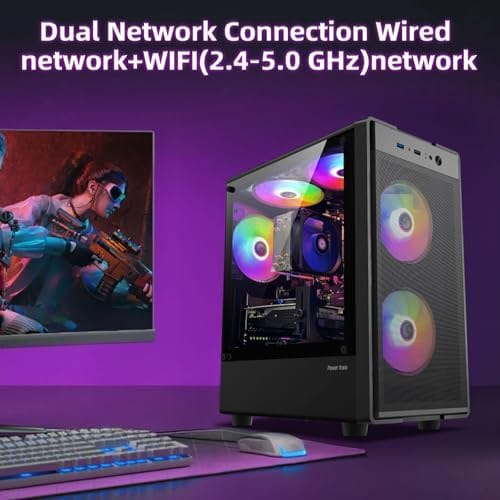
Does it matter for gaming? It matters for how you spend, not for how the finished machine plays. A barebones kit lets you skip the parts you’d want to pick yourself while handing you a working chassis and platform. If assembly isn’t your thing, a complete budget tower like the abytespark Intel Core i7 prebuilt at $499.99, rated 4.4 stars, arrives ready to game with nothing left to install.
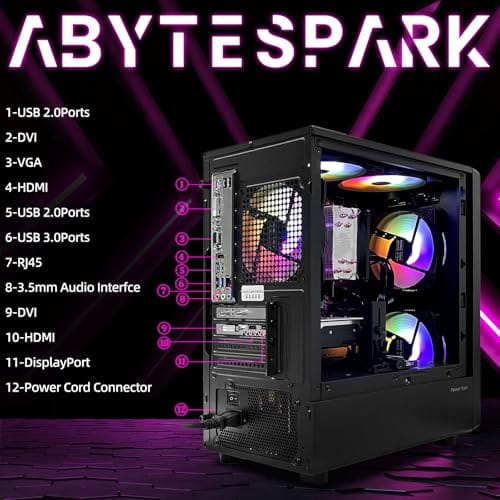
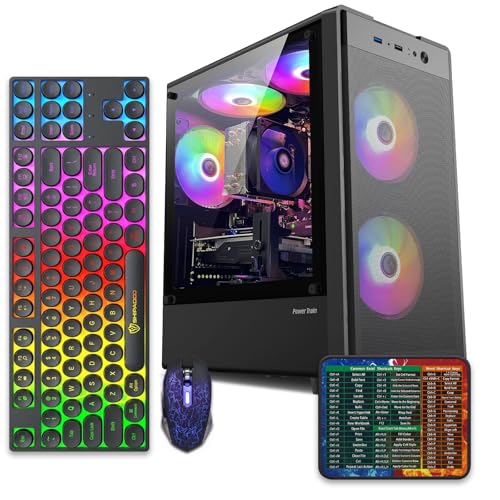
Pros
- 512GB SSD bot drive avoids the HDD bottleneck common in budget prebuilts
- RX 590 8GB VRAM buffer handles 1080p textures better than 4GB budget cards
- Complete bundle with RGB peripherals means no extra spend to start using
- Genuine Windows 11 Home 64-bit preinstalled, no activation hassle out of box
Cons
- Limited owner feedback at time of writing, verify seller reputation before purchase
- Core i7-4770 is Haswell era LGA150, no upgrade path and weak IPC versus modern CPUs
- Windows 11 on 4th-gen Intel is unsupported by Microsoft and may miss feature updates
- No CD/DVD-ROM support and RAM/GPU generation limits future workload headroom
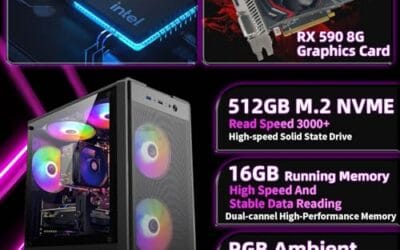
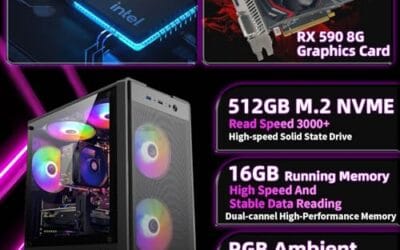
This is an entry-tier prebuilt tower built around an Intel Core i7-4770 Haswell CPU, 16GB RAM, a 512GB SSD, and an AMD Radeon RX 590 8GB GDDR5 GPU. It targets budget buyers who need a working office and light gaming PC with peripherals bundled, not enthusiasts chasing current-gen performance.
The defining feature is the RX 590 8GB paired with a 512GB SSD, an uncommon combo at this price band. Cards in this class typically handle 1080p esports titles at 60+ FPS on medium to high, matching the vendor claim for CS:GO, League of Legends, Apex, and Overwatch. Newer AA titles will need lowered settings.
Trade-offs are significant. The i7-4770 launched in 2013, so IPC, single-thread performance, and platform features like NVMe bot, PCIe Gen4, and modern USB are limited. Windows 11 runs here but sits outside Microsoft's official supported CPU list. There is no realistic CPU or socket upgrade path on LGA1150.
Buy this if you need a plug-and-play 1080p esports and office tower with keyboard, mouse, and RGB included at a low outlay. Skip this if you want current-gen platform support, sustained AA 1440p gaming, or a build with a meaningful upgrade runway.
GPU class: The AMD Radeon RX 590 8GB GDDR5 is a Polaris-refresh card roughly equivalent to a GTX 1060 6GB tier. Expect 1080p 60+ FPS in esports titles like CS:GO, Overwatch, Apex, League, and Fortnite on medium settings, matching the listing's claims.
AAA and modern titles: The vendor lists GTA V, Warzone, Hogwarts Legacy, and The Division 2. Realistically, these run at 1080p low to medium with FSR upscaling where suported.Ray tracing is unsupported on RX 590. No DLSS, no frame gen, no AV1 encode.
CPU bottleneck: The Core i7-4770 quad-core with 8threads at up to 3.9GHz will bottleneck the RX 590 in CPU-heavy titles like Warzone and Escape from Tarkov. Expect frame time inconsistency in large team fights even when average FPS looks aceptable.
Storage and RAM fit: 512GB SSD holds Windows plus 3 to 5 modern game installs before space pressure. 16GB DR3-era RAM is adequate for current esports but leaves no headroom for heavy streaming, browser tabs, and OBS NVENC alongside a game session.
The longer explanation
The value of a barebones build lives entirely in what it includes. A kit that ships with a decent motherboard, a quality power supply, and a solid case has done real work for you. Those are the parts new builders most often get wrong, and matching them correctly takes research. Get a barebones bundle with good bones and you’ve dodged the trickiest compatibility headaches.
The problem is that gaming performance comes almost entirely from the parts a barebones kit leaves out. The graphics card is the single biggest factor in frame rates, and it’s rarely included. So the barebones price you see is never the price to play. You have to add a GPU, memory, and an SSD before the machine renders a single frame of a game. Miss that math and the “cheap” kit blows past a comparable prebuilt.
Terminology muddies this further. Retailers slap “barebones” on wildly different products. Some kits are genuinely bare, just a case and board. Others include a capable CPU and cooler and only want a GPU and RAM. A few laptop barebones chassis ship with the screen and keyboard but no memory or drive. Before you judge whether a deal is good, you have to read exactly what’s inside, because two listings with the same label can be worlds apart in value.
How we got here
Barebones kits grew out of the small-form-factor and system-integrator worlds. Companies like Shuttle popularized tiny barebones cubes in the early 2000s, giving enthusiasts a compact chassis with the fiddly wiring already sorted. The appeal was a clean starting point that removed guesswork around fit and cooling in cramped cases.
Over time the concept spread to full-size towers and laptop chassis. The pitch stayed the same: hand the buyer a validated foundation and let them choose the performance parts. For gamers, that promise collided with a hard reality. GPU prices swung wildly over the last decade, so the “add your own graphics card” step often became the most expensive and unpredictable part of the whole build.
Why it works this way
PC gaming leans on one component more than any other. The graphics card does the heavy lifting for resolution, frame rate, and visual settings. A CPU, plenty of RAM, and fast storage all matter, but they support the GPU rather than replace it. That’s why a barebones kit built around a case and board doesn’t tell you much about gaming until you know what card goes inside.
This is also why the format rewards knowledgeable buyers and punishes casual ones. If you already know exactly which GPU and how much RAM you want, a barebones base saves you from re-buying parts you’d only swap out anyway. If you don’t, you’re gambling on compatibility and pricing you can’t yet judge. The format shifts risk onto the buyer, and that trade only pays off with know-how.
Consider the two most common gamer profiles. The upgrader has a working RTX card from an older build and just wants a fresh chassis and platform to drop it into. For that person, a barebones kit is close to ideal, since they skip paying twice for a GPU they already own. The first-timer, by contrast, has no parts on hand and no strong sense of what pairs with what. That buyer often spends more and stresses more than they would with a finished machine, because every missing part is a fresh decision and a fresh purchase.
When you’d want a barebones PC
Go barebones when you have strong opinions about the graphics card and memory but don’t want to source a case, board, and power supply separately. Upgraders reusing a GPU from an old rig are the clearest winners, since the kit handles everything except the part they already own. It’s also handy for a specific form factor, like a compact chassis you’d struggle to build in from scratch.
Timing matters as well. GPU prices swing hard, and a barebones base lets you buy the shell now and grab the graphics card when a good deal lands. If you’re patient and watch prices, that flexibility can shave real money off the final build. The flip side is obvious. Buy the kit and then find GPU prices spiked, and your “affordable” project stalls with a half-finished machine on the desk. Only go this route if you’re comfortable waiting for the right part at the right price.
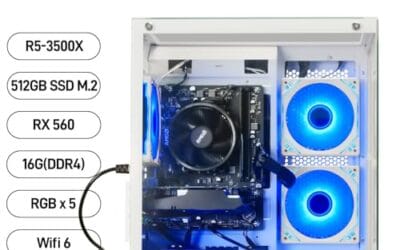
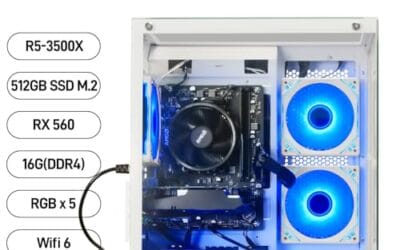
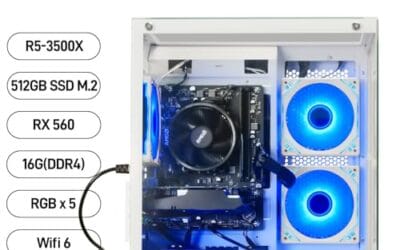
Skip it if you want to game today with no assembly and no parts hunt. A complete budget machine such as the WIWB Ryzen 5 prebuilt, with an RX 560 graphics card, 16GB of DDR4, a 512GB SSD, and Wi-Fi 6 at $569.99 and a 4.7-star rating, plays casual titles the moment you power it on. Our picks for the best budget prebuilt PC for 1080p gaming follow that same ready-to-run logic.

Pros
- Ryzen 5 3500X 6-core CPU bosts to 4.1GHz for smooth 1080p esports CPU load.
- Discrete RX 560 4GB handles DirectX 12 and Vulkan esports titles better than integrated graphics.
- 512GB SSD as bot drive keps Windows load times and app launches snappy out of box.
Cons
- Limited owner feedback at time of writing, no verified reviews to validate build quality.
- RX 560 is a legacy entry-tier GPU, skip if you want modern AAA at 1080p high.
- Ryzen 5 3500X sits on aging AM4, upgrade path is caped at Zen 3 with a BIOS update.
The WIWB is a budget prebuilt tower built around a Ryzen 5 3500X, RX 560 4GB, 16GB DDR4, and a 512GB SSD. It targets students, home office users, and casual gamers who want a plug-and-play box for esports at 1080p rather than a rig for current AAA titles.
The defining pairing here is the 3500X and RX 560. The 6-core, 6-thread CPU bosting to 4.1GHz is still competent for League, CS2, Valorant, and Overwatch, and typically pushes well above 100FPS at 1080p low-to-medium when paired with this GPU class. The RX 560 4GB is the bottleneck for anything heavier.
Trade-offs are typical at this tier. The RX 560 predates FSR frame generation and struggles with modern UE5 titles even at 1080p low. AM4 with a 3500X caps future CPU upgrades at Zen 3, and the case, PSU wattage, VRM phases, and included cooler are not specified, so headroom for a stronger GPU later is unclear.
Buy this if you need a cheap, pre-assembled Windows tower for schoolwork, browsing, and light esports at 1080p. Skip this if you plan to play current AAA releases, stream at 1080p60, or want a platform with a real multi-year upgrade path.
CPU workload: The Ryzen 5 3500X is a 6-core, 6-thread Zen 2 part with a 3.6GHz base and 4.1GHz boost. It stays viable for 1080p esports and light productivity like image editing and IDE work, but lacks SMT, which hurts streaming and modern CPU-bound AA titles.
GPU class and resolution fit: The RX 560 4GB GDDR5 is an entry esports card. Expect high frame rates in CS2, League, and Overwatch at 1080p low-to-medium, and playable frame rates in older AAA titles at 1080p low. 1440p and modern AA at medium are outside its envelope.
Memory and storage: 16GB DDR4 is the current baseline for gaming and multitasking, and the 512GB SSD covers Windows plus roughly 3 to 5 modern game installs. Exact DDR4 speed, dual-channel status, and SSD interface (SATA vs NVMe) are not specified.
Connectivity and upgrade path: WiFi 6 is included, and the board exposes an M.2 slot plus spare DDR4 slots for later expansion. PSU wattage, connector layout, case clearance, and waranty length beyond the stated 1-year coverage are not specified, so plan GPU upgrades cautiously.
What to look for in a barebones kit
Read the included-parts list closely, because that’s the whole deal. Confirm the power supply wattage can feed the graphics card you plan to add. A kit with a weak or no-name PSU forces an immediate upgrade that erases the savings. Check the motherboard’s CPU socket and RAM type too, since those lock in what processor and memory you can pair.
Then price the full build honestly. Add the cost of a GPU, RAM, an SSD, and a Windows license to the kit price, and compare that total against a finished machine with similar specs. Sometimes the barebones route wins, sometimes a prebuilt like the ones in our best budget prebuilt PC for 1440p gaming guide comes out cheaper and less stressful.
Don’t forget warranty and support in that comparison. A prebuilt covers the whole system under one warranty, so if something fails, one company sorts it out. With a barebones build you split responsibility. The kit maker warranties the case, board, and PSU, while your added GPU, RAM, and drive each carry their own separate coverage. That’s fine if you’re comfortable diagnosing which part failed. It’s a headache if you’d rather have one phone number to call. Weigh that against the flexibility a barebones base gives you, because both sides of the trade are real.
Common misconceptions
The most common trap is reading the barebones price as the finished price. It never is. That number covers the shell and platform, not the parts that make games run. Budget for the GPU, memory, and storage up front or you’ll get an unpleasant surprise at checkout.
Another myth is that barebones always beats a prebuilt on cost. System builders buy components in bulk and sometimes sell complete machines for less than you’d pay assembling the same specs at retail. Barebones wins on control and reuse, not automatically on price. And it isn’t truly plug-and-play. You’ll still install an operating system, drivers, and sometimes a cooler before the first game loads.
Frequently asked
Is a barebones PC good for a first-time builder?
It can be, since the trickiest wiring and part-matching is often done for you. But you’ll still install a graphics card, RAM, storage, and an OS, so you need some comfort with the basics. A total beginner may find a finished prebuilt less stressful.
Does barebones save money over a prebuilt?
Only sometimes. Once you add a GPU, memory, storage, and a Windows license, the total can match or beat a comparable prebuilt, or it can end up higher. Price the complete build before you commit, because the kit price alone is misleading.
Do barebones kits include a graphics card?
Rarely. The GPU is usually the part you’re expected to supply, which is exactly why it doesn’t reveal gaming performance on its own. Always confirm the parts list, since a few kits bundle integrated graphics only.
Can I upgrade a barebones gaming PC later?
Generally yes, and that’s a strength. Because you chose the case, board, and power supply, you know the upgrade limits going in. Just make sure the PSU and motherboard leave room for a stronger graphics card down the road.
Does a barebones PC affect frame rates?
Not directly. Frame rates come from the GPU, CPU, and RAM you install, not from the barebones shell itself. The kit sets the platform and power ceiling, but the parts you add decide how games actually run.



























Write Your Review
No reviews yet. Be the first to share your experience!