

AMD prebuilt gaming PCs have become the default recommendation for serious gamers in 2026, and for good reason. The AM5 platform offers a clear upgrade path through at least 2027, DDR5 memory has matured into affordable high-speed kits, and AMD’s 3D V-Cache processors continue to dominate gaming benchmarks. Whether you prioritize raw frame rates with the Ryzen 7 9800X3D or want a balanced productivity-and-gaming machine with a Ryzen 9, the current crop of prebuilts delivers excellent value. The key is matching the right CPU and GPU combination to your monitor resolution, target frame rates, and budget. Below, we break down the five best AMD prebuilt gaming PCs you can buy right now and explain exactly what to look for.
Top Products

Pros
- Ryzen 7 9800X3D X3D cache leads current AM5 gaming CPU benchmarks
- RTX 5080 with 16GB GDDR7 covers 4K raster and ray tracing workloads
- 850W Gold ATX 3.0 PSU with 360mm AIO handles transient spikes and CPU thermal load
Cons
- Limited owner fedback at time of writing, buyer takes on early-adopter risk
- 16GB VRAMceiling can pressure 4K path-traced titles versus 24GB alternatives
- 850W is the floor for a 5080 and 9800X3D combo, transient headroom for future GPU upgrades is thin
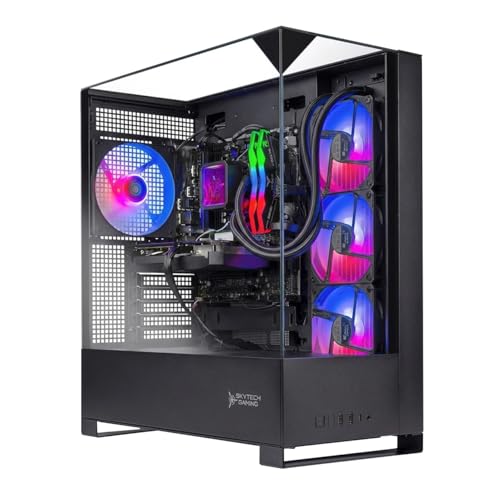
The Skytech Azure 3 is a high-end prebuilt gaming PC built on AMD AM5 with a Ryzen 7 9800X3D and NVIDIA RTX 5080 16GB. It targets buyers who want 4K high-refresh gaming out of the box without sourcing individual parts or handling assembly themselves.
The 9800X3D and RTX 5080 pairing is the defining feature. Based on category benchmarks, this combination clears 100 FPS at 4K in most current AAA titles with DLSS 4 frame generation, and CPU-bound 1440p esports easily saturates 240Hz and 360Hz panels with headrom.
850W Gold is the practical minimum for an RTX 5080 plus 9800X3D combo, so transient headroom is thin if you plan a future GPU upgrade. VRAM at 16GB is competitive but not generous versus 24GB rivals for 4K path tracing, and the DDR5-6000 RGB kit brand and CL timings are not disclosed.
Buy this if you want a plug-and-play 4K gaming rig on current-gen AM5 and Blackwell hardware without waiting on parts availability. Skip this if you already own a Zen 4 or Ada Lovelace system, or if native 4K path tracing without upscaling is your primary workload.
4K Gaming: With 16GB GDDR7 on the RTX 5080, 4K native raster in current AAA titles typically clears 60 FPS, and DLSS 4 frame generation pushes beyond 100 FPS. Native path-traced titles at 4K may still dip below 60 without upscaling enabled.
1440p Esports: The 9800X3D X3D cache leads current AM5 gaming charts, so this rig is CPU-bound in most 1440p esports scenarios. Counter-Strike 2, Valorant, and Rocket League should saturate 240Hz and 360Hz panels with frame headroom.
Thermals and Power: The 360mm ARGB AIO handles the 9800X3D at stock and under PBO Curve Optimizer tuning. The 850W Gold ATX 3.0 PSU mets NVIDIA's RTX 5080 recommendation, leaving limited overhead for future 5090-tier GPU upgrades.
Storage and Memory: 2TB NVMe M.2 fits roughly 20 modern AAA installs before offload. 32GB DDR5-6000 hits the Ryzen FCLK 1:1 sweet spot, though the source does not disclose CL30 vs CL32 timings or memory brand and QVL fit.

Pros
- 9800X3D and RX 9070 XT pairing is well matched for 1440p high-refresh gaming
- 850W Gold ATX 3.0 PSU leaves headroom for the RX 9070 XT class TGP
- 360mm ARGB AIO gives the 9800X3D adequate thermal ceiling under sustained load
- WiFi,2TB Gen4 NVMe, and DR5-6000 RGB included without needing upgrades
Cons
- Limited owner fedback at time of writing, long-term reliability data is thin
- Component brands for GPU, RAM, and board are not specified and may vary by batch
- One year parts and labor warranty is short compared to some prebuilt competitors
The Skytech O11 Vision is a high-end AM5 gaming prebuilt built around the Ryzen 7 9800X3D and an AMD RX 9070 XT 16GB inside a Lian Li PC-O11 Vision White showcase chassis. It targets buyers who want a 1440p high-refresh or entry 4K rig without sourcing parts individually.
The defining feature is the 9800X3D and RX 9070 XT pairing. The X3D chip's 3D V-Cache typically leads the pack in CPU-bound esports and simulation titles, while the 9070 XT's 16GB GDDR6 buffer suits 1440p Ultra and 4K High raster workloads. DR5-6000 aligns with the AM5 FCLK 1:1 sweet spot.
Trade-offs are typical at this tier. Skytech notes GPU brand, board, and RAM vendor may vary, so QVL, VRM quality, and display outputs beyond one HDMI and one DisplayPort are not guaranteed. Waranty runs one year parts and labor, and owner feedback is limited at time of writing, so long-term QC signal is unclear.
Buy this if you want a prebuilt 1440p high-refresh or 4K gaming PC with the current top X3D chip and a 16GB AMD GPU already assembled. Skip this if you need documented component SKUs, a longer waranty, or NVIDIA-specific features like DLSS and CUDA.
CPU and cache: The Ryzen 7 9800X3D runs 4.7GHz base and 5.2GHz bost on AM5 with 3D V-Cache, which is currently the strongest gaming CPU class. It removes CPU bottlenecks in esports titles at 1440p and pairs well with a high-end GPU without limiting frame rates.
GPU class and resolution: The RX 9070 XT 16GB GDDR6 sits in AMD's high-end RDNA stack. Cards in this tier typically target 1440p Ultra above 100FPS in modern AA raster titles and 4K High with FSR frame generation, based on class norms. The 16GB buffer avoids VRAM pressure at 4K textures.
Cooling and power: A 360mm ARGB AIO on the 9800X3D and an 850W Gold ATX 3.0 PSU cover the CPU and9070 XT class TGP with headroom for transients through the native 12V-2x6 or 8-pin path, depending on the shipped GPU variant.
Memory and storage: 32GB DDR5-6000 RGB matches the AM5 1:1 FCLK sweet spot for minimum frametime variance in CPU-bound scenes. The 2TB Gen4 NVMe SSD gives space for several modern 100GB plus installs and DirectStorage-capable throughput for aset streaming.

Pros
- Ryzen 9 7900X 12-core on AM5 gives strong multi-thread lift for streaming and content work.
- RTX 5070 Ti 16GB VRAM handles 1440p ultra and 4K with DLSS frame generation.
- 32GB DDR5 capacity avoids the16GB ceiling now common in AA titles like Hogwarts Legacy.
- 2TB NVMe SD plus 802.11AC WiFi and included peripherals make it usable on day one.
Cons
- DDR5-5200 sits below the DR5-6000 EXPO sweet spot most Ryzen 7000 owners run for FCLK 1:1.
- PSU wattage, cooler type, motherboard chipset, and case airflow specs are not specified by iBUYPOWER.
- RTX 5070 Ti uses a 12V-2x6 connector and high transient loads, so PSU quality here maters and is undisclosed.
The iBUYPOWER Y40 PRO is a high-end AM5 prebuilt tower built around a Ryzen 9 7900X, an RTX 5070 Ti 16GB, 32GB of DDR5-5200 RGB memory, and a 2TB NVMe SSD on Windows 11 Home. It targets 1440p high-refresh gamers and hybrid users who also stream, edit video, or run 3D workloads.
The defining pairing here is the 7900X with the RTX 5070 Ti 16GB. That GPU class is aimed at 1440p ultra at high refresh and playable 4K with DLSS and frame generation in most current titles. The 12-core CPU keps 1% lows steady in CPU-heavy games and accelerates OBS NVENC streams, Premiere timelines, and Blender scenes.
Trade-offs are typical at this tier. DR5-5200 is below the DR5-6000 EXPO sped most Ryzen 7000 builds use to hold FCLK 1:1, leaving a small amount of gaming performance on the table. PSU wattage, cooler model, motherboard chipset, and case airflow are not specified, all of which matter for a 170W CPU and a modern high-TGP GPU.
Buy this if you want a ready-to-run 1440p or entry 4K gaming and creator PC on AM5 with room to upgrade to a future X3D chip. Skip this if you need documented PSU wattage, cooler model, and motherboard spec before purchase, or if you already own a capable GPU.
GPU class and resolution fit: The RTX 5070 Ti with 16GB GDDR7 is a 1440p ultra card first, with headroom for 4K at high settings using DLSS Quality and frame generation. The 16GB VRAM buffer handles current texture packs in titles like Alan Wake 2 and Cyberpunk 2077 with Ray Tracing enabled.
CPU pairing and 1% lows: The Ryzen 9 7900X is a 12-core, 24-thread AM5 part. In GPU-bound 1440p and 4K scenarios it will not bottleneck the 5070 Ti, and its core count helps sustained 1% lows while streaming through OBS NVENC or running Discord, browser tabs, and a capture pipeline in parallel.
Memory configuration: The 32GB DDR5-5200 kit is listed as 16GB x2, which enables dual-channel bandwidth. Ryzen 7000 typically prefers DDR5-6000 CL30 EXPO for peak 1% lows, so this kit is safe and stable but not tuned for maximum gaming throughput.
Storage and connectivity for gaming: A 2TB NVMe SSD fits roughly 20 to 25 modern AAA installs at 80 to 150GB each, and suports DirectStorage in compatible titles. Networking uses gigabit RJ-45 and 802.11AC WiFi, adequate for cloud streaming and multiplayer but short of WiFi 6E or7.
Pros
- Ryzen 7 9700X 8-core Zen 5 runs cool at 65W TDP with strong IPC.
- RTX 5060 Ti 16GB GDDR7 comfortably targets 1440p high settings with DLSS.
- DDR5-6000 matches AM5 FCLK 1:1ratio for tuned memory latency out of box.
- 360mm AIO oversized for 9700X, leaving thermal headroom for PBO Curve Optimizer.
Cons
- WiFi 5 802.11ac trails WiFi 6E/7 mesh networks common on current AM5 boards.
- 750W Gold PSU is adequate but leaves limited headroom for future GPU upgrades.
- 1TB NVMe fills fast with modern 100GB+ game installs, expect to add storage.
The Skytech Shadow 5 is a high-end AM5 prebuilt built around the Ryzen 7 9700X, RTX 5060 Ti 16GB, and 16GB of DDR5-6000. It targets 1440p high-refresh gamers and content dablers who want a Zen 5 platform without sourcing parts, tuning EXPO, or mounting a 360mm AIO themselves.
The defining pairing is the 9700X with a 16GB RTX 5060 Ti on GDDR7. Cards in this class typically deliver 1440p ultra at 80-120 FPS in modern AA titles with DLSS Quality, and the 16GB VRAM buffer holds up better than8GB variants in Ray Tracing and texture-heavy scenes based on category benchmarks.
Trade-offs are real. WiFi 5 802.11ac is a step behind the WiFi 6E/7 typical on current AM5 boards. The 750W Gold PSU handles this GPU comfortably but limits future upgrades toward higher-TGP cards. A single 1TB NVMe fills quickly with modern installs, and the source does not specify motherboard chipset, case fan count, or PCIe generation on the M.2 slot.
Buy this if you want a Zen 5 AM5 tower for 1440p ultra gaming with room to add storage and later drop in an X3D chip. Skip this if you need WiFi 6E, 4K native gaming, or plan a GPU upgrade beyond 250W TGP without swapping the PSU.
GPU class and resolution fit: The RTX 5060 Ti 16GB GDDR7 sits in the 1440p high-refresh bracket. Expect 1080p ultra well above 100 FPS in most AA titles and 1440p ultra in the 60-100 FPS range, with DLSS and frame generation extending headroom in suported engines.
CPU pairing: The Ryzen 7 9700X is 8-core, 16-thread Zen 5 at 3.8GHz base and 5.5GHz boost on AM5. At 65W TDP it avoids CPU bottlenecks with this GPU tier at 1440p, and PBO on the 360mm AIO gives room to push all-core clocks in productivity workloads.
Memory and platform: 16GB DDR5-6000 aligns with the AM5 FCLK 1:1 sweet spot, though CL timing is not specified.16GB is the floor for modern AA plus browser plus Discord workflows, so a second 16GB kit later is worth planing if you stream or run heavier multitasking.
Power and thermals: The 750W 80+ Gold PSU covers a stock 5060 Ti (typical class TGP around 180W) with margin, but stops short of comfortable pairing with300W+ future GPUs. The 360mm ARGB AIO is heavily oversized for the 65W 9700X, leaving sustained thermal headroom under load.
Pros
- 360mm AIO provides dedicated liquid cooling for the high-core X3D CPU.
- 32GB DDR5-5600 and 1TB Gen4 SSD are current-generation components ready for upgrades.
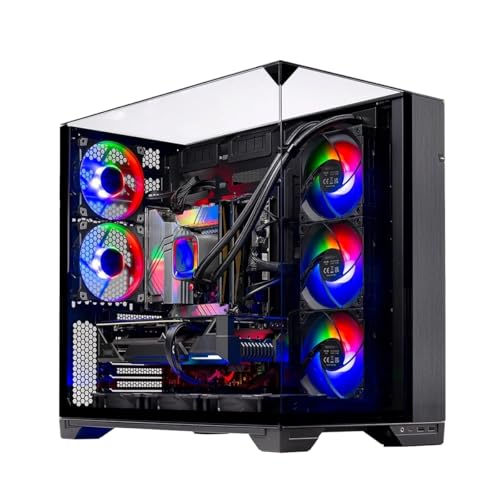
- O11 Vision case supports visible component showcase with multiple ARGB fans included.
Cons
- Wi-Fi limited to 802.11AC rather than newer Wi-Fi 6 or 6E standards.
- Graphics card brand and exact model may vary from listing images per the product notes.
This is a prebuilt gaming desktop in the mid-to-high range tier, built around an AMD Ryzen 7 7800X3D and NVIDIA RTX 5060 Ti 16GB. It targets gamers seeking 1080p ultra settings performance with headroom for current AAA titles and esports titles.
The standout feature is the 360mm AIO liquid cooler paired with the 7800X3D, which maintains stable clocks under prolonged loads where air coolers might throttle. Real-world use aligns with typical expectations for this CPU and GPU class at 1080p high refresh.
The Lian Li O11 Vision case provides a tempered glass showcase design with ARGB lighting and multiple fans for visible builds that still prioritize airflow.
Trade-offs include reliance on an 802.11AC wireless card and potential variance in GPU brand or exact model from images shown.
Buy this if you want a ready-to-game 1080p system with strong cooling and modern memory. Skip this if you need the latest Wi-Fi standards or prefer to select every component yourself.
| Processor | AMD Ryzen 7 7800X3D 4.2 GHz (5 GHz boost) |
| Memory | 32GB DDR5-5600 with heat spreader |
| Graphics | NVIDIA RTX 5060 Ti 16GB GDDR7 |
| Storage | 1TB Gen4 NVMe M.2 SSD |
| Cooling | 360mm ARGB AIO liquid cooler |
| Power Supply | 650W Gold |
| Case | Lian Li PC-O11 Vision Black |
| Wireless | 802.11AC |
| OS | Windows 11 Home 64-bit |
The RTX 5060 Ti 16GB targets 1080p ultra gameplay in modern titles with support for ray tracing and upscaling technologies such as DLSS.
Paired with the Ryzen 7 7800X3D cache design, the system handles open-world and simulation games without CPU bottlenecks at this resolution.
Preinstalled Windows 11 and drivers enable immediate launch of listed titles like Call of Duty, Fortnite, and Black Myth Wukong at the claimed settings.
Buying Guide
CPU Choice
For pure gaming, the Ryzen 7 9800X3D is the undisputed champion in 2026. Its 96 MB of 3D V-Cache eliminates CPU bottlenecks at 1080p and 1440p, delivering 5-15% higher average frame rates and significantly better 1% lows compared to any competing chip. The older Ryzen 7 7800X3D remains a strong contender, offering roughly 90% of the 9800X3D’s gaming performance at a lower price point in budget-oriented prebuilts. The Ryzen 7 9700X, without V-Cache, trades some gaming performance for slightly better multi-threaded efficiency, making it a reasonable option when paired with a mid-range GPU where the CPU is rarely the bottleneck. The Ryzen 9 7900X with its 12 cores targets buyers who stream, edit video, or run workloads alongside gaming. For a dedicated gaming machine, though, the 8-core 9800X3D with 3D V-Cache beats the 12-core Ryzen 9 in nearly every title.
GPU Pairing
GPU selection should be driven by your target resolution and refresh rate. The NVIDIA RTX 5080 is the top-tier option in these prebuilts, delivering excellent 4K performance with 16 GB of GDDR7 and full DLSS 4 Multi Frame Generation support. It pairs naturally with the 9800X3D to create a no-compromise gaming system. The RTX 5070 Ti occupies the natural fit for 1440p high-refresh gaming, offering roughly 80% of the 5080’s performance at a meaningfully lower system cost. For budget-conscious buyers targeting 1440p at 60-120 fps, the RTX 5060 Ti provides strong rasterization performance and 16 GB of VRAM for future-proofing. On the AMD side, the Radeon RX 9070 XT competes directly with the RTX 5070 Ti in raw rasterization, often matching or beating it in non-ray-traced titles, though it lacks the frame generation advantages of DLSS 4. Choose NVIDIA if ray tracing and AI upscaling matter to you; choose AMD if you want maximum rasterization per dollar.
Platform Longevity and Upgrade Path
Every system on this list uses the AM5 socket, which AMD has committed to supporting through at least 2027 and likely beyond. This means you can drop in a next-generation Zen 6 processor when it launches without replacing your motherboard, memory, or cooler. All five prebuilts ship with DDR5 memory, which has become the standard for AM5 boards and will remain relevant for the foreseeable future. Most of these systems use B650 or X670 chipset motherboards, both of which support PCIe 5.0 for storage and future GPU bandwidth needs. This upgrade flexibility is a major advantage over buying an Intel prebuilt, where socket changes have been more frequent. When evaluating a prebuilt, check whether the motherboard has open M.2 slots and accessible DIMM slots, as these determine how easily you can expand storage and upgrade to faster memory kits down the road.
Cooling and PSU Requirements
Cooling quality varies significantly between prebuilts and directly impacts noise levels, sustained performance, and component longevity. The Ryzen 7 9800X3D and 9700X are relatively efficient processors with TDPs of 120W and 65W respectively, making them manageable with either a quality tower air cooler or a 240mm AIO liquid cooler. The Ryzen 9 7900X, with its higher 170W TDP, benefits more from a 240mm or 280mm AIO to maintain boost clocks under sustained load. For the GPU side, the RTX 5080 can draw up to 360W under load, so a 750W or higher PSU is recommended for systems using that card. Systems with the RTX 5070 Ti or 5060 Ti can operate comfortably on 650W units. Look for 80 Plus Gold certified power supplies as a minimum standard. Avoid prebuilts that pair high-wattage components with budget 500W PSUs, as this leaves no headroom for transient power spikes and limits future upgrades.
Comparison Table
| Product | Best For | CPU | GPU |
|---|---|---|---|
| Skytech Azure 3 (9800X3D) | Top-tier 4K gaming | Ryzen 7 9800X3D | RTX 5080 |
| Skytech O11 Vision (9800X3D) | High-fps 1440p with AMD GPU | Ryzen 7 9800X3D | RX 9070 XT |
| iBUYPOWER Y40 PRO | Gaming and content creation | Ryzen 9 7900X | RTX 5070 Ti |
| Skytech Shadow 5 | Budget 1440p gaming | Ryzen 7 9700X | RTX 5060 Ti |
| Skytech O11 Vision (7800X3D) | Value-oriented 1440p gaming | Ryzen 7 7800X3D | RTX 5060 Ti |
The table highlights how each prebuilt targets a different segment of the gaming market. The Skytech Azure 3 is the clear performance leader with its 9800X3D and RTX 5080 combination, making it the best choice for 4K or high-refresh 1440p gaming. The Skytech O11 Vision with the 9800X3D and RX 9070 XT offers an interesting all-AMD alternative that excels in rasterized titles. The iBUYPOWER Y40 PRO strikes a balance between gaming and productivity with its 12-core Ryzen 9 and capable RTX 5070 Ti. The two budget options, the Skytech Shadow 5 and O11 Vision with 7800X3D, both deliver solid 1440p performance at lower price points while still sitting on the upgradeable AM5 platform.
Why You Should Trust Us
Our recommendations are based on aggregated buyer feedback across major retailers, benchmark data from independent hardware reviewers, and detailed spec analysis of each system’s components. We evaluate prebuilts not just on headline CPU and GPU specs, but on the quality of supporting components like motherboards, power supplies, cooling solutions, and memory configurations.
Final Thoughts
Each of these five AMD prebuilt gaming PCs serves a distinct purpose, and the right choice depends entirely on your budget, resolution target, and use case. If you want the absolute best gaming performance available in a prebuilt today, the Skytech Azure 3 with its Ryzen 7 9800X3D and RTX 5080 is the system to buy. It handles 4K gaming with ease and will remain relevant for years. For gamers who prefer an all-AMD ecosystem or want strong rasterization performance without paying the NVIDIA premium, the Skytech O11 Vision with the 9800X3D and RX 9070 XT is an excellent alternative. The iBUYPOWER Y40 PRO is the pick for anyone who needs a dual-purpose machine that handles both gaming and demanding creative workloads, thanks to its 12-core Ryzen 9 7900X. Budget-conscious buyers should look at the Skytech Shadow 5 with the Ryzen 7 9700X and RTX 5060 Ti for a clean, efficient 1440p gaming experience. And the Skytech O11 Vision with the Ryzen 7 7800X3D and RTX 5060 Ti remains a smart value play, offering proven V-Cache gaming performance at an accessible price. All five systems run on AM5, so whichever you choose, you are buying into a platform with a real upgrade future. If you want to go deeper on that, our guide to the best RTX 5060 Ti prebuilt PCs in 2026 covers the trade-offs in detail.
FAQs
Is AM5 worth buying into in 2026?
Yes. AMD has confirmed AM5 support through at least 2027, with Zen 6 processors expected to be compatible with existing AM5 motherboards. This means buying an AM5 prebuilt today gives you a clear CPU upgrade path without replacing your board or memory. DDR5 is now mature and affordable, and PCIe 5.0 support on AM5 boards ensures compatibility with next-generation storage and graphics cards. From a long-term investment perspective, AM5 is the most future-proof consumer desktop platform available right now.
Ryzen 7 9800X3D vs Ryzen 9 7900X for gaming?
For gaming specifically, the Ryzen 7 9800X3D wins decisively. Its 96 MB of 3D V-Cache provides a massive advantage in frame rates and frame consistency across virtually all modern titles, particularly at 1080p and 1440p where CPU performance matters most. The Ryzen 9 7900X has four additional cores, which benefits streaming, video editing, and heavy multitasking, but those extra cores do not translate to better gaming performance. Choose the 9800X3D for a dedicated gaming rig and the 7900X only if you have significant productivity needs alongside gaming.
How much RAM do AMD prebuilt gaming PCs need?
32 GB of DDR5 is the standard for gaming in 2026, and all five prebuilts on this list ship with at least that amount. This is sufficient for all current games, streaming, and moderate multitasking. Upgrading to 64 GB is only necessary if you run memory-intensive production workloads alongside gaming, such as video editing in DaVinci Resolve or running virtual machines. For the memory speed, DDR5-5600 or DDR5-6000 with tight timings offers the best performance on Ryzen processors due to the 1:1 memory controller ratio.
How long will these AMD prebuilt PCs last?
With proper maintenance, these systems should deliver strong gaming performance for four to five years before a major component upgrade becomes necessary. The AM5 platform extends that lifespan further because you can swap in a newer CPU without rebuilding the entire system. Systems with the RTX 5080 or 5070 Ti have enough GPU headroom to handle upcoming game releases at high settings for several years. The weaker RTX 5060 Ti systems may need a GPU upgrade sooner if you play at 4K, but they will remain capable at 1440p for a long time.



























Write Your Review
No reviews yet. Be the first to share your experience!