

A gaming rig the size of a paperback sounds like a gimmick until you plug one in. Mini PCs have crept from office-cubicle duty into the gaming conversation, and the question shoppers keep asking is simple: does the small box actually change anything, or is it just a full tower with the fun parts cut out? The honest answer depends entirely on what you play and at what resolution.
We researched how compact systems handle real games versus what a standard desktop delivers at the same budget, and the results aren’t as one-sided as either camp claims. If you’ve been eyeing something for a living room or a small desk and comparing options like our roundup of the best mini PC for 1080p gaming, this guide lays out where the form factor helps, where it hurts, and when a regular tower still wins.
The short answer
For gaming, a mini PC matters in two directions at once. It matters for space, noise, and power draw, where small wins easily. It also matters for raw performance ceiling, where small usually loses to a same-price tower because thermal and physical limits cap how much GPU you can cram in. So the form factor genuinely affects your experience, just not always in your favor.
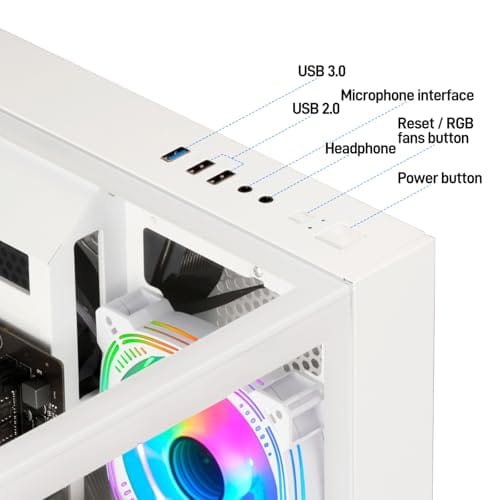
The practical takeaway: if you play esports titles, older games, or anything at 1080p, a well-built compact system is plenty and the small size is pure upside. If you chase 1440p ultra or 4K in demanding new releases, the space savings start costing you frames. A budget prebuilt tower like this one gives you a sense of what the same money buys in a bigger case.


Pros
- Ryzen 5 3500X 6-core CPU bosts to 4.1GHz for smooth 1080p esports CPU load.
- Discrete RX 560 4GB handles DirectX 12 and Vulkan esports titles better than integrated graphics.
- 512GB SSD as bot drive keps Windows load times and app launches snappy out of box.
Cons
- Limited owner feedback at time of writing, no verified reviews to validate build quality.
- RX 560 is a legacy entry-tier GPU, skip if you want modern AAA at 1080p high.
- Ryzen 5 3500X sits on aging AM4, upgrade path is caped at Zen 3 with a BIOS update.
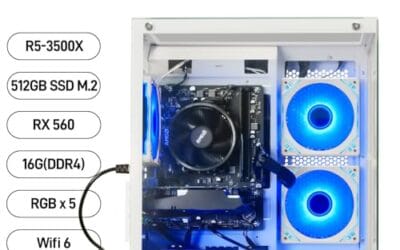
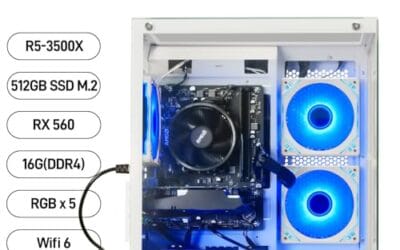
The WIWB is a budget prebuilt tower built around a Ryzen 5 3500X, RX 560 4GB, 16GB DDR4, and a 512GB SSD. It targets students, home office users, and casual gamers who want a plug-and-play box for esports at 1080p rather than a rig for current AAA titles.
The defining pairing here is the 3500X and RX 560. The 6-core, 6-thread CPU bosting to 4.1GHz is still competent for League, CS2, Valorant, and Overwatch, and typically pushes well above 100FPS at 1080p low-to-medium when paired with this GPU class. The RX 560 4GB is the bottleneck for anything heavier.
Trade-offs are typical at this tier. The RX 560 predates FSR frame generation and struggles with modern UE5 titles even at 1080p low. AM4 with a 3500X caps future CPU upgrades at Zen 3, and the case, PSU wattage, VRM phases, and included cooler are not specified, so headroom for a stronger GPU later is unclear.
Buy this if you need a cheap, pre-assembled Windows tower for schoolwork, browsing, and light esports at 1080p. Skip this if you plan to play current AAA releases, stream at 1080p60, or want a platform with a real multi-year upgrade path.
CPU workload: The Ryzen 5 3500X is a 6-core, 6-thread Zen 2 part with a 3.6GHz base and 4.1GHz boost. It stays viable for 1080p esports and light productivity like image editing and IDE work, but lacks SMT, which hurts streaming and modern CPU-bound AA titles.
GPU class and resolution fit: The RX 560 4GB GDDR5 is an entry esports card. Expect high frame rates in CS2, League, and Overwatch at 1080p low-to-medium, and playable frame rates in older AAA titles at 1080p low. 1440p and modern AA at medium are outside its envelope.
Memory and storage: 16GB DDR4 is the current baseline for gaming and multitasking, and the 512GB SSD covers Windows plus roughly 3 to 5 modern game installs. Exact DDR4 speed, dual-channel status, and SSD interface (SATA vs NVMe) are not specified.
Connectivity and upgrade path: WiFi 6 is included, and the board exposes an M.2 slot plus spare DDR4 slots for later expansion. PSU wattage, connector layout, case clearance, and waranty length beyond the stated 1-year coverage are not specified, so plan GPU upgrades cautiously.
The longer explanation
The core issue is physics, not marketing. Graphics performance scales with power, and power turns into heat that has to leave the case. A full tower has room for a triple-fan graphics card, big heatsinks, and airflow to move all that warm air out. A mini PC has a fraction of that volume, so it relies on smaller coolers, laptop-class or compact GPUs, and tighter power budgets. That’s a hard ceiling on how much horsepower fits.
This is why a small box and a big box at the same price rarely match. The tower spends its money on a beefier GPU and cooler; the mini spends part of the budget on engineering the shrink. You’re paying for compactness. For a lot of players that trade is worth it, since a machine that tucks behind a monitor or under a TV changes how the room feels. For frame-rate chasers it’s a real cost.
Power delivery adds another wrinkle. Big desktops run 650-watt supplies and beyond, so they feed hungry graphics cards without breaking a sweat. Compact machines often ship with modest power bricks or small internal supplies sized for the exact hardware inside, which leaves little headroom. That’s fine for the parts they came with. It just means a mini rarely has the electrical or thermal slack to grow into a much stronger card later, even if the slot physically exists.
How we got here
Mini PCs used to mean thin clients and media boxes, weak chips meant for spreadsheets and web browsing. Two shifts changed that. First, integrated graphics got genuinely capable, so a CPU with built-in graphics could run popular games at 1080p without a separate card. Second, compact discrete GPUs and better small-form-factor cooling let builders pack surprising power into liters of space instead of tens of liters.
The result is a spectrum, not a category. On one end sit tiny NUC-style boxes leaning on integrated graphics. On the other sit small-form-factor builds with real desktop cards. In between are prebuilt compact towers like the WIWB Ryzen 5 system with an RX 560 4G card, 16 GB of DDR4, a 512 GB SSD, and Wi-Fi 6 for 569.99 dollars. That machine, with its 4.7 owner rating, shows the modest-but-real gaming a compact prebuilt targets.
Why it works this way
Everything flows from the thermal envelope. A chip and GPU can only run as fast as the cooling allows before they throttle to protect themselves. Small cases have less room for heatsinks and fewer fans, so sustained performance under a long gaming session often sits below the peak numbers on the box. That’s not a defect, it’s the deal you sign for a small footprint.
Upgradeability follows the same logic. A tower lets you swap the graphics card, add drives, and expand memory for years. Many mini PCs solder components or leave no room for a full-length card, so what you buy is largely what you keep. That makes the initial spec choice more important, since you can’t bail yourself out with a bigger GPU in two years the way tower owners can.
Noise ties into the same equation, and it surprises people. A large tower moves air with big fans spinning slowly, which stays quiet even under load. A mini has to shove the same heat through smaller vents with faster, higher-pitched fans, so a compact box working hard can whine in a way a roomy one won’t. Good compact designs manage this well. Cheap ones don’t, and owner reviews usually flag the loud ones early.
When you’d want this
Reach for a mini PC when space, noise, or looks rank near the top of your list. Living-room gaming, dorm desks, tidy office setups, and anywhere a big humming tower would annoy you are ideal homes for one. If your library leans on esports staples, indie titles, or older AAA games at 1080p, a compact machine handles them without drama and disappears into the room. Our picks for the best mini PC for an HTPC lean into exactly that home-theater use.
The calculus changes if you want maximum frames per dollar or plan to upgrade over time. A conventional prebuilt tower like the abytespark Intel Core i7 desktop at 499.99 dollars, rated 4.4 by owners, shows how a standard chassis stretches a budget toward more expandable hardware. If you’re pushing 1440p and want a machine that grows, our best mini PC for 1440p gaming guide covers the compact options that still hold up at the higher resolution.
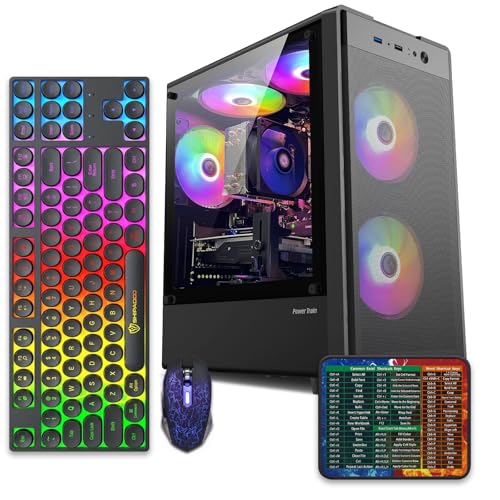
Pros
- 512GB SSD bot drive avoids the HDD bottleneck common in budget prebuilts
- RX 590 8GB VRAM buffer handles 1080p textures better than 4GB budget cards
- Complete bundle with RGB peripherals means no extra spend to start using
- Genuine Windows 11 Home 64-bit preinstalled, no activation hassle out of box
Cons
- Limited owner feedback at time of writing, verify seller reputation before purchase
- Core i7-4770 is Haswell era LGA150, no upgrade path and weak IPC versus modern CPUs
- Windows 11 on 4th-gen Intel is unsupported by Microsoft and may miss feature updates
- No CD/DVD-ROM support and RAM/GPU generation limits future workload headroom
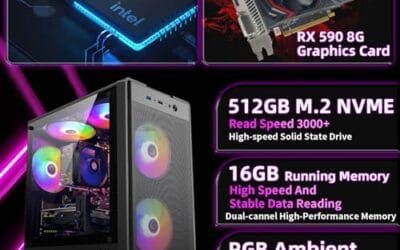
This is an entry-tier prebuilt tower built around an Intel Core i7-4770 Haswell CPU, 16GB RAM, a 512GB SSD, and an AMD Radeon RX 590 8GB GDDR5 GPU. It targets budget buyers who need a working office and light gaming PC with peripherals bundled, not enthusiasts chasing current-gen performance.
The defining feature is the RX 590 8GB paired with a 512GB SSD, an uncommon combo at this price band. Cards in this class typically handle 1080p esports titles at 60+ FPS on medium to high, matching the vendor claim for CS:GO, League of Legends, Apex, and Overwatch. Newer AA titles will need lowered settings.
Trade-offs are significant. The i7-4770 launched in 2013, so IPC, single-thread performance, and platform features like NVMe bot, PCIe Gen4, and modern USB are limited. Windows 11 runs here but sits outside Microsoft's official supported CPU list. There is no realistic CPU or socket upgrade path on LGA1150.
Buy this if you need a plug-and-play 1080p esports and office tower with keyboard, mouse, and RGB included at a low outlay. Skip this if you want current-gen platform support, sustained AA 1440p gaming, or a build with a meaningful upgrade runway.
GPU class: The AMD Radeon RX 590 8GB GDDR5 is a Polaris-refresh card roughly equivalent to a GTX 1060 6GB tier. Expect 1080p 60+ FPS in esports titles like CS:GO, Overwatch, Apex, League, and Fortnite on medium settings, matching the listing's claims.
AAA and modern titles: The vendor lists GTA V, Warzone, Hogwarts Legacy, and The Division 2. Realistically, these run at 1080p low to medium with FSR upscaling where suported.Ray tracing is unsupported on RX 590. No DLSS, no frame gen, no AV1 encode.
CPU bottleneck: The Core i7-4770 quad-core with 8threads at up to 3.9GHz will bottleneck the RX 590 in CPU-heavy titles like Warzone and Escape from Tarkov. Expect frame time inconsistency in large team fights even when average FPS looks aceptable.
Storage and RAM fit: 512GB SSD holds Windows plus 3 to 5 modern game installs before space pressure. 16GB DR3-era RAM is adequate for current esports but leaves no headroom for heavy streaming, browser tabs, and OBS NVENC alongside a game session.
What to look for in a mini PC
Start with the graphics solution, because it decides your gaming ceiling. Integrated graphics suit light 1080p play; a discrete card, even a compact one, opens up more demanding titles. Check whether the GPU is a real desktop part or a mobile chip, since the names look similar but the performance doesn’t match. Then confirm the cooling: reviews and owner reports tell you if a box throttles under load.
Next, weigh memory and storage. 16 GB of RAM is a sensible floor for modern gaming, and an SSD, ideally NVMe, keeps load times short. Verify what’s upgradeable before you buy, since some minis lock you out. Ports and wireless matter too; Wi-Fi 6 and enough USB and display outputs save headaches. For pure living-room duty, our best mini PC for office picks double nicely as light gaming boxes.
Common misconceptions
The loudest myth is that mini PCs can’t game at all. That’s outdated. Plenty run popular titles at 1080p smoothly. The real limit is the high end, not the whole category. The flip side myth is just as wrong: that a mini matches a same-price tower across the board. It usually won’t at the top of the performance range.
People also assume small means quiet by default. Not always. A cramped case with tiny fans can whine under load, sometimes louder than a well-built tower with big slow fans. And don’t assume every mini is upgradeable. Many aren’t, so treat the purchase spec as close to final and buy a bit more than you need today.
Frequently asked
Can a mini PC run modern AAA games?
Many can at 1080p with adjusted settings, especially models with a discrete GPU. Demanding new releases at high settings or higher resolutions push most compact boxes past their comfort zone. Match your expectations to the specific graphics hardware inside, since a mini with a real desktop card behaves very differently from one leaning on integrated graphics.
Is a mini PC worth it over a laptop for gaming?
If you already own a monitor and peripherals, a mini PC often gives you more performance per dollar than a gaming laptop and runs cooler on a desk. You lose portability, obviously. For a fixed setup in one room, the compact desktop is usually the better value; for gaming on the move, a laptop still wins.
Do mini PCs overheat during long sessions?
Well-designed ones hold up fine, but the small volume leaves less thermal headroom than a tower. Some models throttle under sustained load, trimming frame rates as they warm up. Owner reports and reviews are your best guide here, and keeping the box in open air rather than a sealed cabinet helps a lot.
Can I upgrade the graphics in a mini PC later?
Usually not the way you’d upgrade a tower. Many minis use integrated or soldered graphics, or lack room for a full-length card. Some small-form-factor cases do accept standard GPUs, so check the exact model. If future upgrades matter to you, a conventional desktop chassis is the safer long-term bet.
How much should I spend on a gaming mini PC?
Capable compact gaming machines generally start around 500 to 600 dollars for solid 1080p play, as the prebuilt options here show. Spending more buys stronger graphics and better cooling. Below that range you’re mostly looking at light or integrated-graphics gaming, which is fine for esports and older titles but limited for new AAA releases.



























Write Your Review
No reviews yet. Be the first to share your experience!