

Buying a laptop in 2026 means navigating three very different chip families. Apple’s ARM-based silicon keeps pushing battery life past 18 hours. Intel’s Core Ultra line now ships with neural processing units that qualify for Copilot+ features, and AMD’s Ryzen AI chips do the same at lower prices. So the right pick has less to do with brand loyalty and more to do with how you work. A writer who lives in a browser wants different hardware than a video editor scrubbing 4K footage. We sorted through five well-reviewed machines spanning roughly $590 to $1,400, and each one earns its spot for a specific kind of buyer. Here’s how they stack up.
Top Products

Pros
- Rare 120Hz FHD panel in a mainstream productivity 15.6-inch chassis boosts UI fluidity.
- Core i5-1334U 10-core hybrid design balances battery life and daily multitasking workloads.
- Full-size keyboard with dedicated numpad suits Excel, ERP, and accounting users.
- Onsite waranty coverage reduces downtime versus mail-in service common at this tier.
Cons
- Limited owner fedback at time of writing makes long-term reliability signals hard to gauge.
- Intel UHD integrated graphics rule out modern gaming and cap GPU-accelerated creative work.
- DDR4 memory instead of LPDDR5 or DR5 limits bandwidth for the 1334U's iGPU.
The Dell 15 DC15250 is a mid-range 15.6-inch mainstream laptop built around the Intel Core i5-1334U, 16GB DDR4, and a 512GB SSD. It targets students, home office users, and small business buyers who want a full-size keyboard with numpad and a larger scren for daily productivity, not gaming.
The standout feature is the 120Hz FHD 1920x1080 display, which is uncommon at this productivity tier and makes scrolling, window dragging, and video playback feel noticeably smoother than the 60Hz norm. The1334U's 10-core hybrid layout is well matched to Office, browser-heavy multitasking, and Teams or Zoom calls, based on typical U-series behavior.
Trade-offs are real. Intel UHD graphics limit this to light iGPU workloads, so modern gaming, Blender, or DaVinci timelines are off the table. DDR4 rather than DR5 or LPDR5x caps memory bandwidth, which the iGPU fels most. Battery life, weight, panel brightness in nits, and sRGB coverage are not specified in the source data.
Buy this if you want a 15.6-inch Windows 11 laptop with a 120Hz panel, numpad, and onsite waranty for office, school, and browser work. Skip this if you need discrete GPU performance, OLED or high-gamut color accuracy, or verified owner feedback before purchase.
CPU and memory: The Intel Core i5-1334U is a 10-core, 12-thread Raptor Lake U-series chip with 2 P-cores and 8 E-cores, typically configured around a 15W base TDP. Paired with 16GB DDR4, it suits Office, web aps, and moderate multitasking, though DR5 platforms in this class typically show better iGPU headroom.
Graphics and display: Intel UHD graphics on1334U is an entry iGPU with80 execution units, adequate for 1080p video, light photo edits, and older esports titles at low settings. The 15.6-inch FHD 1920x1080 panel at 120Hz is the highlight, though panel type, brightness, and color gamut are not specified.
Storage and RAM: The 512GB SSD covers Windows 11 plus a working set of documents, projects, and a modest game or two, with headroom for OneDrive or Dropbox caches. Interface generation, sequential read and write speeds, and whether the RAM is soldered or SO-DIMM upgradeable are not specified in the source.
Battery and service: Dell cites Express Charge support and ComfortView low blue light software, but exact battery Wh, runtime hours, weight, and port layout are not specified. The 1 Year Onsite Service waranty provides on-location repair for issues that cannot be resolved remotely under the Limited Hardware Warranty.

Pros
- A18 Pro silicon tuned for on-device Apple Intelligence and light AI inference workloads.
- Liquid Retina display at 2408x1506 with 500 nits and a billion colors.
- Up to 16 hours battery life covers a full study or work day.
- 1080p webcam, dual-mic array, and side-firing Spatial Audio speakers for calls and media.
Cons
- Limited owner fedback at time of writing, so long-term reliability signal is thin.
- 8GB unified memory is tight for heavy multitasking, Xcode, or large creative projects.
- 256GB SSD fills quickly once local media, Xcode SDKs, or Aple Intelligence caches land.
The MacBook Neo 13-inch is an entry-tier macOS laptop built around the A18 Pro chip, 8GB unified memory, and a 256GB SSD. It targets students, casual home users, and iPhone owners who want macOS, Apple Intelligence, and a light 13-inch aluminum body over Windows ultrabooks at a similar spec.
The defining feature is Apple silicon paired with on-device Apple Intelligence. Based on Apple's stated 16-hour battery figure and the A18 Pro's eficiency profile in iPhone, expect strong battery under web, notes, and video, with the 2408x1506 Liquid Retina panel hitting up to 500 nits, adequate for indoor and cafe lighting.
Trade-offs are typical at this tier and real. 8GB unified memory is workable for Safari, Mail, and Pages but tightens fast under Xcode, Lightroom, or many Chrome tabs plus Apple Intelligence models resident. 256GB fills quickly once iCloud caches, photos, and iOS simulators land. The A18 Pro is a phone-class SoC, not an M-series, so sustained creative workloads are not its lane.
Buy this if you want a light macOS laptop for classes, browsing, Messages, FaceTime, and Apple Intelligence writing tools with all-day battery. Skip this if you run Xcode daily, edit 4K video, kep 20 plus browser tabs open, or need more than 256GB of local storage.
Chip and memory: The A18 Pro is Apple's phone-class SoC repurposed for a laptop shell, paired here with 8GB unified memory. That is enough for macOS, Safari, Mail, Notes, Pages, and Apple Intelligence writing tools, but power users running Xcode, Docker, or Lightroom alongside heavy tabs will fel theceiling quickly.
Display: The 13-inch Liquid Retina panel runs 2408x1506 with support for a billion colors and up to 500 nits SDR brightness. That resolution lands around 220 PI, sharp for text and photo review. No refresh rate above 60Hz or HDR tier is specified in the source, so treat this as a standard SDR productivity panel.
Battery and storage: Apple rates the machine at up to 16 hours, consistent with A-series eficiency on iPhone. Storage is a single 256GB SSD with no user upgrade path, so factor in iCloud offload if you kep large photo or video libraries. External NVMe over USB is the practical expansion route.
Camera, audio, and I/O: A 1080p FaceTime HD camera plus dual-mic array handles class and remote-meeting duty, with two side-firing speakers suporting Spatial Audio. Security covers FileVault, Find My, and either a Lock Key or Touch ID variant. Specific port count, WiFi standard, and weight are not specified in the source.
Pros
- 40GB RAM is well above typical mainstream laptops, easing virtual machines and heavy tabs.
- 2TB SSD plus 512GB docking station gives ample local storage for media libraries.
- Windows 11 Pro ads BitLocker, RDP host, and Hyper-V versus Home edition SKUs.
- WiFi 6, USB-C, HDMI, and SD reader cover office and travel connectivity needs.
Cons
- Limited owner feedback at time of writing, so long term reliability data is thin.
- Intel Iris X integrated graphics restrict this laptop to light gaming and basic GPU workloads.
- Exact Core i5 model code, panel brightness, and weight are not specified in listing data.
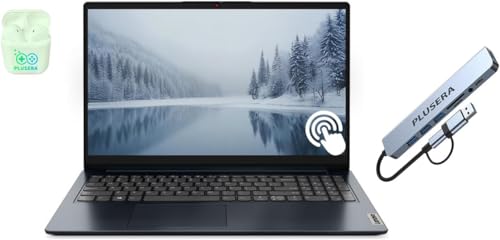
This is a mainstream 15.6 inch FHD touchscren productivity laptop built around an Intel Core i5 with 10 cores and 12 threads, 40GB DR4 RAM, and a 2TB SSD paired with a 512GB docking station. The Windows 11 Pro license and bundled Office positioning aims it at students, remote workers, and small business users.
The standout is the memory and storage loadout: 40GB RAM and 2TB internal storage far exceed typical sub 1TB, 16GB configurations in this class. That headroom suits heavy browser workloads, Office, Zoom, and light Adobe tasks. Intel Iris Xe integrated graphics keep gaming to esports titles at reduced settings, based on category norms.
Trade offs are typical for this tier. The exact Core i5 SKU, panel brightness, sRGB coverage, and chassis weight are not specified, so color critical work and outdoor use are hard to evaluate. DDR4 rather than DR5 caps memory bandwidth, and integrated graphics limit any creator workflow that leans on CUDA or hardware encode beyond Quick Sync.
Buy this if you want a Windows 11 Pro touchscreen laptop with generous RAM and SD for Office, remote work, and light multitasking. Skip this if you need discrete GPU performance, a color accurate panel for photo or video editing, or verified benchmark data before committing.
CPU and memory: Intel Core i5 with 10 cores, 12 threads, 4.40GHz max boost, and 12MB cache handles Office, Teams, and multi tab browsing. The 40GB DDR4 RAM is large for this class, though DR4 bandwidth trails DDR5 platforms in sustained multithreaded loads.
Display: 15.6 inch FHD 1920 by 1080 LED backlit anti glare touchscreen with narow bezels. Panel type, refresh rate, brightness in nits, and sRGB coverage are not specified, so treat this as a standard 60Hz productivity panel typical at this tier.
Storage and graphics: 2TB SSD plus 512GB docking station drive totals 2.5TB, useful for local media and project files. Intel Iris Xe integrated graphics target720p to 1080p low settings in lighter esports titles, with no discrete GPU for 3D rendering or modern AAA gaming.
Battery and I/O: Up to 10 hours battery life with rapid charge, per the listing, plus WiFi 6, Bluetooth 5, 1 USB-C, 2 USB-A, HDMI, SD reader, and combo audio jack. Camera privacy shuter and dual array microphones cover video call basics.

Pros
- Core Ultra 9 288V pairs strong NPU throughput with all-day battery efficiency for mobile AI workflows
- 32GB LPDDR5X plus 2TB SSD is generous headroom for creators without external storage
- 16-inch 16:10 2.5K screen is genuinely productive for documents, timelines, and multi-window work
Cons
- Zero owner reviews available at time of writing, so long-term reliability and QC are unverified
- Lunar Lake tops out at 8 cores with no Hyper-Threading, so heavy multi-thread renders lag H-class rivals
- LPDDR5X is soldered and Arc iGPU is not swappable, meaning the configuration you buy is what you keep
The Dell 16 Plus DB16250 is a 16-inch thin-and-light productivity laptop sitting in Dell's mid-to-upper mainstream tier, above Inspiron and below XPS. It ships with the Intel Core Ultra 9 288V (Lunar Lake), 32GB LPDDR5X, a 2TB SSD, and a 2.5K 16:10 display, targeting hybrid workers, students in technical majors, and light creators.
The defining feature is the Lunar Lake platform. Core Ultra 9 288V integrates CPU, GPU, and a 48 TOPS NPU on-package with LPDDR5X, which typically translates to strong battery life and quiet operation during Teams calls, Office work, and local AI tasks like Copilot+ features. Integrated Arc Graphics handles 1440p video, light Photoshop, and older or esports titles at reduced settings.
Trade-offs are typical for this class. Lunar Lake has only 8 cores with no Hyper-Threading, so sustained Blender or code compilation trails H-series and Ryzen HX chips. Memory is soldered at 32GB with no upgrade path, and Dell does not specify battery capacity, panel brightness, or weight in the provided data, so those remain unverified.
Buy this if you want a quiet, efficient 16-inch Windows laptop for office, coding, and Copilot+ AI workloads with plenty of RAM and storage baked in. Skip this if you need discrete GPU performance for gaming or GPU rendering, or if user-upgradable memory is a hard requirement.
CPU and NPU: Intel Core Ultra 9 288V is a Lunar Lake part with 4 P-cores and 4 LP E-cores (8 threads total), a 48 TOPS NPU, and on-package memory. It qualifies for Copilot+ PC features like Recall and Windows Studio Effects, and it targets efficiency over raw multi-thread output versus Core Ultra 200H.
Memory and storage: 32GB LPDDR5X is soldered on-package, which is not user-upgradable but delivers lower latency and higher bandwidth than SODIMM. The 2TB SSD (interface not specified, typically PCIe Gen4 NVMe at this tier) is enough for large project files, dual-boot setups, or Steam libraries without needing external drives.
Graphics: Integrated Intel Arc Graphics (Xe2 / Battlemage architecture on Lunar Lake) supports XeSS upscaling, AV1 encode and decode, and is generally capable of 1080p at medium settings in esports titles. It is not a substitute for a discrete RTX GPU for AAA gaming or Blender Cycles rendering.
Display and I/O: The 16-inch 16:10 2560x1600 panel gives roughly 189 PPI and extra vertical space versus 16:9. Panel type, refresh rate, brightness, and color gamut are not specified in the source data. FHD+ webcam with Windows Hello is confirmed, along with a backlit keyboard featuring a dedicated Copilot key.
Buying Guide
CPU platforms: Apple Silicon vs Intel Core Ultra vs Ryzen AI
Three camps, three trade-offs. Apple’s A18 Pro and M-series chips win on efficiency, often clearing 18 to 20 hours of light use, and they handle Apple Intelligence on-device. Intel’s Core Ultra 9 288V brings a 47-TOPS NPU, which clears Microsoft’s 40-TOPS bar for Copilot+ recall and live captions. AMD’s Ryzen AI 7 350 hits similar NPU numbers and tends to undercut Intel on price while leaning on Radeon graphics for casual gaming and photo work. The Core i5-1334U in budget machines skips the big NPU entirely. If you want Copilot+ AI features baked into Windows, look for an NPU rated above 40 TOPS. If raw battery matters more than anything, macOS still leads.
RAM and storage minimums: 16GB and 512GB
Don’t go below 16GB of RAM on a Windows machine in 2026. Eight gigs still technically runs, but Chrome tabs, Teams, and a couple of Office apps will swap to disk and stutter. Apple’s unified memory is more efficient, so its 8GB base holds up better for light tasks, though 16GB is the safer buy if you keep a laptop four or five years. Storage is the other floor: 512GB is the realistic minimum once Windows, Office, and a year of downloads pile up. Power users editing video or hoarding game installs should jump to 1TB or 2TB. SSDs are standard now, so you won’t find a spinning drive, but check whether the RAM is soldered. Most thin laptops can’t be upgraded later. If you want to go deeper on that, our guide to the best laptops for college covers the trade-offs in detail.
Display: resolution, refresh, touch, and 16:10
Screen quality is where cheap and premium laptops split hard. A 1920×1080 panel is fine for a 15-inch budget machine, but on a 16-inch screen you’ll want 2K (2560×1600) or higher so text stays crisp. The 16:10 aspect ratio, now common, gives you extra vertical space for documents and code versus old 16:9 panels. Refresh rate matters less for office work, though 120Hz makes scrolling and animations feel smoother. Touchscreens help if you take notes or use Windows Ink, less so otherwise. Brightness counts too: aim for 300 nits or more if you ever work near a window. Glossy panels look punchy but fight glare.
Battery, portability, and build
A laptop you carry daily lives or dies by its battery and weight. The 13-inch MacBook class is the portability champ, often under three pounds with all-day endurance. A 16-inch productivity machine trades that for screen real estate and usually weighs four pounds or more, fine for a desk but heavier in a bag. Build quality is worth checking: aluminum chassis resist flex and dents far better than plastic shells found on sub-$700 models. Look at port selection too. USB-C with Thunderbolt or USB4 lets you drive an external monitor and charge from one cable. Hinges, keyboard travel, and trackpad size separate a laptop that feels nice from one that just works.
Comparison Table
| Laptop | Best For | CPU / RAM | Display |
|---|---|---|---|
| Dell 16 (DC16256) | All-round productivity | Ryzen AI 7 350 / 32GB | 16″ 2K touch, 16:10 |
| Dell 15 (DC15250) | Budget pick | Core i5-1334U / 16GB | 15.6″ FHD 120Hz |
| Apple MacBook (A18 Pro) | Battery / macOS | A18 Pro / 8GB unified | 13″ Liquid Retina |
| Lenovo IdeaPad 15.6 | Bundle / storage | Intel Core i5 10-core / large | 15.6″ FHD touch |
| Dell 16 Plus (DB16250) | Premium performance | Core Ultra 9 288V / 32GB | 16″ 2.5K (2560×1600) |
Why You Should Trust Us
We don’t claim to have run these laptops through a lab. Our picks come from cross-referencing verified buyer feedback, manufacturer specs, and the broad consensus among reviewers who do hands-on work. We weigh real owner complaints, like thermal throttling or weak battery, against marketing claims, and we flag where a config differs from what shoppers expect. The goal is a shortlist you can trust without reading fifty reviews yourself.
Final Thoughts
Five laptops, five clear winners. The Dell 16 (DC16256) is our all-round pick at around $899, pairing a Ryzen AI 7 350, 32GB, and a 2K touchscreen for people who want one machine to do everything. Shopping on a budget? The Dell 15 (DC15250) covers the basics near $650 with a smooth 120Hz panel. The 13-inch Apple MacBook with the A18 Pro is the choice for battery life and macOS fans, and it’s the cheapest entry here around $590. The Lenovo IdeaPad makes sense if you want Windows 11 Pro plus Office bundled with big storage. And the Dell 16 Plus (DB16250) is the premium play near $1,400, with a Core Ultra 9, 2TB SSD, and a sharp 2.5K display for demanding work. Match the chip and screen to your job, and you’re set. Our best laptops for video editing breakdown goes further on where the money actually goes.
FAQs
Do I need a Copilot+ laptop in 2026?
Not strictly, but it’s a nice future-proof bonus. Copilot+ unlocks Windows AI features like Recall, live captions, and on-device image generation, and it needs an NPU rated above 40 TOPS. The Dell 16 with Ryzen AI and the Dell 16 Plus with Core Ultra 9 both qualify. If you mostly browse, write, and use Office, a standard Core i5 still handles those tasks fine. Buy the NPU if you want to grow into the AI tools, not because you need them today.
Is 8GB of RAM enough for a laptop now?
It depends on the operating system. On the MacBook, 8GB of unified memory holds up for browsing, email, and light editing thanks to Apple’s efficient memory handling. On Windows, 8GB feels tight the moment you open several browser tabs alongside Teams and Office. We’d push Windows buyers to 16GB minimum, which is why four of our five picks ship with at least that much. If you plan to keep the laptop past three years, more RAM ages better.
MacBook or Windows for students?
Both work, so it comes down to your software and budget. The MacBook wins on battery and resale value, and it’s lightweight for campus carry. But if your courses require specific Windows apps, like certain engineering or finance tools, a Windows laptop saves headaches. The Dell 15 and Lenovo IdeaPad cover Windows needs affordably, while the 13-inch MacBook is hard to beat for endurance. Check what your program recommends before deciding.
How much storage do I really need?
For most people, 512GB is the comfortable starting point in 2026. Windows and Office alone eat a chunk, and downloads creep up fast. If you store photos, video projects, or large game libraries locally, jump to 1TB or 2TB like the Lenovo and Dell 16 Plus offer. Cloud storage helps, but it isn’t a full substitute when you’re offline. Remember that soldered SSDs can’t be swapped later, so buy a bit more than you think you’ll need.
Are touchscreens worth it on a laptop?
For some workflows, yes. A touchscreen shines if you take handwritten notes, sketch, or navigate Windows with taps, and the Dell 16 and Lenovo IdeaPad both include one. The downsides are a glossier finish that catches glare, slightly added weight, and a small battery hit. If you just type and click, you won’t miss it. macOS doesn’t support touch at all, so the MacBook skips the feature entirely. Decide based on how you actually use the screen.
C:\Users\LSC\AppData\Local\Temp\claude\C–Users-LSC-Downloads-Auto-Article\047397c3-1640-436b-8832-304e5870ab6b\scratchpad\4968.htmlC:\Users\LSC\AppData\Local\Temp\claude\C–Users-LSC-Downloads-Auto-Article\047397c3-1640-436b-8832-304e5870ab6b\scratchpad4968.htmlArrayArray1








Write Your Review
No reviews yet. Be the first to share your experience!