

Content creation eats memory the way a render eats time. Open a 4K timeline with a dozen effects layers, keep Photoshop and After Effects running in the background, and toss in a browser full of reference tabs, and suddenly 16GB feels like a studio apartment during a house party. RAM is where multitasking either flows or grinds to a halt, and for editors, motion designers, and 3D artists, the right memory kit is the difference between smooth scrubbing and a spinning cursor.
We researched five memory kits that stretch from an affordable DDR4 set to a high-capacity DDR5 monster, so you can match capacity and speed to the kind of creative work you actually do. If you’re building the rest of the machine too, our guides to the best DDR5 RAM 2026 and the best RAM for gaming and video editing add more context on where memory fits. This roundup keeps its eye on creative workloads. Nothing else.

Pros
- DDR4-3600 XMP at 1.35V is the Ryzen AM4 sweet spot, aligning FCLK 1:1 at 1800MHz for best latency.
- Matched 2x16GB kit is factory-tested as a pair, reducing dual-channel instability compared to mixing sticks.
- Compatible with both Intel XMP and AMD DOCP/A-XMP BIOS profiles without manual sub-timing adjustments.
- Ships with JEDEC SPD fallback so the system always boots safe at default clocks before XMP is enabled.
Cons
- CL18 primary latency is mid-range; DDR4-3600 CL16 kits exist for buyers prioritizing tighter timings.
- No ECC support, so workstation or Threadripper ECC builds need a different kit entirely.
The G.SKILL RipjawsV F4-3600C18D-32GVK is a mid-range DDR4 desktop kit targeting Intel and AMD mainstream platform builders who want 32GB capacity at DDR4-3600 without overpaying for CL14 or CL16 enthusiast kits. It ships as a matched 2x16GB dual-channel pair in the standard 288-pin U-DIMM form factor.
The defining spec here is the XMP profile: DDR4-3600 at CL18-22-22-42, 1.35V. On AMD AM4 Ryzen systems, 3600MHz is the well-documented sweet spot for achieving a 1:1 FCLK ratio at 1800MHz, which keeps infinity fabric latency in check and translates to measurable gains in lightly-threaded workloads and gaming frame times compared to DDR4-3200 or lower.
CL18 is a genuine trade-off at this speed. Competing DDR4-3600 kits with CL16 or CL14 exist and offer lower absolute latency, though they typically carry a price premium. Owners report stable XMP operation across a wide range of B450, X570, and Z490/Z590 boards, but reaching rated speed on some budget AM4 boards may require manual sub-timing adjustments or AGESA microcode updates.
Buy this if you are building or upgrading an AM4 Ryzen or Intel LGA1700 desktop and want reliable 32GB DDR4-3600 dual-channel performance without tuning. Skip this if you need CL16 or tighter for competitive latency, or if your board has a limited QVL and you have not verified compatibility via G.SKILL's configurator tool first.
Platform Support: This kit uses 288-pin DDR4 U-DIMM and is compatible with Intel LGA1700 (Z690/Z790) and AMD AM4 (B450/X470/B550/X570) platforms. AM5 uses DDR5 exclusively, so this kit is not compatible with Ryzen 7000/9000 series builds on AM5 boards.
XMP and DOCP Activation: Rated speed of DDR4-3600 CL18-22-22-42 at 1.35V requires enabling XMP (Intel) or DOCP/A-XMP (AMD) in BIOS. Default JEDEC SPD boots at DDR4-2133 or DDR4-2400. On AM4, DDR4-3600 aligns FCLK at 1800MHz for a 1:1 ratio, which is the recommended operating point for Ryzen 3000 and 5000 series CPUs.
Slot Population and Mixing: Install both sticks in the recommended dual-channel slots per your motherboard manual, typically A2 and B2 in a 4-slot board. G.SKILL explicitly warns against mixing this kit with other modules; doing so voids the matched-pair guarantee and risks instability at XMP speeds.
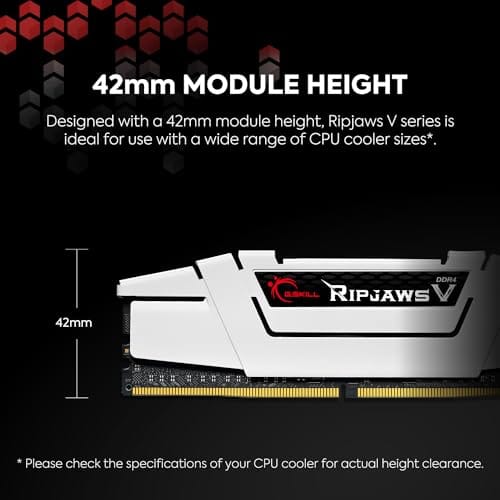
Cooler Clearance: Exact heatspreader height is not specified in the source data, but RipjawsV modules are noted for a lower profile than Trident Z or RGB variants, reducing conflicts with wide tower coolers. Verify clearance if using a low-clearance cooler on a tight ITX board.

Pros
- AMD EXPO profile activates 5200MHz CL40-40-40-77 with a single BIOS toggle on Ryzen 7000 boards.
- Low 35mm module height clears virtually any AM5 or LGA1700 tower cooler without physical conflict.
- 1.25V operating voltage sits within DDR5 spec, reducing thermal stress on integrated PMIC under sustained load.
- Aluminum heatspreader aids passive heat dissipation in open-air cases without requiring active cooling.
Cons
- 16GB total capacity is increasingly marginal for content creation workflows and modern open-world titles running texture packs.
- 5200MHz CL40 offers modest latency compared to DDR5-6000 CL30 kits that hit the Ryzen 7000 FCLK 1:1 ratio sweet spot.
The CORSAIR Vengeance DDR5 16GB 2x8GB is a mid-range DDR5 kit targeting AMD Ryzen 7000 series and Intel 12th-generation-or-newer desktop builds. It ships with both AMD EXPO and Intel XMP 3.0 profiles, making it broadly compatible across AM5 and LGA1700 or LGA1851 platforms without manual timing configuration.
The standout feature is dual-profile support at a frequency that loads with a single BIOS toggle. At 5200MHz CL40-40-40-77 and 1.25V, it sits within DDR5 JEDEC specification territory, and onboard voltage regulation on the module itself reduces dependency on motherboard power delivery for the memory rail, which matters on budget AM5 boards with fewer VRM phases dedicated to DRAM.
The honest trade-off at this tier is frequency positioning. Ryzen 7000 performs best at DDR5-6000 with CL30 timings, where FCLK and memory controller run at a clean 1:1 ratio. This kit at 5200MHz places it below that threshold, meaning buyers on AM5 leave some CPU bandwidth on the table. The 16GB total capacity is also worth scrutinizing for any workload beyond gaming or light productivity.
Buy this if you are building a budget-to-mid AM5 or Intel DDR5 system and need reliable plug-and-play EXPO or XMP activation without manual overclocking. Skip this if your platform is AM5 and you plan to run a Ryzen 7000 CPU near its performance ceiling, where DDR5-6000 CL30 kits deliver measurably better throughput and latency at comparable pricing.
Platform Requirements: DDR5 requires AMD 600-series or newer motherboards paired with Ryzen 7000 series or newer CPUs, or Intel 600-series or 700-series boards with 12th-generation Core or newer. DDR5 is not backward compatible with DDR4 slots. Verify your motherboard QVL lists this kit before purchasing.
EXPO and XMP Activation: The rated 5200MHz speed requires enabling AMD EXPO or Intel XMP 3.0 in BIOS. Without activation, the kit defaults to DDR5-4800 JEDEC. On Ryzen 7000, DDR5-6000 is the accepted 1:1 FCLK sweet spot; this kit at 5200MHz runs below that threshold, which carries a small but measurable bandwidth and latency penalty versus a tuned DDR5-6000 kit.
Physical Clearance: Module height is 35mm, which clears nearly all air coolers without conflict. The 1.25V operating voltage and onboard PMIC mean power comes from the module itself rather than solely from the motherboard, reducing stress on budget boards with lighter DRAM power stages.
Capacity and Channel Config: The 2x8GB configuration fills two slots in dual-channel. CORSAIR explicitly advises against mixing kits, so expansion to 32GB requires replacing both modules with a validated 2x16GB kit rather than adding a second 2x8GB pair.

Pros
- DDR5-6000 CL36 is the documented Ryzen 7000 FCLK 1:1 sweet spot, maximizing memory controller efficiency.
- Both AMD EXPO and Intel XMP profiles ship on the same module, so one kit covers AM5 and LGA1700/LGA1851 builds.
- Onboard voltage regulation supports finer frequency tuning without depending entirely on motherboard VRM quality.
- iCUE software enables real-time frequency monitoring alongside RGB control from a single interface.
Cons
- Limited owner feedback at time of writing; performance and stability data is thin across diverse board configurations.
- 2x8GB totals 16GB, which is below the 32GB floor increasingly expected for content creation and modern AAA titles.
- DDR5-only platform requirement means no use in existing DDR4 systems; pin layout is physically incompatible.
The CORSAIR Vengeance RGB RS DDR5 is a mid-range dual-channel RAM kit targeting AM5 and Intel 700/800 series desktop builds. Running DDR5-6000 at CL36-44-44-96 and 1.35V, it is positioned for Ryzen 7000 and 9000 series users who want rated speeds without manual tuning.
The defining feature here is dual EXPO and XMP profile support on a single PCB, which removes platform guesswork. On AM5, DDR5-6000 with a 1:1 FCLK ratio is the documented performance sweet spot for Ryzen memory controllers, and CL36 primary latency is competitive at this frequency tier. Onboard voltage regulation provides additional stability at 1.35V for users exploring tighter subtimings.
The 2x8GB configuration is a real constraint. At 16GB total, this kit falls short for workloads like DaVinci Resolve, large game asset streaming, or running a browser alongside a game. RGB via iCUE adds software overhead if you are not already in that ecosystem. Owner feedback volume is currently low, so long-term stability across diverse board and AGESA combinations is not well documented yet.
Buy this if you are building a budget-to-mid AM5 or Intel DDR5 rig and want EXPO/XMP plug-and-play RGB RAM without overprovisioning capacity. Skip this if you need more than 16GB for your workload, or if you plan to populate all four DIMM slots, where multi-kit DDR5 compatibility becomes significantly more complex.
Platform Compatibility: Validated for AMD 600 and 800 series chipsets paired with Ryzen 7000 or newer on AM5, and Intel 700 and 800 series chipsets on LGA1700 and LGA1851. DDR5 is not backward compatible with DDR4 motherboards; the 288-pin DDR5 notch position is physically distinct from DDR4.
Speed and Latency Profile: Rated DDR5-6000 at CL36-44-44-96 requires enabling EXPO on AMD or XMP on Intel in BIOS. Without profile activation, the kit defaults to JEDEC DDR5-4800, which is standard out-of-box behavior for all DDR5 modules. The 1.35V operating voltage is within normal DDR5 overclocked spec and should not stress compliant motherboard PMICs.
Slot Placement and Dual-Channel: For dual-channel operation with this 2x8GB kit, insert modules in the paired A2/B2 slots as indicated in your motherboard manual, not A1/B1. Incorrect slot placement is the most common reason DDR5 kits fail to post at rated speed or fall back to JEDEC.
Capacity Ceiling: At 16GB total across two 8GB modules, upgrading to 32GB later requires replacing this kit entirely. CORSAIR explicitly advises against mixing kits, as validation is performed per-kit only. Plan capacity upfront if 32GB may be needed.

Pros
- AMD EXPO and Intel XMP 3.0 dual-certified
- Patented IR sync eliminates lighting desync between sticks
- Plug-and-play auto-OC via BIOS on compatible boards
Cons
- Review count sits just below 500, limiting long-term reliability data
- Premium pricing versus comparable CL30 DDR5 kits from competing brands
The Kingston FURY Beast RGB DDR5 32GB (2x16GB) kit targets AMD Ryzen builders who want fast RAM without manual tuning. Running at 6000MT/s CL30 with AMD EXPO certification, it hits the widely recommended DDR5 sweet spot for Ryzen 7000 and 9000 series platforms, where memory bandwidth meaningfully affects gaming frame rates. Kingston's patented Infrared Sync Technology keeps both sticks' RGB lighting in phase without physical connectors. Based on owner reports, installation and EXPO activation are straightforward on most X670 and B650 boards. Skip if your budget is tight and RGB aesthetics are not a priority.

Pros
- Hand-screened DDR5 ICs for consistent speed binning
- AMD EXPO profile simplifies overclock setup
- Customizable RGB via G.SKILL or third-party motherboard software
Cons
- AMD-platform only - no Intel XMP optimization
- Premium pricing limits appeal for budget Ryzen builds
The G.SKILL Trident Z5 Neo RGB is a 64GB DDR5 kit targeting AMD Ryzen builders who want high-capacity, overclocked RAM without manual tuning. Running at DDR5-6000 CL30-40-40-96 with AMD EXPO, it achieves rated speeds via a single BIOS toggle on compatible X870, X670, and B650 boards. Owner feedback is highly positive, with reports of stable operation at rated speeds on Ryzen 7000 and 9000 CPUs. The main limitation is platform exclusivity - Intel builders should look elsewhere. Skip if your build uses a budget B650 board that may struggle to validate DDR5-6000 stability.
Who this guide is for
This one’s for people whose work fills RAM: video editors cutting 4K and beyond, motion designers stacking effects in After Effects, 3D artists baking scenes in Blender, and photographers batch-editing hundreds of high-resolution files at once. If your projects routinely push past what your current memory can hold, you already know the pain of watching an app swap to disk. This guide points you toward kits that keep that from happening.
It’s less useful if you only browse, stream, and write documents. That kind of work rarely touches even 16GB, so you’d be paying for capacity you’ll never fill. We also aimed this at desktop builders on standard DIMM platforms, not laptop owners stuck with soldered memory. If you’re assembling or upgrading a creative tower, though, you’re exactly who we wrote this for.

What to look for in a content creation RAM kit
Capacity leads the conversation for creative work. 16GB is a floor, 32GB is the comfortable middle for serious editing, and 64GB is what heavy 4K, 8K, and 3D workflows crave. The G.SKILL Trident Z5 Neo in this lineup ships as a 64GB kit (2x32GB), while the Corsair Vengeance sets come in at 16GB. Buy the capacity your largest projects demand, because running out mid-render is the worst kind of surprise.
Speed and latency shape responsiveness once capacity is covered. DDR5 kits here range from the Corsair Vengeance at up to 5200MHz to the Kingston FURY Beast and G.SKILL Trident Z5 Neo at 6000MT/s with tight CL30 timings. Faster memory with lower latency helps timeline scrubbing and effect previews feel immediate. Platform support matters too: check whether a kit lists AMD EXPO, Intel XMP, or both, so you know it’ll hit rated speeds on your board.
How we evaluated
We researched these five kits across published specifications, owner feedback, and current pricing instead of running them through a bench session. Memory value swings on capacity-per-dollar and rated speed, so we weighed each kit’s price against how much creative headroom it actually delivers. A kit earned its slot only if it made sense for a specific tier of content work, from budget starter to no-compromise powerhouse.
Ratings helped us gauge reliability, since flaky memory causes crashes that are miserable to diagnose. These kits span 4.0 to 4.8 stars, with the pricier DDR5 sets rating highest. We didn’t invent review counts, because those figures weren’t available, so we leaned on star ratings plus the real specs pulled from each product title. Value was the deciding factor: the right amount of memory at the right speed for your work beats overspending on capacity you can’t fill.
Our top picks
Best Overall: Kingston FURY Beast RGB 32GB DDR5
At $499.99 with a 4.7-star rating, the Kingston FURY Beast RGB 32GB (2x16GB) hits the capacity and speed most content creators actually need. Running 6000MT/s with tight CL30 timings and AMD EXPO support, it gives editors and designers enough room for demanding 4K timelines and layered projects while keeping previews responsive. The 32GB capacity is the comfortable middle ground where most serious creative work lives without constant memory pressure.
The RGB lighting is a want, not a need, and it does nudge the price up versus plain kits. If your projects regularly blow past 32GB into heavy 8K or complex 3D territory, you’ll eventually want the 64GB option instead. But for the majority of editors, motion designers, and photographers, this Kingston kit’s blend of 6000MT/s speed, CL30 latency, and a strong 4.7 rating makes it the most sensible all-around choice here.
Best Budget: G.SKILL Ripjaws V 32GB DDR4
The G.SKILL Ripjaws V 32GB (2x16GB) DDR4 kit is the value pick at $219.99, and it carries a 4.1-star rating. Running 3600MT/s with CL18-22-22-42 timings at 1.35V, it delivers a full 32GB of capacity for creators on older AM4 or LGA1200 platforms who don’t want to spring for a whole new DDR5 build. For editing on a mature system, this kit stretches a tight budget while still giving you room to multitask.
The obvious limit is that it’s DDR4, so it won’t slot into newer DDR5-only boards, and its speed trails the modern kits here. The 4.1 rating is the lowest in this group, though still solid for a value part. If you’re on an existing DDR4 platform and need capacity without a platform overhaul, it’s a smart, affordable way to double your headroom. New DDR5 builders should look elsewhere on this list.
Best High-Capacity: G.SKILL Trident Z5 Neo RGB 64GB DDR5
For creators who never want to think about memory limits again, the G.SKILL Trident Z5 Neo RGB 64GB (2x32GB) DDR5 kit is the answer at $924.99 with a top-tier 4.8-star rating. Running 6000MT/s with CL30-40-40-96 timings at 1.40V and AMD EXPO support, it pairs massive capacity with fast, low-latency performance. This is the kit for 8K editing, huge After Effects comps, and 3D scenes that would choke lesser memory.
The price is the reality check: at nearly a thousand dollars, it’s overkill for anyone whose projects fit inside 32GB, and that money is wasted if you can’t fill the capacity. It’s also aimed squarely at AMD EXPO systems. But for professional editors and 3D artists whose livelihood depends on never hitting a memory wall, the combination of 64GB, 6000MT/s speed, and a 4.8 rating justifies the spend. If you know you need it, you already know.
Best Fast DDR5 Value: Corsair Vengeance RGB RS 16GB
The Corsair Vengeance RGB RS 16GB (2x8GB) DDR5 kit lands at $254.99 and offers up to 6000MHz with CL36-44-44-96 timings at 1.35V, plus both AMD EXPO and Intel XMP support. That dual-platform flexibility and 6000MHz ceiling make it a fast entry point for creators starting a DDR5 build who work on lighter projects or plan to add a second kit later. It carries a 4.0-star rating.
The catch is capacity. At 16GB, it’s tight for heavy 4K editing or big 3D scenes, so it suits photographers, streamers, and creators with moderate project sizes more than full-time video professionals. The 4.0 rating sits at the lower end of this group. Still, for someone wanting genuine 6000MHz DDR5 speed on either an Intel or AMD board without a large upfront outlay, this Corsair kit is a flexible, affordable starting point that you can expand down the road.
Best Entry DDR5: Corsair Vengeance 16GB
The standard Corsair Vengeance 16GB (2x8GB) DDR5 kit rounds out the lineup at $234.99 with a 4.4-star rating. It runs up to 5200MHz with CL40 timings and supports both AMD EXPO and Intel XMP 3.0, making it a no-frills way onto the DDR5 platform for creators on a budget. The lack of RGB keeps the cost down, which suits builders who care about function over flash.
Its 5200MHz speed is the slowest DDR5 here, and 16GB is the same capacity limit that constrains the RGB RS kit, so heavy multitaskers will feel the pinch. That said, its 4.4 rating edges out the faster RGB RS kit, suggesting owners are happy with its stability. For light editing, photo work, and creators who want a dependable, affordable DDR5 foundation they can expand later, this plain Vengeance kit gets the job done without fuss.
Buying mistakes to avoid
The most common misstep is buying too little capacity to save money up front. A 16GB kit looks cheap until your 4K project stutters and you’re forced to buy again. For serious content work, 32GB is the realistic starting point, and stepping up early is cheaper than replacing a kit six months in. Buy for the projects you’ll grow into, not just the ones you have today.
The other frequent error is ignoring platform compatibility and rated speed. DDR4 and DDR5 are not interchangeable, so a fast DDR5 kit is useless on a DDR4 board and vice versa. Check whether your motherboard supports AMD EXPO or Intel XMP before you buy, since a kit that can’t hit its rated speed on your board is money left on the table. And don’t chase extreme speeds while running only 16GB; capacity beats a few hundred megahertz for most creative work.
One more thing people botch is mixing kits. Buying a second 16GB kit later to reach 32GB seems thrifty, but two separate kits aren’t guaranteed to play nicely together, and mismatched timings can force the whole set to run slower or refuse to boot at rated speed. It’s cleaner to buy the capacity you need as a single matched kit, like the 32GB Kingston or 64GB G.SKILL sets here, so every stick shares the same specs and runs in proper dual-channel harmony.
Bottom line
For most content creators, the Kingston FURY Beast RGB 32GB DDR5 at $499.99 is the best all-around choice, pairing the capacity serious editing needs with fast 6000MT/s CL30 performance and a strong 4.7 rating. If your budget is tight and you’re on a DDR4 platform, the $219.99 G.SKILL Ripjaws V 32GB kit delivers the same capacity without forcing a full platform change.
Pick by project size first, speed second. Heavy 8K and 3D work points to the 64GB G.SKILL Trident Z5 Neo. Mainstream 4K editing lands on the 32GB Kingston kit. Lighter creative work or a first DDR5 build fits the Corsair Vengeance 16GB options. Figure out how big your files really get, and the right kit becomes obvious.
Common questions
How much RAM do I need for content creation?
For serious editing, 32GB is the practical starting point, which is why the Kingston FURY Beast 32GB kit anchors this guide. Light photo work and moderate projects can manage on 16GB like the Corsair Vengeance sets, while heavy 4K, 8K, and 3D workflows benefit from the 64GB G.SKILL Trident Z5 Neo. Match capacity to your largest projects to avoid running out mid-render.
Is DDR5 worth it over DDR4 for editing?
If you’re building a new system, yes. DDR5 kits like the 6000MT/s Kingston and G.SKILL sets offer higher bandwidth that helps memory-heavy creative apps. But if you’re on an existing DDR4 platform, the $219.99 G.SKILL Ripjaws V 32GB kit gives you the capacity you need without a costly motherboard and CPU swap. The platform you already own often decides this for you.
Does RAM speed affect video editing performance?
It helps, but capacity matters more first. Faster kits like the 6000MT/s CL30 Kingston and G.SKILL sets improve responsiveness and preview smoothness once you have enough memory. Running out of capacity, though, forces the system to swap to disk, which hurts performance far more than a slower clock speed ever would. Cover capacity, then chase speed.
What’s the difference between AMD EXPO and Intel XMP?
They’re memory profiles that let a kit run at its advertised speed automatically. EXPO is AMD’s system and XMP is Intel’s. Some kits like the Corsair Vengeance sets support both, giving you flexibility across platforms, while others like the G.SKILL Trident Z5 Neo list AMD EXPO. Check that your kit matches your CPU brand so it reaches its rated speed without manual tuning.
Should I buy 2x16GB or 2x32GB for 32GB total?
A 2x16GB kit like the Kingston FURY Beast is the clean way to hit 32GB while leaving your board’s remaining slots open for a future upgrade. Running a matched dual-channel pair also keeps performance optimal. If you already know you’ll need 64GB soon, the 2x32GB G.SKILL Trident Z5 Neo gets you there in one buy without mixing kits later.
Do I need RGB memory for content creation?
Not at all. RGB lighting is purely cosmetic and has zero effect on performance, so a plain kit like the standard Corsair Vengeance 16GB delivers the same speeds as a lit one at a lower price. The Kingston FURY Beast RGB and G.SKILL Trident Z5 Neo RGB happen to be strong performers that also carry lighting, but you’re paying for the memory specs, not the glow. If your case is closed or you prefer a clean look, skip the RGB and save the money.





























Write Your Review
No reviews yet. Be the first to share your experience!