

ECC memory is RAM with built-in error correction. Instead of only storing data temporarily while your PC is running, it also stores extra check information so the system can detect and often correct a tiny memory error before it turns into a crash, a corrupted file, or a silent bad calculation. That’s the plain-English version. It’s less about making a gaming PC faster and more about making a workstation, server, NAS, or always-on machine more trustworthy.
Most desktop builders shopping DDR5 RAM or tuning a Ryzen build with RAM for a 9800X3D won’t need ECC for frame rates. Still, if you’re editing large projects, running virtual machines, storing important data, or leaving a PC on for weeks, it’s worth understanding what ECC actually does. Small detail. Big consequences.
The short answer
ECC stands for Error-Correcting Code. ECC memory adds extra data bits to each memory word, then uses those bits to detect whether a bit flipped unexpectedly. In many common implementations, it can correct a single-bit error automatically and detect some larger multi-bit errors so the system can halt instead of continuing with bad data.

Normal consumer RAM, like a G.SKILL Ripjaws V DDR4 32GB kit at $229.99 with a 4.6 rating, focuses on capacity, speed, latency, voltage, and compatibility. That particular kit is listed as 32GB, 2x16GB, DDR4-3600, CL18-22-22-42, 1.35V, XMP, and U-DIMM for Intel and AMD desktop systems. It’s not an ECC-first product from the title, but it shows what most shoppers are comparing: speed and capacity before fault tolerance.


Pros
- DDR4-3600 XMP at 1.35V is the Ryzen AM4 sweet spot, aligning FCLK 1:1 at 1800MHz for best latency.
- Matched 2x16GB kit is factory-tested as a pair, reducing dual-channel instability compared to mixing sticks.
- Compatible with both Intel XMP and AMD DOCP/A-XMP BIOS profiles without manual sub-timing adjustments.
- Ships with JEDEC SPD fallback so the system always boots safe at default clocks before XMP is enabled.
Cons
- CL18 primary latency is mid-range; DDR4-3600 CL16 kits exist for buyers prioritizing tighter timings.
- No ECC support, so workstation or Threadripper ECC builds need a different kit entirely.
The G.SKILL RipjawsV F4-3600C18D-32GVK is a mid-range DDR4 desktop kit targeting Intel and AMD mainstream platform builders who want 32GB capacity at DDR4-3600 without overpaying for CL14 or CL16 enthusiast kits. It ships as a matched 2x16GB dual-channel pair in the standard 288-pin U-DIMM form factor.
The defining spec here is the XMP profile: DDR4-3600 at CL18-22-22-42, 1.35V. On AMD AM4 Ryzen systems, 3600MHz is the well-documented sweet spot for achieving a 1:1 FCLK ratio at 1800MHz, which keeps infinity fabric latency in check and translates to measurable gains in lightly-threaded workloads and gaming frame times compared to DDR4-3200 or lower.
CL18 is a genuine trade-off at this speed. Competing DDR4-3600 kits with CL16 or CL14 exist and offer lower absolute latency, though they typically carry a price premium. Owners report stable XMP operation across a wide range of B450, X570, and Z490/Z590 boards, but reaching rated speed on some budget AM4 boards may require manual sub-timing adjustments or AGESA microcode updates.
Buy this if you are building or upgrading an AM4 Ryzen or Intel LGA1700 desktop and want reliable 32GB DDR4-3600 dual-channel performance without tuning. Skip this if you need CL16 or tighter for competitive latency, or if your board has a limited QVL and you have not verified compatibility via G.SKILL's configurator tool first.
Platform Support: This kit uses 288-pin DDR4 U-DIMM and is compatible with Intel LGA1700 (Z690/Z790) and AMD AM4 (B450/X470/B550/X570) platforms. AM5 uses DDR5 exclusively, so this kit is not compatible with Ryzen 7000/9000 series builds on AM5 boards.
XMP and DOCP Activation: Rated speed of DDR4-3600 CL18-22-22-42 at 1.35V requires enabling XMP (Intel) or DOCP/A-XMP (AMD) in BIOS. Default JEDEC SPD boots at DDR4-2133 or DDR4-2400. On AM4, DDR4-3600 aligns FCLK at 1800MHz for a 1:1 ratio, which is the recommended operating point for Ryzen 3000 and 5000 series CPUs.
Slot Population and Mixing: Install both sticks in the recommended dual-channel slots per your motherboard manual, typically A2 and B2 in a 4-slot board. G.SKILL explicitly warns against mixing this kit with other modules; doing so voids the matched-pair guarantee and risks instability at XMP speeds.
Cooler Clearance: Exact heatspreader height is not specified in the source data, but RipjawsV modules are noted for a lower profile than Trident Z or RGB variants, reducing conflicts with wide tower coolers. Verify clearance if using a low-clearance cooler on a tight ITX board.
The longer explanation
RAM is constantly reading and writing electrical states. Each bit is stored as a 0 or 1, and the CPU trusts that value when it loads game assets, browser tabs, project files, virtual machines, or database chunks into memory. A bit flip happens when one of those values changes unexpectedly. The causes can include electrical noise, marginal hardware, cosmic radiation, unstable overclocking, heat, firmware issues, or simply running a lot of memory for a long time.
On a regular non-ECC desktop kit, the system generally has no built-in way to know that one stored bit changed. If the flipped bit is in unused memory, nothing obvious happens. If it’s in a browser tab, you might get a crash. If it’s in a file operation, a render, a virtual machine, or a long calculation, the problem can be harder to notice. ECC adds a checking layer so the memory controller can catch certain errors at the moment data is read back.
This doesn’t mean ECC makes a PC immune to every kind of memory failure. It doesn’t fix a dying motherboard, a bad power supply, a corrupted drive, or software bugs. It also doesn’t replace backups. What it does is reduce the chance that a small memory error quietly becomes bad output. That’s why ECC is common in servers and serious workstations, where uptime and data integrity matter more than squeezing out another few frames per second.
History / how we got here
Error correction has been part of serious computing for decades because large systems multiply risk. One tiny error in one memory cell may sound rare, but servers can run hundreds of gigabytes or even terabytes of RAM, 24 hours a day, for years. More memory cells and more operating hours mean more chances for something odd to happen.
Consumer PCs went a different direction. For home desktops, cost, speed, motherboard simplicity, and broad compatibility mattered more. Gamers wanted high clocks and lower latency. Office PCs needed inexpensive DIMMs. So ECC stayed mostly in Xeon, EPYC, workstation, server, and NAS platforms, while mainstream desktop memory brands pushed XMP, EXPO, RGB, tighter timings, and higher data rates.
DDR5 changed part of the conversation because many DDR5 chips include on-die error correction inside the memory chip itself. Don’t mix that up with platform-level ECC. On-die correction helps improve chip reliability at high density, but it usually doesn’t provide the same end-to-end reporting and correction path that workstation ECC memory offers through the memory module, memory controller, firmware, and operating system. Similar words. Different job.
Why it works this way
ECC works by storing redundant information alongside normal data. A simplified way to think about it: the system doesn’t just remember the data bits, it also remembers a mathematical fingerprint of those bits. When the CPU asks for the data later, the memory controller compares what it gets back against that fingerprint. If one bit is wrong, the code can often identify the bad position and correct it before the data reaches the software.
That extra protection requires support from more than the memory stick. You need a CPU memory controller that supports ECC, a motherboard and firmware that expose it correctly, and the right type of memory module. Some platforms support ECC only unofficially, some support it but don’t report errors cleanly, and some won’t boot with ECC modules at all. That’s why the motherboard QVL and CPU documentation matter more here than a generic product listing.
There are also different kinds of modules. Unbuffered ECC DIMMs are common in entry workstations and some NAS-style builds. Registered ECC DIMMs are common in servers and are not interchangeable with ordinary desktop UDIMMs. Laptop SO-DIMMs, desktop UDIMMs, registered DIMMs, and load-reduced server DIMMs can look similar in shopping pages if you’re moving fast. Don’t guess.
When you’d want this
You’d want ECC memory when data correctness matters more than peak benchmark numbers. A home server storing family photos, a ZFS NAS, a small business file server, a Linux workstation compiling large projects, a machine running multiple virtual machines, or a PC doing long scientific or financial calculations can benefit. If the machine runs unattended and a crash or bad write would ruin your week, ECC starts to make sense.
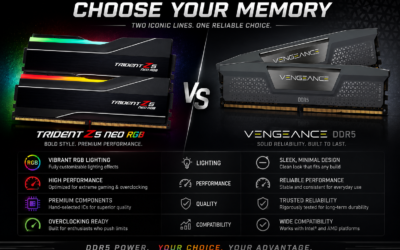
For a gaming-first desktop, ECC is usually not the first upgrade. A Corsair Vengeance DDR5 16GB kit at $234.99 with a 4.4 rating lists 2x8GB capacity, up to 5200MHz speed, CL40 timing, AMD EXPO, and Intel XMP 3.0 support. Those are the kind of specs most gamers compare while checking RAM for gaming: capacity, frequency, platform profiles, and whether the kit fits the board. ECC enters the conversation only if the PC also doubles as a workstation or storage box.

Pros
- AMD EXPO profile activates 5200MHz CL40-40-40-77 with a single BIOS toggle on Ryzen 7000 boards.
- Low 35mm module height clears virtually any AM5 or LGA1700 tower cooler without physical conflict.
- 1.25V operating voltage sits within DDR5 spec, reducing thermal stress on integrated PMIC under sustained load.
- Aluminum heatspreader aids passive heat dissipation in open-air cases without requiring active cooling.
Cons
- 16GB total capacity is increasingly marginal for content creation workflows and modern open-world titles running texture packs.
- 5200MHz CL40 offers modest latency compared to DDR5-6000 CL30 kits that hit the Ryzen 7000 FCLK 1:1 ratio sweet spot.
The CORSAIR Vengeance DDR5 16GB 2x8GB is a mid-range DDR5 kit targeting AMD Ryzen 7000 series and Intel 12th-generation-or-newer desktop builds. It ships with both AMD EXPO and Intel XMP 3.0 profiles, making it broadly compatible across AM5 and LGA1700 or LGA1851 platforms without manual timing configuration.
The standout feature is dual-profile support at a frequency that loads with a single BIOS toggle. At 5200MHz CL40-40-40-77 and 1.25V, it sits within DDR5 JEDEC specification territory, and onboard voltage regulation on the module itself reduces dependency on motherboard power delivery for the memory rail, which matters on budget AM5 boards with fewer VRM phases dedicated to DRAM.
The honest trade-off at this tier is frequency positioning. Ryzen 7000 performs best at DDR5-6000 with CL30 timings, where FCLK and memory controller run at a clean 1:1 ratio. This kit at 5200MHz places it below that threshold, meaning buyers on AM5 leave some CPU bandwidth on the table. The 16GB total capacity is also worth scrutinizing for any workload beyond gaming or light productivity.
Buy this if you are building a budget-to-mid AM5 or Intel DDR5 system and need reliable plug-and-play EXPO or XMP activation without manual overclocking. Skip this if your platform is AM5 and you plan to run a Ryzen 7000 CPU near its performance ceiling, where DDR5-6000 CL30 kits deliver measurably better throughput and latency at comparable pricing.
Platform Requirements: DDR5 requires AMD 600-series or newer motherboards paired with Ryzen 7000 series or newer CPUs, or Intel 600-series or 700-series boards with 12th-generation Core or newer. DDR5 is not backward compatible with DDR4 slots. Verify your motherboard QVL lists this kit before purchasing.
EXPO and XMP Activation: The rated 5200MHz speed requires enabling AMD EXPO or Intel XMP 3.0 in BIOS. Without activation, the kit defaults to DDR5-4800 JEDEC. On Ryzen 7000, DDR5-6000 is the accepted 1:1 FCLK sweet spot; this kit at 5200MHz runs below that threshold, which carries a small but measurable bandwidth and latency penalty versus a tuned DDR5-6000 kit.
Physical Clearance: Module height is 35mm, which clears nearly all air coolers without conflict. The 1.25V operating voltage and onboard PMIC mean power comes from the module itself rather than solely from the motherboard, reducing stress on budget boards with lighter DRAM power stages.
Capacity and Channel Config: The 2x8GB configuration fills two slots in dual-channel. CORSAIR explicitly advises against mixing kits, so expansion to 32GB requires replacing both modules with a validated 2x16GB kit rather than adding a second 2x8GB pair.
What to look for in ECC memory
Start with platform support. The CPU, chipset, motherboard, BIOS, and operating system all need to line up. If the board vendor says ECC memory is supported but error reporting is limited, that’s not the same as a full workstation platform. Check the qualified memory list, read the manual, and match the exact module type: DDR4 or DDR5, UDIMM or RDIMM, ECC or non-ECC, and the supported capacity per slot.
Next, treat capacity as the main performance decision. A stable 64GB ECC setup is usually more useful for a VM host or editing workstation than a smaller kit with flashier speeds. For DDR4 systems, you’ll often see kits around 2666MT/s to 3200MT/s depending on platform age. For DDR5 workstation builds, speeds vary by board, CPU generation, rank layout, and how many DIMM slots are populated. Four sticks can clock lower than two. Annoying, but normal.
Also look for real error reporting. If you’re buying ECC for a NAS or server, you should be able to see memory errors in system logs, IPMI, WHEA events, Linux EDAC output, or vendor management tools. Silent correction is useful, but visible reporting tells you whether a DIMM is starting to fail. One corrected error over years may not matter. Repeated corrected errors on the same stick do.
Common misconceptions
The biggest misconception is that ECC RAM is faster. It usually isn’t. ECC is about correctness, not speed. Depending on platform and workload, the performance difference can be tiny, but you shouldn’t buy ECC expecting better game performance. If you’re building a normal desktop, guides like budget RAM picks are usually more relevant than server memory compatibility charts.
Another misconception is that all DDR5 is the same as ECC. It isn’t. DDR5 on-die correction helps the memory chips manage internal reliability, but that doesn’t mean your desktop kit gives the CPU the same external correction and error reporting as ECC memory. One protects inside the chip. The other protects the data path in a way the platform can use.
People also assume ECC is mandatory for every NAS. It’s not mandatory in the sense that a storage box won’t function without it. But if you’re using checksumming file systems, storing irreplaceable files, and running the machine for years, ECC fits the same philosophy as backups, UPS power, and regular drive monitoring. It’s boring insurance. That’s the point.
Frequently asked
Does ECC memory improve gaming performance?
No, not in the way gamers usually mean. ECC memory is designed to detect and correct certain memory errors, not raise average FPS. For a gaming PC, capacity, frequency, latency, CPU support, and GPU balance usually matter more. If your gaming rig also runs workstation jobs, then ECC can still be worth considering.
Can I use ECC RAM in any motherboard?
No. ECC support depends on the CPU, motherboard, chipset, firmware, and memory type. Some boards physically accept the module but run it without ECC behavior, and others won’t boot. Always check the board manual and qualified memory list before buying.
Is DDR5 on-die correction the same as ECC?
No. DDR5 on-die correction is an internal feature of many DDR5 memory chips, while platform ECC involves the module, memory controller, firmware, and operating system. On-die correction helps the chip maintain reliability, but it usually doesn’t give you the same system-visible correction and reporting.
Who should actually buy ECC memory?
Buy ECC if the machine is used for data storage, long calculations, workstation jobs, virtualization, or server duties. It’s especially useful when the PC stays on for long stretches and bad data would be costly. For a simple gaming desktop, non-ECC memory is usually the better value.
Can ECC memory replace backups?
No. ECC can reduce the chance of memory-related corruption, but it won’t save you from accidental deletion, malware, drive failure, power problems, or software bugs. You still need backups. Ideally, keep one local backup and one separate copy somewhere else.















Write Your Review
No reviews yet. Be the first to share your experience!