

Your power supply pulls electricity from the wall, and not all of it reaches your components. Some of it leaks out as heat before it ever touches your GPU or CPU. That gap between what comes in and what gets used is the whole story behind PSU efficiency, and it’s one of the most misunderstood specs on a build sheet.
If you’ve ever wondered why one 750W unit costs $70 and another costs $160, efficiency is a big part of the answer. It affects your electric bill, how hot your case runs, and how loud the fan spins. Before you shop, it helps to know what the 80 Plus badge really promises. Our guide to the best modular PSU for a gaming PC and our roundup of the best 1000W PSUs of 2026 both lean on these numbers, so let’s break down what they mean.
The short answer
PSU efficiency is the percentage of AC power drawn from the wall that actually gets converted into usable DC power for your PC. An 85% efficient unit delivering 500W to your components is pulling roughly 588W from the outlet. The other 88W? Wasted as heat. Higher efficiency means less waste, cooler operation, and a slightly smaller number on your utility statement.
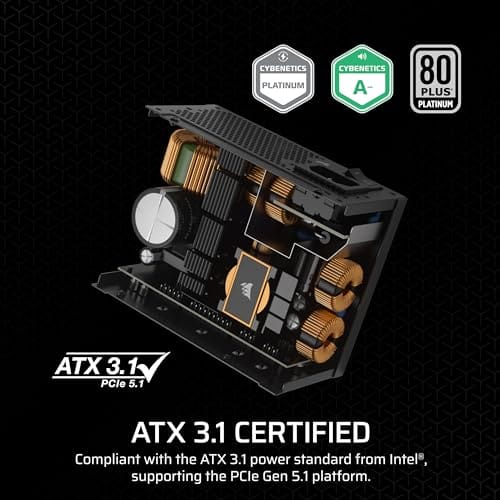
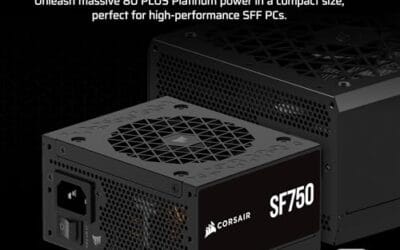
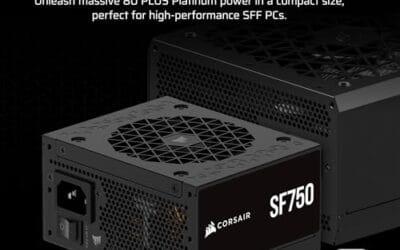
The 80 Plus certification tiers (White, Bronze, Silver, Gold, Platinum, Titanium) rank how well a unit holds efficiency at 20%, 50%, and 100% load. Platinum-rated supplies like the Corsair SF750 hit around 92% at 50% load, which is near the top of what’s realistically available. It’s a fully modular SFX unit with ATX 3.1 and PCIe 5.1 support, priced at $159.99 with a 4.1 rating, and it shows what a premium efficiency tier looks like in a small form factor.

Pros
- ATX 3.1 compliant with PCIe 5.1 support, resists transient spikes from RTX 50 and RX 9000 series GPUs.
- Zero RPM Mode eliminates fan noise at low and medium loads, a real advantage in acoustically sensitive SFF builds.
- Fully modular design with short SFX cables reduces cable management friction in sub-10-liter cases.
- 105 degree C Japanese capacitors indicate quality component selection typical of high-tier SFX units.
Cons
- Limited owner feedback at time of writing; real-world noise, ripple, and transient performance are unverified by community data.
- Short SFX cables are unsuitable for mid-tower or full-tower cases without aftermarket cable extensions.
- 750W ceiling may fall short for extreme SFF builds pairing a 300W-plus TGP GPU with a high-core-count CPU.
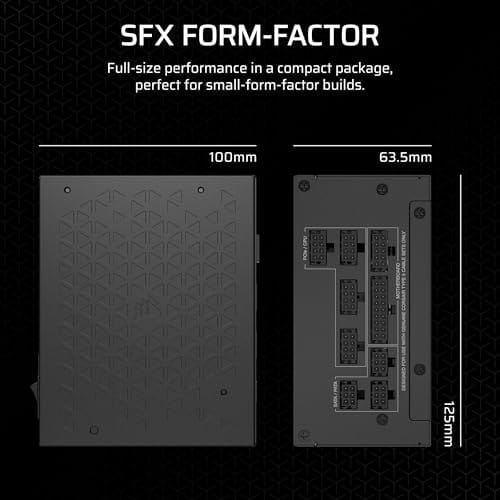
The Corsair SF750 (2024) is a high-end SFX PSU targeting SFF builders who need substantial wattage in a compact footprint. With 80 Plus Platinum certification and ATX 3.1 compliance, it sits at the upper tier of the SFX market, aimed at builders pairing it with current-gen discrete GPUs inside sub-10-liter cases.
The most defining specification here is ATX 3.1 compliance combined with PCIe 5.1 readiness. This means the unit is rated to handle the sharp transient power spikes that RTX 50 and RX 9000 series GPUs can produce, where non-compliant PSUs may trigger overcurrent protection. At 750W, it covers most single-GPU SFF configurations without derating concerns.
The honest trade-off is the review data gap. At time of writing, no substantial owner feedback exists to validate Corsair's noise and ripple claims under real load. The Zero RPM Mode claim and 92mm fan acoustics are based on spec sheets only. Buyers should also note that SFX cable lengths are intentionally short and will not reach connectors in mid-tower or larger cases without extensions.
Buy this if you are building an SFF PC around a single high-TGP GPU and need confirmed ATX 3.1 compliance in a modular SFX unit. Skip this if you want a large ATX case build, need more than 750W for a dual-component high-wattage system, or require extensive owner testing before purchasing.
Form Factor and Mounting: This is a standard SFX form factor PSU, not SFX-L. Verify your case specifies SFX compatibility before purchasing. An SFX-to-ATX bracket is included, allowing installation in ATX-footprint cases, though short cable lengths will require extensions in anything larger than a compact SFF enclosure.
Power Standard and Connector: ATX 3.1 compliant with PCIe 5.1 readiness. The unit supports the 12V-2x6 connector standard, relevant for RTX 40 and RTX 50 series GPUs as well as AMD RX 7000 and RX 9000 cards with high transient draw. Non-ATX 3.1 units can trigger OCP shutdowns above 150 percent peak load spikes.
Efficiency and Thermal Operation: 80 Plus Platinum certification indicates roughly 92 percent efficiency at 50 percent load under 115V. The 92mm PWM fan uses a fluid dynamic bearing and Zero RPM Mode activates at low loads, which in SFF cases where airflow is restricted can noticeably reduce system acoustic output.
GPU Wattage Pairing: At 750W, this PSU pairs appropriately with GPUs up to approximately 300W TGP when combined with a mid-range CPU. For a 320W-plus TGP GPU alongside a 65W-plus CPU, headroom becomes tight and a higher-wattage SFX unit should be considered instead.
The longer explanation
Every switching power supply loses energy in the conversion process. It takes 120V AC from your wall, rectifies it, steps it down, and outputs the clean 12V, 5V, and 3.3V rails your motherboard expects. Each stage has resistance, and resistance turns power into heat. A more efficient design uses better transformers, lower-resistance components, and smarter switching to shrink those losses.
Here’s the part people miss. Efficiency isn’t a flat number across the whole load range. A PSU is usually most efficient at somewhere between 40% and 60% of its rated capacity. Run it at 10% load or peg it at 100%, and efficiency drops on both ends. That’s why the 80 Plus program measures three points, not one. A Gold unit has to stay at or above 87% at 20% load, 90% at 50%, and 87% at full load. Miss any threshold and it doesn’t earn the badge.
How we got here
The 80 Plus program launched back in 2004, when a typical PSU converted maybe 70% to 75% of the power it drew. That waste added up fast across millions of computers, so the certification was created to push manufacturers toward better designs and reward the ones that delivered. It worked. The baseline White tier alone requires 80% efficiency at all three load points, which was ambitious two decades ago and is now the floor.
Over the years the tiers stacked up as engineering improved. Bronze, Silver, and Gold arrived first, then Platinum and Titanium as flagship units started hitting 94% and beyond. The certification also split into regional standards, because efficiency at 115V (North America) differs from 230V (Europe). Most spec sheets you’ll read quote the 115V internal or the 230V numbers, so it’s worth checking which one a manufacturer is advertising.
Why it works this way
The load-curve behavior comes down to physics. At very low loads, the PSU’s own control circuitry and standby draw eat up a proportionally large chunk of the output, so efficiency sags. At very high loads, current runs high and resistive losses climb with the square of that current, so efficiency dips again. The middle is where the balance lands best.
This is also why oversizing a PSU by a huge margin isn’t automatically smart. If your system pulls 300W under load and you buy a 1200W unit, you’re often sitting near that inefficient low-load region during normal use. A 650W or 750W unit would keep you closer to that efficient midpoint. Bigger isn’t wasteful in a safety sense, but it doesn’t buy you efficiency the way some builders assume. Match the wattage to your actual draw plus a sensible buffer.
When you’d want this
A high-efficiency PSU earns its price in a few clear situations. If your PC runs many hours a day (gaming rig, workstation, home server), the electricity savings compound. If your case is compact or poorly ventilated, less wasted heat keeps every other component cooler. And if you value silence, higher efficiency means the fan has less heat to dump, so it spins slower or stays off entirely under light loads. Builders chasing an overclocking-ready 1000W PSU care about this because pushed hardware draws more, and a stable, efficient rail matters more when you’re near the edge.
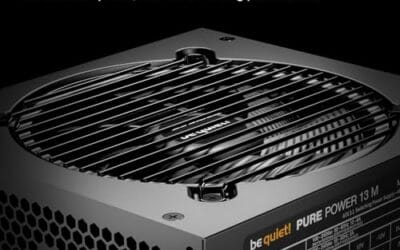
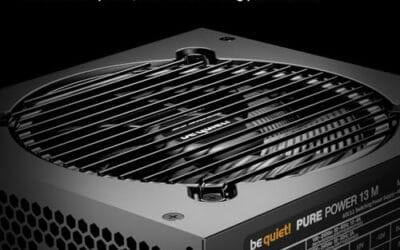
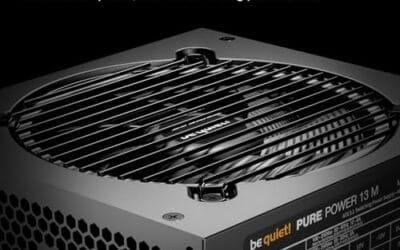
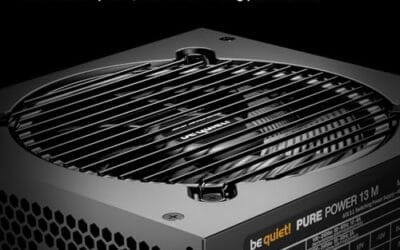
The be quiet! Pure Power 13 M 1000W is a good example of a Gold-rated unit built for that job. At $139.90 with a strong 4.8 rating, it carries ATX 3.1, PCIe 5.1 support for current GPUs, a semi-passive 120mm fan that stays silent under light load, and a single-rail design the brand markets for overclocked cards. It’s not a Platinum unit, but Gold at 1000W hits a practical balance of efficiency, headroom, and price for a high-end build.

Pros
- Native 12V-2x6 connector on ATX 3.1 platform ready for RTX 40 and PCIe 5.1 GPUs.
- Handles power excursions up to 2000W transient, headroom for RTX 4080 and 4090 class spikes.
- Semi-passive zero-RPM mode below moderate load keps idle acoustics near inaudible.
- LLC topology with single 12V rail delivers stable voltage regulation for overclocked GPUs.
Cons
- Limited independent owner feedback available at time of writing, riple and hold-up data unverified.
- Only four PCIe 6+2-pin connectors, tight for legacy multi-GPU or high-CPU-EPS custom lop builds.
- 80 PLUS Gold trails Platinum and Titanium units at similar wattage on sustained efficiency.
The be quiet! Pure Power 13 M 1000W is a high-end ATX 3.1 PSU aimed at builders pairing a Ryzen 7000/9000 or Core Ultra CPU with an RTX 4070Ti Super,4080 Super, 4090, or RX 7900 XTX class GPU. It targets buyers who want native 12V-2x6 wiring and transient headroom without stepping up to Platinum-tier pricing.
The defining trait is ATX 3.1 compliance with power excursion handling up to double the rated 1000W, meaning brief 2000W spikes from modern GPUs should not trip OCP. Combined with the single 12V rail and LLC topology, this suits overclocked GPUs where transient behavior, not average draw, tends to triger shutdowns on older units.
Trade-offs are typical at this tier. 80 PLUS Gold is eficient but not Platinum, soustained heavy loads generate more heat than a higher-rated unit. Four PCIe 6+2-pin connectors is standard, though builders running EATX boards with dual EPS plus a 4x8-pin GPU adapter should verify cable counts against the modular panel before buying.
Buy this if you are building a single-GPU gaming or content rig around a 250-450W TGP card and want native 12V-2x6 without paying Platinum prices. Skip this if you need sub-audible acoustics under sustained full load, or if you already own a workingATX 3.0 unit with a 12VHPWR pigtail.
ATX standard: Full ATX 3.1 compliance with native 12V-2x6 connector integration, which corects the sense-pin issue found on early 12VHPWR cables. Supports PCIe 5.1 GPUs at spec, and handles transient power excursions up to 2000W, roughly double the 1000W continuous rating.
GPU pairing: Comfortable for GPUs in the 250W to 450W TGP range, including RTX 4080 Super (320W) and RTX 4090 (450W) with headroom for overclocking. Four PCIe 6+2-pin outputs cover legacy 8-pin GPUs; the native 12V-2x6 removes the need for a 4x8-pin adapter dongle.
Efficiency and cooling: 80 PLUS Gold rated up to 94.4% at optimal load, typically around 50% utilization. The 120mm be quiet! fan runs semi-passive with zero-RPM below a load threshold not specified by the manufacturer, so idle and light workloads should remain silent.
Cabling: Fully modular design, leting builders omit unused SATA and Molex leads. Exact cable lengths and connector counts beyond the four PCIe 6+2-pin and single 12V-2x6 are not specified in source material, verify against your case routing before purchase.
What to look for in a PSU efficiency rating
Start with the 80 Plus tier, but don’t stop there. The badge tells you the unit met efficiency thresholds, not that the internals are high quality. A cheap Bronze unit and a well-built Bronze unit both wear the same sticker. Look for the efficiency number at 50% load specifically, since that’s closest to where most systems live. Gold is the value pick for the majority of builds. Platinum and Titanium make sense for always-on machines or when you want the coolest, quietest operation you can get.
Also check the form factor and connector support against your case and GPU. An SFX unit like the Corsair SF750 fits small builds where an ATX supply won’t. ATX 3.1 and PCIe 5.1 (or the 12V-2×6 connector) matter if you’re running a recent high-power graphics card. Efficiency is one axis. Fit, connectors, warranty length, and the quality of the components behind that badge round out a real buying decision. Our picks for the best 1000W PSU for a high-end GPU weigh all of these together.
Common misconceptions
The biggest one: a more efficient PSU gives you more power. It doesn’t. A 750W Gold unit and a 750W Platinum unit both deliver 750W to your components. The Platinum one just wastes less pulling it from the wall. Efficiency is about the conversion tax, not the output ceiling.
Another myth is that the efficiency rating is a measure of build quality or reliability. Those correlate loosely because good manufacturers tend to certify higher, but the 80 Plus badge only certifies efficiency at three load points. It says nothing about voltage regulation, ripple, protection circuits, or how long the capacitors will last. And no, a higher tier won’t meaningfully change your frame rates. It changes your power bill and your thermals, full stop.
Frequently asked
Is Gold efficiency worth the extra money over Bronze?
For most builds, yes. Gold typically runs 3% to 5% more efficient than Bronze at the loads you’ll actually see. On a system that draws real power for hours daily, that pays back over the unit’s life through lower heat and lower bills. It’s the tier most enthusiasts settle on as the value baseline.
Does a higher-wattage PSU use more electricity?
No. A PSU only draws what your components demand plus its conversion losses. A 1000W unit powering a 300W system pulls roughly the same from the wall as a 650W unit doing the same job. The catch is that a heavily oversized unit may run in its less-efficient low-load zone, so match wattage to your real draw with a modest buffer.
What does 80 Plus Platinum actually guarantee?
Platinum requires roughly 90% efficiency at 20% load, 92% at 50%, and 89% at full load on the 115V standard. That’s why a Platinum unit like the Corsair SF750 wastes so little heat. The badge is a floor, so many units perform a hair above their rated tier in practice.
Will an efficient PSU make my PC quieter?
It can. Less wasted energy means less heat inside the unit, so the fan has less work to do. Many higher-tier supplies add a semi-passive mode that keeps the fan off entirely under light loads, like the be quiet! Pure Power 13 M does. That’s near-silent operation during desktop use and light gaming.
How much can efficiency actually save me?
It’s modest but real. Jumping from Bronze to Gold might save 15W to 30W of waste under typical gaming load. Over a year of daily use, that’s a few dollars to maybe ten-plus depending on your rates and hours. The bigger wins are cooler temps and quieter fans, which are harder to put a price on but easy to notice.
























Write Your Review
No reviews yet. Be the first to share your experience!