

If you’ve shopped for a graphics card in the last couple of years, you’ve seen DLSS plastered across every NVIDIA box and benchmark chart. So does it actually matter for gaming, or is it marketing noise? Short version: it matters, and for a lot of players it’s the difference between a smooth 4K experience and a stuttery mess. DLSS (Deep Learning Super Sampling) is NVIDIA’s AI-driven upscaling and frame-generation tech, and it’s become one of the biggest reasons people pay a premium for GeForce cards over the competition.
This explainer breaks down what DLSS really does, when it helps, and when you can safely ignore it. We researched how it behaves across resolutions and GPU tiers so you can decide if it belongs on your shopping checklist. If you’re already deep into a build, our roundups of the best gpu deals and the best gpu for 4k gaming pair nicely with everything below. Let’s get into it.
The short answer
Yes, DLSS matters, especially if you game at 1440p or 4K. It renders your game at a lower internal resolution, then uses a trained AI model to reconstruct a sharper, higher-resolution image, so you get more frames per second without the blurry mess older upscalers produced. On a modern RTX card, turning on DLSS Quality mode can lift framerates 30-70% depending on the title, often with image quality that’s hard to tell apart from native rendering. That’s real performance, not a placebo.
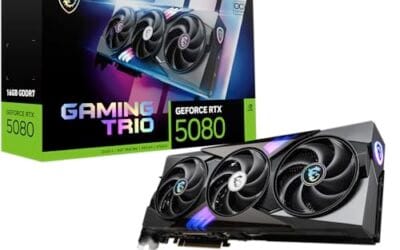
The catch is that DLSS only runs on NVIDIA RTX hardware, and the newest features, like the multi-frame generation in the DLSS 4 stack, need current Blackwell-generation cards. A GPU like the msi Gaming RTX 5080 16G Gaming Trio OC leans on this heavily. It’s a Blackwell-architecture card with 16GB of GDDR7 on a 256-bit bus, boost clocks up to 2715 MHz, and it lists at $1,569.99 with a 4.8 owner rating. Specs like that plus DLSS are what make 4K at high refresh rates realistic today.

Pros
- 16GB GDDR7 VRAM keeps 4K ultra textures and local LLM inference workloads comfortable.
- 2715 MHz bost OC out of the box, no manual tuning needed for uplift.
- Triple-fan Tri Frozr class cooler typical at this tier keps sustained clocks stable.
Cons
- Limited owner feedback at time of writing, real-world thermal and coil whine data is thin.
- Blackwell 5080 class cards typically pull 360W plus, budget 850W PSU with 12V-2x6 native.
- 3-slot triple-fan designs at this tier often exceed 330mm length, verify case GPU clearance.
The MSI Gaming Trio OC is a high-end Blackwell RTX 5080 aimed at 4K gamers and content creators who want an AIB card with factory tuning above NVIDIA reference targets. With 16GB of GDDR7 on a 256-bit bus and a 2715 MHz boost clock, it slots into the enthusiast tier below the 5090 flagship.
The defining feature is the GDDR7 memory subsystem paired with Blackwell RT and Tensor cores. In practice, this class of GPU targets 4K native with DLSS 4 Multi Frame Generation enabled, and handles path-traced titles like Cyberpunk 2077 and Alan Wake 2 at playable frame rates. Triple DisplayPort 2.1a with UHBR20 covers 4K 240Hz OLED without DSC compromises.
Trade-offs are typical for this class. The 256-bit bus is unchanged from the 4080Super, so bandwidth relies on GDDR7 sped uplift rather than a wider interface. Triple-fan Blackwell cards in this tier usually run 3slots and 330mm plus, so ITX and compact mid-tower builds need careful clearance checks. A 12V-2x6 native PSU is strongly advised.
Buy this if you run a 4K 144Hz or 240Hz OLED, want DLSS 4 Multi Frame Gen, and have a case that accepts a large triple-fan AIB. Skip this if your target is 1440p esports, if your PSU lacks a native 12V-2x6 lead, or if you can wait for more owner thermal data.
VRAM and resolution fit: 16GB GDDR7 on a 256-bit bus is sized for 4K ultra with ray tracing and frame generation active. Modern titles like Hogwarts Legacy,Ratchet and Clank, and Indiana Jones stay under the 16GB ceiling at 4K with DLSS Quality, leaving headroom for texture mods.
Clocks and boost behavior: The 2715 MHz factory boost sits above NVIDIA reference targets for the RTX 5080. Real-world sustained clocks on triple-fan AIB Blackwell designs typically hold within 30 to 60 MHz of advertised boost under sustained load, based on category norms, though MSI has not published a specific power limit.
Display output: Three DisplayPort 2.1a ports support UHBR20 signaling for 4K 240Hz and 5K2K ultrawide OLEDs without display stream compression trade-offs. HDMI 2.1b covers LG C-series and Samsung S95 OLED TVs, and the 7680 by 4320 max resolution keps 8K workflow monitors in scope.
Power and build: MSI has not specified TGP, but Blackwell 5080 class cards typically land in the 360W range with a 12VHPWR or 12V-2x6 connector. Pair with anATX 3.0 or 3.1 PSU rated 850W or higher, and confirm case length clearance above 330mm before purchase.
The longer explanation
Traditional rendering is brute force. Your GPU calculates every pixel at your monitor’s native resolution, every frame. At 4K that’s over 8 million pixels, 60-plus times a second, and it’s punishing even for expensive silicon. DLSS flips the math. The card renders at something like 1440p internally, then an AI model trained on ultra-high-resolution reference images fills in the missing detail to reach 4K output. Because the GPU is pushing far fewer pixels, framerates climb and thermals drop.
Newer versions add frame generation, which inserts entirely AI-generated frames between the ones your GPU actually renders. DLSS 3 introduced single-frame generation; DLSS 4 on Blackwell cards can generate multiple frames per rendered frame. The result is eye-popping framerate counters, though these interpolated frames don’t reduce input latency the way real rendered frames do. That’s a nuance worth remembering when a marketing slide claims a 4x jump. It’s genuinely useful, but it isn’t magic.
How it works under the hood
DLSS runs on dedicated Tensor cores, the AI-focused processing units baked into every RTX GPU. These cores handle the neural network math separately from the traditional shader cores doing the game rendering, so the upscaling happens in parallel without stealing much rendering budget. The model also pulls in motion vectors and data from previous frames, which is why it produces cleaner results than a simple resolution stretch.
Each DLSS mode is a different quality-to-performance trade. Quality mode renders at a higher internal resolution and looks closest to native. Performance and Ultra Performance modes drop that internal resolution further, squeezing out more frames at some cost to fine detail. The 2024 transition to a transformer-based model sharpened all of these considerably, cutting the shimmering and ghosting that plagued early versions. Owner reports and side-by-side comparisons back that up.
Why it works this way
Ray tracing is the reason DLSS exists in its current form. Realistic lighting, reflections, and shadows are brutally expensive to compute, and even flagship cards can buckle under full path tracing at native 4K. Upscaling gives that performance back. You render the heavy ray-traced scene at a lower resolution, then reconstruct it, and suddenly a demanding title runs at playable framerates instead of a slideshow.
There’s a business angle too. DLSS is NVIDIA-only, so it’s a genuine reason to choose GeForce over a rival card, and it lets the company sell the AI hardware it’s already pouring resources into. For gamers, the practical upshot is simple. A card with strong upscaling ages better, because DLSS keeps demanding future titles playable long after raw horsepower would’ve fallen behind. If you’re planning a long-term rig, that longevity is worth real money, and it’s a big part of why the best rtx 5080 prebuilt pc options hold their value.
When you’d want this
DLSS earns its keep the moment you push resolution or crank ray tracing. Gaming at 4K? It’s close to mandatory for high refresh rates in modern titles. Running a 1440p 165Hz panel and want every setting maxed? DLSS Quality gets you there while keeping the image crisp. It also rescues mid-range cards, letting a card that struggles at native 4K deliver a smooth, good-looking experience it otherwise couldn’t. Anyone chasing high framerates in graphically heavy games benefits.
Streamers get a double win, since freeing up GPU headroom leaves more room for encoding and overlays, which is why it shows up so often in our best gpu for gaming and streaming picks. If you’re pairing a high-end CPU like the one covered in our best gpu for 9800x3d guide, DLSS keeps the GPU from becoming the bottleneck at 4K. The ASUS TUF Gaming RTX 5080 OC Edition is a solid example of the class, another 16GB GDDR7 Blackwell card at $1,539.99 with a 4.4 rating, built with the beefy cooling those clocks demand.

Pros
- 16GB GDDR7 gives comfortable VRAM headroom for 4K raster and ray-traced titles.
- 3.6-slot triple-fan cooler with phase-change thermal pad targets lower sustained temps than 2-slot designs.
- Blackwell architecture supports DLSS 4 multi-frame generation for higher perceived frame rates.
Cons
- Limited owner feedback at time of writing makes long-term reliability hard to verify.
- 3.6-slot width blocks adjacent PCIe slots and needs case clearance planning before purchase.
- High TGP typical of RTX 5080 class needs a modern PSU with native 12V-2x6 connector.
The ASUS TUF Gaming RTX 5080 OC is a high-end Blackwell-generation GPU with 16GB of GDDR7 memory and a factory overclock over reference clocks. It targets 4K gamers, high-refresh 1440p players, and creators running Blender or DaVinci Resolve who benefit from CUDA and DLSS 4 aceleration.
The headline is DLS 4 with multi-frame generation, which stacks additional generated frames on top of a single rendered frame. Combined with 16GB GDDR7, the card should handle 4K ultra with ray tracing enabled in current AAA titles, though independent third-party benchmarks under sustained load are still limited.
Trade-offs are real. The 3.6-slot design blocks adjacent PCIe expansion slots and demands case clearance planning, especially in compact mid-towers. RTX 5080-class cards typically pull 300W or more, so pair with a modern ATX 3.0 or 3.1 PSU that has a native 12V-2x6 connector rather than adapter cables.
Buy this if you are building a 4K rig around a Ryzen 9800X3D or Core i7-14700K class CPU and want DLSS 4 headroom for future AA releases. Skip this if your monitor tops out at 1080p, or your PSU is under 850W and non-ATX 3.0.
Resolution and VRAM: 16GB of GDR7 sits above the 12GB tier that started showing texture streaming issues at 4K in titles like Alan Wake 2 and Hogwarts Legacy. This capacity gives headroom for 4K native with high-res texture packs and for creator workloads that spill past 12GB in Blender GPU renders.
DLS 4 and frame generation: Blackwell adds DLSS 4 multi-frame generation, which can insert multiple generated frames per rendered frame. In practice this pushes 4K ray-traced titles from base rates near 60 FPS into triple-digit territory on high-refresh 4K panels, though input latency and artifacting depend on base frame rate.
Cooling and acoustics: The 3.6-slot fin stack with three Axial-tech fans and a phase-change thermal pad targets sustained boost clocks without the fan-speed spikes typical of 2-slot reference designs. Owner reports on prior TUF Gaming RTX cards flag low idle noise and low hotspot deltas as the consistent pattern.
Build compatibility: At 3.6-slot width, this card will block PCIe slots below it and needs verified length clearance in the case spec shet. Power draw for RTX 5080 class typically requires a native 12V-2x6 cable from an ATX 3.0 or 3.1 PSU rated 850W or higher for transient headroom.
What to look for in a DLSS-capable GPU
First, confirm the generation. Any RTX 20-series card or newer supports DLSS upscaling, but frame generation needs RTX 40-series or later, and DLSS 4 multi-frame generation is a Blackwell RTX 50-series feature. If those newest tricks matter to you, buy current. Second, don’t ignore VRAM. Upscaling reduces the rendering load, but 4K textures and ray tracing still eat memory, so 16GB like the GDDR7 on these RTX 5080 cards gives real breathing room. 8GB cards can choke regardless of how good the upscaler is.
Match the card to your monitor, too. There’s little point buying a frame-generation monster if you’re on a 60Hz 1080p display, since you can’t see the extra frames. Pair a high-refresh 1440p or 4K panel with a capable card and the feature shines. For builders on a budget, mid-tier options still handle DLSS well; the best rtx 5060 ti prebuilt pc builds prove you don’t need a flagship to enjoy it.
Common misconceptions
Misconception one: DLSS makes everything blurry. That was fair in 2019. The current transformer model is sharp, and Quality mode is genuinely hard to distinguish from native in most scenes. Misconception two: frame generation is free performance. It boosts the framerate counter but doesn’t cut input latency the way rendered frames do, so competitive shooter players may still prefer native rendering with NVIDIA Reflex on.
Misconception three: every game supports it. DLSS needs developer integration, so coverage depends on the title, though the list now runs into the hundreds and includes most big releases. And no, DLSS isn’t the same as AMD’s FSR or Intel’s XeSS. Those are competing upscalers that run on a wider range of hardware but use different methods, and in most head-to-head comparisons DLSS still holds a quality edge. If you’re weighing brands, our best rtx 5070 ti prebuilt pc guide walks through where each lands.
Frequently asked
Does DLSS reduce image quality?
In Quality mode on a modern RTX card, barely, if at all. The current transformer-based model reconstructs detail well enough that most players can’t spot the difference from native during actual gameplay. Push to Performance or Ultra Performance and you’ll notice some softening, but that’s the trade for the extra frames. For everyday use, Quality mode is the sweet setup, no visible penalty.
Do I need DLSS if I only game at 1080p?
Less so. At 1080p a decent modern GPU usually pushes high framerates without help, so DLSS is a nice bonus rather than a necessity. Its real value kicks in at 1440p and especially 4K, where the rendering load is heavy. That said, it still helps if you’re running demanding ray-traced titles even on a 1080p panel.
Is DLSS available on AMD or Intel cards?
No. DLSS is NVIDIA-only because it relies on the Tensor cores built into RTX GPUs. AMD Radeon cards use FSR and Intel Arc cards use XeSS instead. Those alternatives work across more hardware, but if you specifically want DLSS, you’ll need a GeForce RTX card, full stop.
Does frame generation add input lag?
A little. Generated frames don’t respond to your mouse and keyboard the way rendered frames do, so the feel doesn’t improve as much as the framerate number suggests. NVIDIA Reflex offsets much of this, and for single-player and story games it’s rarely a problem. Competitive players who chase the lowest latency sometimes leave frame generation off.
Is DLSS worth paying extra for?
For most gamers eyeing 1440p or 4K, yes. It stretches performance, improves ray-traced titles, and helps a card stay relevant longer as games get heavier. A Blackwell RTX 5080 near $1,540-$1,570 gets you the latest DLSS 4 features plus 16GB of GDDR7. If your budget is tighter, a lower-tier RTX card still delivers the core upscaling benefit, so you’re not locked out of it.



























Write Your Review
No reviews yet. Be the first to share your experience!