

On a spec sheet the jump from 240Hz to 360Hz looks enormous, but the clock disagrees. A 240Hz panel paints a fresh frame every 4.17 milliseconds. A 360Hz panel does it every 2.78 milliseconds. That’s roughly a 1.4ms gain, smaller than the blink reflex most players never notice. So the real question isn’t which number is bigger. It’s which price tier hands you a meaningful upgrade versus a rounding error. We researched both tiers against panel quality, resolution, GPU demands, and street pricing. If you’re still mapping the landscape, our roundups of the best 240Hz monitors for 2026 and the best 360Hz gaming monitors pair well with the breakdown below.
Matchup at a glance
Both refresh rates target the same buyer: someone who plays fast shooters and cares about motion clarity. The difference is where each sits on the value curve. A 240Hz display is now mainstream, with capable IPS models in the $200 to $350 band and response times that keep pace instead of smearing. 360Hz sits a tier up, usually $300 to $500, and it’s almost always locked to 1080p because that many frames at higher resolutions demands a serious graphics card.
Here’s the catch spec charts hide. Refresh rate only helps if your graphics card can feed it. A 360Hz panel wants a new frame every 2.78ms, so your GPU has to hold roughly 360fps to light up the full advantage, which means dropping settings hard even on high-end silicon. Miss the frame budget and a 360Hz panel behaves like a 240Hz one with a fatter price tag.
There’s a physics wrinkle worth naming, too. Motion clarity depends on both refresh rate and pixel response. A panel can advertise 360Hz yet still show ghosting if its transitions can’t finish inside 2.78ms. That’s why the honest comparison weighs the number against the panel behind it, not the marketing sticker alone.
Spec sheet showdown
| Metric | 240Hz class | 360Hz class | Acer Nitro XV271U | AOC 24G51F |
|---|---|---|---|---|
| Refresh rate | 240Hz | 360Hz | Up to 180Hz | 144Hz |
| Frame time | 4.17ms | 2.78ms | 5.56ms | 6.94ms |
| Typical resolution | 1080p or 1440p | 1080p | 2560×1440 | 1920×1080 |
| Panel type | IPS or TN | IPS or TN | IPS, DCI-P3 95% | IPS |
| Street price | ~$200-350 | ~$300-500 | $169.99 | $89.99 |
The frame-time column is the honest one. Going from 240Hz to 360Hz shaves 1.39ms off each frame. Going from 60Hz to 240Hz shaved 12.5ms. The returns shrink fast the higher you climb, and that curve is exactly why the tier debate matters more than the raw Hz. Each doubling of refresh rate halves the frame interval, so the visible gain per dollar keeps flattening. The leap from 144Hz to 240Hz already lives on the shallow part of that curve, and 360Hz sits further down still.
Notice the two real monitors in the table. Neither one chases 360Hz, and that’s deliberate. The Acer Nitro XV271U spends its budget on a 1440p IPS panel with 95% DCI-P3 coverage rather than raw speed, topping out at 180Hz. The AOC 24G51F keeps things simple at 144Hz and 1080p for under $90. Both prove the same point the frame-time math makes: past 240Hz, your money often buys more when it goes toward resolution, color, or a stronger GPU instead of another Hz milestone.
240Hz strengths
240Hz is the point where motion clarity stops being a problem for almost everyone. Fast pans read cleanly, flick shots land, and enemy silhouettes hold their shape while you strafe. Blur between frames drops to a level most eyes can’t separate from perfectly smooth. The bigger win is flexibility. Because 240Hz no longer forces a 1080p compromise, you can pair it with sharper panels. A 1440p 240Hz IPS gives you competitive smoothness and desktop clarity in one box, which is why we point mixed-use buyers toward the best 1440p gaming monitors and the best 27-inch 1440p monitors when refresh isn’t the only priority.
There’s a GPU angle too. Sustaining 240fps is realistic on midrange cards in popular esports titles, so the panel rarely outruns your rig. In Valorant or Overwatch 2, a mainstream card can park near 240fps without stripping every setting to the floor. You spend the whole refresh budget instead of paying for headroom you can’t fill. For most players, that’s the smarter allocation of money.
Response time matters here as well. Modern 240Hz IPS panels routinely finish pixel transitions inside the 4.17ms frame window, so the refresh number actually translates into clean motion. That wasn’t always true a few generations back, when only TN panels could keep up and you traded color and viewing angles to get speed. Today you rarely have to make that swap.
360Hz strengths
360Hz earns its keep in one specific place: the ranked ladder of a fast shooter, at 1080p, on a GPU that can actually deliver the frames. In that scenario the extra frames trim input-to-photon latency and tighten motion feel during rapid tracking. When you flick between two targets, the panel updates the image sooner, so the picture your eyes catch is a hair closer to the current game state. Serious competitors who’ve maxed everything else will feel it. It’s a genuine edge, just a narrow one.
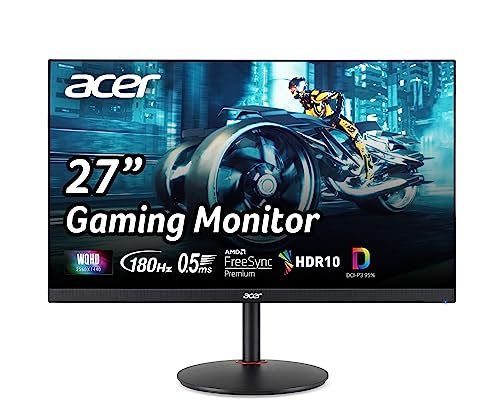
The honest weakness is context. That 1.4ms improvement only appears when your frame rate lives near the panel’s ceiling; below that, you’re paying premium money for a number you can’t reach. Many buyers chasing high refresh actually want resolution, and a 27-inch 1440p IPS like the Acer Nitro XV271U at $169.99 makes that trade obvious: up to 180Hz, 95% DCI-P3, and a 4.8 rating.
Pros
- 1440p 180Hz IPS panel via DisplayPort 1.2 hits the current price/perf sweet spot
- 95% DCI-P3 gamut is uncommon at this tier, useful for content viewing
- Full ergonomic stand: 4.7 inch height, 360 swivel, plus/minus 90 pivot, VESA 100
Cons
- Limited owner feedback at time of writing, long-term panel uniformity unverified
- HDMI 2.0 caps at 144Hz; only DisplayPort 1.2 unlocks the full 180Hz refresh
- No USB hub and 2W stereo speakers are strictly a bep-only backup at this tier
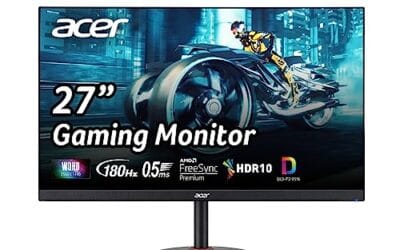
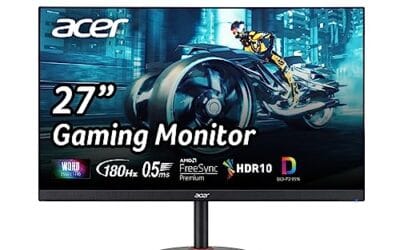
The Acer Nitro XV271U M3bmiiprx is a budget-oriented 27inch 1440p IPS gaming monitor targeting builders stepping up from 1080p high refresh. With 2560x1440 resolution, 180Hz over DisplayPort, and FreeSync Premium, it fits users pairing an RTX 4060,X 4060 Ti, or RX 7600 XT class GPU running competitive and AA titles at medium to high settings.
The defining feature is the 180Hz IPS panel with a claimed 0.5ms GtG response, paired with 95% DCI-P3 coverage. In practice, IPS panels at this tier typically deliver around 300to 350 nits SDR brightness and moderate contrast near 1000:1, so blacks will lift in dark rooms. FreeSync Premium adds low framerate compensation, useful when demanding titles drop below 60 FPS.
Trade-offs are typical for the segment. HDMI 2.0 bandwidth caps refresh at 144Hz, so consoles and older GPUs will not reach the full 180Hz ceiling. HDR tier, panel bit depth, and factory calibration are not specified in the listing, and there is no USB hub. The 2W speakers are functional only as a fallback.
Buy this if you want a 1440p 180Hz IPS panel with a full ergo stand and 95% DCI-P3 for mixed gaming and casual creative work. Skip this if you need verified HDR performance, USB-C daisy chaining, or OLED-level contrast for dark-room cinema use.
Panel and Resolution: 27 inch WQHD IPS at 2560x1440 gives a 0.233m pixel pitch, sharp enough that antialiasing needs drop versus 1080p 27 inch panels. IPS delivers wide viewing angles suited to desk sharing or off-axis reference monitors during editing sessions.
Refresh and Response: 180Hz refresh is available only through DisplayPort 1.2; HDMI 2.0 tops out at 144Hz due to bandwidth limits. Acer lists 1ms GtG typical and up to 0.5ms GtG at aggressive overdrive, though inverse ghosting is common at max overdrive on IPS panels in this bracket.
Color and HDR: 95% DCI-P3 coverage is the standout spec, wider than most sub-tier IPS panels that sit near 90% sRGB. HDR certification level, peak brightness, and local dimming are not specified in the source, so treat HDR as a compatibility mode rather than a true HDR experience.
Ports and Ergonomics: 1 DisplayPort 1.2, 2 HDMI 2.0, and audio out cover a PC plus one console. The stand offers minus 5 to 25 degree tilt, 4.7 inch height range, 360 degree swivel, and plus/minus 90 degree pivot, with 100x100 VESA for monitor arms. FreeSync Premium is confirmed, G-SYNC compatibility is not listed.
Real-world scenarios
Ranked FPS at 1080p on a top-tier GPU
This is 360Hz territory. If you’re grinding Valorant or CS2 with a card that pushes 300-plus fps consistently, the higher refresh delivers the smoothest tracking your money can buy at this resolution. The lower input latency and reduced blur compound during long ranked sessions, where consistency counts as much as peak reflex. The upgrade is real here, though it’s the only scenario where it clearly pays off, and even then it assumes you’ve already tuned settings to hold those frame rates.
Mixed gaming plus work and streaming
240Hz wins this one, and it isn’t close. A 1440p 240Hz panel handles competitive matches, single-player epics, and a browser full of tabs without a resolution downgrade. Streaming loads the GPU further and makes a 360Hz ceiling even harder to reach, so the faster panel would sit half-used. That versatility beats 120 extra Hz you’d rarely saturate.
Building on a fixed budget
When the build has a ceiling, refresh rate is the wrong place to overspend. Money moved from a 360Hz panel into a stronger GPU raises your actual frame rate across every game. Budget builders should treat 240Hz, or even a solid 144Hz, as the ceiling and route the savings into silicon.
Pricing and availability
Pricing is where the tiers separate cleanly. 240Hz models are widely stocked and frequently discounted, with 1080p versions dipping under $200 during sale events. 360Hz stays scarcer and pricier, and the discounts are shallower because demand is concentrated among competitive players. If you shop patiently, the gap between the two tiers can widen to $150 or more, which reframes the value math entirely. Our running list of the best gaming monitor deals is the fastest way to catch those swings.
Screen size shifts the equation too. High-refresh panels cluster at 24 and 27 inches because smaller screens keep pixel density reasonable at 1080p and make fast motion easier to track. A 24-inch competitive display costs less, fits closer viewing distances, and keeps the whole play area inside your central vision, so shoppers hunting pure value should scan the best 24-inch monitors before committing to a larger, costlier panel. Bigger isn’t automatically better when every pixel needs to stay in your field of view during a firefight.
Which to buy
For the overwhelming majority of players, 240Hz is the correct answer. It delivers motion clarity that feels effortless, it doesn’t chain you to 1080p, and it doesn’t demand a flagship GPU to justify itself. You get nearly all the competitive benefit at a friendlier price, and the leftover budget buys frames you’ll actually see. That’s the allocation we’d make nine times out of ten, and the frame-time curve backs it up at every price point.
Choose 360Hz only if you’re a dedicated competitive player, you game at 1080p, and your GPU already parks near 300fps in your main titles. If any of those isn’t true, the premium buys a spec you can’t cash in. If the real goal is smoother gaming on a budget, an accessible 144Hz IPS like the AOC 24G51F at $89.99 gets you most of the way there, a 24-inch Full HD panel with a 4.9 rating. Buy the tier your hardware can actually feed. Everything else is paying for a number on a box.

Pros
- IPS panel offers wider off-angle color stability than VA screens common at this price.
- 116% sRGB coverage handles gaming and general content color reproduction adequately.
- Three-year zero-bright-dot warranty coverage is uncommon on entry-tier IPS panels.
Cons
- Limited owner feedback at time of writing, hard to confirm QC consistency across units.
- HDR ready label lacks a VESA tier, so peak brightness likely sits near 250 to 300 nits.
- 1ms MPRT is a strobed figure; real GtG on entry IPS typically lands between 4 and 8ms.
The AOC 24G51F is an entry-level 24-inch FHD gaming monitor built around a 144Hz IPS panel with Adaptive-Sync. It targets budget esports players and console owners who want higher refresh than 60Hz without steping up to 1440p or OLED tiers. Console output tops out at 120Hz over HDMI 2.0.
The defining feature is IPS at 144Hz in the sub-24-inch budget class. Owner data is thin at time of writing, but panels in this tier typically deliver 250 to 300 nits SDR brightness and near-full sRGB coverage. The 1ms MPRT figure is strobing based; real GtG response on entry IPS usually falls between 4 and 8ms.
HDR ready is marketing shorthand rather than VESA HDR400 certification, so expect flat highlights in HDR content. Pixel density on a 23.8-inch 1080p panel is roughly 92 PPI, visibly softer than 1440p at the same size. No USB hub or built-in speakers are listed, which is typical at this tier.
Buy this if you need a second high-refresh IPS display for 1080p esports or a Series X console at 120Hz, and you value the zero-bright-dot coverage. Skip this if you already run a 1440p-class GPU like an RTX 4070, or if you need calibrated color for photo and video work.
Panel and resolution: IPS panel at 1920x1080 across a 23.8-inch viewable diagonal, yielding roughly 92 PPI. Refresh rate reaches 144Hz over DisplayPort. IPS provides wider off-angle color stability than VA panels at this size class, useful for shared or dual-monitor setups.
Response and sync: AOC lists 1ms MPRT, a strobed measurement rather than GtG. Real gray-to-gray on entry IPS panels typically sits between 4 and 8ms. Adaptive-Sync support covers the FreeSync range and works with G-SYNC Compatible mode on NVIDIA cards, cutting tearing when framerate dips.
Color and HDR: Rated 116% sRGB coverage, adequate for gaming and general content but not calibrated for DCI-P3 workflows. HDR ready is unbadged, so no VESA HDR400 tier is specified. Expect peak brightness in the 250 to 300 nit range typical of this segment.
Connectivity: One HDMI 2.0 and one DisplayPort input, no USB hub, no built-in speakers listed. HDMI 2.0 handles 1080p at 120Hz for PS5 and Xbox Series X. The three-sided frameless design suits stacked 24-inch panels with minimal bezel between screns.
Common questions
Can you actually see the difference between 240Hz and 360Hz?
Some people can, most can’t reliably. The frame-time gap is about 1.4ms, which sits below the reaction threshold of the average player. Trained competitive players tracking fast motion may perceive slightly smoother movement, but for casual and mid-level gamers the difference is subtle enough to disappear in normal play. Side-by-side, most viewers guess wrong more than half the time.
Do I need a specific GPU for 360Hz?
You need one strong enough to push near 360fps in your games, otherwise the panel is wasted. That usually means a high-end card plus lowered settings in demanding titles. In lighter esports games a strong midrange card can approach it, but anything visually heavy will fall short. If your rig can’t sustain frame rates close to the refresh ceiling, a 240Hz panel gives you the same experience for less.
Is 240Hz enough for competitive gaming?
Yes, comfortably. 240Hz is a common standard among serious players and delivers the motion clarity that matters for flick shots and tracking. Only a small slice of top-tier competitors gain a measurable edge from going higher, and even then the benefit is marginal. For everyone from ranked grinders to weekend players, 240Hz covers the need.
Should I pick resolution or refresh rate?
It depends on your games and GPU. Pure competitive players lean toward refresh at 1080p, while mixed-use buyers get more daily value from a 1440p 240Hz panel that stays sharp for work and single-player titles. A 1440p high-refresh display is the balanced choice for most people, since it doesn’t force you to pick one strength over the other.
Will 360Hz become the new standard soon?
Not for mainstream buyers anytime soon. GPU limits keep 360Hz practical only at 1080p with powerful hardware, so it stays a niche competitive product. 240Hz is the tier going mainstream, and that’s where pricing and panel variety improve fastest.




























Write Your Review
No reviews yet. Be the first to share your experience!