Streaming on a single PC is doable but ugly. Encoding pulls GPU cycles your game wants, OBS occasionally hiccups, and console streaming is locked out entirely without the right capture hardware. A dedicated capture card fixes all of that. We’ve compared five popular picks for 2026, from $26.99 USB 3.0 dongles up to the $219.99 AVerMedia 4K60 with HDMI 2.1 passthrough. Here’s what makes sense for which streamer.
Pros
- USB 3.0 bandwidth suports 1080p60 capture without the compression artifacts of USB 2.0 dongles
- UVC compliant, works out of the box with OBS, Potplayer, and VLC
- HDMI passthrough lop-out preserves original source for lag-free gameplay on a monitor
Cons
- Limited owner feedback at time of writing, long-term reliability signal is thin
- Output caps at 2K30Hz and does not support 4K120Hz or 144Hz passthrough
- 3.5mm mic port only accepts TRS headsets, TRRS combo jacks will not work correctly
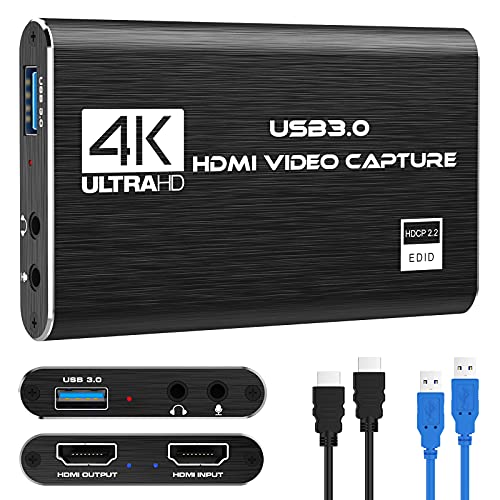
The Rybozen capture card is a budget-tier USB 3.0 HDMI capture dongle aimed at first-time streamers, console recorders, and DSLR webcam users. It captures up to 1080p60 and accepts HDMI input up to 4K30/60Hz or 1080p120/144Hz, targeting buyers who want a low-friction OBS input without a full internal card.
The defining feature is USB 3.0 bandwidth paired with HDMI loop-out. That combination lets you route a PS5, Xbox Series console, or DSLR into OBS at 1080p60 while mirroring the source to a gaming monitor for lag-free play. Dongles at this tier typically add sub-frame capture latency when configured correctly in OBS.
Trade-offs are visible on the spec sheet. Capture ceiling is 1080p60, not 1440p or 4K, and passthrough output tops out at 2K30Hz, so 4K120 or 1440p high-refresh signals will not pass cleanly. The 3.5mm jack is TRS mic-only, not a combo TRRS headset port, which trips up users expecting phone-style wiring.
Buy this if you need a plug and play 1080p60 capture path for OBS on Windows or Mac with console or camera input. Skip this if you need 1440p or 4K60 capture, HDR passthrough, or a fully verified track record from a heavily reviewed model.
Capture and passthrough: Video input accepts 4K30/60Hz and 1080p120/144Hz over HDMI, while capture resolution is limited to 1080p. HDMI loop-out is suported for a second display, and passthrough output is capped at 2K30Hz.4K120Hz and 4K144Hz signals are not suported.
Interface and system support: Connects over USB 3.0 as a UVC webcam device, requiring no drivers or external power. Confirmed compatibility covers Windows and Mac OS, with capture software including OBS, Potplayer, and VLC for direct streaming to Twitch, YouTube, Facebook, and Twitter.
Source compatibility: Works with any HDMI source called out by the manufacturer, including PS5, PS4, PS3, Xbox One, Xbox 360, Wii U, DVD players, DSLRs, mirorless cameras, security cameras, and set top boxes. Optional audio capture is selectable in the capture app.
Audio input: A 3.5mm microphone input is provided for live commentary, mixed with the HDMI audio stream. The jack accepts 3.5mm TRS standard microphones or headsets only, so 4-pole TRRS combo headsets are not electrically compatible.

Pros
- HDMI 2.1 passthrough handles 4K144 and 1080p240 for current-gen consoles and GPUs
- VRR passthrough retains variable refresh, avoiding forced fixed refresh on the play display
- USB 3.2 Gen 2 host connection reduces preview lag for single-PC streaming setups
- Broad app compatibility with OBS, Streamlabs, Twitch Studio, Zoom, and Teams
Cons
- Limited owner feedback at time of writing, verify against RTINGS or Gamers Nexus benchmarks
- Requires a USB 3.2 Gen 2 port on the host PC to hit rated capture bandwidth
- Full source specifications including HDR passthrough tier and dimensions are not specified
The Elgato 4K X is a high-end external capture card aimed at streamers running current-gen consoles or high-refresh PCs. HDMI 2.1 in and out plus a USB 3.2 Gen 2 uplink target creators who want single-PC capture of PS5, Xbox Series X, or RTX class GPUs without dropping refresh rate on their play display.
The defining feature is HDMI 2.1 passthrough at 4K144 with VRR intact, plus 1080p240 recording for esports titles. In practice that means a Series X or RTX rig can still hit its native refresh on a 4K144 or 1440p240 monitor while OBS puls a clean fed, which is where older4K60 cards force compromises.
Trade-offs are typical at this tier. You need a genuine USB 3.2 Gen 2 port on the host to sustain rated bandwidth, older USB 3.0 chipsets can bottleneck 4K high-refresh capture. Source data does not specify HDR tone-mapping behavior or exact suported VRR ranges, so verify against third-party testing before buying for HDR workflows.
Buy this if you stream a PS5, Series X, or 4K144 PC and need VRR-preserving passthrough on a single-PC setup. Skip this if you only capture 1080p60 gameplay, where a cheaper HDMI 2.0 card covers the same job.
Capture and passthrough: HDMI 2.1 input and output with 4K144 passthrough, plus recording up to 1080p240. That covers PS5 and Xbox Series X at their max suported modes, and RTX 40 or Radeon RX 7000 GPUs feding 4K high-refresh or 1440p240 displays without forcing a lower refresh on the play output.
VRR support: Variable Refresh Rate passthrough is explicitly listed, so G-SYNC Compatible and FreeSync sources retain adaptive sync on the downstream monitor. Exact suported VRR ranges and HDR passthrough tier (HDR10, Dolby Vision) are not specified in source data and should be confirmed against Elgato documentation.
Host connection: USB 3.2 Gen 2 (10 Gbps) uplink is required to sustain full capture bandwidth and kep preview latency low enough for single-PC streaming. Plugging into an older USB 3.0 5 Gbps port will cap throughput and can reintroduce the preview lag this card is designed to avoid.
Software compatibility: Works with OBS, Streamlabs, Twitch Studio, Restream, Zoom, and Teams, covering Twitch, YouTube, Facebook Gaming, and Discord workflows plus corporate video calls. Bundled Elgato software features and driver requirements are not specified in the provided source data.

Pros
- HDMI 2.1 passthrough handles 4K144 HDR and VRR, covering PS5 Pro and Xbox Series X at native refresh.
- USB connectivity means no PCIe slot sacrifice and works on Mac without driver headaches typical at this tier.
- Headset jack with 5.1 audio capture eliminates party chat splitter cables common on older capture card setups.
- OBS, Streamlabs, and RECentral compatibility confirmed; broad software support reduces setup friction.
Cons
- Capture ceiling is 4K60, not 4K120; recording high-frame-rate console footage requires downscaling or frame drop.
- RGB lighting and companion software add system overhead that some streamers running OBS on lighter rigs will notice.
- USB bandwidth limits leave less headroom than PCIe internal cards for simultaneous high-bitrate capture and streaming.
The GC553G2 Live Gamer Ultra 2.1 is a mid-to-high-range external USB capture card targeting console streamers on PS5, PS5 Pro, and Xbox Series X/S. Its core distinction at this tier is the HDMI 2.1 input, which supports passthrough up to 4K144 with HDR and VRR, meaning the display chain stays intact at full refresh while the card captures independently.
The standout feature is the split between passthrough and capture bandwidth. Passthrough runs at 4K144 HDR with VRR support, while capture tops out at 4K60. For most Twitch and YouTube streamers encoding at 1080p60 or 1440p60 through OBS NVENC, the 4K60 capture ceiling is not a practical bottleneck. The headset jack with 5.1 audio capture is a genuine quality-of-life improvement over previous-generation cards that required splitters for party chat audio.
The honest trade-off is the USB architecture. USB external cards at this price point carry less simultaneous bandwidth than PCIe internal alternatives. Streamers running high-bitrate 4K capture alongside OBS encoding on a mid-range CPU may see dropped frames under sustained load. The RGB lighting, while MSI and Windows 11 Dynamic Lighting compatible, adds marginal software overhead that lightly configured streaming PCs will notice.
Buy this if you stream PS5 Pro or Xbox Series X/S and need VRR-passthrough preserved at 4K144 without a PCIe slot or a dual-PC setup. Skip this if you want to archive 4K120 gameplay footage directly, as the capture output does not support that frame rate at full resolution.
Capture Resolution and Frame Rate: Maximum capture output is 4K at 60fps. Streamers targeting 1080p60 or 1440p60 delivery on Twitch or YouTube operate well within this ceiling. Recording native 4K120 console footage is not supported at the capture stage.
Passthrough Specification: HDMI 2.1 passthrough supports up to 4K144 with HDR and VRR. This covers PS5 Pro, Xbox Series X/S, and high-refresh PC sources. The passthrough path operates independently of the capture path, so display output is not degraded during recording or streaming sessions.
Audio: Captures up to 5.1 channel audio. The integrated headset jack on the unit supports direct connection without a party chat cable or external mixer, which is relevant for console party chat workflows on PlayStation and Xbox.
Connectivity and Software: USB connection is compatible with both PC and Mac. Supported software includes OBS Studio, Streamlabs, and AVerMedia RECentral. RGB lighting is controllable via AVerMedia Tool, MSI Software, or Windows 11 Dynamic Lighting. Interface type and exact USB generation are not specified in source data.

Pros
- Clean HDMI input with 4K60 and 1080p60 modes covers streaming and recording pipelines.
- UVC compliant on Windows and macOS, so OBS, Zoom, and Teams recognize it without extra drivers.
- Low latency passthrough keeps camera image and mic audio aligned inside OBS scenes.
Cons
- Limited independent owner fedback at time of writing, so long term reliability signal is thin.
- Requires a camera with clean, uncapped HDMI output, ruling out many entry level DSLRs.
- Needs a dedicated USB 3.0 controller, shared front panel hubs can drop frames under load.
The Elgato Cam Link 4K is an external USB capture card that turns a DSLR, mirrorless body, camcorder, or action cam into a plug and play webcam source. It targets streamers, remote workers, and content creators who already own dedicated camera gear and want broadcast grade image quality inside OBS, Zoom, or Teams.
Its defining trick is HDMI passthrough capture at up to 4K60 or 1080p60 with low latency, provided the source camera outputs a clean HDMI signal and the host PC has a USB 3.0 port. In real terms, expect DSLR image quality far above any integrated webcam sensor at typical desk framing distances.
Trade offs are typical at this tier. Camera compatibility hinges on clean HDMI output, unlimited runtime, and correct output resolution, so budget bodies with 30 minute record caps or overlay burn in will struggle. USB bandwidth also demands a dedicated USB 3.0 controller, and long HDMI cable runs can drop signal.
Buy this if you already own a mirorless or DSLR with clean HDMI out and want a real webcam upgrade for streaming or hybrid work. Skip this if your only camera is a smartphone without UVC output, or if a dedicated 4K webcam already covers your framing needs with less setup overhead.
Capture resolution: Supports 1080p60 and 4K60 capture over HDMI input, with the latest hardware revision required for 4K60 mode. 1080p60 remains the safe default for most Twitch and YouTube Live pipelines, since platform ingest typically caps around 6000 to 8000 kbps at 1080p60.
Host requirements: Needs a USB 3.0 port on a dedicated controller lane. USB 2.0 ports will not enumerate the device at full bandwidth. On laptops, prefer the rear or type-C USB 3.0 socket, since front hubs often share controllers with other peripherals and can drop frames.
Camera compatibility: Requires clean HDMI output, meaning no overlays, focus boxes, or record indicators on the signal. Most Sony Alpha, Panasonic Lumix, Canon EOS mirrorless, and modern GoPro action cams with micro or mini HDMI output are supported per Elgato's published compatibility list.
Latency and workflow: Marketed as ultra low latency capture, keeping preview drift below what OBS or Streamlabs introduces on top. iPad with USB-C can act as a field monitor over UVC, useful for solo shooters framing themselves without a second HDMI display.
Pros
- USB 3.0 bandwidth suports 1080p 60FPS capture where USB 2.0 sticks cap at 30FPS
- HDMI lop-out passthrough lets console players avoid preview delay on the main TV
- UVC compliance means no driver install on Windows, macOS, or Linux OBS setups
- Dongle form factor draws bus power, no external adapter required for portable use
Cons
- Limited owner feedback at time of writing makes long-term reliability hard to verify
- 4K label refers to passthrough only, actual capture ceiling is 1080p 60FPS per source
- Budget MS2130-class dongles typically show variable latency and audio drift in extended sessions
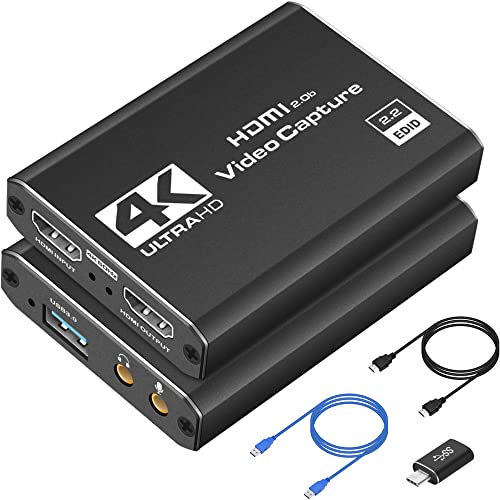
The Dcyfol 4K HDMI Capture Card is a budget-tier USB 3.0 capture dongle aimed at hobbyist streamers and creators who need a cheap on-ramp to OBS. It records at 1080p 60FPS with 4K HDMI passthrough via loop-out, and targets buyers pairing a PS5, Xbox Series X, or Switch with a laptop capture rig.
The defining feature is the USB 3.0 interface paired with HDMI loop-out. That combination is what separates it from sub-tier USB 2.0 dongles caped at 1080p 30FPS. Based on category norms, MS2130-class dongles at this price typically deliver usable 1080p 60FPS in OBS with sub-100ms preview latency on modern PCs.
Trade-offs are typical at this tier. The 4K figure describes passthrough resolution, not capture resolution, which is a common labeling pattern on cheap dongles. Owner feedback is not yet available to confirm audio sync stability, thermal throttling on long sessions, or HDCP behavior with PS5 sources. Expect the usual budget-dongle caveats around HDR and VRR handling.
Buy this if you need a cheap, portable 1080p 60FPS capture path for OBS on a secondary PC and can tolerate unverified long-session reliability. Skip this if you stream 1440p or 4K60 gameplay, need guaranteed HDR passthrough, or require validated low-latency capture for competitive dual-PC setups.
Interface and bandwidth: USB 3.0 Type-A host connection, which provides the roughly 5 Gbps ceiling needed for uncompressed 1080p 60FPS YUY2streams in OBS. USB 2.0 fallback is not specified by the manufacturer, and detailed chipset identification is not provided in the source data.
Capture and passthrough: Capture output is 1080p at 60FPS per the listing. HDMI loop-out is advertised as 4K capable for passthrough to a monitor or TV, leting console players view native console output while the PC records the downscaled 1080p60 feed.
Software compatibility: UVC and UAC plug-and-play operation, no vendor driver required. Confirmed compatible with OBS Studio, Streamlabs, and XSplit on Windows and macOS. Source-listed device support covers PS5, PS4, Xbox, Nintendo Switch, PC, Mac, and HDMI-out DSLR cameras.
Not specified: HDR passthrough, VRR support, HDCP behavior, exact capture latency in miliseconds, dongle weight, cable length, and internal chipset are not listed in the source data. Buyers needing verified numbers should treat these as unknowns until independent testing is available.
Who needs a capture card
Console streamers, full stop. If you’re capturing PS5, PS5 Pro, Xbox Series X/S, or Nintendo Switch 2 gameplay, there’s no software workaround. You need hardware between the console’s HDMI and your PC’s USB or PCIe slot. Camera-based content creators using DSLRs as webcams also need one. The Elgato Cam Link 4K at $99.99 has 13,883 reviews because it turned every mirrorless camera into a Zoom-grade webcam during the lockdown era.
Dual-PC streamers benefit too. Sending your gaming PC’s HDMI output to a second PC running OBS frees the gaming machine from all encoding work. That’s how most full-time Twitch streamers run their setups. The Elgato 4K X at $201.99 and AVerMedia 4K60 GC553G2 at $219.99 are built for this workflow with 4K144 and 4K120 passthrough respectively.
What to look for in 2026
HDMI 2.1 passthrough is the headline feature now. PS5 Pro outputs 4K at 120Hz with VRR, and you’ll want your monitor seeing that signal unmodified while the capture card records or streams at a lower resolution. The Elgato 4K X handles up to 4K144 passthrough, while the AVerMedia GC553G2 hits 4K144/4K120. The budget USB 3.0 sticks at $26.99 cap out at 1080p60 capture with 4K passthrough, which is the right compromise for most casual streamers.
Latency is the other spec to watch. Internal PCIe cards offer the lowest latency for direct-feed gameplay, but they tie you to a desktop. External USB 3.0 and USB 3.2 Gen 2 cards trade a few milliseconds for portability. For streaming, that latency doesn’t matter because you’re seeing the console output on the TV directly. For competitive console play through a single monitor, you’d want the lowest-latency option. VRR support also matters if you stream PS5 Pro at variable refresh.
How we evaluated these capture cards
We compared resolution and refresh-rate specs against verified owner feedback, weighed software ecosystems (Elgato’s 4K Capture Utility vs AVerMedia’s RECentral), and checked OBS integration reliability. Hardware encoding versus uncompressed capture matters too. The pricier cards capture uncompressed which gives editors clean footage to work with, while the budget USB dongles use hardware H.264 to fit through USB 3.0 bandwidth.
Review counts shaped the verdicts. The Cam Link 4K’s 13,883 reviews represent years of camera streamers, while the AVerMedia GC553G2’s 273 reviews reflect its 2026 release window. We didn’t penalize newer cards but flagged where the long-term reliability picture isn’t fully drawn yet. Pricing per feature got weighed against the alternatives available at each tier.
Picks by tier
Best high-end pick: The Elgato 4K X at $201.99 is the move for serious streamers. 4K144 capture, ultra-low latency on PS5 Pro and Xbox Series X|S, HDMI 2.1, VRR, HDR10, and USB 3.2 Gen 2. Works on PC, Mac, and iPad. 1,488 reviews at 4.6 stars and Elgato’s software ecosystem is unmatched.
Best premium alternative: The AVerMedia 4K60 GC553G2 at $219.99 brings HDMI 2.1, 4K144/4K120 passthrough, and low latency in a slightly different package. AVerMedia’s RECentral software is robust if you’d rather avoid Elgato’s ecosystem lock-in. 273 reviews at 4.2 stars, newer to market.
Best for camera streamers: The Elgato Cam Link 4K at $99.99 turns any DSLR, mirrorless, or camcorder with HDMI out into a webcam. 1080p60 or 4K30/4K60 capture, easy OBS, Zoom, and Discord integration. 13,883 reviews at 4.6 stars. Still the default for serious camera streamers.
Best budget pick: The 4K HDMI Capture Card with USB 3.0 at $26.99 (B0BWT35QW8) handles 1080p 60FPS gaming and streaming with HDMI loop-out. Plug-and-play, low latency, works with PS5, PS4, Xbox, Switch, OBS, PC, and Mac. 967 reviews at 4.4 stars. Best entry-level recommendation.
Best Switch-focused entry: The Capture Card for Nintendo Switch at $26.99 (B097DKNS1M) is the cheap pick that’s optimized for the Switch crowd. 4K HDMI input, 1080P 60FPS recording, USB 3.0. 2,263 reviews at 4.3 stars. Identical price to the other budget option but slightly more reviews give it a slight edge for new buyers.
Bottom line
For dedicated console streamers with PS5 Pro or Xbox Series X, the Elgato 4K X at $201.99 is the right buy. It’s expensive but it’ll outlive your current console generation. Camera streamers should grab the Cam Link 4K. Hobbyists capturing occasional Switch or PS5 gameplay at 1080p can save big with either $26.99 USB capture dongle. The AVerMedia 4K60 is the alt-pick if you don’t want to commit to Elgato’s software ecosystem.
Common questions
Do I need a capture card to stream PC games?
No, you can stream PC gameplay using OBS directly with NVENC or AMD’s hardware encoder. A capture card is only needed for console gameplay or dual-PC streaming setups. If you’re streaming PC-only and have a recent GPU, save your money. Capture cards become essential the moment you add a console, a DSLR camera, or want to offload encoding to a second machine.
What’s HDMI passthrough and why does it matter?
Passthrough sends the console’s signal to your TV or monitor unmodified while the capture card records a copy. Without it, you’d see the recorded resolution (often delayed) instead of native console output. The Elgato 4K X passes 4K144 through to your display so PS5 Pro at 4K120 reaches your monitor while OBS captures 1080p60 for streaming. Critical for low-latency console gaming.
Internal PCIe or external USB capture card?
Internal PCIe cards offer slightly lower latency and don’t tie up USB ports, but they’re stuck inside one desktop. External USB cards travel with you and work with laptops. For most streamers in 2026, external USB 3.2 Gen 2 (like the Elgato 4K X) hits the same performance envelope as internal cards while staying portable. Internal makes sense only for permanent setups.
Will a $26 capture card work for serious streaming?
For 1080p60 streaming to Twitch or YouTube, yes. The bandwidth ceiling on USB 3.0 limits you there, and that’s also what most viewers actually watch. The 4K HDMI Capture Card at $26.99 with loop-out is fine for hobby streamers. You’ll feel the limits if you want 4K60 recording, HDR, VRR, or dual-PC setups. That’s when the $200+ tier earns its price.
Does the Cam Link 4K work as a regular webcam?
Yes. Connect any HDMI-output camera (DSLR, mirrorless, camcorder, or action cam), plug Cam Link into your PC via USB 3.0, and Windows treats it as a standard webcam. Works in Zoom, Discord, Teams, OBS, anything. The catch is your camera needs clean HDMI output (most modern Sony, Canon, and Fujifilm models do) and you’ll want a dummy battery for marathon recording sessions.