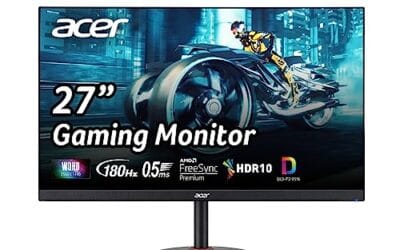
The cable on the back of your GPU matters more than you’d think. HDMI 2.1 caps at 48 Gbps. DisplayPort 2.1 punches up to 80 Gbps with UHBR 20. That’s the headline gap, but the real-world picture in 2026 is messier. Most monitors only expose one or the other, GPU vendors split support, and cheap “8K” adapters lie about their bandwidth. Let’s untangle which port handles 4K 240Hz, HDR, and VRR without compression.
Matchup at a glance
HDMI 2.1 was finalized in 2017 and shows up on every modern TV plus RTX 30/40-series and Radeon RX 6000+ GPUs. It supports 4K at 120Hz uncompressed, 4K 144Hz with DSC, and 8K 60Hz with chroma subsampling. DisplayPort 2.1 with UHBR 20 didn’t hit consumer GPUs in volume until the RTX 50-series. When it works, it handles 4K 240Hz uncompressed and 8K 120Hz with DSC.
For most gamers in 2026, the choice gets made for you by what ports your monitor has. High-end QD-OLED panels lean DisplayPort. Living-room setups and console-shared monitors lean HDMI 2.1. Knowing which spec your gear actually supports matters more than picking a winner on paper.
Spec sheet showdown
| Spec | HDMI 2.1 | DisplayPort 2.1 |
|---|---|---|
| Max bandwidth | 48 Gbps | 80 Gbps (UHBR 20) |
| 4K uncompressed | 120Hz | 240Hz |
| 8K support | 60Hz w/ DSC | 120Hz w/ DSC |
| VRR / FreeSync | Yes | Yes |
| Max cable length | 10ft passive | 6ft passive |
Where HDMI 2.1 still wins
Cable length is HDMI’s underrated edge. Passive HDMI 2.1 cables hold full bandwidth out to about 10 feet. DisplayPort starts dropping link speed past 6 feet without going active. If you’re running from a tower under the desk to a TV across the room, HDMI’s the practical pick.
It’s also the only port that works with PS5, Xbox Series X, and current-gen receivers. eARC, CEC, and Auto Low Latency Mode are HDMI-exclusive. For a console-and-PC shared setup, you’d be silly to skip it.
There’s a useful workaround when your GPU lacks DP 2.1 but you’ve got an HDMI 2.1 monitor: a unidirectional DP-to-HDMI cable like the Cable Matters 8K model that hits 4K 240Hz or 8K 60Hz. These cables convert DisplayPort 1.4 source signals into HDMI 2.1, which lets older RTX 30-series cards drive modern HDMI panels at full refresh.
The GPU-port reality in 2026
Here’s what gets messy: GPU vendors don’t ship matched ports. RTX 40-series cards expose HDMI 2.1 and DisplayPort 1.4a. RTX 50-series adds DP 2.1 with UHBR 20 on the higher tiers. Radeon RX 7000-series shipped DP 2.1 but with UHBR 13.5, not the full 80 Gbps. Mixing GPU and monitor generations matters more than ever. Check the spec sheet before assuming “DisplayPort 2.1” on the box means the same thing on both ends of the cable.
Where DisplayPort 2.1 pulls ahead
Pure bandwidth. UHBR 20 carries 80 Gbps, enough for 4K 240Hz with 10-bit color and HDR uncompressed. HDMI 2.1 can’t do that without Display Stream Compression. DSC is visually lossless 99% of the time, but it adds a tiny processing step and some monitors handle it better than others.
DP also chains better. Multi-monitor setups via Multi-Stream Transport let you daisy-chain two or three displays off a single port. HDMI doesn’t offer that. For productivity rigs with three 1440p panels, DisplayPort cuts cable clutter and frees up GPU outputs.
Adaptive sync is also more mature on DisplayPort. G-Sync (the real hardware module version) is DP-only. FreeSync works on both, but the wider VRR range on DP is more forgiving on lower-end refresh-rate dips.

Pros
- Active chipset enables true8K at 60Hz output from DP 1.4 sources to HDMI 2.1 sinks.
- Supports 4K at 120Hz and 1440p at 144Hz, matching current OLED gaming monitor targets.
- HDCP 2.3, HDR10, and DSC 1.2 handled for protected 4K HDR playback.
- Backward compatible with DP 1.3, 1.2, 1.2a, 1.1, and 1.0 source outputs.
Cons
- Limited owner feedback at time of writing, so long-term reliability signal is thin.
- Unidirectional only: DP source to HDMI display, will not work reversed or through KVMs, hubs, or docks.
- Requires an HDMI 2.1 display for the headline8K at 60Hz and 4K at 120Hz modes.
The ZIXIAMZ 6FT cable is a mid-range active adapter cable that converts a DisplayPort 1.4 source to an HDMI 2.1 sink in one direction only. It targets PC builders running NVIDIA RTX or AMD Radeon GPUs whose HDMI 2.1 TV or gaming monitor needs a DP output driven at high refresh.
The defining feature is the active DP to HDMI 2.1 conversion, rated for 8K at 60Hz, 4K at 120Hz, and 1440p at 144Hz with DSC 1.2 and HDR10. Based on the vendor spec sheet, this covers the common OLED and Mini-LED gaming display targets, though8K modes depend on both GPU and display suporting the mode.
Trade-offs are typical for active DP to HDMI cables at this tier: it is strictly unidirectional, it will not tolerate hubs, docks, or KVMs in the path, and the source GPU must expose a real DP 1.4 output with DSC. Owner feedback volume is low, so failure rate and EMI behavior over long runs are not yet well characterized.
Buy this if you have a DisplayPort-only GPU and a fixed HDMI 2.1 monitor or TV target that needs 4K at 120Hz or 8K at 60Hz. Skip this if your display is HDMI 2.0 only, if you need bidirectional use, or if the cable must pass through any switch or dock.
Protocol conversion: Active DisplayPort 1.4 input to HDMI 2.1 output, unidirectional. Backward compatible with DP 1.3, 1.2, 1.2a, 1.1, and 1.0 sources. Works with DP, DP++, and DisplayPort++ outputs. Direct source-to-display only, no hubs, docks, or KVMs in line.
Resolution and refresh: 8K at 7680x4320 60Hz, 4K at 3840x2160 120Hz or 60Hz, 2K at 2560x1440 144Hz or 120Hz, and 1080p at 165Hz, 144Hz, or 120Hz. DSC 1.2 is required for the top4K and 8K modes on the DP side.
HDR, audio, and content protection: Dynamic HDR and HDR10 pass-through, HDCP 2.3 compliant for protected 4K streaming. Uncompressed audio pass-through for 7.1, 5.1, and 2.0 channel PCM. No mention of eARC, Dolby Vision, or CEC support in source data.
Build and compatibility:6FT length, braided nylon jacket, gold-plated connectors, aluminum connector housings. Vendor lists compatibility with NVIDIA RTX 5070, 5080, 5090, AMD RX 7900 and 6900 series on the source side, and Alienware AW3225QF, Samsung Odyssey Neo G8, G7, Ark, S95D OLED, and LG UltraGear 32GQ950 and 48GQ900 on the sink side.
Which one to buy
Single high-refresh gaming monitor at 4K 144Hz or 1440p 240Hz on a current-gen GPU? DisplayPort. It’s cleaner, no DSC dependency, and it’s what your monitor’s primary input expects.
PC plus PS5 sharing a TV or monitor? HDMI 2.1, no question. The console doesn’t speak DisplayPort. Adapters introduce input lag you don’t want for fighting or rhythm games.
Stuck with an RTX 30-series and want to drive a 4K 240Hz HDMI panel? Grab a quality DP-to-HDMI active cable. The Cable Matters and 8K-rated braided options handle the conversion without dropping VRR. Just confirm the cable explicitly lists 4K 240Hz support, not just “8K compatible.”
One thing worth flagging: not every adapter cable supports VRR. The cheap $15 DP-to-HDMI options often skip the feature entirely, which means screen tearing in any game that doesn’t hit your panel’s exact refresh. Look at the product description carefully. If VRR isn’t called out, assume it’s missing.
DSC (Display Stream Compression) deserves a mention too. It’s visually lossless in most workloads, but if you’ve got an older monitor that doesn’t handle DSC well, you might see banding in dark gradients or shimmer on fine text. Pure bandwidth via UHBR 20 avoids the question entirely, which is why high-end OLED panels lean toward DP for the cleanest signal path.
Common questions
Do I need a DP 2.1 cable for an RTX 5080?
Only if your monitor accepts UHBR 20 and you’re pushing past 4K 144Hz. Most current panels still use DP 1.4 inputs, so a high-quality DP 1.4 cable handles real-world workloads fine.
Will an HDMI 2.0 cable work with HDMI 2.1?
It’ll connect, but bandwidth caps at 18 Gbps. You’ll lose 4K 120Hz, VRR, and HDR headroom. Buy a certified Ultra High Speed HDMI cable for full 2.1 features.
Does cable quality actually matter?
For short runs under 6 feet, most certified cables behave the same. Past that, braided shielding and proper gauge start mattering. Cheap “8K” cables under $10 often can’t sustain the link.
Can DisplayPort carry audio like HDMI?
Yes, DP carries 8-channel uncompressed audio. The catch is that it doesn’t pass eARC back to receivers. If you’ve got a home theater setup, HDMI’s still the audio path.
Should I replace existing cables when I upgrade my GPU?
If the cable is older than three years or uncertified, yes. Modern UHBR 20 and Ultra High Speed HDMI specs are strict. A 2019-era cable might handshake at lower link rates and silently throttle your refresh ceiling.
What about USB-C with DisplayPort Alt Mode?
It works fine for laptops and portable monitors, but the bandwidth caps at DP 1.4 in most implementations. For 4K 240Hz desktop gaming, you’ll want a dedicated DisplayPort cable, not USB-C.