

If you’ve shopped for a router lately, you’ve seen the two labels plastered across every box: dual-band and tri-band. They sound like marketing filler, but the difference is real, and it changes how your home network behaves once a dozen devices start fighting for airtime. Most people buy the wrong one because they focus on the top speed number instead of how the bands are actually split up.
Here’s the plain-English version. A band is a lane of wireless traffic. Dual-band gives you two lanes, tri-band gives you three. That’s it at the surface, but the way those lanes get used decides whether your 4K stream stutters when someone else hops on a call. If you’re weighing a new purchase, our roundups of the best gaming router picks and the best budget router 2026 options both lean on this exact distinction. Let’s break down what you’re really paying for.
The short answer
Dual-band means the router broadcasts on two frequencies: 2.4 GHz and 5 GHz. Tri-band adds a third radio, usually a second 5 GHz band (or a 6 GHz band on Wi-Fi 6E and Wi-Fi 7 hardware). The extra band doesn’t make any single device faster. What it does is spread your gadgets across more lanes so they stop crowding each other. Think of it as adding a checkout line at the store. Nobody scans groceries quicker, but everybody waits less.
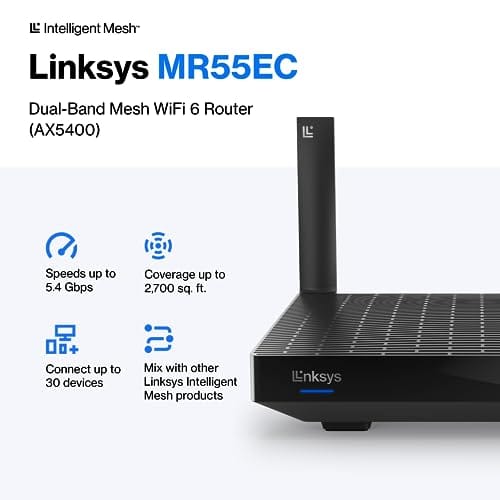
For a household with a handful of devices, dual-band is plenty. Something like the Linksys Hydra Pro 6 covers that ground well. It’s a Wi-Fi 6 dual-band unit rated for around 2,700 square feet and 30-plus devices, priced near $199.99 with a 4.4-star rating. Owner reports point to steady coverage in mid-size homes, and it doubles as a mesh node if you outgrow one unit.


Pros
- AX5400 class dual-band throughput up to 574 plus 4804 Mbps on 5 GHz
- Six spatial streams with OFDMA reduce congestion for 30+ device homes
- Intelligent Mesh compatibility allows scaling coverage beyond the 2,700 sq ft rating
Cons
- Limited owner feedback at time of writing, so real-world reliability data is thin
- Dual-band only, no dedicated 6 GHz or wireless backhaul band at this tier
- Detailed specifications, WAN port sped, and waranty not specified in source listing
The Linksys Hydra Pro 6 (MR5500-AMZ) is a mid-range dual-band WiFi 6 mesh router aimed at households upgrading from an older AC1900 or extender-based setup. Linksys rates it for 2,700 sq ft and 30 plus devices, targeting medium apartments, condos, and small two-story homes with mixed smart home and streaming traffic.
The defining feature is six-stream AX5400 class WiFi 6 with quoted rates of 574 Mbps on 2.4 GHz and 4804 Mbps on 5 GHz. OFDMA and MU-MIMO help when many low-bandwidth clients share airtime, which is where WiFi 5 routers typically stall. Real-world 5 GHz throughput at range appears to land in the mid-hundreds of Mbps based on category norms.
Trade-offs are typical at this tier. It is dual-band, so there is no dedicated 6 GHz radio and no separate backhaul channel when you add mesh nodes, meaning throughput can halve on satellite hops. Linksys does not specify WAN port speed, USB, or processor details in the listing, so multi-gig ISP users should verify before buying.
Buy this if you want a single WiFi 6 router that can grow into a Linksys Intelligent Mesh system for a 2,000 to 3,000 sq ft home with 30 plus clients. Skip this if you need WiFi 6E, 2.5 GbE WAN, or a dedicated backhaul band for a large multi-story house.
Wireless class: AX5400 class dual-band WiFi 6 with quoted PHY rates of 574 Mbps on the 2.4 GHz band and 4804 Mbps on the 5 GHz band, totaling roughly 5378 Mbps aggregate across six spatial streams. No 6 GHz radio is listed, so WiFi 6E clients fall back to 5 GHz.
Coverage and capacity: Linksys rates the MR5500 for 2,700 sq ft and 30 plus simultaneous devices. OFDMA, MU-MIMO, and 1024-QAM are standard at this WiFi 6 tier and help maintain throughput as client count scales, though actual coverage depends heavily on wall material and node placement.
Mesh behavior: Intelligent Mesh lets you pair the MR5500 with other Linksys nodes to extend coverage. Because it is dual-band, backhaul shares the 5 GHz client band, so expect throughput to roughly halve one hop from the root node. A wired Ethernet backhaul between nodes avoids this penalty.
Not specified: WAN and LAN port speeds, USB ports, processor and RAM, warranty length, and physical dimensions are not disclosed in the source listing. Buyers pairing this with multi-gig fber or DOCSIS 3.1 plans above 1 Gbps should confirm port specs before purchase.
The longer explanation
The 2.4 GHz band is the old workhorse. It travels far and punches through walls, but it’s slow and painfully congested because your neighbors, your microwave, and your smart bulbs all live there. The 5 GHz band is faster and cleaner, though it fades over distance and doesn’t love thick walls. Every dual-band router juggles these two, steering devices to whichever makes sense.
Tri-band routers hand you a bonus lane. On most models that’s a second 5 GHz radio, so two groups of fast devices can run at full tilt without stepping on each other. On newer Wi-Fi 6E and Wi-Fi 7 gear, the third band is 6 GHz, a wide-open highway with almost no legacy traffic. The catch: only recent phones, laptops, and adapters can even see 6 GHz, so the benefit depends on your device lineup.
Here’s how that plays out in a real house. Say you’ve got a gaming PC, a 4K TV streaming Netflix, three phones, a couple of laptops, and eight smart-home gadgets. On dual-band, the fast stuff all crowds a single 5 GHz lane while the smart plugs and cameras sit on 2.4 GHz. When the network gets busy, the gaming PC and the TV take turns, and that’s where stutter creeps in. Split those onto two 5 GHz bands and the fight mostly disappears. Same devices, same internet plan, steadier feel. The third lane isn’t magic. It’s just more room.
How we got here
Early wireless routers were single-band, stuck on 2.4 GHz. As homes filled with laptops and phones, that lane jammed. The 5 GHz band arrived to relieve pressure, and dual-band became the default around the Wi-Fi 5 era. Then streaming, smart home gear, and remote work piled dozens of connections onto every network. Tri-band showed up to answer that load, first in high-end gaming routers, then trickling down to mainstream mesh kits.
The 2020 opening of the 6 GHz spectrum for unlicensed use changed the math again. It gave tri-band a genuinely new lane instead of just a duplicate of an existing one. That’s why a modern tri-band Wi-Fi 6E router feels different from a tri-band model that just stacks two 5 GHz radios.
Why it works this way
Wireless is a shared medium. Only one device on a given band can transmit at a time, so the more devices you cram onto one lane, the more they take turns and wait. Adding a band doesn’t raise the ceiling on any one device’s speed. It multiplies the number of conversations that can happen at once. That’s the whole trick.
This also explains a common letdown. People buy a pricey tri-band router expecting their laptop to suddenly download quicker, then feel cheated when the single-device number barely moves. It won’t move much. The payoff shows up when the network is busy, not when one device is alone.
There’s a band-steering angle worth knowing too. Good routers watch signal strength and load, then nudge each device toward the band that suits it best. A phone across the house gets parked on 2.4 GHz for reach, a nearby console gets 5 GHz for speed. The more bands the router has to work with, the more room it has to make smart placements. That’s part of why a tri-band unit can feel calmer under pressure even when raw numbers look similar on paper.
When you’d want tri-band
Reach for tri-band when your home runs a lot of simultaneous, bandwidth-hungry traffic. Multiple 4K streams, cloud backups, video calls, a gaming rig, and a swarm of smart devices all going at once. Large houses using mesh benefit too, since one band can be reserved as a dedicated backhaul link between nodes, keeping your device lanes clear. If your setup is a couple of phones and one streaming box, you won’t notice the third band and the extra cost is wasted.
Gamers and streamers sit right on the fence. A strong dual-band Wi-Fi 6 router handles a single gaming PC fine, but if that PC shares the house with other heavy users, tri-band keeps latency steadier. And speaking of the desktop itself, a clean build matters for the whole setup. Cheap add-ons like the MoKo magnetic PC dust filter, a $12.99 two-pack with a 4.9-star rating and PVC magnetic frames, keep airflow through your rig tidy so the machine doing all that streaming stays cool and quiet.
Apartment dwellers are the flip side of this. In a small space with fewer devices and short distances, a solid dual-band unit does everything a tri-band would, for less. There’s no long backhaul run to worry about and no swarm of devices choking a single lane. If that’s your situation, spend the saved cash on a better Wi-Fi generation instead of a third band you won’t use. Our best budget router for streaming 4K picks show where that money goes furthest for a stream-heavy but device-light home.

Pros
- Large 400x300mm sheets cover full-tower top or side panels after trimming.
- Magnetic strip and adhesive combo works on any ferrous steel case panel.
- 1mm mesh openings pass more air than tight foam filters at similar coverage.
- Two-pack plus eight strips gives enough material for multiple vents in one build.
Cons
- Limited owner feedback at time of writing, real-world durability is unverified.
- Requires ferrous steel panels, will not stick to aluminum or tempered glass cases.
- PVC and 3M adhesive strips can lose grip over time in warm, high-airflow builds.
This is a budget DIY dust filter kit, not a pre-cut case-specific filter. The package includes two 400x300mm PVC mesh sheets with a 1mm hole pattern plus eight 400mm magnetic frame strips. It targets builders with non-standard vents, modded cases, HTPC chassis, or console dust covers who want to fabricate their own filters.
The defining feature is the trim-to-fit format. You measure the vent, cut the PVC sheet with scissors, then frame the edges using the adhesive-backed magnetic strips so the assembly clamps to steel panels. The 1mm aperture is coarser than typical foam filters, which favors airflow over fine-dust capture, a reasonable trade for intake or exhaust with strong static pressure fans.
Trade-offs are typical at this tier. PVC is not as tear-resistant as nylon or stainless mesh, and 3M adhesive can soften near warm PSU or GPU exhaust zones. The magnetic attachment only works on ferrous steel, so tempered glass side panels or aluminum shells need alternative mounting. With no verified owner data yet, longevity and mesh consistency are unproven.
Buy this if you need to filter oddly shaped vents or console intakes and are comfortable cutting and framing your own mesh. Skip this if your case already ships with pre-fit magnetic filters, or if the panels are aluminum or glass where the magnets will not hold.
Sheet dimensions: Each sheet measures 400x300mm (15.75 x 11.81 inches) with a stated thickness of 0.01 inches. Two sheets ship per pack, enough surface area to cover a full-tower top vent plus a PSU shroud intake, or several smaller vents across a mid-tower build.
Mesh and material: PVC construction with a 1mm hole pattern. The 1mm aperture is coarser than fine foam or stainless woven filters, which prioritizes airflow over sub-micron dust capture. Expect it to catch pet hair, lint, and coarse household dust rather than fine particulates.
Mounting hardware: Eight 400mm magnetic strips are included, framed with 3M adhesive backing. Peel-and-stick application to the trimmed PVC edge lets the assembly clamp to any ferrous steel case panel. No screws or drilling needed, and the filter lifts off for shake-out or rinse cleaning.
Compatibility notes: Total kit weight is around 0.5 pounds. Magnetic mounting requires steel panels, it will not attach to aluminum shells, tempered glass, or plastic vents without a separate ferrous shim. Best suited to standard steel PC cases, older server chassis, HTPC builds, and console dust covers.
What to look for in a router
Band count is only one spec. Check the Wi-Fi generation first. Wi-Fi 6 (802.11ax) is the current mainstream baseline and improves how many devices a band can handle through smarter scheduling, so a good dual-band Wi-Fi 6 unit often beats an older tri-band Wi-Fi 5 model in a busy home. Coverage claims like 2,700 square feet give you a rough guide, but walls and floors cut that down fast.
Also weigh device support, port count, and mesh capability. If you want future 6 GHz access, you need Wi-Fi 6E or Wi-Fi 7 hardware and client devices that can use it. For most buyers the honest question isn’t dual versus tri, it’s how many hungry devices run at the same time. Our best gaming router 2026 guide walks through the specs that actually move the needle.
For a gaming desktop, don’t ignore wired options either. If the router sits in the same room, Ethernet removes band selection from the equation and gives the most stable latency. Wi-Fi is still useful for laptops, handhelds, and rooms where cable routing is ugly, but a $10 cable can beat a $300 router for one nearby PC. Spend the router money where it helps the whole home, not just one machine that could be wired in five minutes.
Common misconceptions
The biggest myth is that tri-band means faster internet. It doesn’t. Your internet speed is capped by your ISP plan, not your router’s band count. A second myth: more bands equals more range. Range comes mostly from the 2.4 GHz radio and antenna design, not the number of 5 GHz lanes. Adding a duplicate 5 GHz band does nothing for how far the signal reaches.
One more. Some folks assume tri-band is always Wi-Fi 6E with a 6 GHz band. Plenty of tri-band routers just run two 5 GHz radios and never touch 6 GHz. Read the band breakdown on the box before you assume you’re getting the newest spectrum.
Frequently asked
Is tri-band worth it for a single gaming PC?
Not on its own. A solid dual-band Wi-Fi 6 router handles one gaming rig with low latency. Tri-band starts to pay off only when that PC shares the network with several other heavy users at the same time.
Does dual-band slow down when many devices connect?
It can. With only two lanes, a large pile of simultaneous devices means more waiting for airtime. Wi-Fi 6 softens this with better scheduling, but at some point a third band genuinely helps a busy household.
What’s the difference between tri-band and mesh?
They’re separate ideas. Tri-band is about how many radios one unit has. Mesh is about multiple units blanketing a home. Many mesh kits use a tri-band design so one band handles the link between nodes while the others serve your devices.
Do I need Wi-Fi 6E to benefit from tri-band?
No. Plenty of tri-band routers use a second 5 GHz band and skip 6 GHz entirely. Wi-Fi 6E only matters if you specifically want the 6 GHz lane and own devices that can connect to it.
Will a tri-band router make my downloads faster?
For one device downloading alone, no. Your speed is limited by your internet plan and the single band that device uses. Extra bands help the network stay fast when lots of gear runs at once, not a lone download.































Write Your Review
No reviews yet. Be the first to share your experience!