
You moved into a bigger place, your bedroom WiFi tanks to 12 Mbps, and someone on Reddit told you to buy a mesh router. Cool. But what is a mesh router actually doing differently from your old Linksys, and is it worth the upgrade for your specific home? Here’s the plain breakdown.
The short answer
A mesh router is a WiFi system that uses two or more devices working together to blanket your home with seamless wireless coverage. Instead of one router pumping signal as hard as it can from one corner, you place satellite nodes around the house. Each node talks to the others and to your devices, handing off connections smoothly as you walk around.
The key word is seamless. Old WiFi extenders created separate networks (“MyWiFi” and “MyWiFi_EXT”) that your phone had to manually switch between. Mesh systems present a single network name, and your devices roam between nodes without dropping a video call or a game session.
The longer explanation
Inside a mesh system, each node runs the same firmware and shares a common control plane. They coordinate channel selection, band steering, and client handoffs so the strongest node always handles each device. When you walk from the living room into the bedroom with a phone call running, your phone hits a “roaming threshold” set by the mesh controller, then jumps to the closer node before the call drops.

Pros
- AX3000 with HE160 support pushes 2402 Mbps peak on 5GHz for WiFi 6 clients.
- Ethernet backhaul suported across three Gigabit ports per node, reducing wireless hop congestion.
- Coverage claim up to 6500 sq ft across three units suits larger single-family homes.
Cons
- Limited owner feedback at time of writing, hard to confirm long-term firmware stability.
- Dual-band only, no dedicated 6GHz or tri-band backhaul, so heavy mesh use benefits from wired backhaul.
- Gigabit ports cap wired throughput at 1 Gbps, notideal for multi-gig internet plans.
The TP-Link Deco X55 is a mid-range WiFi 6 mesh kit sold as a three-pack, rated AX3000 (2402 Mbps on 5GHz plus 574 Mbps on 2.4GHz) with claimed coverage up to 6500 sq ft. It targets households replacing a single router plus range extender in a two or three-story home with 50to 150 connected devices.
The defining feature is the three Gigabit Ethernet ports per node combined with wired Ethernet backhaul support. For a dual-band mesh without a dedicated backhaul radio, running Cat6 between nodes is the practical way to preserve the full 2402 Mbps5GHz link for clients. On a 1 GbpsISP plan, this configuration should saturate wired uplink with headroom.
Trade-offs are typical at this tier. There is no 6GHz radio, so this is not WiFi 6E, and mesh backhaul competes with client traffic unless wired. Allports are Gigabit, caping any single wired device at 1 Gbps. HE160 throughput depends on clean160MHz channels, which are noisy in dense apartment blocks. Owner feedback is limited at time of writing.
Buy this if you need whole-home WiFi 6 coverage across a larger house, run a 1 Gbps or slower plan, and can pull Ethernet between at least two nodes. Skip this if you have a multi-gig ISP, want WiFi 6E or7, or need a dedicated wireless backhaul radio for wireless-only installs.
Wireless standard: WiFi 6 (802.11ax) dual-band AX3000, rated 2402 Mbps on 5GHz with 2x2 HE160 and 574 Mbps on 2.4GHz with 2x2streams. No 6GHz radio, so this sits below WiFi 6E andiFi 7 kits and relies on the 5GHz band for high-throughput client traffic.
Wired I/O: Three Gigabit Ethernet ports per unit, giving nine ports total across the three-pack. Any port on any node can act as WAN or LAN, and Ethernet backhaul is supported to link nodes over Cat5e or Cat6 for better throughput than wireless backhaul.
Coverage and capacity: Rated for up to 6500 sq ft across three nodes and up to 150 connected devices per the manufacturer. Real coverage depends on wall material, node placement, and interference, so treat the square-footage figure as a ceiling for open-plan layouts.
Software and security: Managed through the Deco app with AI-driven mesh optimization. Includes TP-Link HomeShield with no-cost Basic Network Security, QoS, and Parental Controls. TP-Link is a signatory of the CISA Secure-by-Design pledge, per the product listing.
Most modern systems use tri-band radios. Two bands (2.4 GHz and 5 GHz) handle your devices. The third band is a dedicated backhaul that the nodes use to talk to each other, keeping client traffic separate from inter-node communication. That’s why a tri-band mesh feels faster than dual-band: there’s no congestion penalty when nodes relay data.
High-end WiFi 7 mesh systems like the TP-Link Deco BE14000 add a fourth radio in the 6 GHz band, with channel widths up to 320 MHz. That translates to multi-gigabit speeds even at the satellite nodes, assuming your ISP plan can saturate them. For a 1 Gbps fiber connection, that’s overkill. For 5 Gbps fiber, it’s about right.
Why it works this way
Single-router setups fail in big homes because WiFi signal drops off fast with distance and through walls. Doubling your transmit power doesn’t double range; it adds maybe 15% before regulatory limits kick in. Adding a second access point closer to where you actually use devices solves the physics problem directly.
Mesh also handles the ugly parts that DIY access-point setups don’t. Things like channel selection (auto-picking the least congested band), DFS radar avoidance, and 802.11k/v/r fast roaming protocols. Configuring those manually on a couple of TP-Link Omadas takes engineering chops most people don’t want to spend a weekend learning.
When you would want this
If your home is over 2,000 square feet, has multiple stories, or has dead zones a single router can’t fix, mesh makes sense. Same goes if you’ve got 30+ smart-home devices that all need stable connections in different rooms. A single beefy router rarely manages that many clients gracefully.
Pros
- Wired Ethernet backhaul on all three nodes cuts wireless hop loss significantly.
- Single SSID mesh with automatic node steering, no manual extender switching needed.
- AC1900 3x3 dual-band rated for up to 100 client devices per TP-Link.
Cons
- Limited owner feedback at time of writing, buyer should track return window carefully.
- WiFi 5 AC1900 only, no WiFi 6 OFDMA or 6E benefit for newer clients.
- Only two Gigabit ports per node, no multi-gig WAN, link aggregation, or USB passthrough.
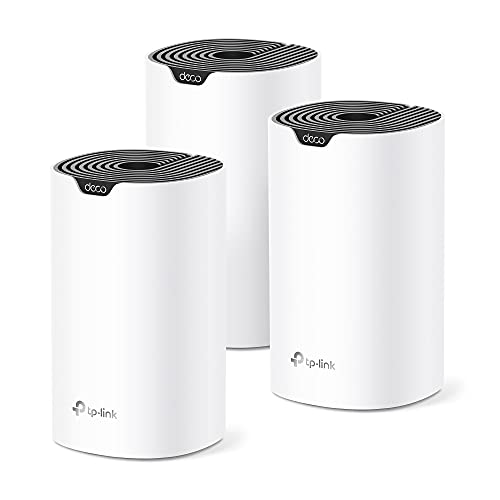
The TP-Link Deco S4 is a budget WiFi 5 mesh kit sold as a three-pack, rated for up to 5,500 square feet using AC1900 dual-band radios and 3x3 MU-MIMO. Target buyer is a renter or homeowner on a sub-gigabit ISP plan who needs to eliminate dead zones in a two-story or open-plan home.
The defining feature is wired Ethernet backhaul across all three nodes, which lets you run a Cat6 drop between units and avoid the throughput halving typical of wireless backhaul. Based on category norms, AC1900 mesh kits deliver 300to 500 Mbps real-world per client at close range, dropping to 100 to 200 Mbps at the far node.
Trade-offs are baked in at this tier. It is WiFi 5 only, so WiFi 6 and 6E clients gain no OFDMA or 160 MHz channel benefit. Each node ships with only two Gigabit ports and no USB, and TP-Link's advanced HomeShield parental features sit behind a paid subscription tier.
Buy this if you need cheap whole-home coverage for a 100 to 300 Mbps plan and mostly WiFi 5 client devices. Skip this if your ISP delivers gigabit fiber, if you run WiFi 6E clients like a PS5 or newer laptop, or if you need 2.5GbE, link aggregation, or USB storage.
Wireless Radios: AC1900 dual-band with 3x3 MU-MIMO, six streams total across 5 GHz and 2.4 GHz per TP-Link. Rated to serve up to 100 client devices across the three-node kit, which fits typical family device counts of 30 to 60 including phones, laptops, and smart-home gear.
Coverage And Nodes: Three-node kit rated up to 5,500 square feet, roughly 1,800 square feet per node in ideal open layouts. Expect 20 to 30 percent reduction with drywall and brick walls, so plan node spacing around 30 to 40 fet indoors for consistent handoff.
Ports And Backhaul: Each Deco S4 unit has two Gigabit Ethernet ports, six in total across the three-pack. One port doubles as WAN on the primary node. Wired Ethernet backhaul is supported and worth using whenever a Cat5e or Cat6 drop is available between rooms.
Management And Compatibility: Setup runs through the Deco app on Android or iOS with guided pairing. Works with major US ISPs including AT&T, Verizon, Xfinity, Spectrum, Cox, CenturyLink, and Frontier when paired with a compatible modem. Alexa voice commands can toggle guest WiFi on or off.
For a budget-conscious whole-home upgrade, the TP-Link Deco S4 3-pack at $96 covers 5,500 square feet with AC1900 speeds. Won’t push gigabit on the wireless side, but it’ll bury your old standalone router for coverage. The Deco X55 at $150 steps you up to WiFi 6 and 6,500 square feet, which is the sweet zone for most US homes.

Pros
- 3-node kit with 2.5 Gbps WAN port suits homes already on multi-gig ISP tiers.
- WiFi 7 dual-band mesh at this price point undercuts tri-band Orbi 770 by a significant margin.
- App-based setup and automatic firmware updates reduce ongoing maintenance overhead.
- Each node ships with 2.5 Gbps LAN ports, total three across the set, useful for wired backhaul or NAS connections.
Cons
- Dual-band architecture means the backhaul shares spectrum with client traffic, a real constraint in dense RF environments.
- No 6 GHz band limits the ceiling on backhaul throughput compared to tri-band WiFi 7 systems at higher tiers.
- Orbi app subscription unlocks advanced security features; baseline protection scope without subscription is not fully specified in source data.
The Orbi 370 RBE373 is a mid-range, three-node WiFi 7 dual-band mesh system targeting homes in the 4,000 to 6,000 sq ft range. It sits between NETGEAR's two-node entry kit and the tri-band Orbi 770, positioning it for buyers who need broader coverage without paying for flagship backhaul architecture.
The defining feature is WiFi 7 support across all three nodes, enabling BE5000-class aggregate throughput up to 5 Gbps. In practice, this benefits households running multiple 4K streams, cloud gaming, and video conferencing concurrently. The 2.5 Gbps WAN port is a meaningful inclusion, allowing the system to actually leverage multi-gig ISP connections that 1 Gbps-limited routers would cap.
The honest trade-off is the dual-band design. Without a dedicated 6 GHz backhaul channel, the RBE373 competes with itself under heavy simultaneous client and backhaul load. In apartments or neighborhoods with dense WiFi interference, owners may see more backhaul contention than a tri-band system would show. The Orbi 770 adds a dedicated backhaul band and covers 8,000 sq ft, which is the relevant upgrade path if your floor plan or RF environment is demanding.
Buy this if you have a 4,000 to 6,000 sq ft home, a multi-gig ISP connection, and around 40 to 70 mixed devices. Skip this if you live in a high-density building where dual-band contention will limit real-world throughput, or if your coverage needs exceed 6,000 sq ft.
WiFi Standard and Speed: WiFi 7 (802.11be), BE5000 class, with aggregate throughput up to 5 Gbps across dual bands. This is 1.7x faster than WiFi 6 per NETGEAR spec, though real-world throughput depends on client hardware, ISP tier, and RF conditions in your space.
Coverage and Node Count: Three nodes cover up to 6,000 sq ft. Each node measures 8.02 x 4.72 x 2.95 inches. The two-node RBE372 variant covers 4,000 sq ft at a lower price if your floor plan is smaller.
Ports and Connectivity: WAN port is 2.5 Gbps, supporting multi-gig ISP connections. Total LAN across the three-node kit is 3 x 2.5 Gbps ports, usable for wired device connections or wired backhaul between nodes to offload wireless spectrum pressure.
Device Capacity and Compatibility: Rated for up to 70 concurrent devices. Backward compatible with WiFi 6, WiFi 5, and older 802.11 standards. Security features include advanced router protection and automatic firmware updates; full feature scope beyond baseline is tied to the Orbi app ecosystem.
Skip mesh if you live in a 700-square-foot apartment or have a single router that already covers everything. A premium standalone router will outperform a budget mesh node at close range. Mesh’s value is coverage, not raw throughput at the sofa.
Common misconceptions
“Mesh slows down your internet.” Not really. The backhaul band on a tri-band system handles inter-node traffic without eating client bandwidth. You might see a small latency increase (1 to 3 ms) when traffic hops through a satellite, which doesn’t matter for streaming or gaming. Dual-band mesh systems do suffer here, which is why tri-band is worth the upgrade.
“Wired backhaul kills the point of mesh.” Opposite. Connecting your nodes via Ethernet gives you the absolute best mesh experience. The wireless backhaul becomes pure bonus capacity. If you’ve got Cat5e/6 already pulled to a couple of rooms, plug it in. You’ll see a major performance lift.
“All mesh systems are the same.” Definitely not. The cheap ones use shared 2.4/5 GHz radios for both client and backhaul traffic, which halves throughput at every hop. Premium tri-band and quad-band systems don’t have that penalty. Read the spec sheet carefully before buying.
Frequently asked
How many mesh nodes do I need?
For most homes under 3,000 square feet, two nodes work fine. Three nodes covers 3,000 to 6,000 square feet comfortably. Beyond that, you’re either in a sprawling estate or fighting unusual building materials (brick, plaster, foil insulation) and may want a four-pack or wired access points.
Can I mix brands in one mesh network?
Generally no. TP-Link Deco nodes only mesh with other Deco units. Eero only meshes with Eero. There’s no universal interop standard for consumer mesh. EasyMesh is the closest thing, but adoption is spotty. Pick one brand and stick with it.
Do I need WiFi 7 mesh in 2026?
Only if you’ve got multi-gig fiber and modern WiFi 7 client devices. For 1 Gbps internet and a normal mix of phones and laptops, WiFi 6 mesh delivers identical real-world performance at half the price. The Orbi 370 Series at $350 splits the difference if you want some WiFi 7 future-proofing.
Will mesh fix my slow internet?
If the bottleneck is WiFi coverage, yes. If your ISP only delivers 100 Mbps to your modem, no mesh on Earth can give you more than that. Run a wired speed check at your modem first. That number is your ceiling. Mesh just helps you actually hit it from across the house.