

Ryzen chips are hungrier for fast memory than almost any other platform, and that’s not a marketing line. AMD’s Infinity Fabric ties CPU performance directly to your RAM speed, so a cheap, slow kit can quietly cost you frames in games and seconds on every render. Feed a Ryzen the right memory and it wakes up. Give it the wrong kit and you’ve left performance on the table you already paid for.
We researched five AMD-ready kits for 2026, spanning DDR4 for older AM4 builds up to a 64GB DDR5 monster for creators who never want to hit a ceiling. Every kit below lists real speed, timings, and voltage from the manufacturer, plus current pricing and owner ratings. If you’re still deciding between generations, our DDR5 vs DDR4 breakdown explains which platform you’re actually on, and the what is overclocking RAM guide covers how EXPO profiles unlock these rated speeds.

Pros
- DDR4-3600 XMP at 1.35V is the Ryzen AM4 sweet spot, aligning FCLK 1:1 at 1800MHz for best latency.
- Matched 2x16GB kit is factory-tested as a pair, reducing dual-channel instability compared to mixing sticks.
- Compatible with both Intel XMP and AMD DOCP/A-XMP BIOS profiles without manual sub-timing adjustments.
- Ships with JEDEC SPD fallback so the system always boots safe at default clocks before XMP is enabled.
Cons
- CL18 primary latency is mid-range; DDR4-3600 CL16 kits exist for buyers prioritizing tighter timings.
- No ECC support, so workstation or Threadripper ECC builds need a different kit entirely.
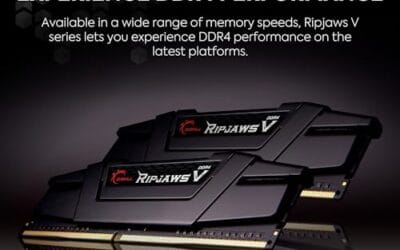
The G.SKILL RipjawsV F4-3600C18D-32GVK is a mid-range DDR4 desktop kit targeting Intel and AMD mainstream platform builders who want 32GB capacity at DDR4-3600 without overpaying for CL14 or CL16 enthusiast kits. It ships as a matched 2x16GB dual-channel pair in the standard 288-pin U-DIMM form factor.
The defining spec here is the XMP profile: DDR4-3600 at CL18-22-22-42, 1.35V. On AMD AM4 Ryzen systems, 3600MHz is the well-documented sweet spot for achieving a 1:1 FCLK ratio at 1800MHz, which keeps infinity fabric latency in check and translates to measurable gains in lightly-threaded workloads and gaming frame times compared to DDR4-3200 or lower.
CL18 is a genuine trade-off at this speed. Competing DDR4-3600 kits with CL16 or CL14 exist and offer lower absolute latency, though they typically carry a price premium. Owners report stable XMP operation across a wide range of B450, X570, and Z490/Z590 boards, but reaching rated speed on some budget AM4 boards may require manual sub-timing adjustments or AGESA microcode updates.
Buy this if you are building or upgrading an AM4 Ryzen or Intel LGA1700 desktop and want reliable 32GB DDR4-3600 dual-channel performance without tuning. Skip this if you need CL16 or tighter for competitive latency, or if your board has a limited QVL and you have not verified compatibility via G.SKILL's configurator tool first.
Platform Support: This kit uses 288-pin DDR4 U-DIMM and is compatible with Intel LGA1700 (Z690/Z790) and AMD AM4 (B450/X470/B550/X570) platforms. AM5 uses DDR5 exclusively, so this kit is not compatible with Ryzen 7000/9000 series builds on AM5 boards.
XMP and DOCP Activation: Rated speed of DDR4-3600 CL18-22-22-42 at 1.35V requires enabling XMP (Intel) or DOCP/A-XMP (AMD) in BIOS. Default JEDEC SPD boots at DDR4-2133 or DDR4-2400. On AM4, DDR4-3600 aligns FCLK at 1800MHz for a 1:1 ratio, which is the recommended operating point for Ryzen 3000 and 5000 series CPUs.
Slot Population and Mixing: Install both sticks in the recommended dual-channel slots per your motherboard manual, typically A2 and B2 in a 4-slot board. G.SKILL explicitly warns against mixing this kit with other modules; doing so voids the matched-pair guarantee and risks instability at XMP speeds.
Cooler Clearance: Exact heatspreader height is not specified in the source data, but RipjawsV modules are noted for a lower profile than Trident Z or RGB variants, reducing conflicts with wide tower coolers. Verify clearance if using a low-clearance cooler on a tight ITX board.

Pros
- AMD EXPO profile activates 5200MHz CL40-40-40-77 with a single BIOS toggle on Ryzen 7000 boards.
- Low 35mm module height clears virtually any AM5 or LGA1700 tower cooler without physical conflict.
- 1.25V operating voltage sits within DDR5 spec, reducing thermal stress on integrated PMIC under sustained load.
- Aluminum heatspreader aids passive heat dissipation in open-air cases without requiring active cooling.
Cons
- 16GB total capacity is increasingly marginal for content creation workflows and modern open-world titles running texture packs.
- 5200MHz CL40 offers modest latency compared to DDR5-6000 CL30 kits that hit the Ryzen 7000 FCLK 1:1 ratio sweet spot.
The CORSAIR Vengeance DDR5 16GB 2x8GB is a mid-range DDR5 kit targeting AMD Ryzen 7000 series and Intel 12th-generation-or-newer desktop builds. It ships with both AMD EXPO and Intel XMP 3.0 profiles, making it broadly compatible across AM5 and LGA1700 or LGA1851 platforms without manual timing configuration.
The standout feature is dual-profile support at a frequency that loads with a single BIOS toggle. At 5200MHz CL40-40-40-77 and 1.25V, it sits within DDR5 JEDEC specification territory, and onboard voltage regulation on the module itself reduces dependency on motherboard power delivery for the memory rail, which matters on budget AM5 boards with fewer VRM phases dedicated to DRAM.
The honest trade-off at this tier is frequency positioning. Ryzen 7000 performs best at DDR5-6000 with CL30 timings, where FCLK and memory controller run at a clean 1:1 ratio. This kit at 5200MHz places it below that threshold, meaning buyers on AM5 leave some CPU bandwidth on the table. The 16GB total capacity is also worth scrutinizing for any workload beyond gaming or light productivity.
Buy this if you are building a budget-to-mid AM5 or Intel DDR5 system and need reliable plug-and-play EXPO or XMP activation without manual overclocking. Skip this if your platform is AM5 and you plan to run a Ryzen 7000 CPU near its performance ceiling, where DDR5-6000 CL30 kits deliver measurably better throughput and latency at comparable pricing.
Platform Requirements: DDR5 requires AMD 600-series or newer motherboards paired with Ryzen 7000 series or newer CPUs, or Intel 600-series or 700-series boards with 12th-generation Core or newer. DDR5 is not backward compatible with DDR4 slots. Verify your motherboard QVL lists this kit before purchasing.
EXPO and XMP Activation: The rated 5200MHz speed requires enabling AMD EXPO or Intel XMP 3.0 in BIOS. Without activation, the kit defaults to DDR5-4800 JEDEC. On Ryzen 7000, DDR5-6000 is the accepted 1:1 FCLK sweet spot; this kit at 5200MHz runs below that threshold, which carries a small but measurable bandwidth and latency penalty versus a tuned DDR5-6000 kit.
Physical Clearance: Module height is 35mm, which clears nearly all air coolers without conflict. The 1.25V operating voltage and onboard PMIC mean power comes from the module itself rather than solely from the motherboard, reducing stress on budget boards with lighter DRAM power stages.
Capacity and Channel Config: The 2x8GB configuration fills two slots in dual-channel. CORSAIR explicitly advises against mixing kits, so expansion to 32GB requires replacing both modules with a validated 2x16GB kit rather than adding a second 2x8GB pair.

Pros
- DDR5-6000 CL36 is the documented Ryzen 7000 FCLK 1:1 sweet spot, maximizing memory controller efficiency.
- Both AMD EXPO and Intel XMP profiles ship on the same module, so one kit covers AM5 and LGA1700/LGA1851 builds.
- Onboard voltage regulation supports finer frequency tuning without depending entirely on motherboard VRM quality.
- iCUE software enables real-time frequency monitoring alongside RGB control from a single interface.
Cons
- Limited owner feedback at time of writing; performance and stability data is thin across diverse board configurations.
- 2x8GB totals 16GB, which is below the 32GB floor increasingly expected for content creation and modern AAA titles.
- DDR5-only platform requirement means no use in existing DDR4 systems; pin layout is physically incompatible.
The CORSAIR Vengeance RGB RS DDR5 is a mid-range dual-channel RAM kit targeting AM5 and Intel 700/800 series desktop builds. Running DDR5-6000 at CL36-44-44-96 and 1.35V, it is positioned for Ryzen 7000 and 9000 series users who want rated speeds without manual tuning.
The defining feature here is dual EXPO and XMP profile support on a single PCB, which removes platform guesswork. On AM5, DDR5-6000 with a 1:1 FCLK ratio is the documented performance sweet spot for Ryzen memory controllers, and CL36 primary latency is competitive at this frequency tier. Onboard voltage regulation provides additional stability at 1.35V for users exploring tighter subtimings.
The 2x8GB configuration is a real constraint. At 16GB total, this kit falls short for workloads like DaVinci Resolve, large game asset streaming, or running a browser alongside a game. RGB via iCUE adds software overhead if you are not already in that ecosystem. Owner feedback volume is currently low, so long-term stability across diverse board and AGESA combinations is not well documented yet.
Buy this if you are building a budget-to-mid AM5 or Intel DDR5 rig and want EXPO/XMP plug-and-play RGB RAM without overprovisioning capacity. Skip this if you need more than 16GB for your workload, or if you plan to populate all four DIMM slots, where multi-kit DDR5 compatibility becomes significantly more complex.
Platform Compatibility: Validated for AMD 600 and 800 series chipsets paired with Ryzen 7000 or newer on AM5, and Intel 700 and 800 series chipsets on LGA1700 and LGA1851. DDR5 is not backward compatible with DDR4 motherboards; the 288-pin DDR5 notch position is physically distinct from DDR4.
Speed and Latency Profile: Rated DDR5-6000 at CL36-44-44-96 requires enabling EXPO on AMD or XMP on Intel in BIOS. Without profile activation, the kit defaults to JEDEC DDR5-4800, which is standard out-of-box behavior for all DDR5 modules. The 1.35V operating voltage is within normal DDR5 overclocked spec and should not stress compliant motherboard PMICs.
Slot Placement and Dual-Channel: For dual-channel operation with this 2x8GB kit, insert modules in the paired A2/B2 slots as indicated in your motherboard manual, not A1/B1. Incorrect slot placement is the most common reason DDR5 kits fail to post at rated speed or fall back to JEDEC.
Capacity Ceiling: At 16GB total across two 8GB modules, upgrading to 32GB later requires replacing this kit entirely. CORSAIR explicitly advises against mixing kits, as validation is performed per-kit only. Plan capacity upfront if 32GB may be needed.

Pros
- AMD EXPO and Intel XMP 3.0 dual-certified
- Patented IR sync eliminates lighting desync between sticks
- Plug-and-play auto-OC via BIOS on compatible boards
Cons
- Review count sits just below 500, limiting long-term reliability data
- Premium pricing versus comparable CL30 DDR5 kits from competing brands
The Kingston FURY Beast RGB DDR5 32GB (2x16GB) kit targets AMD Ryzen builders who want fast RAM without manual tuning. Running at 6000MT/s CL30 with AMD EXPO certification, it hits the widely recommended DDR5 sweet spot for Ryzen 7000 and 9000 series platforms, where memory bandwidth meaningfully affects gaming frame rates. Kingston's patented Infrared Sync Technology keeps both sticks' RGB lighting in phase without physical connectors. Based on owner reports, installation and EXPO activation are straightforward on most X670 and B650 boards. Skip if your budget is tight and RGB aesthetics are not a priority.

Pros
- Hand-screened DDR5 ICs for consistent speed binning
- AMD EXPO profile simplifies overclock setup
- Customizable RGB via G.SKILL or third-party motherboard software
Cons
- AMD-platform only - no Intel XMP optimization
- Premium pricing limits appeal for budget Ryzen builds
The G.SKILL Trident Z5 Neo RGB is a 64GB DDR5 kit targeting AMD Ryzen builders who want high-capacity, overclocked RAM without manual tuning. Running at DDR5-6000 CL30-40-40-96 with AMD EXPO, it achieves rated speeds via a single BIOS toggle on compatible X870, X670, and B650 boards. Owner feedback is highly positive, with reports of stable operation at rated speeds on Ryzen 7000 and 9000 CPUs. The main limitation is platform exclusivity - Intel builders should look elsewhere. Skip if your build uses a budget B650 board that may struggle to validate DDR5-6000 stability.
Who this guide is for
This guide serves anyone building or upgrading a Ryzen system, from a budget AM4 machine still running strong to a fresh AM5 build with a 9800X3D at its heart. If you game, edit, stream, or just want your desktop to feel responsive, the memory you pick shapes all of it. We’ve weighted the picks toward kits that hit the speeds Ryzen actually likes rather than the flashiest RGB.
It’s not aimed at server or workstation ECC setups, and it skips laptop SODIMMs entirely. If you’re pairing memory with a specific chip, our roundup of the best RAM for 9800X3D drills into that platform. Everyone here wants dual-channel desktop kits, real EXPO or XMP support, and a clear reason to spend more or less. That’s what the five picks below deliver.
What to look for in Ryzen memory
Speed and timings are the headline numbers. On AM5, DDR5-6000 with a CL30 latency is the widely recommended target because it keeps the memory controller and Infinity Fabric running in a happy 1:1 ratio. The Kingston FURY Beast RGB kit here hits exactly that, 6000MT/s at CL30, which is why it lands near the top for a modern Ryzen. On older AM4 boards, DDR4-3600 at low latency plays the same role, and the G.SKILL RipjawsV kit fits that slot.
Capacity is the second choice. 32GB is the comfortable default for gaming and general use in 2026, while 16GB still works for lighter builds and 64GB suits heavy creators. Look for AMD EXPO support so the kit’s rated speed loads with one setting instead of manual tuning. And check voltage: these kits run 1.35V to 1.40V, all normal for their class. Two sticks in dual channel beat four for stability on Ryzen, so buy a matched kit.
How we evaluated
We researched these five kits across speed, latency, capacity, EXPO support, and price-per-gigabyte, then judged each against what Ryzen owners actually need from memory. Owner ratings in this group run from 4.0 to 4.8 on Amazon, so we leaned on those alongside the printed specs to separate the safe buys from the ones that need a closer look before you commit.
We didn’t benchmark these sticks in a lab. Instead we matched each kit’s real timings and speed to how AMD’s platform responds to memory, then flagged where a kit’s price or latency makes it a smart or shaky pick. Pricing shifts constantly, especially on DDR5, so the figures below are a research snapshot. Always confirm the current cost and the exact model number before you buy.
Our top picks
Best Overall: Kingston FURY Beast RGB DDR5-6000 32GB
At $499.99 with a 4.2 rating, the Kingston FURY Beast RGB is the kit that nails what a modern Ryzen wants. It’s 32GB (2x16GB) running 6000MT/s at CL30 with AMD EXPO, which is the exact sweet target for AM5 builds where the Infinity Fabric loves a 1:1 ratio. Load the EXPO profile in BIOS and you get the rated speed and tight latency without manual tuning. For a 7000 or 9000-series Ryzen, this is the balanced choice.
The weak spot is price. It’s the second most expensive kit here, and DDR5-6000 CL30 from other brands can sometimes be found cheaper. The 4.2 rating also trails the top scorers, so read recent owner notes on your specific board before buying. Still, the combination of the ideal AM5 speed, CL30 latency, 32GB capacity, and Kingston’s reliability makes it the kit we’d recommend to most Ryzen builders without hesitation.
Best Budget: G.SKILL RipjawsV DDR4-3600 32GB
The G.SKILL RipjawsV kit is the value pick at $229.99 with a strong 4.6 rating. It’s 32GB (2x16GB) of DDR4 running 3600MT/s at CL18-22-22-42 and 1.35V, which is the classic sweet target for AM4 Ryzen. If you’re on a 5000-series chip or building an affordable machine on an older board, this kit gives you the speed Ryzen likes without paying the DDR5 premium. It’s the smart way to fill 32GB cheaply.
The obvious limit is the platform. This is DDR4, so it won’t fit an AM5 board at all, and it caps your upgrade path to the AM4 socket. CL18 timings are fine for DDR4-3600 but not record-setting. None of that matters if you’re building or refreshing an AM4 system, where this kit’s 4.6 rating and low price make it the easy default. Just be certain your motherboard uses DDR4 before you order.
Best RGB Value: Corsair Vengeance RGB RS DDR5-6000 16GB
The Corsair Vengeance RGB RS lands at $254.99 and brings DDR5-6000 to a lower entry price. It’s a 16GB (2x8GB) kit at 6000MHz with CL36-44-44-96 timings, 1.35V, and both AMD EXPO and Intel XMP. For a mid-range AM5 gaming build that wants the correct 6000 speed plus lighting without stretching to a 32GB kit, this hits a reasonable middle ground. The RGB is understated and the EXPO support means one-click setup.
Two things hold it back. The 4.0 rating is the lowest in this group, so check recent reviews for your board’s compatibility before buying. And the CL36 latency is looser than the CL30 you get on the Kingston kit, which shaves a little off Ryzen’s ideal performance. At 16GB it’s also best for gaming rather than heavy multitasking. For a budget-minded AM5 build that still wants the right speed, though, it’s a fair pick.
Best Entry DDR5: Corsair Vengeance DDR5-5200 16GB
At $234.99 with a 4.4 rating, the Corsair Vengeance DDR5 is the cheapest way onto DDR5 here. It’s a 16GB (2x8GB) kit rated up to 5200MHz at CL40, with AMD EXPO and Intel XMP 3.0 support. If you’re building a basic AM5 machine and simply need reliable DDR5 to get the system running, this kit does the job at the lowest DDR5 price on our list. It’s plain, dependable memory.
The tradeoff is that 5200MHz sits below the DDR5-6000 that Ryzen prefers, so you’re leaving a slice of performance behind compared to the faster kits. The CL40 latency is relaxed too, which means the memory controller works a touch harder on the same data. For an office or light-gaming build that values cost over squeezing out every frame, that’s an acceptable compromise, and the 4.4 rating shows owners are happy with it. But if gaming performance is your goal, spending the extra few dollars on a 6000 CL30 kit pays off in a way this one can’t quite match. Think of it as the reliable floor for DDR5 rather than the performance pick.
Best High Capacity: G.SKILL Trident Z5 Neo RGB DDR5-6000 64GB
The G.SKILL Trident Z5 Neo RGB is the top-shelf pick at $924.99, and it earns a 4.8 rating, the highest in this roundup. It’s a 64GB (2x32GB) kit running 6000MT/s at CL30-40-40-96, 1.40V, with AMD EXPO tuned specifically for Ryzen. You get both the ideal AM5 speed and latency and a massive capacity, which is exactly what heavy creators, streamers, and multitaskers who keep dozens of tabs and a render open need.
Price is the only real objection. At nearly $925 it’s more than triple the budget kits, and 64GB is overkill for pure gaming, where 32GB still covers everything. The 1.40V is slightly higher than the 1.35V kits, though it’s well within spec for this tier. If your work fills 32GB and asks for more, this kit’s blend of Ryzen-optimized 6000 CL30 speed and 64GB headroom is as good as memory gets in 2026.
Buying mistakes to avoid
The biggest mistake on Ryzen is buying slow memory to save money and then wondering why performance feels flat. Because Infinity Fabric scales with RAM speed, a DDR5-5200 kit genuinely leaves frames behind a DDR5-6000 CL30 kit on AM5. Don’t undercut your CPU here. The gap between a cheap kit and the right kit is often small in dollars but real in performance, so spend to hit 6000 CL30 if your board and budget allow.
The second slip is mismatching the memory generation to your board. DDR4 and DDR5 are not interchangeable, and an AM5 board only takes DDR5 while most AM4 boards only take DDR4. Buying four separate sticks instead of a matched two-stick kit is another trap, since Ryzen runs more stably with two DIMMs in dual channel. Four sticks also force the memory controller to run slower on many AM5 boards, which undoes the speed you paid for. Confirm your socket, then buy one kit that matches it. And always enable EXPO in BIOS, or your fast RAM runs at a slow default speed and quietly wastes the money you spent.
Bottom line
For a modern AM5 Ryzen build in 2026, the Kingston FURY Beast RGB DDR5-6000 CL30 32GB at $499.99 is the kit that gets everything right, hitting the exact speed and latency AMD’s platform craves. On an older AM4 machine, the $229.99 G.SKILL RipjawsV DDR4-3600 32GB is the value champion with its 4.6 rating and low price.
Building on a tighter budget with DDR5? The Corsair Vengeance kits get you onto the platform for around $235 to $255, with the RGB RS bringing the better 6000 speed. And if your work demands room to breathe, the 64GB G.SKILL Trident Z5 Neo at $924.99 is the no-compromise choice. Match the kit to your socket, enable EXPO, and let your Ryzen run the way it’s meant to.
Common questions
What RAM speed is best for a Ryzen build?
On AM5, DDR5-6000 at CL30 is the widely recommended target because it keeps the memory controller and Infinity Fabric in a 1:1 ratio for peak performance. The Kingston FURY Beast and G.SKILL Trident Z5 Neo kits here both hit that mark. On older AM4 boards, DDR4-3600 at low latency, like the G.SKILL RipjawsV, plays the equivalent role.
Is EXPO the same as XMP for Ryzen?
They do the same job but AMD EXPO is the profile designed for Ryzen, while XMP is Intel’s version. Most kits here support both, so they work on either platform. On a Ryzen board you’ll want to enable the EXPO profile in BIOS, which loads the kit’s rated speed and timings in one step instead of forcing you to tune memory by hand.
How much RAM do I need for gaming on Ryzen in 2026?
32GB is the comfortable default for gaming and general use this year, and it’s what we’d recommend for most builds. 16GB kits like the Corsair Vengeance options still handle games fine on a budget machine. If you stream, edit, or run heavy multitasking alongside gaming, stepping up to a 64GB kit like the Trident Z5 Neo gives you real breathing room.
Can I use DDR4 memory on an AM5 motherboard?
No. AM5 boards use DDR5 exclusively, so the DDR4 G.SKILL RipjawsV kit here fits only AM4 systems. The two memory types are physically and electrically different and can’t be swapped. Always confirm whether your motherboard is AM4 or AM5 before buying, since that single detail decides whether you need a DDR4 or DDR5 kit.
Does RGB memory perform any differently?
No, the lighting is purely cosmetic and doesn’t change speed or latency. The Corsair Vengeance RGB RS, Kingston FURY Beast RGB, and G.SKILL Trident Z5 Neo RGB kits perform based on their rated timings, not their lights. If you value a clean, dark build you can save a little by skipping RGB, though the price difference is usually small at these tiers.




























Write Your Review
No reviews yet. Be the first to share your experience!