A great movie projector turns a blank wall into a 100-inch screen for less than the price of a mid-size TV. That’s the appeal. But the gap between a projector that wows and one that washes out the second you turn on a lamp is huge, and it rarely shows up on the spec sheet. Brightness ratings get inflated, “4K support” often means the panel accepts a 4K signal and downscales it, and outdoor claims assume you’re in total darkness. We researched dozens of current models to sort the honest performers from the marketing.
This guide leans toward real movie watching: contrast that holds up in a dim living room, color that doesn’t skew green, and audio you can live with before you add a soundbar. If you want the full rundown on picking display gear for a home setup, our notes on what a 4K gaming TV really delivers and why a soundbar matters pair well with everything below. Let’s get into the picks.

Pros
- Native 1080p with HDR10 and 4K decoding covers modern streaming codecs at this portable tier
- WiFi 6 dual-band plus Bluetooth 5.2 two-way pairing supports Miracast, AirPlay, and external speakers
- Lightweight 2.4lb chassis with 1/4 inch tripod thread and 1.1:1 short throw simplifies setup
Cons
- Limited owner feedback at time of writing, so long-term reliability data is thin
- ANSI lumen brightness is not specified, likely dim for daytime or lit-room viewing
- Some streaming aps run web-only through the browser rather than as native installs
The TOPTRO TP1 is an entry-level portable smart projector positioned for casual movie nights, backyard use, and secondary bedrom setups. Native 1080p resolution with 4K signal decoding, HDR10, WiFi 6, and Bluetooth 5.2 put it in the sub-flagship portable category rather than the true home theater bracket.
The headline is the built-in smart OS with pre-loaded YouTube and Prime Video, backed by OTA updates. Portable LED projectors at this tier typically deliver 200 to 300 ANSI lumens equivalent, meaning best results in fully darkened rooms or after dusk outdoors. Auto focus and 4D keystone reduce setup friction versus manual-focus mini units.
Brightness in ANSI lumens is not specified, which is typical opacity at this tier and a red flag for daytime viewing. Dual 10W speakers with Dolby Audio suit casual use, though serious audio needs HDMI ARC to a soundbar. Some streaming apps are web-only through the browser, not native.
Buy this if you want a lightweight 2.4lb projector for backyard movies, dorm rooms, or bedroom streaming without stacking a Fire Stick on top. Skip this if you need daytime brightness, native Netflix DRM, or a true 4K panel for a dedicated theater room with a fixed screen above 120 inches.
Resolution and Image: Native 1080p Full HD with 4K video decoding, HDR10 support, and a claimed 20000:1 contrast ratio. Color coverage is stated at up to 98% NTSC. ANSI lumen rating is not specified, so treat brightness claims cautiously and plan around dim-room or after-dark viewing.
Throw and Placement: 1.1:1 throw ratio projects 50 to 200 inches from short distances, with 100% to 50% digital zoom for size triming without moving the unit. Vertical 4D/4P keystone plus auto focus handles side and ceiling angles. Weight is 2.4lb, dimensions 4.5 x 4.8 x 9.4 inches.
Connectivity and OS: WiFi 6 dual-band plus Bluetooth 5.2 with two-way pairing for external speakers or phone audio input. Physical I/O covers HDMI with ARC, USB, and a 3.5mm jack. Built-in smart OS ships with YouTube and Prime Video pre-loaded, with sideload access through the app assistant.
Audio and Warranty: Dual 10W speakers with Dolby Audio decoding, HDMI ARC for soundbar passthrough. TOPTRO lists a 3-year warranty, 2-year return window, and lifetime technical support. Note that some 4K files may fail to play over USB or HDMI, per the manufacturer note.

Pros
- Built-in licensed streaming apps and Chromecast cut the need for a separate HDMI streaming device
- Dual 60W Dolby-tuned drivers fill small to medium rooms without external speakers or a soundbar
- Auto focus, keystone, and obstacle avoidance simplify quick setup on uneven wals or outdoor surfaces
Cons
- Limited verified owner fedback available at time of writing, so long-term reliability remains unproven
- Vendor-cited 3500 brightness figure lacks an ANSI lumen disclosure, typical of LED projectors at this tier
- Native panel resolution not specified in source, likely a 1080p panel accepting a 4K input signal
The ONOAYO ONO5Pro 2.0 is a smart LED home projector positioned in the budget to lower mid-range 4K-input segment, bundling Smart TV OS 2.0, WiFi 6, HDMI 2.1, and dual 60W speakers. It targets casual buyers who want a plug and play movie and streaming setup for bedrooms, living rooms, or occasional backyard screnings.
The defining pitch is the integrated audio, with dual 60W Dolby-tuned drivers claimed to cover 540 square feet. In practice, LED projectors at this price typically deliver 200 to 400 ANSI lumens regardless of marketing figures like 3500, so plan for a dark room and a screen size around 80 to 100 inches for the sharpest image.
Native resolution is not stated in the source data, which is common for units marketed as 4K support rather than native 4K. Expect a 1080p or lower panel accepting a 4K signal. The 18ms input latency is vendor-claimed and applies only inside game mode, not across general viewing modes or upscaling paths.
Buy this if you want an all in one streaming projector for casual movie nights and light PS5 or Xbox gaming in a controled-light room. Skip it if you need calibrated color, verified ANSI brightness for daylight viewing, or a true native 4K panel for critical film watching.
Image and Resolution: Accepts 4K input with vendor claims of 98% NTSC coverage and 1.07 billion colors via an AI Image Engine. Native panel resolution is not specified, so treat this as a 4K-compatible LED projector rather than a native 4K unit. The 3500 brightness figure is not stated in ANSI lumens.
Audio System: Dual 60W speakers with Dolby Audio tuning cover a manufacturer-cited 540 square feet, adequate for typical bedroom or living-room setups. Driver size and bass extension are not specified, so external subwoofers may still be preferred for action-heavy content. Audio outputports are not listed in source.
Smart Platform and Connectivity: Runs Smart TV OS 2.0 with licensed apps for YouTube, Prime Video, and Disney+, plus WiFi 6, a Bluetooth remote, HDMI 2.1, and built-in Chromecast. CEC support allows single-remote control across connected devices. Exact HDMI and USB port counts and wattage draw are not specified.
Setup and Calibration: VisionIQ handles auto focus, keystone correction, obstacle avoidance, screen fit, and orientation detection, with a claimed 3-second alignment. Dynamic zoom scales the image between 50 and 100 percent without moving the chassis. Throw ratio, native throw distance, and mounting thread specifications are not stated in source.
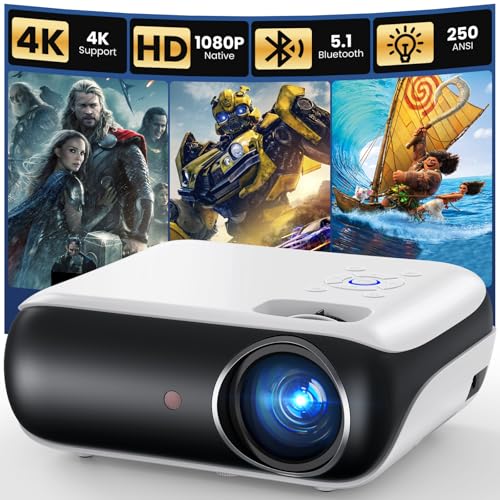
Pros
- Native 1920x1080 panel resolves fine text sharper than typical 720P units at this tier
- Bluetooth 5.1 output enables private headphone listening without a separate audio transmiter
- Compact 4.5 pound body with tripod, ceiling, and desktop mounting flexibility
Cons
- Limited owner feedback at time of writing, long-term reliability signals are minimal
- Brightness in lumens, contrast ratio, and light source are not specified in the listing
- No built-in WiFi, Google TV, or native streaming apps, an external dongle is required
The HAPPRUN H1 is an entry-level portable home projector with a native 1920x1080 panel and Bluetooth 5.1 audio output. At 4.5 pounds and 9.3 x 8.1 x 3.5 inches, it targets casual buyers who want a bedroom, dorm, or backyard movie setup without committing to a dedicated home theater budget.
The native 1080P panel is the headline spec, avoiding the upscaled 720P hardware common at this price tier. Brightness, contrast ratio, and light source are not specified, so expect performance typical of budget portable projectors: usable in fully dark rooms, washed out under any ambient light. The 200-inch maximum image is an optical ceiling, not a comfortable viewing target.
Owner-facing data is thin at time of writing, so long-term reliability signals are limited. The unit lacks Google TV and built-in WiFi streaming, so cable-free casting requires a Fire Stick, Chromecast, or wired HDMI source. iPhone and Android mirroring both need adapters that ship separately, adding cost and cable clutter to any phone-first workflow.
Buy this if you need a cheap secondary projector for dark bedrooms, kids' rooms, or occasional backyard use paired with a streaming stick. Skip this if you plan daytime viewing, want native app support without an external dongle, or need accurate color and higher refresh rates for gaming on PS5 or PC.
Resolution and Display: Native 1920x1080 panel, rated to project up to a 200-inch image. Lumens, contrast ratio, HDR support, and light source (LED versus lamp) are not specified in the listing, which is common for budget projectors at this tier and worth confirming with the seller before purchase.
Audio and Connectivity: Bluetooth 5.1 for output to external speakers or headphones, plus built-in stereo drivers of unspecified wattage. HDMI input supports Fire TV Stick, Chromecast, and PS5 pass-through. WiFi, native streaming apps, and Google TV are explicitly absent, so all smart features route through an external dongle.
Physical Footprint: Dimensions measure 9.3 x 8.1 x 3.5 inches at 4.5 pounds, small enough for a backpack side pocket or nightstand placement. White chassis. Ceiling, desktop, and tripod mounting are all supported, though tripod thread size and ceiling-mount hardware inclusion are not called out in the listing.
Phone and Console Compatibility: iPhone requires an official Lightning to HDMI adapter, not included. Android needs a MHL-capable USB-C or Micro USB to HDMI cable, otherwise Chromecast is the workaround. PS5, Fire Stick, and standard HDMI sources plug in directly without extra hardware.

Pros
- Native 1080P with HDR10 and 4K signal aceptance covers Prime Video and YouTube playback
- 600ANSI brightness rating outperforms typical sub-300ANSI outdoor projectors in mixed ambient light
- Dual HDMI with ARC and CEC lets a soundbar and consolexist without swapping cables
Cons
- Limited owner fedback at time of writing makes long-term reliability hard to verify
- 4K content is downscaled to native 1080P, so true 4K sharpness is not delivered
- Dual 10W speakers and Dolby decode are adequate outdoors but weaker than a dedicated soundbar
The WiMiUS P62 Pro is a mid-range smart outdoor projector built around a native 1080P panel with 4K signal acceptance, HDR10, and a claimed 600ANSI brightness. It targets backyard movie viewers and casual living-room users who want built-in Prime Video and YouTube without ading a Fire TV or Chromecast dongle.
The defining feature is the smart OS with an app store plus WiFi 6, AirPlay, and Miracast. For1080P streaming outdoors after dusk, 600ANSI is workable on a 80 to 120 inch scren based on category norms, though slightly lit patios will push it toward the High picture mode. Auto focus and auto keystone handle quick tripod repositioning.
Trade-offs are typical at this tier. 4K labeled content is downscaled to 1080P, so buyers expecting true UHD detail will be disappointed. The dual 10W speakers with Dolby decode are fine for casual viewing but benefit from HDMI ARC to a soundbar or Bluetooth 5.2 headphones. Owner feedback is limited at time of writing, so long-term panel and lamp behavior is unverified.
Buy this if you want a plug-and-play outdor projector with native streaming aps, WiFi 6, and dual HDMI for a console plus soundbar. Skip this if you need genuine 4K resolution, cinema-grade contrast, or a documented track record from established owner reviews.
Panel and Image: Native 1080P resolution with 4K signal support and HDR10 decoding. Rated 600ANSI lumens with High and Standard picture modes. Zoom range is 50 to 100 percent, and auto focus plus auto keystone with obstacle avoidance and screen alignment handle setup on tripod,ceiling, or wall.
Connectivity: Two HDMI inputs, with HDMI 1 suporting CEC and HDMI 2 supporting ARC and CEC, two USB ports, a 3.5mm audio output, and top control buttons. Wireless is WiFi 6 with AirPlay for iOS and Miracast for Android and Windows, plus two-way Bluetooth 5.2 for speakers or headphones.
Audio: Dual 10W Hi-Fi speakers with Dolby audio decode and AI sound balancing. Two-way Bluetooth 5.2 allows the unit to act as a standalone speaker or output to external Bluetooth audio. HDMI ARC provides a clean path to soundbars or AV receivers.
Mounting and Support: Four M5 screw holes on the base plus a center M6 thread for tripods and ceiling mounts. Coverage includes a 2-year money-back guarantee, 3-year repair coverage, and lifetime technical support per the listing. Carrying case is not included.

Pros
- Native Roku TV OS avoids the sluggish Android launchers common at this projector tier.
- Auto focus and auto keystone reduce setup time for outdoor or renter-friendly use.
- Bluetooth 5.2 suports low-latency wireless audio to headphones or a portable speaker.
Cons
- Limited owner feedback at time of writing, no verified review count to validate longevity.
- Dual 5W speakers and Dolby Audio branding typical at this tier, external audio recommended for large rooms.
- Brightness in nits or ANSI lumens not specified, likely constrains use to darkened rooms.
The Aurzen Roku TV Smart Projector is a budget-tier portable 1080P FHD unit weighing about 4.65 pounds, targeted at casual buyers who want a plug-and-play streaming projector for movie nights, sports viewing, and backyard use rather than a permanent ceiling-mounted home theater install.
The defining feature is the integrated Roku TV platform, which sidesteps the cluttered forked-Android interfaces typical in sub-tier projectors. Combined with auto focus and auto keystone, setup is genuinely quick. Projectors in this class typically deliver 200to 400ANSI lumens, so expect best results in a fully darkened room.
Trade-offs at this tier are predictable. Brightness, contrast ratio, throw distance, and native panel type are not specified in source data. Dual 5W speakers with Dolby Audio branding are adequate for a small room but will struggle outdoors, so Bluetooth 5.2 pairing to a portable speaker is worth planing. Owner feedback is not yet established.
Buy this if you want a lightweight, Roku-driven portable projector for casual 1080P streaming in a dark room or backyard after sunset. Skip this if you need daytime viewing, a fixed 4K home theater, or verified brightness and contrast figures before committing.
Resolution and Image: Native 1080P Full HD output with a stated projection range of 60 to 150 inches. Auto focus and auto keystone correction handle alignment automatically. Brightness inANSI lumens, contrast ratio, and throw ratio are not specified, so plan for a controlled-light environment.
Platform and Streaming: Roku TV is built in and requires a free Roku account plus internet activation. Supports Netflix, Prime Video, Hulu, YouTube, and Roku Channel natively. AirPlay mirroring and Apple TV integration are supported, along with Android device casting.
Connectivity: Dual-band WiFi covering 2.4GHz and 5GHz for streaming headroom. Bluetooth 5.2 for wireless headphones or speakers. Voice control integrates with Alexa, Google Assistant, Apple HomeKit, and Siri. Specific HDMI or USB port counts are not listed in source data.
Audio and Power: Dual 5W internal speakers with Dolby Audio branding. Power input 100 to 240V AC at 50/60Hz. Unit weight is 4.65 pounds in white finish. Battery capacity is not specified, so treat this as an AC-tethered portable rather than cordless.
Who this guide is for
This is for people who want big-screen movies at home without dropping four figures on a dedicated projector and a light-controlled room. Maybe you’re setting up a bonus room, a bedroom ceiling mount, or a backyard screen for summer nights. You care more about a watchable, immersive picture than about chasing reference-grade color accuracy. If that’s you, everything here fits.
It skips the $2,000-plus tri-laser and DLP heavyweights aimed at true home-theater rooms with blackout curtains. Those are a different conversation. It also skips ultra-short-throw units that sit inches from the wall, since they carry a big price premium. What’s left is the practical middle: portable and mid-range LED and LCD projectors that punch above their cost for movie nights.
What to look for in a movie projector
Brightness comes first, but read it carefully. Cheap projectors quote “lumens” that don’t match ANSI standards, so a listed 15,000 might behave like 400 real ANSI lumens. For a dim room, 300 to 500 ANSI lumens looks great. For a room with some ambient light, you’ll want more, and for true daylight, no affordable projector wins. Native resolution matters too. Native 1080p is the honest baseline for movies; treat “4K support” as a signal-compatibility note, not real 4K pixels.
Contrast decides how deep your blacks look, which is where movies live. Auto focus and keystone correction save you real setup pain, especially if you move the unit around. Built-in streaming apps, WiFi, and Bluetooth let you skip extra boxes, though a dedicated Fire Stick or Roku often beats a projector’s built-in OS. And don’t ignore the throw ratio, since it controls how far back you need to sit for your target screen size. Small room? Check that number before you buy.
How we evaluated
We researched a broad field of current movie projectors across the sub-$400 range, weighing owner reports, brightness claims against real-world feedback, and the honesty of each spec sheet. Picks had to be in stock, hold a solid rating from a meaningful number of buyers, and deliver a picture that people actually praise for film watching rather than slideshows or business decks. We cross-checked focus reliability, fan noise complaints, and how each handled a partly lit room.
Value carried heavy weight. A projector that costs half as much and lands 90 percent of the picture usually wins for a first setup. We favored native 1080p over marketing-inflated 4K labels, and we flagged where a model’s outdoor or brightness claim only holds in a fully dark space. Our goal was picks you won’t regret when the movie starts and the room isn’t pitch black.
Our top picks
Best Overall: TOPTRO Smart Native 1080p Projector
At $255.99, the TOPTRO Smart Projector hits the practical middle for movie fans who want built-in apps and a genuinely watchable picture. It carries a 4.9 rating across 82 reviews, and owners keep coming back to two things: the auto focus just works, and the native 1080p panel looks crisp on a 100-inch wall. WiFi and Bluetooth are built in, YouTube and Prime Video run on the unit itself, and Dolby Audio gives it enough punch to skip a speaker for casual nights.
The tradeoff is brightness honesty. Its “4K support” means it accepts the signal, not that it renders true 4K, and outdoor use really wants full dark to shine. It’s portable, so it’s not built for a permanent ceiling mount with heavy throw needs. Buy it if you want an all-in-one movie projector that’s easy to set up and light on fuss. For a bedroom, spare room, or occasional patio screen, it’s the one we’d grab first.
Best Budget: HAPPRUN Native 1080p Home Theater Projector
The HAPPRUN lands at just $84.94 and has the crowd to back it, with a 4.4 rating across a massive 13,447 reviews. That’s the deepest owner base here by a wide margin, which tells you the picture holds up for a lot of people. Native 1080p, a built-in speaker, and easy hookups for a Fire Stick, PS5, or HDMI source make it a plug-and-play movie box. There’s no Google TV system, so you’ll add a streaming stick, and honestly that’s the better route anyway.
Its weakness is light output. This is a dark-room projector, full stop, and it won’t fight daylight or a bright lamp. There’s no auto focus, so you’ll dial in the image by hand. For the money, none of that stings. If you’re building a first home theater on a tight budget, or you want a cheap backyard screen for summer, it’s the obvious value pick. It does the core job and doesn’t pretend otherwise.
Best Bright Room: ONOAYO ONO5Pro 2.0 4K Movie Projector
The ONOAYO ONO5Pro 2.0 runs $345.99 and leans into brightness, quoting a 3500-level rating with 60W Dolby Audio and AI auto focus. It holds a 4.6 across 364 reviews, and owners like that it fills a living room with some ambient light better than the dimmer budget units. Officially licensed streaming apps live on the projector, so it’s a real cord-cutter box for both indoor and outdoor movie nights.
The catch is that its brightness claim, like most in this class, reads higher than true ANSI output, so temper expectations for a fully sunlit space. At this price you’re paying for that extra light and the beefier 60W audio, which is a fair trade if your room isn’t a cave. Buy it if you watch in a living room with lamps on or want a patio setup that starts before full dark. It’s the brightness upgrade over the budget crowd.
Best Feature Set: Upgrad P62 Pro Smart Projector
The Upgrad P62 Pro sits at $299.99 and stacks features: built-in apps, WiFi and Bluetooth, dual-speaker Dolby audio, auto focus, and YouTube plus Prime Video on board. It earns a 4.6 rating across a strong 4,399 reviews, so the feature list isn’t hollow. For someone who wants one device that streams, focuses itself, and sounds decent without a soundbar, this covers a lot of ground in a single box.
Same honesty note applies. The “4K support” is signal acceptance, and outdoor claims want darkness to look their best. It’s a portable unit, not a fixed-install powerhouse, so heavy throw-distance rooms aren’t its home. Buy it if you value the dual-speaker audio and convenience of on-board streaming and hate juggling extra remotes. It’s the pick for a self-contained movie night with the fewest cables.
Best Streaming Value: Aurzen Roku TV Smart Projector
The Aurzen at $139.99 is the smart move for anyone already living in the Roku world. Roku TV is built right in, so you get the interface you know without a separate stick. It’s 1080p FHD with Dolby audio, auto focus and keystone, plus zoom, and it holds a 4.6 across 696 reviews. That’s a lot of streaming convenience for the price, and the built-in Roku OS beats most projector-brand app stores by a mile.
It’s a portable, dark-room-leaning projector, so bright spaces will fight it and the built-in speaker is fine rather than great. Pair it with a soundbar and you’re set. Buy it if you want the cleanest streaming experience under $150 and don’t want to mess with extra hardware. For a bedroom or dorm movie setup that just works out of the box, it’s hard to beat at this price.
Buying mistakes to avoid
The biggest one is trusting brightness numbers at face value. When a listing screams huge lumen figures with no ANSI reference, assume the real output is a fraction of that. Match the projector to your room’s light, not to the box. A second trap is expecting true 4K from a sub-$400 unit. Native 1080p is the honest ceiling here, and a sharp 1080p image beats a fake-upscaled one every time.
People also overspend on built-in operating systems that lag. If the projector’s own app store is clunky, a $30 Fire Stick or the Roku-based option fixes it instantly. And don’t forget throw distance and mounting. A projector that needs 12 feet of space won’t fit a small bedroom, and skipping a proper screen or clean white wall throws away contrast you paid for. Measure first. Then buy.
A quieter mistake is ignoring keystone and focus adjustment range. Every projector here has auto keystone, but the cheaper units struggle at extreme angles and leave the edges soft. If you plan to ceiling-mount or place the projector off to the side, check the manual keystone range before you commit, since auto correction can’t fix a badly skewed image without shrinking it. Budget for a short-throw model if your room is tight, and always leave a little zoom headroom instead of relying on digital correction alone. A spare HDMI cable of the right length saves a second trip to the store, too.
Bottom line
For most people, the TOPTRO Smart Projector is the pick that balances picture, built-in streaming, and easy setup at $255.99. It’s the one we’d hand a friend who wants big-screen movies without a research rabbit hole. If budget rules the decision, the HAPPRUN at $84.94 and its 13,000-plus happy owners is the smart entry point for a dark-room setup.
Want more brightness for a living room with lamps on? The ONOAYO steps up there. Already a Roku household? The Aurzen keeps things simple and cheap. Whatever you pick, control your room light, add a streaming stick if the built-in OS drags, and consider a proper screen. That’s how a $150 projector starts looking like a $500 one.
Common questions
Do I need a projector screen or is a wall fine?
A smooth, flat white wall works for casual movie nights and saves you money. A dedicated screen adds contrast and even color, so it’s worth it if you watch often. For a first setup, start with the wall and upgrade later if the picture bugs you.
Are these projectors bright enough for daytime?
Not really. Affordable projectors like these are built for dim or dark rooms. The ONOAYO handles some ambient light better than the rest, but none will beat direct daylight. For movies, watch after dark or in a room you can shade well.
Is “4K support” the same as a 4K projector?
No. On these units it means the projector accepts a 4K signal and displays it at native 1080p. That’s still a sharp, enjoyable image for movies. True 4K panels cost far more, so don’t pay a premium chasing that label at this price.
Do I need a separate streaming device?
Sometimes. The Aurzen’s built-in Roku and the app-loaded models can stream on their own. But projector operating systems can lag, so a cheap Fire Stick or Roku stick often gives a smoother experience. It’s an easy upgrade if the built-in apps feel slow.
Will the built-in speaker be loud enough for a room?
For a bedroom or small space, yes, especially the 60W ONOAYO. For a full living room or outdoor night, you’ll want a soundbar or Bluetooth speaker. Most of these support Bluetooth audio out, so pairing external sound is straightforward.