

Shop for PC parts long enough and you’ll hit a listing called a “barebones” system that costs oddly little and seems to be missing half the components. It’s not a scam and it’s not broken, it’s a deliberate middle ground between buying every part yourself and buying a finished machine off the shelf. Barebones confuses a lot of first-time builders because it sits in that gray zone, so it’s worth understanding exactly what you’re getting and what you’ll still need to add. If you’d rather skip the assembly entirely, our guides to the best budget prebuilt PC 2026 and the best budget prebuilt PC for 1080p gaming cover the finished-machine route.
This explainer breaks down what a barebones PC actually includes, why the format exists, who it suits, and how to decide if it fits your project. We’ll keep it plain and practical, with a clear picture of the parts you supply versus the parts that come in the box. By the end you’ll know if barebones is the smart shortcut for your next build or a detour you can skip.
The short answer
A barebones PC is a partially assembled computer that gives you the foundation and leaves the expensive, personal choices to you. Typically it ships as a case with the power supply, motherboard, and sometimes a CPU cooler already installed and wired. What’s missing is usually the processor, memory, storage, and often the graphics card, the parts where preferences and budgets vary most.
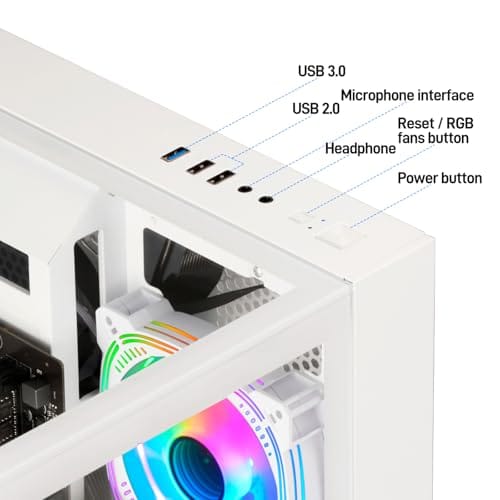
The idea is to save you the fiddly groundwork, mounting the board, routing the front-panel cables, seating the PSU, while still letting you pick the components that define performance. If assembling from a bare case sounds intimidating and a barebones kit sounds like too much work, a fully built machine like the WIWB prebuilt gaming desktop is the no-assembly alternative worth comparing against.

Pros
- Ryzen 5 3500X 6-core CPU bosts to 4.1GHz for smooth 1080p esports CPU load.
- Discrete RX 560 4GB handles DirectX 12 and Vulkan esports titles better than integrated graphics.
- 512GB SSD as bot drive keps Windows load times and app launches snappy out of box.
Cons
- Limited owner feedback at time of writing, no verified reviews to validate build quality.
- RX 560 is a legacy entry-tier GPU, skip if you want modern AAA at 1080p high.
- Ryzen 5 3500X sits on aging AM4, upgrade path is caped at Zen 3 with a BIOS update.
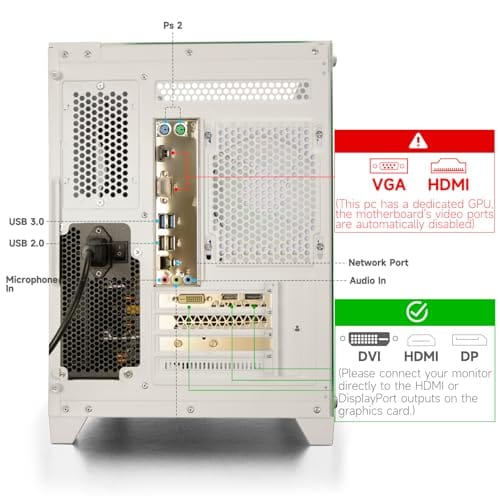
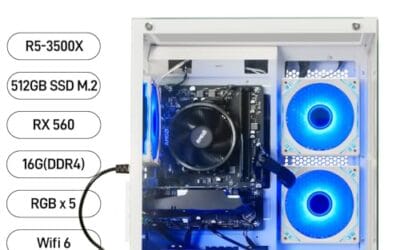
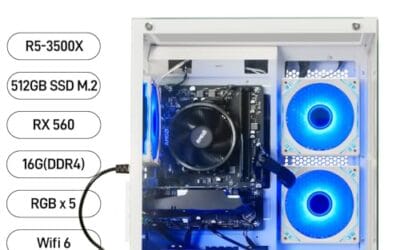
The WIWB is a budget prebuilt tower built around a Ryzen 5 3500X, RX 560 4GB, 16GB DDR4, and a 512GB SSD. It targets students, home office users, and casual gamers who want a plug-and-play box for esports at 1080p rather than a rig for current AAA titles.
The defining pairing here is the 3500X and RX 560. The 6-core, 6-thread CPU bosting to 4.1GHz is still competent for League, CS2, Valorant, and Overwatch, and typically pushes well above 100FPS at 1080p low-to-medium when paired with this GPU class. The RX 560 4GB is the bottleneck for anything heavier.
Trade-offs are typical at this tier. The RX 560 predates FSR frame generation and struggles with modern UE5 titles even at 1080p low. AM4 with a 3500X caps future CPU upgrades at Zen 3, and the case, PSU wattage, VRM phases, and included cooler are not specified, so headroom for a stronger GPU later is unclear.
Buy this if you need a cheap, pre-assembled Windows tower for schoolwork, browsing, and light esports at 1080p. Skip this if you plan to play current AAA releases, stream at 1080p60, or want a platform with a real multi-year upgrade path.
CPU workload: The Ryzen 5 3500X is a 6-core, 6-thread Zen 2 part with a 3.6GHz base and 4.1GHz boost. It stays viable for 1080p esports and light productivity like image editing and IDE work, but lacks SMT, which hurts streaming and modern CPU-bound AA titles.
GPU class and resolution fit: The RX 560 4GB GDDR5 is an entry esports card. Expect high frame rates in CS2, League, and Overwatch at 1080p low-to-medium, and playable frame rates in older AAA titles at 1080p low. 1440p and modern AA at medium are outside its envelope.
Memory and storage: 16GB DDR4 is the current baseline for gaming and multitasking, and the 512GB SSD covers Windows plus roughly 3 to 5 modern game installs. Exact DDR4 speed, dual-channel status, and SSD interface (SATA vs NVMe) are not specified.
Connectivity and upgrade path: WiFi 6 is included, and the board exposes an M.2 slot plus spare DDR4 slots for later expansion. PSU wattage, connector layout, case clearance, and waranty length beyond the stated 1-year coverage are not specified, so plan GPU upgrades cautiously.
At $569.99 with a 4.7-star rating, the WIWB prebuilt pairs a Ryzen 5 chip clocking up to 4.1GHz with an RX 560 4GB graphics card, 16GB of DDR4, a 512GB SSD, and Wi-Fi 6 in a white tower. It arrives ready to plug in, which is the opposite philosophy to barebones: zero assembly, zero part-picking, but also zero flexibility. Seeing the two side by side makes the barebones tradeoff clear.
The longer explanation
Barebones exists on a spectrum. On the light end, a kit might be just a case and power supply with a compatible motherboard pre-mounted, leaving nearly everything else to you. On the heavier end, especially with mini-PC barebones, you might get the case, board, cooler, and CPU all together, needing only RAM and an SSD to finish. The common thread is that the platform is set and the performance parts are your call.
This matters because the platform decisions, socket type, form factor, power delivery, are the ones that constrain everything else. A barebones kit locks in your motherboard and case, so your CPU choice, expansion options, and cooling limits are already partly decided. You’re trading some freedom for convenience, which is fine as long as the fixed parts match what you want to build.
How we got here
Barebones systems grew popular in the small-form-factor and mini-PC world, where fitting parts into a tiny chassis is genuinely tricky. Vendors realized that novices struggled with the mechanical basics, mounting a board in a cramped case, wiring the power button, while feeling perfectly capable of pushing in a stick of RAM or an SSD. So the format handled the hard mechanical work and left the easy, personal upgrades open.
It also served budget builders and businesses. A company could buy identical barebones units and drop in whatever CPU and memory a given role required, standardizing the fleet while controlling cost. For hobbyists, barebones offered a gentler on-ramp to building than starting with a pile of loose boxes and a screwdriver.
Why it works this way
The split makes sense because it draws the line right where difficulty and personal preference both peak. The pre-assembled parts, the case, board, and power supply, are the ones that are annoying to install and rarely differentiate one build from another. The parts you add, the CPU, RAM, and storage, are easy to fit and are exactly where you’d want to spend according to your needs and budget.
There’s a compatibility benefit too. Because the vendor chose and mounted the motherboard and power supply together, you’re spared the worry of mismatched form factors or an underpowered PSU. That guaranteed baseline is reassuring for a first build, even if it means you can’t swap those foundation parts without unwinding the kit.
It’s a division of labor that mirrors how people actually feel about building. The steps that scare newcomers, aligning standoffs, seating a stiff 24-pin cable, wiring the tiny front-panel headers, are handled at the factory. The steps that feel rewarding and low-stakes, clicking in a CPU or sliding home an SSD, stay yours. For a lot of people, that’s the exact balance that turns a daunting project into an afternoon they enjoy.
When you’d want this
Barebones fits people who want some of the building experience and savings without all the risk. A first-time builder nervous about mounting a motherboard, a small-form-factor fan who wants a proven case-and-board pairing, or someone repurposing spare RAM and an SSD from an old machine all benefit. It’s also handy for a compact office or media PC where the mini-barebones format keeps the footprint tiny.
Where it makes less sense is a high-flexibility gaming build, since locking in the board and case early limits your upgrade path. If you want full control, buying every part loose is better. And if you want zero effort, a finished prebuilt like the abytespark gaming desktop skips the assembly step entirely.
Pros
- 512GB SSD bot drive avoids the HDD bottleneck common in budget prebuilts
- RX 590 8GB VRAM buffer handles 1080p textures better than 4GB budget cards
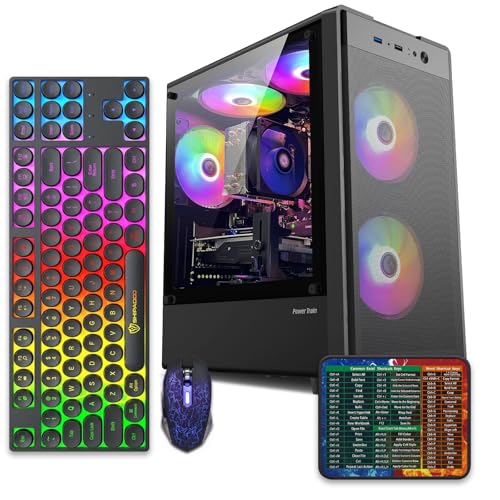
- Complete bundle with RGB peripherals means no extra spend to start using
- Genuine Windows 11 Home 64-bit preinstalled, no activation hassle out of box
Cons
- Limited owner feedback at time of writing, verify seller reputation before purchase
- Core i7-4770 is Haswell era LGA150, no upgrade path and weak IPC versus modern CPUs
- Windows 11 on 4th-gen Intel is unsupported by Microsoft and may miss feature updates
- No CD/DVD-ROM support and RAM/GPU generation limits future workload headroom
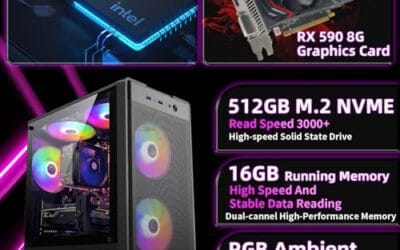
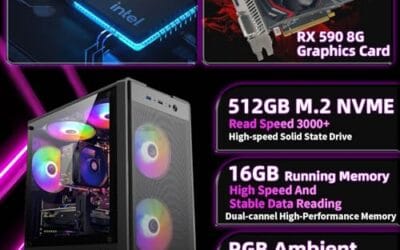
This is an entry-tier prebuilt tower built around an Intel Core i7-4770 Haswell CPU, 16GB RAM, a 512GB SSD, and an AMD Radeon RX 590 8GB GDDR5 GPU. It targets budget buyers who need a working office and light gaming PC with peripherals bundled, not enthusiasts chasing current-gen performance.
The defining feature is the RX 590 8GB paired with a 512GB SSD, an uncommon combo at this price band. Cards in this class typically handle 1080p esports titles at 60+ FPS on medium to high, matching the vendor claim for CS:GO, League of Legends, Apex, and Overwatch. Newer AA titles will need lowered settings.
Trade-offs are significant. The i7-4770 launched in 2013, so IPC, single-thread performance, and platform features like NVMe bot, PCIe Gen4, and modern USB are limited. Windows 11 runs here but sits outside Microsoft's official supported CPU list. There is no realistic CPU or socket upgrade path on LGA1150.
Buy this if you need a plug-and-play 1080p esports and office tower with keyboard, mouse, and RGB included at a low outlay. Skip this if you want current-gen platform support, sustained AA 1440p gaming, or a build with a meaningful upgrade runway.
GPU class: The AMD Radeon RX 590 8GB GDDR5 is a Polaris-refresh card roughly equivalent to a GTX 1060 6GB tier. Expect 1080p 60+ FPS in esports titles like CS:GO, Overwatch, Apex, League, and Fortnite on medium settings, matching the listing's claims.
AAA and modern titles: The vendor lists GTA V, Warzone, Hogwarts Legacy, and The Division 2. Realistically, these run at 1080p low to medium with FSR upscaling where suported.Ray tracing is unsupported on RX 590. No DLSS, no frame gen, no AV1 encode.
CPU bottleneck: The Core i7-4770 quad-core with 8threads at up to 3.9GHz will bottleneck the RX 590 in CPU-heavy titles like Warzone and Escape from Tarkov. Expect frame time inconsistency in large team fights even when average FPS looks aceptable.
Storage and RAM fit: 512GB SSD holds Windows plus 3 to 5 modern game installs before space pressure. 16GB DR3-era RAM is adequate for current esports but leaves no headroom for heavy streaming, browser tabs, and OBS NVENC alongside a game session.
At $499.99 with a 4.4-star rating, the abytespark prebuilt gaming desktop is an Intel Core i7 business and office tower that arrives fully assembled and ready to run. It represents the opposite end from barebones: no part-picking, no screwdriver, just power on. For a buyer who values simplicity over the hands-on aspect, comparing it against a barebones kit clarifies which side of the effort-versus-control line you fall on.
What to look for in a barebones kit
Check exactly which parts are included, because “barebones” isn’t a fixed definition. Read the listing carefully to see if the CPU and cooler are in the box or if you’re supplying them, and confirm the socket and memory type match the parts you plan to add. Verify the power supply’s wattage suits any graphics card you intend to install, since a weak bundled PSU can cap your GPU options.
Also weigh the case and board against your goals. If you want to add a large graphics card later, make sure the case has clearance and the PSU has the connectors. A barebones kit is only a bargain if its fixed foundation genuinely fits your plan, so match the platform to your ambitions before you commit.
Common misconceptions
People often assume barebones means broken or incomplete in a bad way, when it simply means intentionally unfinished so you can customize it. Another myth is that it’s always cheaper than a full build, which isn’t guaranteed once you add quality parts. And some think barebones is only for experts, when the format actually targets the opposite, handling the intimidating mechanical work so newcomers can finish the easy parts themselves.
Frequently asked
What parts do I still need to buy for a barebones PC?
It varies by kit, but you’ll typically supply the CPU, RAM, and storage at minimum, and often the graphics card too. Some mini-PC barebones include the processor and cooler, needing only memory and an SSD to finish. Always read the listing to see exactly what’s in the box, then match your added parts to the included socket and memory type so everything is compatible.
Is a barebones PC cheaper than building from scratch?
Sometimes, but not always. Barebones saves you the effort of sourcing and mounting the foundation parts, and it can bundle them at a fair price. Once you add a strong CPU, fast RAM, and a good SSD, though, the total can approach a full custom build. The real value is convenience and a guaranteed-compatible base, not a dramatic discount over careful part-by-part shopping.
Can I put a graphics card in a barebones system?
Usually yes, if the case has a PCIe slot with clearance and the power supply provides enough wattage and the right connectors. This is why checking the bundled PSU matters, since a low-wattage unit meant for office use may not feed a gaming GPU. Confirm the case length, slot availability, and power headroom before you plan on adding a discrete card to a barebones kit.
Is barebones good for a first-time builder?
It can be a great starting point. The format handles the trickiest mechanical steps, like mounting the motherboard and wiring the front panel, while leaving you the satisfying, low-risk parts of dropping in a CPU, RAM, and storage. You learn how a PC goes together without the full intimidation of a bare case and a table full of loose components. Just confirm the included parts suit your plan first.
How is barebones different from a prebuilt?
A prebuilt arrives fully assembled and ready to power on, with every part installed and Windows often preloaded. A barebones kit is deliberately unfinished, giving you the foundation and letting you choose and install the performance parts. Prebuilts trade flexibility for zero effort, while barebones trades a little effort for some customization and often a compatible, hassle-free base to build on.





























Write Your Review
No reviews yet. Be the first to share your experience!