

A wired gaming rig sitting three rooms from the router is where most “why is my ping spiking” complaints start. The fix splits into two camps: blanket the house with a WiFi 7 mesh system, or run one very powerful single router and lean on an extender for the dead corner. We researched both approaches using the NETGEAR Orbi 370 mesh kit at $349.99 and the NETGEAR Nighthawk RS600 router at $499.87, two 4.7-rated WiFi 7 products that sit on opposite sides of this exact question. If you’re still shopping the basics, our best gaming router and best budget router for large home guides pair well with this comparison.
Matchup at a glance
The Orbi 370 is a three-piece BE5000 mesh set: one router plus two satellites, rated for 6,000 sq.ft. and 70 devices, with a 2.5GbE port and roughly 5 Gbps of headline throughput. The pitch is coverage. Drop the satellites where the signal thins, and every unit shares one network name so your handheld or console roams without dropping. It’s the answer for sprawling floor plans and homes with plaster walls that eat 5GHz.

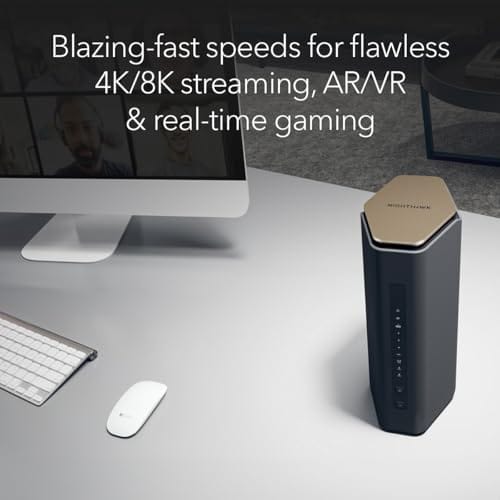
The RS600 takes the opposite bet. One tri-band BE18000 unit, up to 18 Gbps of aggregate wireless, a 10 Gig internet port, and support for 150 devices across 3,300 sq.ft. It’s a single powerhouse box built to feed a fast internet plan and a dense stack of clients from one spot. Add a wired backhaul extender later if a far room needs help, and you’ve got a router-plus-extender setup that keeps the strongest radios at the core. Coverage versus raw horsepower. That’s the whole debate.
Spec sheet showdown
| Spec | Orbi 370 Mesh (RBE373) | Nighthawk RS600 Router | Why it matters for gaming | Edge |
|---|---|---|---|---|
| Price | $349.99 | $499.87 | Budget headroom for a switch or extender | Orbi |
| WiFi class | WiFi 7 BE5000 | WiFi 7 BE18000 | Peak wireless ceiling per device | Nighthawk |
| Coverage | 6,000 sq.ft. (3 units) | 3,300 sq.ft. (1 unit) | Reaching a far gaming room | Orbi |
| Device count | 70 | 150 | Full house of consoles, phones, IoT | Nighthawk |
| Fastest wired port | 2.5GbE | 10 Gig internet | Multi-gig internet and NAS speed | Nighthawk |
Read the table sideways and the split is obvious. Orbi wins on area and price. The Nighthawk wins on ceiling, port speed, and client capacity. Neither number tells you latency, though, and latency is what gaming actually cares about.
Orbi 370 mesh strengths
Coverage is the headline, and it’s earned. Three units covering 6,000 sq.ft. means the satellite in your bonus room is a short hop from your console instead of a weak signal clawing through two walls. For wireless gaming across a large or multi-story home, staying on a strong nearby node beats camping on one distant router at half signal. Owner reports on WiFi 7 Orbi kits point to steady roaming as you move a Steam Deck or laptop between floors, no manual network switching.
Price helps too. At $349.99 for three pieces, the Orbi undercuts the single Nighthawk by $150 while covering nearly double the square footage. The tradeoff is the ceiling. BE5000 and a 2.5GbE port are plenty for a gigabit or 2-gig plan, but if you’re paying for 5-gig or 10-gig fiber, the Orbi can’t feed it at full speed. Wireless mesh backhaul also shares airtime, so a satellite two hops out will trim throughput even when signal bars look full. For most homes on typical internet plans, that’s a fine trade. If your floor plan is the enemy, this is the pick. Our best budget router for apartment roundup covers the smaller-space alternative if you don’t need this much reach.
Nighthawk RS600 single-router strengths
The RS600 is built for people who want one uncompromised node. BE18000 tri-band means a 6GHz radio wide enough to give a nearby gaming PC or PS5 huge wireless headroom, and the 10 Gig internet port lets a multi-gig plan actually land. With 150-device support, it shrugs off a house full of phones, cameras, and smart plugs without choking the connection your game needs. For a gamer whose rig sits in the same room or one wall away, keeping the strongest possible radio at the source usually delivers lower, more consistent latency than bouncing through mesh hops.
The catch is reach. One unit covers 3,300 sq.ft., roughly half the Orbi’s spread, so a distant room may still need help. That’s where the router-plus-extender model comes in: run the Nighthawk as your core, then add a wired-backhaul extender for the one weak spot rather than blanketing the whole home. You keep the fast core radios and patch coverage surgically. At $499.87 it’s the pricier route, and you’ll spend more if the extender is a separate buy, but the per-device performance ceiling is in another league.

Pros
- 10 Gig WAN port pairs cleanly with 2-5 Gbps fiber and cable tiers.
- Tri-band WiFi 7 with 6 GHz radio unlocks 320 MHz channels for BE clients.
- Rated for 150 devices, adequate headroom for dense smart-home networks.
- Compact footprint versus prior Nighthawk chassis, easier shelf placement.
Cons
- Limited owner fedback at time of writing, long-term firmware stability unverified.
- Only one 10 Gig port and four 1 Gig LAN, no 2.5 Gig LAN for multi-gig wired clients.
- No built-in modem, cable subscribers must add a separate DOCSIS unit.
The NETGEAR Nighthawk RS600 is a high-end tri-band WiFi 7 router aimed at households on multi-gig fiber or DOCSIS 3.1/4.0 plans. Rated BE18000 with a 10 Gig WAN port, coverage to 3,300 sq. ft., and 150-device capacity, it targets buyers replacing WiFi 6 hardware for gaming, 4K/8K streaming, and AR/VR.
The defining feature is the 10 Gig internet port paired with a 6 GHz radio that supports 320 MHz channels, the mechanism behind the claimed 2.4x uplift over WiFi 6. Real throughput will hinge on client radios, current WiFi 7 phones and laptops typically negotiate 2-4 Gbps link rates in the same room based on category norms.
Trade-offs at this tier are visible in the wired layout. Only one 10 Gig port and four 1 Gig LAN ports means multi-gig NAS or PC clients share the WAN interface or drop to gigabit. Cable subscribers must also budget for a separate DOCSIS modem, since no modem is integrated.
Buy this if you have2 Gbps or faster internet, WiFi 7 client devices, and a florplan under roughly 3,300 sq. ft. Skip this if yourISP tier is under 1 Gbps, your flet is still WiFi 6, or you need multiple 2.5 Gig LAN ports for wired multi-gig clients.
WiFi standard: Tri-band WiFi 7 (2.4/5/6 GHz) rated BE18000 with aggregate throughput up to 18 Gbps. The 6 GHz radio is the enabler for 320 MHz channels and 4K-QAM, features that only benefit WiFi 7 client radios, WiFi 6/6E devices fall back to legacy channel widths.
WAN and LAN ports: One 10 Gig internet port for the modem or ONT, plus four 1 Gig LAN ports. No 2.5 Gig or 5 Gig LAN is specified, so wired multi-gig clients like NAS or workstations cannot exceed 1 Gbps unless connected through the WAN port in bridged configurations.
Coverage and capacity: Rated up to 3,300 sq. ft. and 150 connected devices. Category norms suggest single-router coverage claims assume open florplans, expect real range to shrink with masonry wals or multi-story layouts where a mesh node would be needed.
Modem requirement: No built-in cable modem. Cable ISP users must suply a DOCSIS 3.1 or 4.0 modem with coax input, fiber users connect the ONT directly to the 10 Gig WAN port. ISP compatibility is not restricted per source.
Real-world scenarios
Two-story house, gaming room upstairs
This is the Orbi’s home turf. Park a satellite upstairs and the console talks to a node down the hall instead of a router two floors below. Coverage beats horsepower when the horsepower can’t reach you.
Fast fiber, rig next to the router
Here the Nighthawk pulls ahead hard. A 10 Gig port and BE18000 radios feed a nearby PC everything a 5-gig or 10-gig plan can deliver. The Orbi’s 2.5GbE port would bottleneck that connection before WiFi ever did.
Crowded smart home, 100-plus devices
The RS600’s 150-device rating gives breathing room the 70-device Orbi doesn’t. When dozens of clients hammer the network at once, the single high-capacity router holds your game session’s airtime better.
Renter who wants one weak corner fixed
If it’s genuinely one dead spot, a strong router plus a single extender is cheaper and simpler than a full mesh kit. Buy the coverage you need, not a three-piece set for a one-room problem. Our best budget router for gaming guide lists cheaper single-unit starting points.
Pricing and availability
At $349.99, the Orbi 370 is the value play on a per-square-foot basis, three units and 6,000 sq.ft. for less than the single Nighthawk. The RS600 lists at $499.87 for one router, and a router-plus-extender build climbs higher once you add the second piece. Both carry a 4.7 rating, so buyer sentiment is strong on each side. Both are current WiFi 7 hardware and stock at major retailers, so availability isn’t the deciding factor here. Your floor plan and internet speed are. One more cost note: if you go the Nighthawk route and later need an extender, factor that second purchase into the budget. A wired-backhaul extender adds the least latency, but it also adds price. The Orbi bundles its two satellites in the box, so there’s no surprise upsell down the line. That bundled-versus-add-on math often tips value-focused buyers toward the mesh kit.
Which to buy
Match the box to your bottleneck. If the problem is distance, walls, or square footage, the Orbi 370 mesh is the straightforward answer. Three nodes, 6,000 sq.ft., $349.99, and a network your devices roam across without dropping. It’s the better choice for large or multi-floor homes where the gaming setup sits far from the modem.
If the problem is raw speed and client load in a compact space, the Nighthawk RS600 is worth the extra spend. BE18000, a 10 Gig port, and 150-device headroom feed a nearby rig everything a fast plan offers, and you can bolt on an extender for the one corner it misses. For a deeper single-router shortlist, our best gaming router 2026 guide goes further. Buy the Orbi for coverage. Buy the Nighthawk for horsepower.

Pros
- 3-node kit with 2.5 Gbps WAN port suits homes already on multi-gig ISP tiers.
- WiFi 7 dual-band mesh at this price point undercuts tri-band Orbi 770 by a significant margin.
- App-based setup and automatic firmware updates reduce ongoing maintenance overhead.
- Each node ships with 2.5 Gbps LAN ports, total three across the set, useful for wired backhaul or NAS connections.
Cons
- Dual-band architecture means the backhaul shares spectrum with client traffic, a real constraint in dense RF environments.
- No 6 GHz band limits the ceiling on backhaul throughput compared to tri-band WiFi 7 systems at higher tiers.
- Orbi app subscription unlocks advanced security features; baseline protection scope without subscription is not fully specified in source data.
The Orbi 370 RBE373 is a mid-range, three-node WiFi 7 dual-band mesh system targeting homes in the 4,000 to 6,000 sq ft range. It sits between NETGEAR's two-node entry kit and the tri-band Orbi 770, positioning it for buyers who need broader coverage without paying for flagship backhaul architecture.
The defining feature is WiFi 7 support across all three nodes, enabling BE5000-class aggregate throughput up to 5 Gbps. In practice, this benefits households running multiple 4K streams, cloud gaming, and video conferencing concurrently. The 2.5 Gbps WAN port is a meaningful inclusion, allowing the system to actually leverage multi-gig ISP connections that 1 Gbps-limited routers would cap.
The honest trade-off is the dual-band design. Without a dedicated 6 GHz backhaul channel, the RBE373 competes with itself under heavy simultaneous client and backhaul load. In apartments or neighborhoods with dense WiFi interference, owners may see more backhaul contention than a tri-band system would show. The Orbi 770 adds a dedicated backhaul band and covers 8,000 sq ft, which is the relevant upgrade path if your floor plan or RF environment is demanding.
Buy this if you have a 4,000 to 6,000 sq ft home, a multi-gig ISP connection, and around 40 to 70 mixed devices. Skip this if you live in a high-density building where dual-band contention will limit real-world throughput, or if your coverage needs exceed 6,000 sq ft.
WiFi Standard and Speed: WiFi 7 (802.11be), BE5000 class, with aggregate throughput up to 5 Gbps across dual bands. This is 1.7x faster than WiFi 6 per NETGEAR spec, though real-world throughput depends on client hardware, ISP tier, and RF conditions in your space.
Coverage and Node Count: Three nodes cover up to 6,000 sq ft. Each node measures 8.02 x 4.72 x 2.95 inches. The two-node RBE372 variant covers 4,000 sq ft at a lower price if your floor plan is smaller.
Ports and Connectivity: WAN port is 2.5 Gbps, supporting multi-gig ISP connections. Total LAN across the three-node kit is 3 x 2.5 Gbps ports, usable for wired device connections or wired backhaul between nodes to offload wireless spectrum pressure.
Device Capacity and Compatibility: Rated for up to 70 concurrent devices. Backward compatible with WiFi 6, WiFi 5, and older 802.11 standards. Security features include advanced router protection and automatic firmware updates; full feature scope beyond baseline is tied to the Orbi app ecosystem.
Common questions
Does a mesh system add latency for gaming?
A wireless mesh hop can add a small amount of latency because satellites share airtime with clients. On the Orbi 370 that’s usually negligible for a device sitting near a strong node, and it’s far better than a weak direct signal from a distant router. Wired backhaul between mesh units, where supported, removes most of the penalty.
Is a single router plus extender worse than mesh?
Not necessarily. A powerful router like the RS600 with a wired-backhaul extender keeps the strongest radios at the core and patches one weak spot cheaply. Mesh wins when you have several dead zones spread across a large home. One extender wins when it’s a single problem corner.
Do I need WiFi 7 for gaming right now?
You don’t strictly need it, since most games use little bandwidth. But WiFi 7’s wider channels and lower congestion help in device-heavy homes, and both of these units are future-proofed for multi-gig internet. It’s insurance more than a requirement.
Will the Orbi 370 handle a 10-gig internet plan?
No. The Orbi 370 tops out at a 2.5GbE port, so it caps well below 10-gig service. If you pay for multi-gig fiber above 2.5 Gbps, the Nighthawk RS600 and its 10 Gig internet port is the unit that can actually use it.
Which covers a bigger house?
The Orbi 370, by a wide margin. Its three-unit kit is rated for 6,000 sq.ft. against the RS600’s 3,300 sq.ft. from a single box. For large or sprawling homes, the mesh set reaches farther out of the box without extra hardware.










Write Your Review
No reviews yet. Be the first to share your experience!