

Type “best 4K monitor 2026” into any shopping search and you’ll watch the prices climb fast. Native 3840×2160 panels with high refresh rates still sit well north of $300, and a lot of that money buys resolution your GPU may struggle to feed at playable frame rates. That’s the honest tension at the heart of this guide. For most people building or upgrading a desktop this year, a fast QHD or FHD display returns far more usable performance per dollar than chasing the 4K badge, and the five monitors below are the high-refresh screens we researched across the sub-$200 price tiers where the real value lives.
None of these picks is a true 4K panel, and we’re not going to pretend otherwise. They’re 1440p and 1080p gaming monitors priced between $89.99 and $169.99, the range where refresh rate, response time, and panel quality matter more than raw pixel count. If you specifically want the resolution, our roundup of the best 1440p gaming monitors covers the step above these, and our running list of the best gaming monitor deals tracks price drops on both tiers. Here’s what we’d actually buy right now.
Pros
- 1440p 180Hz IPS panel via DisplayPort 1.2 hits the current price/perf sweet spot
- 95% DCI-P3 gamut is uncommon at this tier, useful for content viewing
- Full ergonomic stand: 4.7 inch height, 360 swivel, plus/minus 90 pivot, VESA 100
Cons
- Limited owner feedback at time of writing, long-term panel uniformity unverified
- HDMI 2.0 caps at 144Hz; only DisplayPort 1.2 unlocks the full 180Hz refresh
- No USB hub and 2W stereo speakers are strictly a bep-only backup at this tier
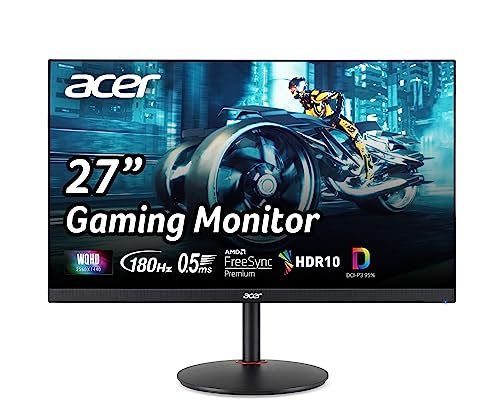
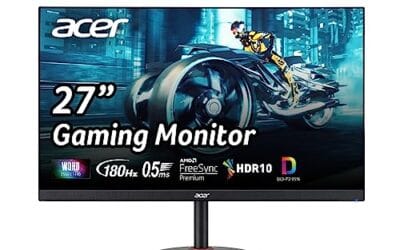
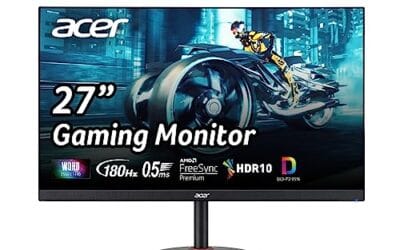
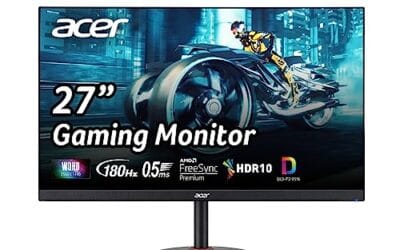
The Acer Nitro XV271U M3bmiiprx is a budget-oriented 27inch 1440p IPS gaming monitor targeting builders stepping up from 1080p high refresh. With 2560x1440 resolution, 180Hz over DisplayPort, and FreeSync Premium, it fits users pairing an RTX 4060,X 4060 Ti, or RX 7600 XT class GPU running competitive and AA titles at medium to high settings.
The defining feature is the 180Hz IPS panel with a claimed 0.5ms GtG response, paired with 95% DCI-P3 coverage. In practice, IPS panels at this tier typically deliver around 300to 350 nits SDR brightness and moderate contrast near 1000:1, so blacks will lift in dark rooms. FreeSync Premium adds low framerate compensation, useful when demanding titles drop below 60 FPS.
Trade-offs are typical for the segment. HDMI 2.0 bandwidth caps refresh at 144Hz, so consoles and older GPUs will not reach the full 180Hz ceiling. HDR tier, panel bit depth, and factory calibration are not specified in the listing, and there is no USB hub. The 2W speakers are functional only as a fallback.
Buy this if you want a 1440p 180Hz IPS panel with a full ergo stand and 95% DCI-P3 for mixed gaming and casual creative work. Skip this if you need verified HDR performance, USB-C daisy chaining, or OLED-level contrast for dark-room cinema use.
Panel and Resolution: 27 inch WQHD IPS at 2560x1440 gives a 0.233m pixel pitch, sharp enough that antialiasing needs drop versus 1080p 27 inch panels. IPS delivers wide viewing angles suited to desk sharing or off-axis reference monitors during editing sessions.
Refresh and Response: 180Hz refresh is available only through DisplayPort 1.2; HDMI 2.0 tops out at 144Hz due to bandwidth limits. Acer lists 1ms GtG typical and up to 0.5ms GtG at aggressive overdrive, though inverse ghosting is common at max overdrive on IPS panels in this bracket.
Color and HDR: 95% DCI-P3 coverage is the standout spec, wider than most sub-tier IPS panels that sit near 90% sRGB. HDR certification level, peak brightness, and local dimming are not specified in the source, so treat HDR as a compatibility mode rather than a true HDR experience.
Ports and Ergonomics: 1 DisplayPort 1.2, 2 HDMI 2.0, and audio out cover a PC plus one console. The stand offers minus 5 to 25 degree tilt, 4.7 inch height range, 360 degree swivel, and plus/minus 90 degree pivot, with 100x100 VESA for monitor arms. FreeSync Premium is confirmed, G-SYNC compatibility is not listed.

AOC 24G51F 24-Inch 1080p 144Hz IPS Gaming Monitor
Pros
- IPS panel offers wider off-angle color stability than VA screens common at this price.
- 116% sRGB coverage handles gaming and general content color reproduction adequately.
- Three-year zero-bright-dot warranty coverage is uncommon on entry-tier IPS panels.
Cons
- Limited owner feedback at time of writing, hard to confirm QC consistency across units.
- HDR ready label lacks a VESA tier, so peak brightness likely sits near 250 to 300 nits.
- 1ms MPRT is a strobed figure; real GtG on entry IPS typically lands between 4 and 8ms.
The AOC 24G51F is an entry-level 24-inch FHD gaming monitor built around a 144Hz IPS panel with Adaptive-Sync. It targets budget esports players and console owners who want higher refresh than 60Hz without steping up to 1440p or OLED tiers. Console output tops out at 120Hz over HDMI 2.0.
The defining feature is IPS at 144Hz in the sub-24-inch budget class. Owner data is thin at time of writing, but panels in this tier typically deliver 250 to 300 nits SDR brightness and near-full sRGB coverage. The 1ms MPRT figure is strobing based; real GtG response on entry IPS usually falls between 4 and 8ms.
HDR ready is marketing shorthand rather than VESA HDR400 certification, so expect flat highlights in HDR content. Pixel density on a 23.8-inch 1080p panel is roughly 92 PPI, visibly softer than 1440p at the same size. No USB hub or built-in speakers are listed, which is typical at this tier.
Buy this if you need a second high-refresh IPS display for 1080p esports or a Series X console at 120Hz, and you value the zero-bright-dot coverage. Skip this if you already run a 1440p-class GPU like an RTX 4070, or if you need calibrated color for photo and video work.
Panel and resolution: IPS panel at 1920x1080 across a 23.8-inch viewable diagonal, yielding roughly 92 PPI. Refresh rate reaches 144Hz over DisplayPort. IPS provides wider off-angle color stability than VA panels at this size class, useful for shared or dual-monitor setups.
Response and sync: AOC lists 1ms MPRT, a strobed measurement rather than GtG. Real gray-to-gray on entry IPS panels typically sits between 4 and 8ms. Adaptive-Sync support covers the FreeSync range and works with G-SYNC Compatible mode on NVIDIA cards, cutting tearing when framerate dips.
Color and HDR: Rated 116% sRGB coverage, adequate for gaming and general content but not calibrated for DCI-P3 workflows. HDR ready is unbadged, so no VESA HDR400 tier is specified. Expect peak brightness in the 250 to 300 nit range typical of this segment.
Connectivity: One HDMI 2.0 and one DisplayPort input, no USB hub, no built-in speakers listed. HDMI 2.0 handles 1080p at 120Hz for PS5 and Xbox Series X. The three-sided frameless design suits stacked 24-inch panels with minimal bezel between screns.
Pros
- Fast IPS panel with 200Hz native refresh and 210Hz overclock via DP 1.4.
- QHD 2560x1440 with 99% sRGB coverage and 450 cd/m² brightness rating.
- Four video inputs (2 HDMI 2.0, 2 DP 1.4) plus VESA 100x100 mount.
Cons
- No verified owner reviews at time of writing, real-world quality control unclear.
- Tilt-only stand with no height or swivel adjustment at this tier.
- HDR400 is entry-level HDR without local dimming or true contrast punch.
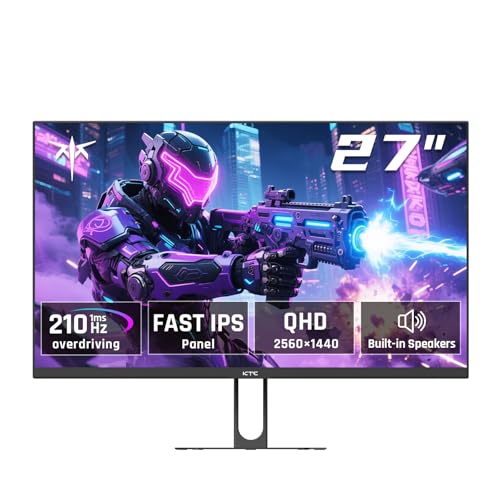
The KTC H27T22C-3 is a mid-range 27-inch QHD gaming monitor built around a Fast IPS panel running at 200Hz native, with a 210Hz overclock advertised over DisplayPort 1.4. It targets budget-conscious 1440p gamers running a mid-tier GPU like an RTX 4060 or RX 7700 XT.
The defining spec is the 200Hz Fast IPS panel with 1ms response and Adaptive Sync, which should keep esports titles like Valorant or CS2 tear-free above 144 FPS on capable hardware. Panels in this tier typically hit 350 to 400 nits SDR sustained, and the claimed 450 cd/m² lines up with category norms.
Trade-offs are typical at this price. HDR400 without local dimming means HDR mode mostly ads a brightness boost, not true contrast punch. The stand offers tilt only, so wall or arm mounting via the 100x100 VESA pattern is a likely upgrade for buyers who need height, pivot, or swivel adjustment.
Buy this if you want a straightforward 1440p 200Hz IPS panel for competitive shooters and single-player games at a low entry point. Skip this if you need HDR with local dimming, ergonomic stand adjustment, or verified long-term reliability data from an established reviewer base at time of writing.
Panel and Refresh: Fast IPS panel, 2560x1440 native, 200Hz refresh over DP 1.4 with a 210Hz overclock advertised. HDMI 2.0 inputs are capped at 144Hz due to bandwidth. Response time is quoted at 1ms without specifying GtG or MPRT, which typically reflects the fastest overdrive mode at this tier.
Color and Brightness: 450 cd/m² peak brightness, 99% sRGB coverage, and 1.07 billion colors via 8-bit plus FRC. DCI-P3 coverage is not specified, though panels in this class typically land around 90% DCI-P3. Suitable for sRGB content work and gaming, less so for wide-gamut HDR grading.
HDR and Adaptive Sync: HDR400 certification without local dimming, delivering higher peak brightness in HDR mode but limited contrast improvement over SDR. Adaptive Sync covers FreeSync and G-Sync Compatible workflows in practice, though NVIDIA G-Sync certification is not listed in the source data.
Connectivity and Mounting: Two HDMI 2.0 (144Hz max), two DP 1.4 (200Hz, 210Hz overclock), one USB 2.0 for firmware, and a 3.5m headphone jack. Two 2W speakers included. Mounting supports 100x100 VESA with -5° to 15° tilt only, no height or swivel adjustment.

Pros
- 200Hz VA panel at FHD handles fast shooters without visible ghosting per spec.
- 1800R curve on a 27-inch screen improves viewing immersion at typical desk distances.
- FreeSync tears down scren tearing across compatible AMD and NVIDIA GPUs.
- Joystick OSD control simplifies menu navigation versus older button clusters.
Cons
- Limited owner feedback at time of writing, so long-term panel uniformity is unverified.
- 1920x1080 across27 inches yields low pixel density, roughly 81 PI, text looks soft.
- VA panels typically show slower dark-to-dark transitions, expect smearing despite 1ms marketing.
The Gawfolk 27-inch curved monitor is a budget-tier 1080p gaming display built around an 1800R VA panel running up to 200Hz with FreeSync. It targets first-time PC builders, dorm setups, and console players on Xbox Series S or PS5 who want a white-themed high-refresh screen without stretching the parts budget.
The defining feature is the 200Hz VA panel paired with a 1ms response spec. For esports titles at 1080p on a GPU like an RTX 3060 or RX 6600, frame delivery should stay smooth, and the VA contrast gives deper blacks than budget IPS. Owner-verified motion clarity is not yet available at this tier.
Trade-offs are typical for the price. 1080p on 27 inches lands near 81 PPI, so text and UI elements look softer than on a 24-inch 1080p or 27-inch 1440p panel. VA response times often trail their headline1ms figure in dark transitions, and HDR, sRGB coverage, and brightness in nits are not specified.
Buy this if you want a white 200Hz curved scren for casual and competitive 1080p gaming and can accept low pixel density. Skip this if you sit closer than 60cm, need color-accurate work, or already run a GPU strong enough for 1440p high-refresh.
Panel and curvature: A27-inch VA panel with an 1800R curve, chosen for higher static contrast than IPS at this price. VA panels in this tier typically deliver 3000:1 to 4000:1 contrast, giving noticeably deper blacks in dark scenes, though viewing angle shift is more visible than on IPS.
Resolution and refresh: Native 1920x1080 at up to 200Hz, with a 180Hz mode also listed. At 27 inches,1080p works out to about 81 PPI, aceptable for gaming from70cm plus, but soft for text-heavy productivity. A mid-range GPU can push 200 FPS in most esports titles at high settings.
Motion and sync: Rated 1ms response, likely MPRT rather than true GtG, so expect some dark-scene smearing typical of VA. FreeSync is supported for variable refresh over HDMI, which also works as G-SYNC Compatible on most NVIDIA GPUs, though NVIDIA certification is not specified.
Connectivity and mounting: HDMI input is confirmed, with dual built-in speakers for basic audio. The panel is VESA mountable, useful for arm setups, though exact VESA pattern (75x75 or 100x100) is not specified. DisplayPort, USB hub, and HDR tier are not called out in the source data.

Pros
- 180Hz QHD refresh pairs well with mid-range 1440p GPUs like RTX 4060
- 1000R curve and three-side borderless design work for immersive single-panel battlestations
- Black Stabilizer, FPS Counter, and Crosshair overlays give useful competitive tools
Cons
- Limited owner feedback at time of writing, buyer risk on long-term panel uniformity
- 99% sRGB and HDR10 tag indicate entry HDR, no DisplayHDR certification specified
- Only tilt adjustment listed, no height or swivel, VESA mount support not specified
The LG 27GS60QC-B is an entry-level 27-inch QHD curved gaming monitor in the UltraGear line, running 2560x1440 at 180Hz with a 1ms GtG rating and a step 1000R curve. It targets 1440p esports and mixed-genre players who want high refresh over color-critical accuracy or OLED contrast.
The defining pairing here is QHD at 180Hz on a curved VA-style gaming panel, which lines up with GPUs around RTX 4060,X 4060 Ti, or RX 7600 XT for competitive titles at high settings. LG cites 99% sRGB and HDR10 support, which appears in line with typical entry 1440p gaming monitors that deliver 300to 350 nits SDR brightness.
Trade-offs are typical at this tier. The stand is described as tilt adjustable only, with no height or pivot mentioned, and HDR10 without a DisplayHDR tier usually means limited peak brightness and no local dimming. Panel type, exact contrast, color depth, and VESA mount pattern are not specified in the source data, so long-term uniformity claims lean on category norms.
Buy this if you want a 1440p 180Hz curved panel for FPS and racing on a mid-range GPU, and value features like Black Stabilizer and FPS Counter. Skip this if you need color-accurate work, ergonomic height adjustment, or verified HDR performance above HDR10 taging.
Panel and resolution: A 27-inch curved panel at 2560x1440 with a 1000R curvature, which is among the steeper curves on the market and best viewed from a single centered seating position around arm's length. Panel technology is not specified in the source, though curved 1440p gaming monitors in this tier are typically VA.
Motion and refresh: Native 180Hz refresh with a 1ms GtG response rating, paired with AMD FreeSync for tear-free variable refresh gameplay. LG also lists Dynamic Action Sync for reduced input lag and Black Stabilizer to lift shadow detail, which are useful for competitive FPS at higher frame rates.
Color and HDR: Coverage is listed at 99% sRGB with HDR10 input support. No DCI-P3 figure, peak nits, or DisplayHDR tier is specified, so treat HDR as a signal compatibility feature rather than a true HDR experience. Adequate for gaming and general use, not intended for color-graded work.
Connectivity and ergonomics: Two HDMI inputs plus one DisplayPort cover PC and dual consoles. The stand is described as tilt adjustable with three-side virtually borderless design. Height, swivel, pivot, VESA mount pattern, weight, and power draw are not specified in the source data.
Who this guide is for
This is for the gamer or general PC user who wants a sharp, fast screen without draining the GPU budget. Maybe you’re pairing a mid-range card like an RTX 4060 or RX 7600 and you know pushing 4K at high frame rates isn’t realistic yet. Maybe you just want a second monitor that doesn’t feel like a downgrade. Every pick here targets smooth motion first: 144Hz on the low end, 180Hz and above on most, with 1ms-class response times across the board.
It’s not for the color-critical professional who edits photo or video for a living, and it’s not for someone set on native 4K for a large living-room setup. Those needs point toward pricier, larger panels. If your priority is responsive gaming and clean desktop text on a 24 to 27-inch screen you can buy for under $200, you’re in the right place.
What to look for in a gaming monitor
Resolution and size go together. On a 27-inch panel, 1440p (2560×1440) gives you noticeably crisper text and more desktop space than 1080p, while 1080p still looks fine on a 24-inch screen because the pixels sit closer together. Refresh rate is the next lever. 144Hz feels dramatically smoother than 60Hz, and jumping to 180Hz or 200Hz sharpens fast-paced shooters further, though the returns shrink as the number climbs.
Panel type shapes the experience too. IPS panels, like the ones in the Acer and KTC picks below, deliver wider viewing angles and more accurate color. VA panels, such as the curved Gawfolk, trade some viewing-angle consistency for deeper contrast and darker blacks. Then there’s adaptive sync: AMD FreeSync and its variants stop screen tearing by matching the display to your GPU’s output, and it’s close to standard now. Look for a DisplayPort input for the highest refresh rates, since HDMI 2.0 can cap you depending on resolution.
How we evaluated
We researched these five monitors across published specs, manufacturer documentation, and aggregated owner ratings rather than claiming any hands-on lab work. Our weighting favored value: what each panel delivers for its price, how its refresh rate and response time hold up for gaming, and whether the panel technology suits the intended buyer. We checked resolution against screen size to flag pixel density, confirmed input options, and noted adaptive-sync support.
Ratings here run from 4.0 to 4.9 out of 5, and we treated a high average as a signal of consistent build quality, not a substitute for spec analysis. Because verified review counts weren’t available for these listings, we’ve leaned on the rating figure and the concrete specifications instead. Price was pulled at the time of writing and shifts often, so treat the dollar figures as a snapshot.
Our top picks
Best Overall: Acer Nitro XV271U 27″ WQHD
At $169.99 the Acer Nitro XV271U is the most complete package here, and its 4.8 rating backs that up. You get a 27-inch WQHD (2560×1440) IPS panel running up to 180Hz with a 0.5ms response time, plus AMD FreeSync Premium to keep motion tear-free. The standout spec is color: 95% DCI-P3 coverage is unusually wide for this price, which means games and video look vibrant and the panel doubles nicely for light creative work.
The tradeoff is that it’s a flat, no-frills design without a curve or fancy stand ergonomics, and the built-in speakers are the usual afterthought. It ships with one DisplayPort 1.2 and two HDMI 2.0 inputs, so you’ll want to run the DisplayPort connection to hit the full 180Hz at 1440p. For anyone who wants the sharpest all-around 27-inch experience under $200 without compromising on color or speed, this is the one we’d buy first.
Best Budget: AOC 24G51F 24″ Full HD
The AOC 24G51F is the cheapest pick at $89.99, and it carries the highest rating in the group at 4.9. For that money you get a 24-inch 1920×1080 IPS panel at 144Hz with a three-sided frameless design and console-gaming readiness. On a 24-inch screen, 1080p stays crisp because the pixel density holds up, and the IPS panel means colors and viewing angles beat the cheap TN screens that used to own this price point.
You’re giving up resolution and refresh headroom compared with the pricier picks. There’s no 1440p sharpness and no 180Hz-plus ceiling, so competitive players chasing every frame will feel the cap. It’s got one HDMI 2.0 and one DisplayPort, plus AOC’s three-year zero-bright-dot coverage, which is reassuring at this price. If you’re on a tight budget or outfitting a second machine, it’s hard to argue with what this delivers for under $90.
Best High Refresh: KTC H27T22C-3 27″ QHD 200Hz
The KTC H27T22C-3 leans into speed. Priced at $144.32 with a 4.3 rating, it’s a 27-inch QHD (1440p) fast-IPS panel that runs at 200Hz and can push up to 210Hz, with a 1ms response time and HDR400 support. That refresh ceiling is the highest here, and paired with adaptive sync it makes for very fluid motion in fast shooters and racing games. Built-in speakers and VESA mount compatibility round out a practical feature set.
The 4.3 rating is the lowest of the five, which suggests some owners have run into quality variance, so it’s worth buying from a seller with an easy return path. HDR400 is entry-level HDR, more a checkbox than a transformative feature, so don’t expect OLED-grade contrast. Still, if raw refresh rate at 1440p is your priority and you want to stay near $145, the KTC offers more Hz per dollar than anything else on this list.
Best Value Curved: Gawfolk 27″ Curved FHD VA
The Gawfolk 27-inch curved monitor is the wildcard, and at $109.99 it’s the cheapest way into a curved screen here. It uses an 1800R VA panel at 1920×1080, running 180Hz and up to 200Hz with a 1ms response time and FreeSync. The VA panel is the story: deeper blacks and stronger contrast than the IPS picks, which suits atmospheric single-player games and movie nights. The 1800R curve wraps the image slightly for a more immersive feel on a 27-inch frame.
Its 4.0 rating is the softest in the group, and 1080p stretched across 27 inches means lower pixel density, so text and fine detail won’t look as tight as on the 24-inch AOC or the 1440p panels. VA response times can also show minor smearing in the darkest scenes. It comes in white with built-in speakers and VESA mounting. For a budget-conscious buyer who wants contrast and a curve over outright sharpness, it’s a fair trade.
Best Curved QHD: LG UltraGear 27GS60QC-B
The LG UltraGear 27GS60QC-B sits at $159.99 with a 4.5 rating and bridges the gap between resolution and immersion. It’s a 27-inch curved QHD (2560×1440) panel with a steep 1000R curve, 180Hz refresh, 1ms response, AMD FreeSync, and HDR10. That combination of 1440p sharpness and an aggressive curve is rare under $160, and LG’s gaming extras like Black Stabilizer, a crosshair overlay, and an on-screen FPS counter give competitive players useful tools.
The 1000R curve is polarizing. It’s dramatic and immersive for single-player and racing, but some people find a curve that tight distracting for productivity or spreadsheet work. Connectivity covers two HDMI ports and one DisplayPort. If you want the 1440p resolution of our top pick but prefer a wraparound curved look and trust the LG name for panel quality, this is the natural choice, and it’s only ten dollars below the flat Acer.
Buying mistakes to avoid
The biggest one is overpaying for resolution your graphics card can’t drive. Buying a 4K panel and then running games at low settings to keep frame rates playable defeats the purpose, which is exactly why we steered this guide toward fast 1440p and 1080p screens. Match the panel to the GPU. A mid-range card is happiest at 1440p 144Hz or 1080p high-refresh, not native 4K.
The second mistake is ignoring the connection. Plenty of buyers plug in over HDMI, see a capped refresh rate, and assume the monitor is broken. Use DisplayPort for the highest refresh at full resolution. And don’t fixate on a headline 200Hz number if you’re buying a 1080p panel for a 27-inch desk; you’ll notice the softer image long before you notice the extra 20Hz. Pixel density and panel type deserve as much attention as the refresh spec.
Bottom line
If you want one recommendation, take the Acer Nitro XV271U at $169.99. Its 27-inch 1440p IPS panel, 180Hz refresh, and 95% DCI-P3 color make it the most well-rounded screen here, and the 4.8 rating reflects that. It’s the pick we’d hand to most buyers without hesitation.
From there the decision is simple. Tight on cash? The $89.99 AOC 24G51F punches far above its price. Want a curve with 1440p sharpness? The LG UltraGear 27GS60QC-B. Chasing the highest refresh at 1440p? The KTC. Craving contrast on a budget? The curved Gawfolk. None of them is a native 4K display, but each one earns its spot on value, and that’s what actually matters for real-world gaming in 2026.
Common questions
Are any of these monitors actually 4K?
No, and we want to be clear about that. These picks are QHD (1440p) and FHD (1080p) panels, not native 3840×2160 4K displays. We focused on this price range because true 4K high-refresh monitors still cost well over $300 in 2026 and demand a powerful GPU to run properly. For most gamers, a fast 1440p screen delivers better real-world value.
Is 1440p worth it over 1080p?
On a 27-inch monitor, yes, the jump is clearly visible. 1440p gives you sharper text, more desktop space, and cleaner in-game detail than 1080p stretched across the same size. The Acer, KTC, and LG picks here are all 1440p. On a 24-inch screen like the AOC, 1080p still looks sharp because the pixels are packed more tightly.
Do I need more than 144Hz?
For most people, 144Hz already feels dramatically smoother than a standard 60Hz display. Going to 180Hz or 200Hz sharpens motion further in fast shooters, but the improvement gets smaller the higher you climb. Competitive players will appreciate the extra frames, while everyone else will find 144Hz plenty. Your GPU also needs to produce those frames for the higher refresh to help.
IPS or VA panel, which should I choose?
Choose IPS for wider viewing angles and more accurate color, which suits mixed use and competitive gaming; that’s what the Acer, AOC, and KTC use. Choose VA, like the curved Gawfolk, if you want deeper blacks and stronger contrast for atmospheric games and movies. VA can show slight smearing in dark scenes, while IPS trades some contrast for consistency. Both are fine at this price.
Does a curved monitor make a difference?
A curve wraps the image slightly toward your eyes, which can feel more immersive on a 27-inch panel, especially in single-player and racing games. The LG’s 1000R curve is aggressive and dramatic; the Gawfolk’s 1800R is gentler. Some people love it, others find a tight curve distracting for spreadsheets and desktop work. It’s a preference call, not a clear upgrade, so buy the curve only if the look appeals to you.




























Write Your Review
No reviews yet. Be the first to share your experience!