

If you’ve shopped for a monitor in the last year, you’ve run into the same two letters over and over: IPS and VA. Both are LCD technologies, both power some excellent gaming displays, and both get argued about endlessly in forums. The confusing part is that a $90 panel and a $900 panel can wear the same label, so the acronym alone tells you less than the marketing wants you to believe.
Here’s the plain-English version. IPS (In-Plane Switching) trades a bit of contrast for wide viewing angles and accurate color. VA (Vertical Alignment) trades some viewing angle and response speed for deep blacks and high contrast. That’s the whole rivalry in one sentence. The rest is knowing which trade helps the stuff you actually do. If you’re weighing panels while browsing a 1440p gaming monitor roundup or checking the latest gaming monitor deals, the panel type is the first spec worth understanding before you look at anything else.
The short answer
IPS gives you consistent color and brightness no matter where you sit relative to the screen, which is why it dominates work displays, color-critical editing, and most modern fast gaming panels. VA gives you a much higher contrast ratio, typically around 3000:1 versus roughly 1000:1 on IPS, so blacks look black instead of dark gray. That contrast makes VA a favorite for dark-room gaming, movies, and curved ultrawides.
The catch? VA panels have historically been slower to change pixel states, which can cause dark smearing in fast scenes. IPS panels are quicker but leak a little backlight, the faint glow you see in corners on a black screen, often called IPS glow. Neither is objectively “better.” They’re tuned for different priorities. For most people building a PC in 2026, a good IPS panel is the safer default, and budget options have gotten genuinely great. The AOC 24G51F, a 24-inch 1080p IPS running at 144Hz for $89.99, is a clean example of how cheap solid IPS has become.

Pros
- IPS panel offers wider off-angle color stability than VA screens common at this price.
- 116% sRGB coverage handles gaming and general content color reproduction adequately.
- Three-year zero-bright-dot warranty coverage is uncommon on entry-tier IPS panels.
Cons
- Limited owner feedback at time of writing, hard to confirm QC consistency across units.
- HDR ready label lacks a VESA tier, so peak brightness likely sits near 250 to 300 nits.
- 1ms MPRT is a strobed figure; real GtG on entry IPS typically lands between 4 and 8ms.
The AOC 24G51F is an entry-level 24-inch FHD gaming monitor built around a 144Hz IPS panel with Adaptive-Sync. It targets budget esports players and console owners who want higher refresh than 60Hz without steping up to 1440p or OLED tiers. Console output tops out at 120Hz over HDMI 2.0.
The defining feature is IPS at 144Hz in the sub-24-inch budget class. Owner data is thin at time of writing, but panels in this tier typically deliver 250 to 300 nits SDR brightness and near-full sRGB coverage. The 1ms MPRT figure is strobing based; real GtG response on entry IPS usually falls between 4 and 8ms.
HDR ready is marketing shorthand rather than VESA HDR400 certification, so expect flat highlights in HDR content. Pixel density on a 23.8-inch 1080p panel is roughly 92 PPI, visibly softer than 1440p at the same size. No USB hub or built-in speakers are listed, which is typical at this tier.
Buy this if you need a second high-refresh IPS display for 1080p esports or a Series X console at 120Hz, and you value the zero-bright-dot coverage. Skip this if you already run a 1440p-class GPU like an RTX 4070, or if you need calibrated color for photo and video work.
Panel and resolution: IPS panel at 1920x1080 across a 23.8-inch viewable diagonal, yielding roughly 92 PPI. Refresh rate reaches 144Hz over DisplayPort. IPS provides wider off-angle color stability than VA panels at this size class, useful for shared or dual-monitor setups.
Response and sync: AOC lists 1ms MPRT, a strobed measurement rather than GtG. Real gray-to-gray on entry IPS panels typically sits between 4 and 8ms. Adaptive-Sync support covers the FreeSync range and works with G-SYNC Compatible mode on NVIDIA cards, cutting tearing when framerate dips.
Color and HDR: Rated 116% sRGB coverage, adequate for gaming and general content but not calibrated for DCI-P3 workflows. HDR ready is unbadged, so no VESA HDR400 tier is specified. Expect peak brightness in the 250 to 300 nit range typical of this segment.
Connectivity: One HDMI 2.0 and one DisplayPort input, no USB hub, no built-in speakers listed. HDMI 2.0 handles 1080p at 120Hz for PS5 and Xbox Series X. The three-sided frameless design suits stacked 24-inch panels with minimal bezel between screns.
The longer explanation
Both panel types are variations of the same liquid-crystal design. A backlight shines through a layer of crystals that twist to let more or less light pass, and a color filter turns that light into red, green, and blue subpixels. The difference is the geometry of how those crystals sit and move. In IPS, the crystals rotate parallel to the glass, which keeps the light output stable across a wide arc. In VA, they align perpendicular to the glass and tilt when voltage hits them, blocking light far more completely in the off state.
That perpendicular arrangement is why VA blocks so much more light and produces those deep blacks. It’s also why the picture shifts more when you move off-center. Colors can wash out or gamma can shift if you’re looking from an angle, something you’ll notice on a wide VA screen if you sit close. IPS holds its picture steady side to side, which matters if two people watch the same screen or you glance at a second display at an angle. Response time, the speed a pixel goes from one shade to the next, is where the gap used to be brutal for VA. It’s narrowed a lot, but IPS still generally edges it out in the fastest panels.
How it works in real displays
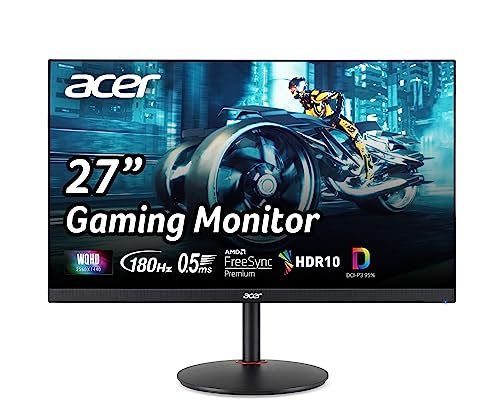
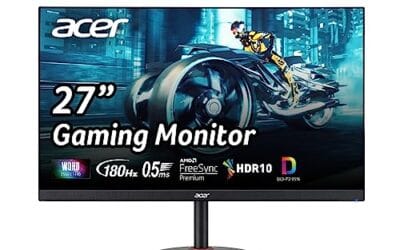
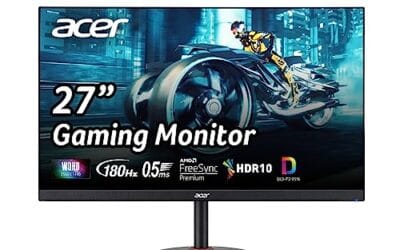
Specs on a box translate the physics into numbers you can compare. Refresh rate tells you how many times per second the screen redraws, so 144Hz redraws 144 times a second. Response time, quoted in milliseconds, tells you how fast a pixel transitions. The Acer Nitro XV271U, a 27-inch 1440p IPS panel, lists a 0.5ms gray-to-gray response and up to 180Hz refresh, numbers that were VA-territory-beating flagship stats a few years ago and now sell for $169.99.
Color coverage is the other big one. That Acer quotes 95% DCI-P3, the wide color space used for HDR content and modern film, which is strong for the price. IPS earned its reputation here because it holds color accuracy across the panel without the shift VA shows at the edges. VA fights back with contrast, and on a curved 34-inch ultrawide that contrast can make a darker game feel far more immersive than a flat IPS at the same price. The right numbers depend entirely on what you plan to run.
Why it works this way
The trade-offs aren’t marketing spin, they’re baked into the crystal structure. VA’s perpendicular crystals need to physically tilt further to change states, which is what historically slowed response times and caused smearing in dark transitions. That same deep tilt is exactly what lets VA choke off backlight for real blacks. You can’t fully have one without paying a little on the other. Engineers keep closing the gap with faster overdrive and better backlight zones, but the underlying physics sets the ceiling.
IPS pays its own tax in contrast and glow. Because the crystals stay parallel and never fully block the backlight, some light always leaks through, so pure black reads as dark gray in a dim room. Manufacturers offset this with local dimming and mini-LED backlights on higher-end models, which is why a premium IPS display can rival VA blacks now. It costs more, though. The physics decides where the easy wins are, and price decides how far you engineer around them.
When you’d want each one
Pick IPS if you value color accuracy, share your screen, do any creative work, or want the fastest competitive esports response. It’s the default for a reason, and it scales cleanly from a budget 24-inch monitor up to a high-refresh 360Hz gaming monitor. If you mostly game solo in a bright or normally lit room and want accurate, punchy color, IPS is hard to argue with. The Acer Nitro XV271U covers that middle ground well at 1440p and 180Hz, and shoppers cross-shopping a 27-inch 1440p monitor will see a lot of IPS in that class.
Pick VA if you game or watch movies in a dark room, love deep contrast, or want a big curved ultrawide where the contrast really pays off. VA also tends to cost less per inch of screen, so it stretches a budget on larger sizes. If dark-scene detail and cinematic black levels top your list and you sit dead center, VA rewards you. It rates a 4.8 on that Acer for a reason, but the panel choice should follow your room and your games first.
Pros
- 1440p 180Hz IPS panel via DisplayPort 1.2 hits the current price/perf sweet spot
- 95% DCI-P3 gamut is uncommon at this tier, useful for content viewing
- Full ergonomic stand: 4.7 inch height, 360 swivel, plus/minus 90 pivot, VESA 100
Cons
- Limited owner feedback at time of writing, long-term panel uniformity unverified
- HDMI 2.0 caps at 144Hz; only DisplayPort 1.2 unlocks the full 180Hz refresh
- No USB hub and 2W stereo speakers are strictly a bep-only backup at this tier
The Acer Nitro XV271U M3bmiiprx is a budget-oriented 27inch 1440p IPS gaming monitor targeting builders stepping up from 1080p high refresh. With 2560x1440 resolution, 180Hz over DisplayPort, and FreeSync Premium, it fits users pairing an RTX 4060,X 4060 Ti, or RX 7600 XT class GPU running competitive and AA titles at medium to high settings.
The defining feature is the 180Hz IPS panel with a claimed 0.5ms GtG response, paired with 95% DCI-P3 coverage. In practice, IPS panels at this tier typically deliver around 300to 350 nits SDR brightness and moderate contrast near 1000:1, so blacks will lift in dark rooms. FreeSync Premium adds low framerate compensation, useful when demanding titles drop below 60 FPS.
Trade-offs are typical for the segment. HDMI 2.0 bandwidth caps refresh at 144Hz, so consoles and older GPUs will not reach the full 180Hz ceiling. HDR tier, panel bit depth, and factory calibration are not specified in the listing, and there is no USB hub. The 2W speakers are functional only as a fallback.
Buy this if you want a 1440p 180Hz IPS panel with a full ergo stand and 95% DCI-P3 for mixed gaming and casual creative work. Skip this if you need verified HDR performance, USB-C daisy chaining, or OLED-level contrast for dark-room cinema use.
Panel and Resolution: 27 inch WQHD IPS at 2560x1440 gives a 0.233m pixel pitch, sharp enough that antialiasing needs drop versus 1080p 27 inch panels. IPS delivers wide viewing angles suited to desk sharing or off-axis reference monitors during editing sessions.
Refresh and Response: 180Hz refresh is available only through DisplayPort 1.2; HDMI 2.0 tops out at 144Hz due to bandwidth limits. Acer lists 1ms GtG typical and up to 0.5ms GtG at aggressive overdrive, though inverse ghosting is common at max overdrive on IPS panels in this bracket.
Color and HDR: 95% DCI-P3 coverage is the standout spec, wider than most sub-tier IPS panels that sit near 90% sRGB. HDR certification level, peak brightness, and local dimming are not specified in the source, so treat HDR as a compatibility mode rather than a true HDR experience.
Ports and Ergonomics: 1 DisplayPort 1.2, 2 HDMI 2.0, and audio out cover a PC plus one console. The stand offers minus 5 to 25 degree tilt, 4.7 inch height range, 360 degree swivel, and plus/minus 90 degree pivot, with 100x100 VESA for monitor arms. FreeSync Premium is confirmed, G-SYNC compatibility is not listed.
What to look for in a monitor panel
Don’t stop at the two-letter label. Refresh rate and response time matter most for fast gaming, so aim for at least 144Hz and a low gray-to-gray figure. Color coverage, quoted as a DCI-P3 or sRGB percentage, matters if you edit photos or care about HDR. Contrast ratio is where VA pulls ahead, and it’s the single number that separates a flat, washed-out image from a rich one in a dark room. Check for adaptive sync too, either FreeSync or G-Sync, to kill tearing.
Resolution and size set the baseline. 1080p is fine at 24 inches, 1440p is the current value pick at 27 inches, and 4K makes sense at 32 inches and up or if you want a premium 4K G-Sync monitor for single-player showcases. Ports matter more than people think. That Acer ships with one DisplayPort 1.2 and two HDMI 2.0 inputs, enough for a PC plus a console. Match the panel to the room, the games, and the budget rather than chasing the acronym.
Common misconceptions
The biggest myth is that IPS is always faster and VA is always slow. That was true years ago. Today plenty of fast VA panels handle high refresh well, and the response gap is small on good models. Another myth: all IPS glow means a defective panel. Some glow is normal for the technology, and it’s usually only visible on a black screen in a dark room. It’s not the same as backlight bleed, which is a manufacturing flaw.
People also assume VA can’t do color. Modern VA panels hit wide color gamuts fine, they just shift more off-angle. And a label doesn’t guarantee quality. A cheap IPS can look worse than a well-built VA, and vice versa. That AOC 24-inch even backs its panel with a 3-year zero-bright-dot guarantee, which tells you build quality varies more than the two letters suggest.
Frequently asked
Is IPS or VA better for gaming?
For competitive fast-paced gaming, IPS usually wins on response speed and consistency. For immersive single-player or movie nights in a dark room, VA’s contrast pulls ahead. Both work well at 144Hz and up, so it’s really about your room and your genre, not a blanket winner.
Which has better contrast, IPS or VA?
VA does, and it’s not close. VA typically hits around 3000:1 while standard IPS sits near 1000:1. That’s why VA blacks look deeper and dark scenes show more depth. Premium IPS with local dimming or mini-LED narrows the gap, but it costs a lot more to get there.
Does IPS glow mean my monitor is broken?
No. IPS glow is a normal trait of the technology, a faint corner glow visible mainly on a black screen in a dim room. It’s different from backlight bleed, which is uneven bright patches and can signal a defect. If the glow bothers you, lowering brightness and sitting straight on helps.
Are cheap IPS monitors any good now?
Yes, they’ve come a long way. A panel like the AOC 24G51F delivers 144Hz IPS at 1080p for $89.99 with adaptive sync, which was flagship territory not long ago. You’ll still pay more for higher resolution, better color coverage, and faster response, but the entry bar is genuinely solid. Anyone building on a tight budget can find good picks under $400.
Should I pick a panel type or just a resolution?
Start with resolution and size for your desk, then pick the panel type that fits your room and use. A bright room and creative work lean IPS, a dark room and movie love lean VA. If you’re weighing options across a gaming monitor under 400, you’ll find strong choices in both camps, so let the trade-offs decide, not the acronym alone.




























Write Your Review
No reviews yet. Be the first to share your experience!