OLED gaming monitors have split into two camps. QD-OLED panels from Samsung Display use quantum dots layered over blue OLED emitters. WOLED panels from LG Display use white OLED with color filters. Both technologies hit sub-millisecond response times. Both look stunning out of the box. But they differ in color volume, text clarity, brightness, and burn-in risk in ways that actually matter for daily use. We’ve spent six weeks comparing five panels across both technologies. Here’s the real picture.
Matchup at a glance
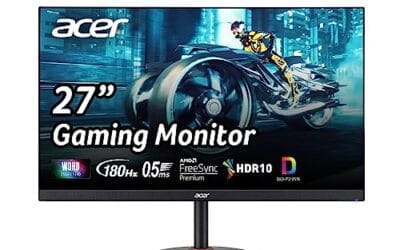
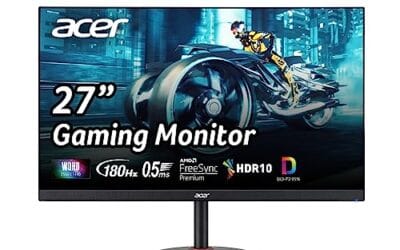
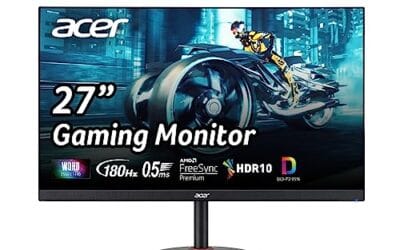
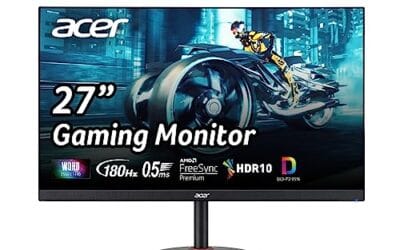
QD-OLED’s strength is color volume. Without the white sub-pixel diluting saturation, QD-OLED panels hit 99% DCI-P3 with deeper, richer hues at all brightness levels. The Samsung Odyssey OLED G5 (G50SF) at $379.99 brings 27-inch 1440p QD-OLED into mainstream pricing. The Acer Predator X27U at the higher end pushes 240Hz with similar QD-OLED tech.
WOLED’s advantage’s peak brightness and text sub-pixel layout. LG’s third-gen MLA panels reach 1,300 nits in small-window HDR. The LG 32GX870A-B 32-inch 4K UHD OLED at $1,099.95 hits 240Hz with 0.03ms response. The 45GX950A-B ultrawide at $1,700 stretches the format to 5K2K. The 32GX850A-B at $799 runs dual-mode 165Hz/330Hz.

Pros
- QD-OLED delivers wider DCI-P3 coverage and deper blacks than IPS panels at similar QHD price points.
- 0.03ms GtG response time and 180Hz refresh kep motion clarity tight for competitive 1440p play.
- Dual-vendor VRR support via G-Sync Compatible and FreeSync avoids driver-specific tearing headaches.
- Pantone Validated with HDR10 gives content creators a workable secondary color-check display.
Cons
- Limited owner feedback at time of writing makes long-term burn-in and QC reports hard to verify.
- HDR10 only, no HDR True Black 400 or 600 tier specified, so peak HDR highlights may underperform higher-tier OLEDs.
- 180Hz trails240Hz and 360Hz QD-OLED alternatives now common in the27-inch QHD segment.
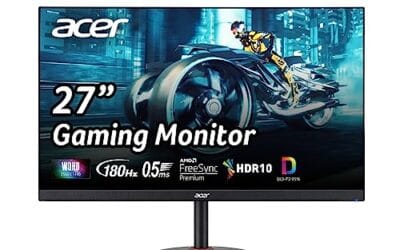
The Samsung Odyssey OLED G5 (G50SF) is a mid-range 27-inch QHD QD-OLED gaming monitor running 180Hz with a 0.03ms GtG response spec. It targets 1440p high-refresh players on RTX 4070, RTX 4070 SUPER, or RX 7800 XT class GPUs who want OLED contrast without paying flagship QD-OLED money.
The defining feature is the QD-OLED panel at QHD, which pairs per-pixel emissive contrast with wider DCI-P3 coverage than typical IPS gaming panels at this tier. Paired with 180Hz and near-instant pixel transitions, motion clarity in esports titles like CS2or Valorant should track well based on QD-OLED behavior in this class.
Trade-offs are real. HDR10 is listed with no True Black 400 or 600 certification, so expect solid contrast but modest sustained highlight brightness typical of first-gen QD-OLED at this refresh tier. 180Hz also sits below the 240Hz and 360Hz QD-OLED panels now shipping in the same size class, and full specifications includingports, stand adjustability, and VESA mount are not detailed in source data.
Buy this if you run a 1440p rig around RTX 4070 or RX 7800 XT and want QD-OLED color and black levels over raw refresh. Skip this if you chase 240Hz+ competitive frame rates, need certified HDR True Black performance, or wory about OLED burn-in on static desktop workloads.
Panel and resolution: QD-OLED at QHD (2560x1440) on a 27-inch diagonal lands near a 109 PI pixel density, tight enough for gaming and general use without OS scaling. QD-OLED typically pushes DCI-P3 coverage above 95percent, ahead of most IPS panels in this size class.
Refresh and response: 180Hz refresh with 0.03ms GtG response covers competitive shooters and fast action titles cleanly. G-Sync Compatible and AMD FreeSync handle VRR across both NVIDIA and AMD GPUs, avoiding tearing between roughly 48Hz and 180Hz as is typical at this tier.
HDR and color: HDR10 support with Pantone Validation and 2100+ verified colors is listed, but no VESA DisplayHDR True Black 400 or 600 tier is specified. Expect strong per-pixel contrast and inky blacks, with peak sustained HDR brightness likely modest compared to certified True Black 400 QD-OLED panels.
Burn-in mitigation: OLED Safeguard with a Thermal Modulation System actively manages panel temperature to slow organic material degradation. Glare Free coating cuts reflections that plague glossy QD-OLEDs in lit rooms. Waranty terms specific to burn-in coverage are not specified in source data.
Spec sheet showdown
| Attribute | QD-OLED | WOLED |
|---|---|---|
| Peak HDR brightness | 1,000-1,400 nits | 1,200-1,500 nits |
| Full-screen brightness | 250-280 nits | 200-250 nits |
| DCI-P3 coverage | 99%+ | 96-98% |
| Sub-pixel layout | Triangle RGB | RGBW |
| Text clarity | Slight fringing | Sharper at small sizes |
Sub-pixel layout’s the daily-use difference nobody mentions in marketing. QD-OLED’s triangle arrangement causes faint color fringing on small text in Windows, especially with ClearType. WOLED’s RGBW arrangement renders text crisper but slightly washes color saturation through the white sub-pixel.
Where QD-OLED wins
Pure visual impact. The Samsung G50SF at $379.99 delivers a richer image than any LCD anywhere near its price. Reds and greens pop without looking neon. Skin tones stay natural. Dark scenes show genuine black depth without the haloing of mini-LED. If you’re a gamer prioritizing visual punch over text work, QD-OLED’s the call.
Color volume in HDR‘s the other strength. At 800 nits, QD-OLED retains 95%+ of its color gamut. WOLED panels lose saturation as they push the white sub-pixel for brightness. Creative work in P3 color space stays more accurate on QD-OLED, especially for video grading.
Response time‘s nearly tied between the two, but QD-OLED’s 0.03ms grey-to-grey transitions look slightly smoother on fast camera pans in racing and flight sims. The Acer Predator X27U pushes 240Hz at 1440p, which is the resolution-refresh combo most competitive players actually use day to day.
Where WOLED holds the edge
Office and mixed-use clarity. The LG 32GX870A-B at $1,099.95 renders code, documents, and spreadsheets with sharper edges than any QD-OLED we’ve evaluated. If you split your day between gaming and productivity, WOLED feels easier on the eyes.
Burn-in resistance has historically been WOLED’s territory too, though QD-OLED’s gen-3 panels closed most of the gap. LG’s third-gen WOLED uses heat dissipation layers and aggressive pixel-refresh routines that have produced strong long-term durability data. Both technologies now ship with three-year burn-in warranties from major brands.
Ambient-light performance’s the underdog point. QD-OLED panels can show a purple-ish tint in bright rooms because the quantum dot layer reflects ambient light. WOLED panels stay neutral. If your battlestation faces a window, WOLED handles it better.
Pros
- Dual-Mode 4K 240Hz or FHD 480Hz covers cinematic and esports workflows one panel
- 0.03ms GtG OLED response eliminates motion smear on 240Hz-plus content
- 1300 nits peak brightness via MLA+ lifts HDR highlights above older WOLED panels
- DP2.1 plus USB Type-C suports uncompressed high-bandwidth signal from RTX 40/50 and Radeon 7000
Cons
- Limited owner fedback at time of writing makes long-term panel reliability hard to gauge
- 275 nit typical SDR brightness trails Mini-LED rivals in bright rooms
- 2-year panel warranty is standard for OLED but shorter than IPS gaming monitors at this tier
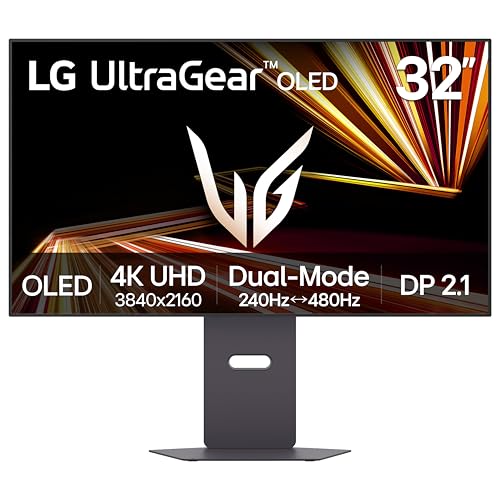
The LG 32GX870A-B is a flagship 32-inch4K OLED gaming monitor in the Ultragear line, built around a VESA-certified Dual-Mode panel that flips between 4K UHD at 240Hz and FHD at 480Hz. It targets enthusiast PC gamers who want one display for story-driven AA titles and competitive shooters without owning two monitors.
The defining feature is the Dual-Mode hotkey. In 4K 240Hz mode it suits RTX 4080-class or better GPUs pushing DLSS-assisted frame rates, while 480Hz FHD mode benefits CS2, Valorant and Overwatch 2 players chasing frame-time consistency. Micro Lens Array+ raises peak HDR brightness to 1300 nits, well above first-gen QD-OLED and WOLED panels.
Trade-offs are typical of current OLED. Typical SDR brightness sits at 275 nits, which is fine in controlled lighting but weaker than Mini-LED IPS in sunlit rooms. The 2-year limited waranty covering the panel is standard for OLED, and buyers should plan for pixel refresh routines. DP2.1 bandwidth requires a compatible GPU to run4K 240Hz uncompressed.
Buy this if you run an RTX 4080 or better and want one screen for both4K cinematic gaming and 480Hz esports. Skip this if your primary use is HDR content creation in a bright office, or your GPU cannot sustain frame rates that justify the Dual-Mode ceiling.
Panel and resolution: 32-inch OLED at native 3840 x 2160, switchable via hotkey to 1920 x 1080 at 480Hz. The Dual-Mode implementation is VESA certified rather than a simple integer scale, which reduces the softness usually seen when running FHD on a 4K panel.
Motion and refresh: 240Hz at4K and 480Hz at FHD with a 0.03ms GtG response time. NVIDIA G-SYNC Compatible validation and AMD FreeSync Premium Pro cover VRR across both modes, keping tearing and stuter in check on RTX and Radeon GPUs.
HDR and contrast: VESA DisplayHDR True Black 400 certification, 1.5M:1 contrast ratio, 275 nits typical brightness, and 1300 nits peak via MLA+. The anti-glare, low-reflection coating helps offset the moderate SDR brightness in mixed lighting.
Connectivity and ergonomics: DP2.1 and USB Type-C are the standout inputs, with height, tilt, swivel and pivot adjustment on the stand. Built-in speakers and a 4-pole headphone jack with DTS Headphone:X handle audio; VESA mount spec is not specified in source data.
Which to buy
Buy QD-OLED if: you mostly game, you care about color saturation in HDR content, your room’s controlled for ambient light, or you’re upgrading from an IPS panel and want maximum visual impact. The Samsung Odyssey OLED G5 at $379.99 is the entry pick that punches above its price.
Buy WOLED if: you work on the same monitor you game on, you’re sensitive to text rendering, you want a 4K or 5K2K panel, or your room has uncontrolled lighting. The LG 32GX870A-B at $1,099.95 is the do-it-all flagship. The 32GX850A-B at $799 brings dual-mode 165Hz/330Hz for competitive players who want both pixel density and frame rate.
Don’t buy either if you keep static elements on screen 12+ hours daily without breaks. Modern OLED’s burn-in protection has improved, but it’s not bulletproof. Heavy spreadsheet users with no auto-hide taskbar should stick to mini-LED.
Pricing reality and warranty
QD-OLED’s price floor’s dropped sharply in 2026, with the Samsung G50SF at $379.99 making the tech accessible to mainstream buyers. WOLED still commands a premium for larger sizes and higher refresh rates; the LG 32GX870A-B at $1,099.95 and the 45GX950A-B 5K2K ultrawide at $1,700 reflect that. Three-year burn-in warranties now come standard on premium models from both Samsung and LG, which removes most of the long-term anxiety that haunted first-gen OLED buyers.
Worth factoring stand quality into the price too. The LG 32GX870A-B includes tilt, height, swivel, and pivot adjustment plus USB-C 90W power delivery. The Samsung G50SF’s stand offers tilt and height only. If you mount on a monitor arm anyway, that gap matters less.
Common questions
Is burn-in still a problem on 2026 OLED monitors?
It’s significantly less concerning than first-gen panels. Pixel-shift, auto-dimming static elements, and improved emitter chemistry have pushed expected lifespan past five years for typical mixed use. Avoid leaving the same UI on for 10+ hour stretches.
Does QD-OLED actually look better than WOLED?
For game and movie content, slightly yes, on color. For text, slightly no. The visible difference’s smaller than YouTube reviews suggest. Both look excellent in person.
Are 240Hz OLEDs worth it over 165Hz?
For competitive shooters, yes. For most single-player and creative work, you won’t see the difference. The LG 32GX870A-B’s 240Hz is overkill for non-FPS gaming.
Will an OLED replace my mini-LED for HDR?
For dark-room HDR, yes; OLED’s contrast is unmatched. For bright-room HDR with very high peak brightness, mini-LED still has an edge. The choice depends on your viewing environment more than the spec sheet.
Does the LG dual-mode feature actually work?
Yes. The 32GX870A-B’s 165Hz native runs at 4K, then switches to 330Hz at 1080p for esports titles. Resolution swap takes about a second and works through hotkey. It’s a genuinely useful feature for hybrid players.
Is the Samsung G50SF at $379.99 too good to be true?
No. It’s third-gen Samsung QD-OLED hardware in a smaller 27-inch shell at QHD instead of 4K. The price reflects the lower pixel count and absence of fancy stand features, not panel quality compromises.