

What is a 75 percent keyboard? It’s a compact keyboard layout that keeps the function row, number row, letters, modifiers, arrow keys, and a small navigation cluster, while dropping the numpad and tightening the spacing between sections. In plain terms, it gives you most of a tenkeyless board’s control in a smaller footprint.
For PC users, the appeal is simple: more mouse room, less desk clutter, and fewer layout sacrifices than a 65 percent board. If you’re comparing compact options, our guides to the best 65 percent keyboard 2026, best 65 percent keyboard for gaming, and best ergonomic keyboard are useful context, because 75 percent boards sit between small gaming layouts and full productivity keyboards.
The short answer
A 75 percent keyboard is roughly 75 percent of a full-size keyboard’s layout, not always exactly 75 percent of its physical size. It removes the numpad, compresses the arrow and navigation keys closer to the main typing area, and usually keeps F1 through F12. Many 75 percent boards also keep Delete, Page Up, Page Down, Home, or End, though the exact cluster varies by brand.
The easiest way to picture it is this: take a tenkeyless keyboard, squeeze out some blank space, and keep the keys most people still use every day. You don’t get the number pad, but you don’t have to rely on layers for function keys or arrows. That’s the big difference from many 60 percent and 65 percent layouts.

Pros
- MX2A Silent Red linears actuate quietly, good fit for open-plan offices
- Metal plate frame keeps chassis stiff and reduces caseping under typing
- Cherry Gold-Crosspoint contacts rated for 50 million keystrokes on this variant
- Full-size layout with dedicated numpad suits data entry and spreadshet work
Cons
- Renewed unit with no owner fedback loged yet, cosmetic and wear condition varies
- Silent Red linears lack tactile bump, typists who prefer fedback should pick Brown
- Source data omits connectivity, cable type, polling rate, and dimensions
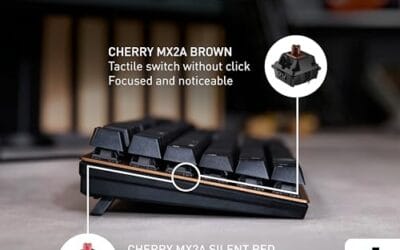
The Cherry KC 200 MX is a full-size office-focused mechanical keyboard sold here as a Renewed unit in Bronze with MX2A Silent Red linear switches. It targets office typists, developers, and finance or admin users who want Cherry switch fel and a metal plate frame without the RGB and gamer styling of enthusiast boards.
The defining feature is the MX2A Silent Red switch, Cherry's updated linear with dampened stems aimed at reducing bottom-out and return noise. Cherry rates this variant for 50 million keystrokes. Based on the linear profile, expect smooth actuation with no tactile bump, which suits fast touch typists and users on frequent video calls.
Trade-offs are typical at this tier and Renewed status. Silent Red linears are polarizing, users coming from Browns or Blues will miss the tactile feedback, and the source does not specify polling rate, connection type, cable, keycap material, or dimensions. As a Renewed listing, cosmetic condition and remaining switch life depend on the refurbisher rather than a factory-fresh baseline.
Buy this if you want a quiet full-size Cherry mechanical for office or shared-space use and value the metal plate build over RGB features. Skip this if you prefer tactile or clicky switches, need confirmed wireless or USB-C connectivity, or want a waranty profile equivalent to new stock.
Switches: Cherry MX2A Silent Red, linear with integrated dampeners, made in Germany with Gold-Crosspoint contacts. Rated for 50 million keystrokes on this variant, versus 100 million on MX2A Brown. Linear travel with no tactile bump favors light, fast keypresses over deliberate typing fedback.
Build: Metal plate frame under the switches, which stiffens the deck and cuts flex compared with plastic-only office boards. Cherry positions the KC 200 MX as a slim modern design, though exact case height, weight, and keycap material are not specified in the source data.
Layout and indicators: Full-size layout retains the dedicated numpad and function row, which maters for spreadsheet,ERP, and accounting workflows. White LED status indicators are built into Caps Lock, Scroll Lock, and Num Lock keys, avoiding a separate indicator strip and keeping the top edge clean.
Gaming fit: Silent Red linears work for casual gaming and MMO or productivity crossover use given their light linear fel, but the source does not list polling rate, N-key rollover, or onboard profiles, so competitive esports buyers should confirm specs before committing.
The longer explanation
Keyboard percentages describe layouts by comparing them to a full-size board, which normally has about 104 keys in the United States layout. A full-size board includes the typing area, function row, navigation cluster, arrow keys, and numpad. A tenkeyless board removes the numpad and often lands around 87 keys. A 75 percent keyboard compresses that tenkeyless idea further, often ending up around 80 to 84 keys depending on the design.
That compression changes the feel. On a traditional full-size keyboard, there are gaps between the alphanumeric area, arrows, function row, and navigation keys. On a 75 percent keyboard, those zones are pushed close together. Some boards use a single vertical navigation column on the right edge. Others use a slightly exploded layout with tiny gaps so the arrows are easier to find by touch. Both count as 75 percent if the main key set is similar.
History / how we got here
Compact keyboards were around long before gaming desks and RGB setups made them trendy. Laptop keyboards pushed users toward tighter layouts because every millimeter mattered. Office users also learned that many tasks don’t need a numpad all day. As mechanical keyboards became more popular, enthusiasts started bringing those compact ideas to desktop boards with better switches, metal plates, and programmable firmware.
The 75 percent layout grew because 60 percent boards were too aggressive for many users. Losing dedicated arrows, function keys, and navigation keys can be annoying in spreadsheets, code editors, BIOS menus, and games with keybind-heavy controls. A 75 percent board keeps those daily-use controls while still freeing up several inches of mouse space compared with a full-size 104-key keyboard. Small enough. Still familiar.
Why it works this way
The layout works because the numpad is the easiest large section to remove for many PC users. Gamers often keep their left hand on WASD and their right hand on the mouse, so the numpad mostly pushes the mouse farther right. That can create shoulder angle strain on narrow desks. Writers and programmers may use arrow keys, function shortcuts, Delete, and Home far more often than a separate number pad.
A 75 percent keyboard also keeps muscle memory more intact than tiny layouts. You can still hit Escape in the top-left corner, use F5 to refresh, press Alt-F4, enter BIOS prompts, and reach arrow keys without holding Fn. Layers still exist for media controls, lighting, macros, or secondary commands, but basic desktop behavior doesn’t depend on them. That’s why this layout feels compact without feeling like a puzzle.
When you’d want this
You’d want a 75 percent keyboard if your desk is cramped, your mouse keeps hitting the keyboard, or you want a cleaner setup without giving up the function row. It’s especially good for gaming and mixed-use PCs where you switch between Discord, Chrome, Steam, spreadsheets, and work apps. A 65 percent board can be excellent, but if you use F-keys often, 75 percent is usually less disruptive.
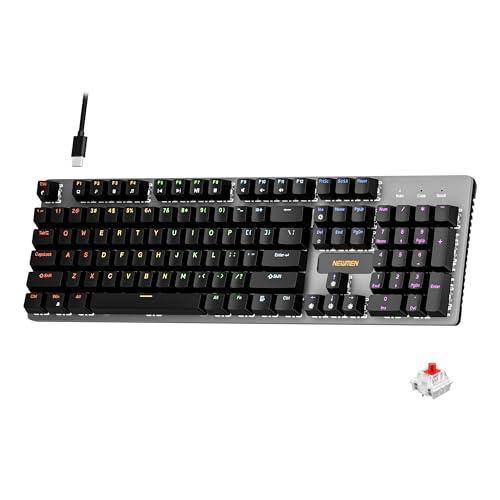
You might not want one if you enter numbers for hours every day. Accounting, data entry, CAD dimensions, and spreadsheet-heavy work can make a numpad feel essential. In that case, a full-size board or a separate USB numpad may be better. For budget context, the Newmen GM325Pro is a $20.89 wired mechanical keyboard with 104 keys, rainbow LED backlighting, hot-swap support, a metal panel, ABS black keycaps, Windows laptop and PC support, linear red switches, and a 4.8 rating. It’s full-size, so it shows exactly what you give up when you move to 75 percent: that full 104-key spread.
Pros
- Hot-swap sockets allow switch experimentation without soldering tools or PCB risk
- Metal top plate delivers firmer typing feel than plastic budget boards at this tier
- Full-key rollover and linear red switches handle rapid inputs for casual gaming
Cons
- Limited owner feedback at time of writing, so long-term reliability is unproven
- RGB is restricted to side lighting only, per-key backlight is fixed rainbow patterns
- ABS keycaps typical at this tier tend to shine and wear faster than PBT
The Newmen GM325Pro is a budget full-size 104-key wired mechanical keyboard aimed at first-time mechanical buyers and casual gamers who want a hot-swap PCB without moving up to enthusiast pricing. It ships with linear red switches, a metal top plate, ABS keycaps, and side-edge RGB lighting.
The defining feature here is the hot-swap socket combined with linear red switches. That gives new users a low-friction path to swap inactile or silent switches later without soldering. Typing fel on metal-plate boards at this tier is usually firmer and less hollow than all-plastic budget pers, based on category norms.
Trade-offs are typical for the price class. Per-key RGB is not suported, only side lighting is true RGB while the top backlight runs 13 preset rainbow effects. ABS keycaps tend to develop shine within months of heavy use, and Newmen does not publish switch lifecycle, polling rate, or NKRO wired specs in the source data.
Buy this if you want a cheap full-size hot-swap platform to learn on and plan to upgrade switches or keycaps later. Skip this if you need per-key RGB, PBT caps, a documented polling rate, or a keyboard with a dep owner review history to validate QC.
Switches and layout: Linear red switches on a full 104-key ANSI layout, with full-key rollover claimed by the manufacturer. Actuation force, travel, and switch brand are not specified in the source. Linear reds typically sit near 45g actuation and 4m total travel in this category.
Hot-swap PCB: Sockets accept standard MX-style switches, so tactile, clicky, or silent linear options from third parties drop in without soldering. Pin compatibility (3-pin vs 5-pin) is not specified, buyers should confirm before ordering replacement switches.
Build and lighting: Metal top plate over ABS black keycaps. RGB is limited to the side edge, while the top backlight cycles through 13 preset rainbow patterns rather than per-key addressable RGB. Case material below the plate is not specified.
Connectivity and software: Wired only via a detachable 1.8m USB cable. FN combos cover F1 to F11 media and calculator shortcuts. Customization software suports key remap, macro recording, and lighting tweaks, though poling rate and software platform support are not specified.
What to look for in a 75 percent keyboard
First, look at the right-side cluster. Some 75 percent keyboards put Delete, Home, Page Up, and Page Down in a vertical column. Others include fewer navigation keys and rely on Fn layers. If you edit text, code, or spreadsheets, those keys matter. You’ll want a layout you can learn quickly, not one that hides every command behind a shortcut.
Second, check switch type and sound. Linear switches feel smooth and are popular for gaming. Tactile switches give a bump that many typists like. Silent switches can make shared offices less annoying. The Cherry KC 200 MX, for example, is a $56.31 renewed mechanical office keyboard rated 4.0, with new MX2A switches, a modern design, a metal plate frame, and MX2A Silent Red switches in the listed bronze version. It’s not a 75 percent board, but those details are useful when you’re thinking about switch feel and office noise.
Third, check connection type, software, and keycap support. Wired boards are simple and low-latency. Wireless boards reduce cable clutter but need battery management. Hot-swap sockets let you change switches without soldering, which is great if you’re still learning what feel you like. Standard keycap sizes make future replacements easier, while unusual right-shift or bottom-row sizes can limit upgrade options. Also check the case angle and front height. A tall compact board may save width but still force wrist extension, so it’s worth pairing it with a low-profile wrist rest or choosing a shallower case if you type for hours.
Common misconceptions
The biggest misconception is that 75 percent keyboards are only for gamers. They’re popular with gamers, sure, but the layout can be just as useful for writing, coding, office work, and small desks. Keeping the function row and arrows makes it more approachable than a 60 percent board for everyday Windows shortcuts and app controls.
Another misconception is that all 75 percent keyboards feel the same. They don’t. A high-profile case, low-profile switches, gasket mount, tray mount, plastic shell, metal plate, and different stabilizers can make two boards with the same layout feel completely different. Layout is just the map. Build quality, switch choice, keycaps, and firmware decide the experience.
For desk space, 75 percent is a practical middle ground. You keep the function row and arrows, but the board is narrow enough to give your mouse hand more room than a full-size layout.
Frequently asked
How many keys does a 75 percent keyboard have?
Most 75 percent keyboards have around 80 to 84 keys, though the exact number depends on the navigation cluster and knob or extra key support. The layout keeps the function row and arrows, which separates it from many smaller 60 percent and 65 percent keyboards.
Is a 75 percent keyboard good for gaming?
Yes, it’s a strong gaming layout for many players. You get more mouse space than a full-size board while keeping F-keys, arrows, and enough navigation keys for launchers, chat, and game shortcuts. It won’t make you better by itself, but it can make your desk feel less cramped.
Is 75 percent better than 65 percent?
It depends on what you use. A 65 percent keyboard is smaller and usually keeps arrows, but it often drops the dedicated function row. A 75 percent keyboard is wider and taller, yet it’s easier if you rely on F1 through F12, screen brightness shortcuts, BIOS prompts, or productivity commands.
Do 75 percent keyboards have a numpad?
No, the numpad is the major section removed. If you need number entry sometimes, you can add a separate numpad and place it on either side of the keyboard. That’s a flexible setup because the numpad doesn’t have to sit on the right all day.
Are 75 percent keyboards hard to learn?
They’re usually easier to learn than 60 percent keyboards because the function row and arrows stay dedicated. The main adjustment is the tighter navigation cluster and reduced spacing between key groups. After a few days, many users stop noticing the compressed layout unless they need the missing numpad.






























Write Your Review
No reviews yet. Be the first to share your experience!