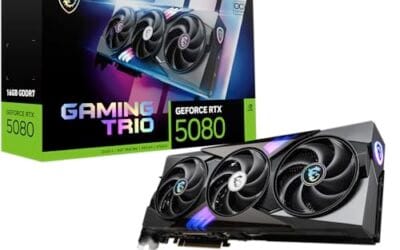

The RTX 5070 Ti sells for $979 at most retailers, the RTX 5080 asks $1,279, and both ship 16GB of GDDR7 on an identical 256-bit bus. Same capacity, same bus width, same Blackwell die. So that $300 buys three things and only three: more CUDA cores, memory clocked 2 Gbps quicker, and a 60W larger power budget. Translated into frames, that’s roughly 10-14% at 1440p and 22-28% at 4K native.
The 5070 Ti isn’t the compromise half of this pairing. It’s a 1440p card that’ll saturate a 240Hz panel in most competitive titles, and it does that inside a 300W budget that drops into a 750W build without any arithmetic. Which card is faster was never the interesting question. The interesting one is whether the 5080’s margin lands at the resolution you already own a monitor for, and there’s a third answer buried in here: for a decent share of the people shopping these two, neither one belongs in the build.
What’s identical, and what isn’t
Both cards come off GB203, the second-largest Blackwell die. Both run DLSS 4 with multi-frame generation, share the same NVENC and NVDEC blocks, use the same display engine, sit on a PCIe 5.0 x16 link, and feed from the same 16-pin 12V-2×6 connector. Feature parity is total. Nothing across NVIDIA’s GeForce card lineup is switched on for the 5080 and withheld from the 5070 Ti, which wasn’t true a generation ago when frame generation split the stack in half.
The difference is quantity. The 5080 lights up 84 of GB203’s streaming multiprocessors where the 5070 Ti gets 70, and that one cut explains the shader gap, the RT core gap, and the Tensor core gap all at once. Memory clock moves from 28 Gbps to 30. Board power climbs from 300W to 360W. That last number quietly rewrites the rest of your parts list, which almost nobody prices in before checkout.

Pros
- 16GB GDDR7 VRAM avoids the buffer ceiling that limits 12GB cards at 4K
- 1440p ultra and entry-level 4K gaming with DLSS 4 Multi Frame Generation on supported titles
- Triple-fan Ventus 3X cooler with square Core Pipes improves die-to-heatpipe contact area
- SFF-Ready badge indicates verified fitment for small form factor chassis compatibility
Cons
- Ventus is MSI's entry cooler tier, expect higher noise than Gaming Trio or Suprim under sustained load
- 12V-2x6 power draw at this class typically needs an ATX 3.0 PSU with 750W or higher
The MSI RTX 5070 Ti 16G Ventus 3X OC is a high-end NVIDIA Blackwell GPU with16GB of GDDR7 on a 256-bit memory bus and a 2497MHz boost clock in Extreme Performance mode. It targets 1440p high-refresh gamers and entry 4K builders who want DLSS 4 without stepping up to an RTX 5080.
The defining feature is the 16GB GDDR7 buffer paired with Blackwell's DLS 4 Multi Frame Generation. In current AA titles, RTX 5070 Ti class silicon typically holds 1440p ultra above 100 FPS and delivers playable 4K with upscaling enabled, based on category benchmarks. The 256-bit bus provides adequate bandwidth for texture streaming at both resolutions.
Trade-offs are typical for the Ventus line. It is MSI's entry cooler above the Shadow, so acoustics and thermal ceilings sit below Gaming Trio or Suprim SKUs at the same silicon tier. Exact TGP, length, and slot width are not specified in the listing, so verify clearance against your case and confirm PSU wattage before purchase.
Buy this if you want a straightforward 5070 Ti with 16GB GDDR7 for 1440p high-refresh or DLSS-assisted 4K in a case that has verified SFF-Ready or mid-tower clearance. Skip this if you prioritize the quietest acoustics under sustained load, in which case the Gaming Trio tier is worth the step up.
Resolution target: 16GB of GDDR7 on a 256-bit bus positions this card for 1440p ultra at high refresh and 4K with DLSS Quality or Performance upscaling. The VRAM buffer clears the 12GB ceiling that bottlenecks lower tiers in path-traced or texture-mod scenarios.
Clocks and architecture: Extreme Performance mode targets 2497 MHz boost on NVIDIA Blackwell silicon. DLSS 4 with Multi Frame Generation is suported, which is the headline software feature versus the RTX 40 series for compatible titles.
Display output: Three DisplayPort 2.1a outputs enable UHBR bandwidth for high-refresh 4K and beyond, and one HDMI 2.1b port handles TV or console-style displays. That output mix suits triple-monitor productivity plus a primary gaming panel.
Cooling and PSU pairing: The Ventus 3X OC uses TORX Fan 5.0, a nickel-plated coper baseplate, and square Core Pipes for GPU contact. Exact TGP is not specified, but RTX 5070 Ti class cards in this tier typically call for an ATX 3.0 PSU rated 750W or higher with a native 12V-2x6 connector.

Pros
- 16GB GDDR7 on 256-bit bus handles 4K textures and heavy ray tracing headroom
- Triple-fan 2.99-slot cooler suggests strong thermal headroom for the 2775 MHz bost clock
- DisplayPort 2.1 and HDMI outputs enable uncompressed high-refresh 4K on newer panels
Cons
- Limited owner feedback at time of writing makes long-term reliability hard to judge
- 2.99-slot thickness needs case clearance check, especially in mid-tower and SF builds
- Blackwell class TGP typically demands a high-wattage ATX 3.0 or 3.1 PSU with native 12V-2x6
The PNY GeForce RTX 5080 Epic-X ARGB OC Triple Fan is a high-end Blackwell GPU built for4K and high-refresh 1440p gaming. It ships with 16GB GDR7 on a 256-bit bus, a 2775 MHz boost clock, PCIe 5.0, and HDMI and DisplayPort 2.1 outputs, targeting enthusiast builders upgrading from a 3080 or 4070-class card.
The defining feature is the DLSS 4 stack with Multi Frame Generation on fifth-gen Tensor Cores. In suported titles this typically lifts 4K frame rates well beyond native raster, based on category norms for the RTX 50 series. The 2.99-slot triple-fan cooler is sized for holding the factory boost under sustained ray-traced loads.
Trade-offs at this tier are real. The 2.99-slot thickness eats a full three expansion slots, so case clearance and motherboard slot spacing need checking. PNY has not published card length, weight, or TGP in the listing, so anti-sag support and PSU sizing should follow NVIDIA reference guidance rather than assumption. Owner feedback is thin, so long-term coil whine and fan behavior remain unverified.
Buy this if you run a 4K 120Hz or 1440p 240Hz display, already have a modern ATX 3.0 or 3.1 PSU, and want DLS 4 with strong ray tracing. Skip this if your CPU is below a Ryzen 700or Core i5-13600K class, since a weaker chip will bottleneck the card at 1440p.
Resolution target: 16GB GDDR7 on a 256-bit bus fits 4K native raster in most current titles and gives clear headroom for 1440p at 240Hz plus. VRAM at this capacity absorbs high-res texture packs and path-traced workloads that push12GB cards into stutter territory.
Clocks and architecture: The2775 MHz factory boost sits above NVIDIA reference on Blackwell, and fifth-gen Tensor Cores enable DLSS 4 Multi Frame Generation. In supported titles this typically multiplies base frame rates at 4K, though native raster gains over the previous generation are more modest based on 50 series category norms.
Power and PSU pairing: PNY does not list TGP in the source data. RTX 5080 class cards typically sit in the 360W range, so pair with an ATX 3.0 or 3.1 PSU rated at least 150W above card TGP for transient headroom,ideally with a native 12V-2x6 cable rather than an adapter.
Physical fit: The 2.99-slot cooler occupies three expansion slots. Confirm your case suports a triple-slot GPU and that the motherboard PCIe x16 slot leaves the slot below usable or free. HDMI and DisplayPort 2.1 outputs support UHBR displays for uncompressed 4K high-refresh.

Pros
- SFF-Ready 2.5-slot design clears manyITX cases other RTX 5070s cannot
- Blackwell architecture suports DLSS 4 multi frame gen for higher 1440p framerates
- 12GB GDDR7 provides useful bandwidth headrom over prior GDDR6X70-class cards
- Dual BIOS switch offers a quiet mode without reflashing firmware
Cons
- Limited owner feedback at time of writing makes long-term reliability hard to judge
- 12GB VRAM buffer is tight for 4K path tracing and heavier AI workloads
- SFF cooler length and2.5-slot width still need case clearance checks before purchase
The ASUS Prime RTX 5070 is a mid-range Blackwell GPU aimed at 1440p gamers building small-form-factor rigs. With a 2.5-slot chassis, 12GB of GDDR7, PCIe 5.0, and HDMI/DP 2.1 outputs, it targets ITX and slim mATX builders who want a current-gen 70-class card without stepping up to a triple-slot tower cooler.
The defining trait here is the SFF-Ready compliance paired with Axial-tech fans and a phase-change thermal pad. GPUs in this class typically run 200-250W TGP, and the barier-ring fan design is meant to hold thermals in tight cases where fin stacks lose airflow. Blackwell plus DLSS 4 frame generation should push comfortable 1440p framerates in modern titles.
Trade-offs are typical at this tier. The 12GB frame buffer is workable at 1440p but gets pressured by 4K ray-traced titles and larger local AI models. The2.5-slot width is friendlier than 3-slot siblings, yet SFF builders still need to confirm card length and PSU cable routing,ideally with a 12V-2x6 nativeATX 3.1 unit.
Buy this if you are assembling a compact 1440p gaming PC and want NVIDIA Blackwell features in a case-friendly footprint. Skip this if you game at 4K with ray tracing enabled, run VRAM-hungry AI workloads, or already own a full-tower with room for a befier 3-slot RTX 5070 Ti.
Resolution target: The 12GB GDDR7 buffer and Blackwell shader layout position this card for 1440p high-refresh gaming, with DLSS 4 upscaling and multi frame generation extending playable framerates into 4K in suported titles. Native 4K path tracing will pressure the 12GB VRAM pool.
Power and PSU: ASUS does not publish TGP in the provided data, but 70-class Blackwell cards typically land in the 200-250W range. Pair with an ATX 3.1 PSU offering a native 12V-2x6 connector, sized roughly 150W above card TGP to absorb transient spikes cleanly.
Cooling and acoustics: The Axial-tech fans use a smaller hub for longer blades plus a barrier ring for downward pressure, and a phase-change pad replaces traditional paste on the GPU die. Dual BIOS lets users toggle between a quieter profile and a performance profile without software.
Build compatibility: The 2.5-slot, SFF-Ready form factor is the standout, opening compatibility with ITX cases that reject 3-slot cards. Confirm exact card length against your case GPU clearance spec and leave room for the 12V-2x6 cable bend radius, which is a common failure point in tight SFF builds.

Pros
- GDDR7 memory on a 12GB frame suits 1440p high-refresh and early 4K workloads without hitting VRAM ceiling quickly.
- 0dB fan-stop below 50C keeps the card silent during desktop use, browsing, and light gaming sessions.
- Dual-ball bearing fans rated for roughly twice the lifespan of sleeve-bearing alternatives, reducing long-term maintenance concerns.
- NVIDIA DLSS 4 support enables frame generation and upscaling, recovering performance in ray-tracing-heavy titles.
Cons
- 3.125-slot footprint requires verifying case GPU clearance before ordering, particularly in mid-tower and mATX builds.
- TGP not explicitly listed in source data; pair with a PSU rated at least 150W above GPU draw for transient headroom, typical recommendation at this tier is 850W or above.
The ASUS TUF Gaming RTX 5070 OC is a high-end discrete GPU built on NVIDIA's Blackwell architecture. With 12GB GDDR7 memory and PCIe 5.0 interface, it targets enthusiast builders running 1440p high-refresh or early 4K setups who want a card that can sustain load without thermal throttling.
The standout feature is the thermal stack. ASUS combines a phase-change GPU thermal pad, MaxContact heat spreader with 5% increased surface area, and three Axial-tech fans spinning on dual-ball bearings. Based on the design specs, the phase-change pad should outperform traditional paste under extended gaming or GPU-compute sessions where die temperatures stabilize near TDP ceiling.
The 3.125-slot width is a real consideration, not a marketing point. Builders in tighter mATX or ITX cases need to confirm GPU slot clearance before purchasing. TGP figures are not listed in source data, but GPUs at this tier typically land between 200W and 250W, so a quality 850W PSU is the minimum sensible pairing. The conformal PCB coating and military-grade capacitors address durability concerns but do not offset the need for adequate airflow in the host case.
Buy this if you are building a dedicated 1440p or 4K gaming rig on PCIe 5.0 and want a card with above-average long-term component reliability. Skip this if your case has less than 3.125 slots of GPU clearance or your PSU is below 750W, as headroom for transient power spikes becomes a real stability risk.
VRAM and Resolution Fit: The 12GB GDDR7 frame is well-positioned for 1440p at maximum settings and 4K at medium-to-high presets in current titles. GDDR7 bandwidth reduces memory bottlenecks compared to GDDR6X at equivalent capacity, which matters in texture-heavy and ray-traced workloads.
Upscaling and Frame Generation: DLSS 4 support includes multi-frame generation, which is significant for GPU-limited scenarios at 4K with ray tracing enabled. Buyers targeting high-refresh 1440p esports titles will find DLSS 4 largely unnecessary at this GPU tier, but ray-tracing users benefit directly.
Slot and Clearance Requirements: The 3.125-slot design requires a minimum of four physical PCIe slot spaces free in the case. Card length is not specified in source data; confirm chassis GPU length clearance against ASUS product page measurements before purchasing.
Power and Connector: Connector type is not specified in source data. GPUs at this tier typically use a 16-pin 12VHPWR or 12V-2x6 connector. Verify PSU connector availability and target a PSU with at least 150W above measured GPU TGP for safe transient headroom.

Pros
- 2625 MHz factory OC boost is above NVIDIA reference spec for the RTX 5070 Blackwell die.
- 12GB GDDR7 on 192-bit bus delivers strong bandwidth for 1440p high-refresh and entry 4K gaming.
- TRI FROZR 4 with nickel-plated copper baseplate and Zero Frozr keeps thermals and noise well managed.
- DisplayPort 2.1a x3 plus HDMI 2.1b covers high-bandwidth display setups including 4K 240Hz and 8K output.
Cons
- RTX 5070 at this wattage tier typically requires a PSU rated at least 750W with 12V-2x6 connector support.
- 192-bit bus width is narrower than the RTX 5070 Ti, which may limit bandwidth headroom in memory-heavy 4K scenarios.
The MSI RTX 5070 12G Gaming Trio OC is a high-end discrete GPU built on the NVIDIA Blackwell architecture. It targets 1440p and 4K gamers who want factory overclocked performance, DLSS 4 Multi Frame Generation support, and a mature triple-fan cooling solution without stepping up to Ti-class pricing.
The defining feature here is the TRI FROZR 4 thermal design, combining STORMFORCE seven-blade fans, a nickel-plated copper baseplate, square-contact Core Pipes, and Wave Curved 4.0 fin arrays. In practice, this cooling stack is engineered to keep junction temperatures in check under sustained gaming loads where Blackwell's boost algorithm relies on thermal headroom to hold the 2625 MHz clock.
The 192-bit memory bus is a real trade-off at this tier. It is narrower than the RTX 5070 Ti and means bandwidth can become a ceiling in heavily sampled 4K scenarios without DLSS. The card also demands a quality PSU with a 12V-2x6 connector; pairing with an underpowered unit risks transient power drops that can suppress boost clocks. Case clearance for triple-fan cards is also a consideration, as length is not specified in available source data.
Buy this if you are building or upgrading a 1440p high-refresh or entry 4K rig and want Blackwell AI features with a well-cooled factory OC. Skip this if you need maximum 4K bandwidth without DLSS reliance, where the RTX 5070 Ti or higher-VRAM alternatives are better fits.
Architecture and Clocks: Built on NVIDIA Blackwell with a factory boost of 2625 MHz, the MSI Gaming Trio OC runs above reference RTX 5070 spec. Fourth-gen RT Cores and fifth-gen Tensor Cores enable DLSS 4 Multi Frame Generation, which can multiply effective frame output significantly in supported titles at 1440p and 4K.
VRAM and Bandwidth: The 12GB GDDR7 frame buffer on a 192-bit bus provides solid bandwidth for 1440p ultra settings and 4K with DLSS quality mode active. The 192-bit interface is narrower than Ti-class RTX 5070 variants, so native 4K without upscaling in VRAM-heavy titles will hit the bus harder than on wider-bus competitors.
Display Output: Three DisplayPort 2.1a outputs support up to 4K 240Hz or 8K 60Hz per port; HDMI 2.1b covers 4K 144Hz+ on TVs and high-bandwidth monitor setups. This output configuration handles triple-monitor or mixed-refresh-rate setups without a passive adapter.
Power and PSU Sizing: NVIDIA Blackwell RTX 5070 class cards at factory OC frequencies typically carry TGPs in the 220-250W range, which is standard for this tier. A PSU rated at 750W or higher with a native 12V-2x6 connector is the correct pairing to handle transient load spikes without clock throttling.
8,960 cores against 10,752
Specs track gameplay unusually closely with this pair, because the 5080 isn’t a different tier of silicon. Same architecture, same memory system, more of it enabled.
Memory is the spec most buyers read wrong. Both cards run a 256-bit bus, so the 5080’s bandwidth advantage comes purely from clock speed: 960 GB/s against 896 GB/s, a gap of 7.1%. Set that beside the 20% shader gap and the results start making sense. At 1440p those extra cores sit behind a CPU or a refresh ceiling, so barely anything separates the two. At 4K they finally get fed, the 5080 pulls ahead, and bandwidth is what caps how far it goes. Neither card carries more VRAM than the other, and that’s the detail with the longest shelf life, because it’s the one thing $300 doesn’t buy you here.
Core counts split 70 RT cores and 280 Tensor cores on the 5070 Ti, 84 and 336 on the 5080.
Something the spec sheet won’t tell you: 16GB is the ceiling for both, and a handful of 2026 releases already ask for 14GB or more at 4K with high-resolution texture packs and full RT loaded. When a game finally pushes past 16GB, the 5080 doesn’t survive it any better than the 5070 Ti does. It stutters at a slightly higher framerate. Paying up for the 5080 buys performance now, not extra years of headroom, and that distinction changes the math if you’re the kind of buyer who keeps a card until it can’t hold 60 fps anymore.
| Spec | RTX 5070 Ti | RTX 5080 | Winner | Why |
|---|---|---|---|---|
| CUDA cores | 8,960 | 10,752 | 5080 | 20% more shader hardware |
| RT / Tensor cores | 70 / 280 | 84 / 336 | 5080 | Widest lead in path-traced games |
| VRAM | 16GB GDDR7, 256-bit | 16GB GDDR7, 256-bit | Tie | Same capacity, same bus width |
| Memory speed | 28 Gbps | 30 Gbps | 5080 | 896 GB/s vs 960 GB/s |
| Boost clock | 2.45 GHz | 2.62 GHz | 5080 | Higher sustained clocks |
| Board power | 300W | 360W | 5070 Ti | 750W PSU covers it, not 850W |
| 4K native average | 62-71 fps | 78-89 fps | 5080 | 22-28% ahead with no upscaling |
| Street price | $979 | $1,279 | 5070 Ti | $300 less for identical VRAM |
At 1440p the gap thins out fast
Published benchmarks put both cards in triple digits at 1440p with DLSS Quality across effectively everything current. Cyberpunk 2077 with path tracing off runs 180-190 fps on the 5070 Ti and 200-215 fps on the 5080. Call of Duty clears 240 fps on both. Forza Motorsport, Spider-Man 2, Alan Wake 2 with standard RT: identical pattern each time, the 5070 Ti already brushing the top of a 240Hz panel while the 5080’s extra shaders get absorbed by display limits or the CPU.
A 10-14% spread at 1440p means 190 fps versus 213 fps. Nobody detects that without a frame counter open. Both parts land in the same band of Tom’s Hardware’s GPU hierarchy, a few percent apart at 1080p and 1440p, separating only as resolution climbs.
One caveat on those numbers. A 240Hz 1440p panel driven at 200 fps needs a CPU that can actually deliver 200 fps in that engine, and plenty of 12-core chips from three years ago can’t in simulation-heavy or open-world titles. Swap in a 5700X3D behind either card and the 10-14% gap collapses to about 4%, because at that point you’re measuring the processor. Card first, then CPU, is the wrong order for a 1440p high-refresh build.
So the $300 buys headroom you can’t perceive at this resolution, while the costs are all things you can: a larger PSU, a warmer case, and money that would have moved you to a better panel or from a 6-core CPU to an 8-core one. If 1440p is the finish line, the decision’s already made.
Who should skip both of these
Three groups shouldn’t buy either card, and the first is larger than Nvidia’s marketing would suggest.
On a 1080p monitor, both are wasted silicon. Modern engines hit a CPU wall at 1080p before either GPU works hard, and the 5070 Ti and 5080 finish within 4-6% of each other because neither is the limiting part. A card two rungs down holds 165 fps on the same panel for under half the money. Our best GPU for 1080p in 2026 breakdown covers what actually fits that resolution.
Second group: anyone whose chassis or PSU can’t absorb a 360W board with transient spikes past 400W. A 650W unit that was fine behind a 4070 has no business under a 5080.
Third, and this one stings a little. If you already own an RTX 4080, 4080 Super, or 4090, the 5070 Ti is a lateral move and the 5080 is a 10-15% step for $1,279. DLSS 4’s upscaling model reached 40-series cards too. Multi-frame generation didn’t, and that single feature is the only honest reason to move, so price what generated frames are worth to you before any of the rest of this comparison matters.
4K native is where the extra cores show up
Drop upscaling entirely, run 4K native, and the spread opens to 22-28% across modern AAA releases. Hogwarts Legacy at 4K Ultra: 62 fps on the 5070 Ti, 78-82 fps on the 5080. Black Myth Wukong with RT off: 71 fps against 89 fps. Horizon Forbidden West, Starfield, and Avatar: Frontiers of Pandora all repeat it.
Framed differently, that’s a card which sometimes dips under 60 against a card which mostly doesn’t. The 5070 Ti handles 4K perfectly well with DLSS Quality on, and lighter engines don’t need it at all. Push it into the heaviest current releases at native 4K, though, and it falls into the 50s, and you’ll reach for the upscaling toggle. The 5080 stays above 60 native far more consistently and clears 100 fps at 4K with DLSS Quality in most engines. Bandwidth counts for more here than at 1440p because texture streaming never stops and the framebuffer’s four times the size.
If a 4K 144Hz OLED is already on your desk, or it’s the next thing on the list, the 5080’s margin pays for itself in precisely the games you bought the monitor for. For 4K 60 with light upscaling, the 5070 Ti’s plenty. There’s more on the tier above this in our look at the RTX 5090 vs RTX 5080, and our best 4K gaming PC guide covers what the rest of the platform needs to look like so a $1,279 GPU isn’t sitting there waiting on a CPU.
Path tracing stretches the lead furthest
Path tracing is where Blackwell’s RT cores earn their keep, and where 84 of them against 70 shows most plainly. Cyberpunk 2077 at 4K with full path tracing, DLSS Performance and frame generation on: 95-105 fps for the 5070 Ti, 120-135 fps for the 5080. Published Alan Wake 2 figures with path tracing enabled show the same 25-30% lead. Indiana Jones at full RT, Black Myth Wukong on cinematic RT, even Portal RTX. The pattern holds everywhere.
Extra RT cores are only half the reason. The other half is the bandwidth feeding them, since ray traversal hammers the BVH structures living in VRAM, and NVIDIA’s RTX ray tracing documentation treats acceleration-structure traversal as one of the most memory-hungry stages in the pipeline. 30 Gbps keeps it fed a little better than 28 does.
DLSS 4 and multi-frame generation behave identically on both cards, so the 5070 Ti isn’t locked out of a single setting. It just tops out lower. In path-traced games you’ll give something up that a 5080 owner doesn’t, usually the difference between DLSS Quality and DLSS Performance at 4K. If your library leans on Nvidia’s RT showcases and you plan to actually run those presets instead of admiring them in a menu, the gap is money well spent. If it doesn’t, you’re funding a feature you’ll load twice and forget. We compared a cheaper rung of the same generation in our look at the RTX 5070 vs RTX 4070 SUPER.
The 60W nobody prices in
Sixty watts sounds like a rounding error. It changes three line items anyway.
Start with the PSU. The 5070 Ti sits comfortably on a quality 750W unit while the 5080 wants 850W, and Blackwell’s transient spikes make undersizing a poor gamble. That upgrade runs $40-70, so the real gap between these builds is closer to $350 than $300.
Cooling is next. 300W is easy work for a dual-fan cooler; 360W of sustained load wants three fans, and partner 5080 cards run 3 to 3.5 slots wide with fan curves that climb once case temps pass 40C. In a mesh mid-tower with decent intake, neither card is a problem. In a compact build with two front fans, the 5070 Ti stays audibly quieter at the same frame target.
Then the boring one: 60W across four hours a day, five days a week, is roughly 62 kWh a year, or about $11 at a typical US rate. That shouldn’t sway anyone. It’s just not zero.
What these actually cost right now
MSRP puts the 5070 Ti at $749 and the 5080 at $999, a $250 spread. Street pricing tells a different story: $979 and $1,279 for cards genuinely in stock, meaning a $230 premium on one and $280 on the other. Founders Edition units at MSRP sell out in minutes and haven’t been a realistic purchase path for months.
Partner models spread the range wider. Base triple-fan 5070 Ti cards hold near $949, while heavily overclocked 5080s with 3.5-slot coolers reach $1,349 to $1,449. Shop those two extremes and you’re comparing a $400-500 difference, not $300, for maybe 3% more clock speed on the expensive end. Buy the cheapest 5080 with an adequate cooler rather than the flashiest one.
Worth watching the used market too. A 4080 Super near $800 lands within a few percent of the 5070 Ti in raster while giving up multi-frame generation and the warranty.
The call, by monitor
At 1440p, even at 240Hz, the RTX 5070 Ti is the better buy and it isn’t close. Identical 16GB of GDDR7, identical DLSS 4 feature set, framerates that already outrun most panels, and $300 left to spend on a display upgrade or a CPU that won’t hold the card back. Its 300W draw also slots into a 750W build with room for a 9800X3D and a pair of NVMe drives.
Take the RTX 5080 if you’re at 4K today or the monitor’s already ordered. That 22-28% native lead and the 25-30% path-traced lead are both real, they appear in exactly the games where you’d want the settings maxed, and the extra cores buy runway if you hold a card four or five years.
There are two ways to get this wrong: pairing a 5080 with a 1440p panel, or buying a 5070 Ti for 4K 120 and then fighting upscaling menus every night. Match the card to the display you’ll actually sit in front of, not the one sitting in a browser tab you haven’t closed.